

Blockchain to Build Communities Free of Hierarchy?
 Toshendra Kumar Sharma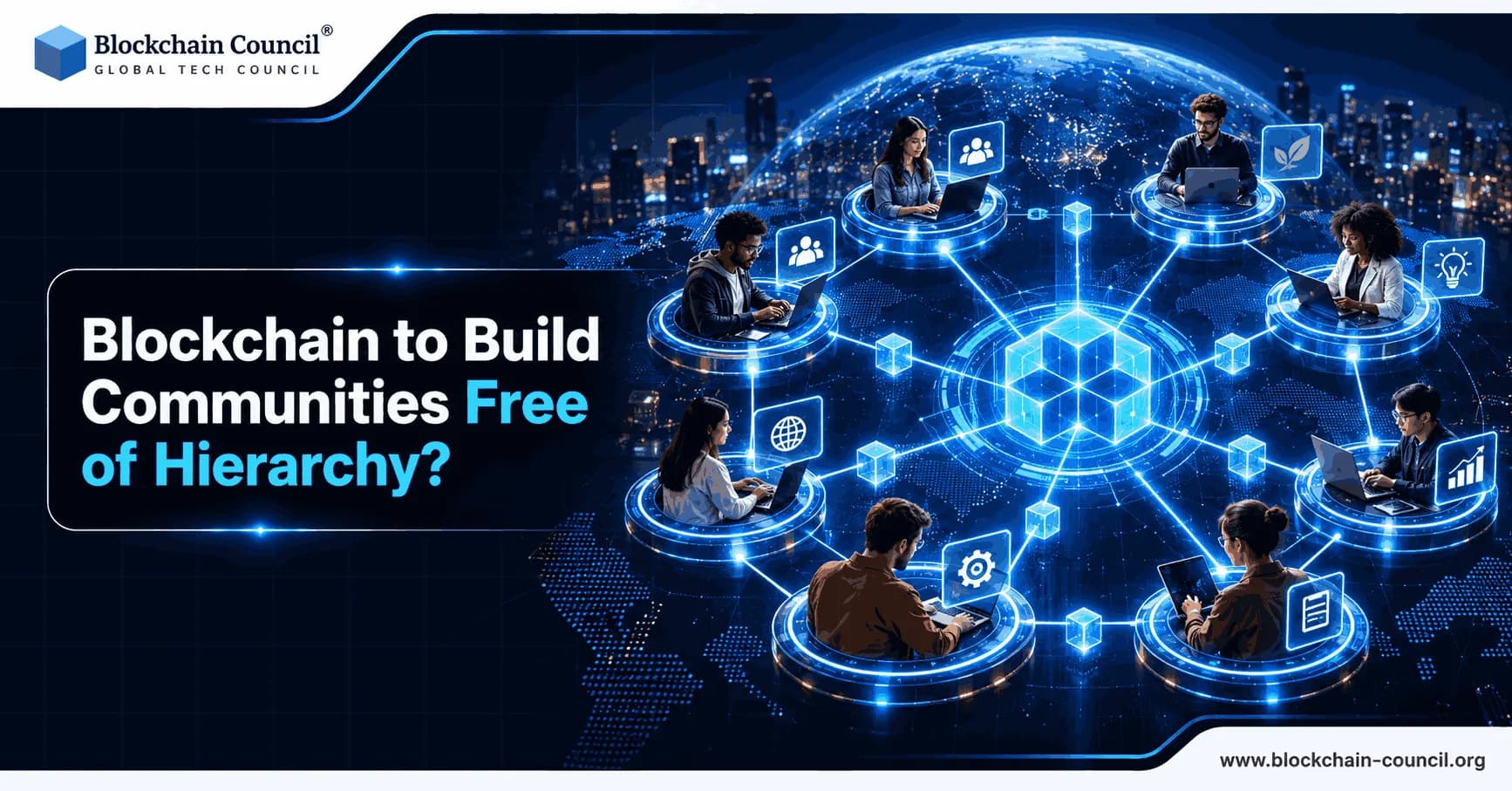
Most groups have leaders. Companies have bosses, clubs have presidents, and online communities have moderators who can ban members. But what if a group could set its own rules in public code, hold money in a shared account, and make decisions by open vote? That is the promise behind blockchain communities free of hierarchy. Blockchain, a shared digital record that is very hard to change, lets strangers cooperate without a central owner. The real picture, however, is more nuanced than the slogan. If you want to understand the technology behind these communities from the ground up, the Certified Blockchain Expert program is a strong place to start.
This guide explains how the idea works, what the data actually shows, and how to build a fairer community, in plain language for beginners and with depth for professionals.

What Does "Free of Hierarchy" Mean?
A hierarchy is a ladder of power, where a few people at the top decide for everyone below. In a normal organization, a board or manager controls the money, the rules, and the membership.
A flat or decentralized community tries to spread that power out. Instead of one authority, members share control over decisions. The most common blockchain version is the decentralized autonomous organization, or DAO. A DAO is a group whose rules and treasury controls are written into smart contracts, which are small programs on a blockchain that run automatically when conditions are met. Members usually hold tokens that give them voting rights.
The goal is simple: replace "trust the boss" with "check the code and vote."
How Blockchain Enables Communities Without Bosses
Building these systems takes careful engineering, because the rules are enforced by code and mistakes can be costly. Developers who want to create and test smart contracts for community projects can learn the practical side through the Certified Blockchain Developer course, which focuses on building secure blockchain applications. Here is how blockchain supports a flatter structure.
Shared Rules Written in Code
In a DAO, the rules for how proposals are made, how votes are counted, and how money is spent are written in smart contracts. Once deployed, they run the same way for everyone. No manager can quietly change the rules, and any member can read them.
A Transparent Shared Treasury
A DAO's treasury, meaning its pool of funds, normally sits in a smart contract. The contract enforces decisions the community makes about how to use it, and every transaction is visible on the public ledger. This gives members a level of openness that most traditional organizations do not offer.
Open Membership and Voting
Anyone who holds the right token can usually take part, no matter where they live. Proposals are put forward, discussed, and voted on in the open. For people with no access to a traditional board seat, this is a real change.
Real-World Examples of Blockchain Communities
DAOs now serve many different purposes. Researchers who study them describe uses such as:
Investment pools, where members fund projects together. "The DAO," launched on Ethereum in 2016, was an early venture fund that raised about $150 million. It was later exploited through a flaw in its code, which became a famous lesson in how risky untested smart contracts can be.
Grant programs, where communities vote on funding for public goods.
Gaming guilds, where players organize and share resources.
Protocol governance, where users of a financial network vote on its upgrades and settings. The DAOs with the largest treasuries are usually of this type, and well-known examples include Uniswap, Lido, Arbitrum, Optimism, and MakerDAO.
These communities show that blockchain-based cooperation works in practice. The next question is whether power is really shared.
Does Blockchain Really Remove Hierarchy? What the Data Shows
This is where the honest answer becomes "partly." Recent research suggests that DAOs often keep a hidden hierarchy, even though they look flat on paper.
Low Participation
One widely discussed finance study found that participation in DAO votes averaged only about 6.3 percent, far below the 70 to 80 percent participation rates seen in traditional corporations. Other research found that in major DAOs, less than 10 percent of tokens take part in votes. Most members hold tokens but never vote, partly because researching every proposal takes time and effort.
The Whale Problem
In many DAOs, one token equals one vote. That means people with the most tokens, often called whales, have the most power. The same study found that the top 10 percent of voters controlled about 76 percent of the voting power. Researchers also note that concentration tends to increase as DAOs grow.
Delegation Can Help or Hurt
To reduce the burden on members, many DAOs let people delegate their votes to trusted representatives. A 2025 scoping review found that voting power in DAOs is often even more concentrated than token ownership, because delegation chains can amplify the influence of a few large delegates. Delegation can reduce effort, but it can also quietly rebuild a ladder of power.
Governance Attacks
Concentrated voting power can be abused. In 2022, an attacker drained about $181 million in tokens from the Beanstalk protocol's treasury by exploiting its governance process. Cases like this show that open voting without safeguards can be hijacked.
So the data does not say that blockchain communities are fake. It says that removing formal bosses does not automatically remove informal power.
Designs That Reduce Hierarchy
The good news is that designers are testing ways to make these systems fairer. Options include:
Reputation-based voting, where influence comes from contributions and not from money. A 2025 review of DAO governance models found that reputation and share-based models can reduce the centralization seen in token-based systems, although all models struggle with low member engagement.
Quadratic voting, where each extra vote costs more, which reduces the power of very large holders. Some researchers argue that no voting design fully avoids rule by the wealthy, so this reduces the problem and does not remove it.
Time locks and vote limits, which delay big changes so the community can react to a suspicious proposal.
Clear scope for token votes, where holders set direction within safe limits and sensitive code changes get extra review.
Better participation tools, such as simple proposal summaries and reminders.
Building these features involves smart contract security, data analysis, cloud tools, and user interface design. That is why many professionals combine blockchain study with a broader Tech Certification, which helps them understand the full technology stack behind a healthy community platform.
Legal and Practical Challenges
Flat communities still live in a world of laws, and rules vary by country.
Liability. In 2023, a US federal court in the CFTC case against Ooki DAO treated the DAO as an unincorporated association, entered a default judgment, and imposed a civil penalty of $643,542. This showed that a group with no formal structure can still be held responsible, and it raised questions about the personal liability of voting members.
Legal wrappers. Wyoming recognized DAOs as limited liability companies in 2021 and later added a nonprofit-style structure called a DUNA. These give members clearer protection.
Security. Code mistakes, governance attacks, and stolen keys are constant risks.
Privacy. Public ledgers show voting activity, which some members may not want.
Burnout and confusion. Members need simple tools and plain language, or they will stop taking part.
How to Build a Healthier Community
If you want to start a community with shared power, here is a practical path:
Define your purpose first. Know what decisions the group will make together and which ones need speed or expertise.
Choose a fair voting model. Consider reputation, quadratic voting, or limits on very large holders.
Protect the treasury. Use audits, time locks, and multi-person approval for large payments.
Make participation easy. Share short summaries, use clear language, and reward helpful contributions.
Choose a legal structure. Talk to a lawyer about wrappers that fit your country and goals.
Be honest about limits. Tell members who still holds practical influence, such as core developers or large holders.
Technology alone will not create trust. A community also needs a clear message and a welcoming voice, so that new members understand how to take part. A Marketing Certification can help community builders explain their mission, rules, and benefits in simple language that attracts the right members.
Conclusion
Can blockchain build blockchain communities free of hierarchy? It can remove many traditional gatekeepers. Smart contracts enforce shared rules, treasuries are transparent, and anyone with the right token can join. But research shows that real DAOs often develop their own hierarchies, with low voter turnout, powerful large holders, and influential delegates. The most realistic view is that blockchain makes power more visible and easier to question, not that it erases power. With thoughtful voting design, strong security, clear legal structures, and active participation, these communities can come much closer to the flat ideal.
FAQs
1. How can blockchain help build communities free of hierarchy?
Blockchain can enable communities to coordinate through shared rules, transparent records, and decentralized governance rather than relying entirely on a single central authority. This can distribute certain decision-making and ownership responsibilities among participants.
2. What does a decentralized community mean?
A decentralized community is a group where control and decision-making are distributed among multiple participants rather than concentrated in one organization or individual. Blockchain can provide infrastructure for coordinating such communities.
3. Can blockchain eliminate hierarchy completely?
No. Blockchain can reduce dependence on centralized authorities for certain functions, but it does not automatically eliminate hierarchy. Communities may still develop informal leadership, governance structures, voting power differences, or control based on ownership and participation.
4. How does blockchain support decentralized governance?
Blockchain can record governance rules and voting outcomes on a shared ledger. This allows participants to verify proposals, votes, and decisions without depending entirely on a central administrator.
5. What are DAOs and how do they support decentralized communities?
DAOs, or decentralized autonomous organizations, use blockchain-based rules and governance mechanisms to coordinate groups. Depending on their design, members can propose, vote on, and execute decisions through smart contracts.
6. Can blockchain give community members more control?
Blockchain can give participants greater control over certain digital assets, governance processes, and community activities. The actual level of control depends on how the blockchain application and governance system are designed.
7. How do smart contracts help decentralized communities?
Smart contracts can automatically execute predefined rules when specified conditions are met. This can reduce the need for intermediaries in activities such as voting, treasury management, membership, and distribution of community resources.
8. How does blockchain improve transparency in communities?
Blockchain can create publicly or permissionedly verifiable records of transactions and governance actions. Participants can use these records to review how certain decisions or assets were managed.
9. Can blockchain create communities without central leaders?
Blockchain can support communities that operate without a single central authority. However, decentralized communities may still have developers, moderators, elected representatives, or other participants who perform leadership or operational roles.
10. How can blockchain distribute ownership within a community?
Blockchain can represent ownership through digital tokens or other blockchain-based assets. These assets can potentially provide members with rights related to governance, access, rewards, or community resources, depending on the system's design.
11. Can blockchain voting make community decisions fairer?
Blockchain can make voting records more transparent and verifiable, but it does not automatically make a voting system fair. Factors such as token concentration, voter participation, governance rules, identity verification, and voting mechanisms can significantly influence outcomes.
12. What role do tokens play in decentralized communities?
Tokens can be used to represent ownership, membership, voting rights, access, or incentives. Their function depends on the specific community and its governance model.
13. How can blockchain reduce dependence on intermediaries?
Blockchain allows participants to interact through shared infrastructure and programmable rules. Smart contracts can automate certain functions that might otherwise require intermediaries, although not every intermediary can or should be replaced.
14. Can blockchain help communities manage shared funds?
Yes. Blockchain-based community treasuries can provide transparent records of incoming and outgoing funds. In some systems, smart contracts and governance mechanisms can determine how treasury funds are allocated.
15. What are the benefits of hierarchy-free communities using blockchain?
Potential benefits include greater transparency, distributed participation, verifiable governance, direct ownership, and reduced dependence on a single controlling entity. These benefits depend heavily on the community's technical and governance design.
16. What are the challenges of building decentralized communities with blockchain?
Challenges include governance disputes, low voter participation, concentration of token ownership, technical complexity, scalability, security risks, regulatory uncertainty, and difficulty coordinating large groups of participants.
17. Can blockchain prevent powerful members from controlling a community?
Not necessarily. If governance depends on token ownership, participants holding large amounts of tokens may have greater voting influence. Designing appropriate voting mechanisms and safeguards is therefore important for distributing decision-making power.
18. Are blockchain-based communities truly decentralized?
Decentralization exists on a spectrum. A blockchain project may distribute control over its ledger while still having centralized developers, infrastructure providers, token holders, or governance groups.
19. What is the relationship between blockchain and community ownership?
Blockchain can provide technical infrastructure for recording and transferring digital ownership. Communities can use this infrastructure to distribute certain assets or governance rights among members instead of keeping all ownership with a central organization.
20. Can blockchain create a future without traditional organizational hierarchies?
Blockchain could enable new organizational models where communities coordinate through decentralized governance, smart contracts, and shared digital ownership. However, it is unlikely to eliminate organizational hierarchies everywhere because different communities and institutions require different structures for coordination, accountability, and decision-making.
Related Articles
View All
Blockchain
How Blockchain Product Managers Collaborate with Developers, Designers, and Communities
Learn how blockchain product managers coordinate developers, designers, and communities across smart contracts, UX, token incentives, and governance.

Blockchain
How Blockchain Product Managers Build Successful Web3 Products
Blockchain product managers combine product strategy, tokenomics, governance, security, and on-chain data to build trusted Web3 products.

Blockchain
Beyond Cryptocurrency: How Blockchain Is Transforming Real-World Industries
Explore how blockchain works beyond cryptocurrency in banking, supply chains, healthcare, tokenisation, CBDCs, and government, plus key challenges and career paths.
Trending Articles
The Role of Blockchain in Ethical AI Development
How blockchain technology is being used to promote transparency and accountability in artificial intelligence systems.
AWS Career Roadmap
A step-by-step guide to building a successful career in Amazon Web Services cloud computing.
How Blockchain Secures AI Data
Understand how blockchain technology is being applied to protect the integrity and security of AI training data.