

Could Blockchain Replace DNS?
 Toshendra Kumar Sharma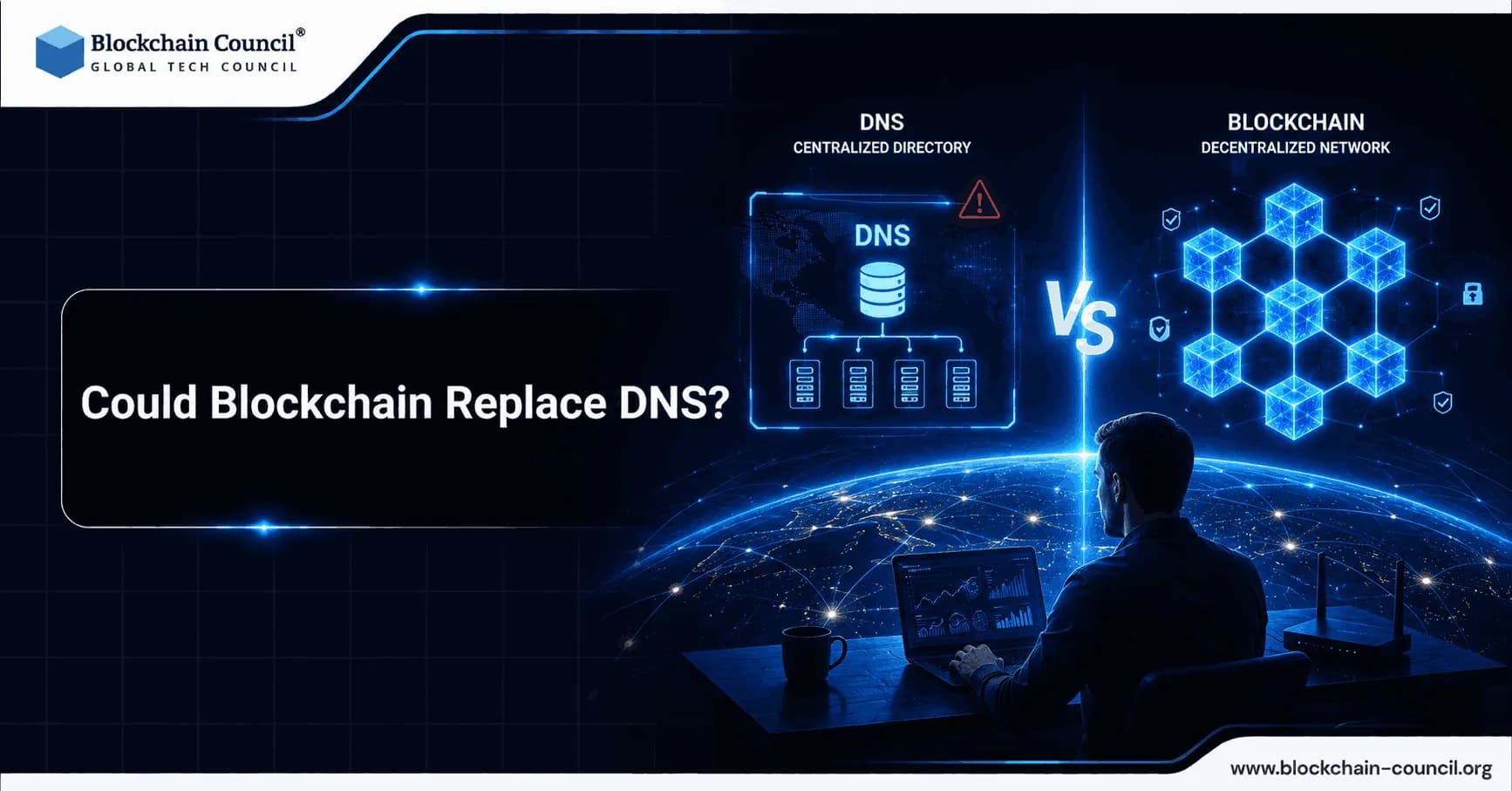
The Domain Name System (DNS) is one of the most essential technologies behind the modern internet. Every time you visit a website, send an email, or use an online application, DNS translates human-readable domain names into IP addresses that computers use to communicate. Although DNS has powered the internet for decades, it also faces challenges related to centralization, cybersecurity threats, censorship, and single points of failure. As blockchain technology continues to evolve, researchers and technology companies are exploring whether decentralized blockchain networks could offer a more secure and resilient alternative to traditional DNS infrastructure.
Blockchain introduces a decentralized method for storing and verifying information across distributed networks rather than relying on centralized servers. This has led to the emergence of blockchain-based naming systems that aim to improve domain ownership, increase resistance to cyberattacks, and give users greater control over digital identities. While blockchain has significant potential, replacing DNS entirely involves technical, operational, and regulatory considerations that continue to be actively researched. Professionals seeking to understand these technologies often strengthen their expertise through the Certified Blockchain Expert certification from Blockchain Council, which covers blockchain architecture, distributed ledger technology, smart contracts, decentralized systems, enterprise applications, and blockchain security.

In this article, we'll examine how DNS works, explore blockchain-based alternatives, compare both technologies, and discuss whether blockchain could eventually replace or complement traditional DNS.
What Is DNS and How Could Blockchain Improve It?
The Domain Name System functions as the internet's address directory. Instead of requiring users to remember numerical IP addresses, DNS translates domain names such as example.com into machine-readable network addresses.
Traditional DNS relies on hierarchical servers managed by organizations around the world. While this architecture has proven reliable for decades, it also introduces centralized control points that may become targets for cyberattacks, outages, domain hijacking, or censorship.
Blockchain-based naming systems approach the problem differently. Instead of storing domain records on centralized DNS servers, blockchain records domain ownership and resolution information on decentralized ledgers distributed across multiple network participants.
Because blockchain records are cryptographically protected and replicated across many nodes, unauthorized modifications become significantly more difficult. This decentralized architecture may improve resilience while reducing dependence on individual organizations.
However, blockchain-based naming systems introduce their own technical challenges, including scalability, governance, browser compatibility, and interoperability with existing internet infrastructure.
Understanding how decentralized systems influence internet security requires expertise in both blockchain technology and cybersecurity. Professionals often strengthen these complementary skills through the Certified Cybersecurity Expert certification, which focuses on digital security, network protection, cryptography, threat detection, identity management, and modern cybersecurity practices that align closely with blockchain-based infrastructure.
Quick Answer
Blockchain has the potential to improve certain aspects of DNS by introducing decentralized domain ownership, stronger resistance to unauthorized modifications, and greater transparency. However, blockchain is unlikely to replace traditional DNS entirely in the near future. Instead, both technologies are more likely to coexist, with blockchain supporting specialized use cases such as decentralized websites, digital identity, and Web3 applications.
How Traditional DNS Works
Domain Name Resolution
Whenever a user enters a website address into a browser, DNS servers translate the domain name into its corresponding IP address.
This process occurs within milliseconds and allows browsers to locate the appropriate web server hosting the requested website.
DNS operates through a hierarchical system involving root servers, top-level domain servers, authoritative name servers, and recursive resolvers that work together to complete each lookup.
Centralized Administration
DNS depends on globally coordinated organizations that manage domain registration, root zones, and domain name allocation.
While this centralized governance enables consistency across the internet, it also creates dependencies on trusted authorities responsible for maintaining domain records and ensuring reliable operation.
How Blockchain-Based DNS Works
Decentralized Domain Ownership
Blockchain-based naming systems record domain ownership directly on blockchain networks.
Instead of relying solely on centralized registrars, users control domain ownership through cryptographic private keys stored in digital wallets.
Ownership records become part of the blockchain ledger, making unauthorized changes significantly more difficult.
Immutable Domain Records
Blockchain stores domain registration information as permanent blockchain transactions.
Every update is cryptographically verified before being recorded on the distributed ledger. Historical ownership records remain transparent and auditable, reducing opportunities for unauthorized modifications.
Smart Contract Automation
Many decentralized naming systems use smart contracts to automate domain registration, transfers, renewals, and ownership verification.
These programmable contracts execute predefined rules automatically without requiring centralized administrators for every operation.
Advantages of Blockchain for DNS
Blockchain introduces several potential improvements over traditional DNS infrastructure.
Decentralization reduces dependence on individual servers, making distributed naming systems more resilient against certain outages and attacks.
Security also improves because blockchain protects records through cryptographic verification and distributed consensus rather than centralized database management.
Domain ownership becomes more transparent since blockchain maintains permanent public records that verify ownership history without relying exclusively on centralized registrars.
Blockchain may also improve resistance to censorship because decentralized records are distributed across multiple network participants rather than controlled by a single authority.
These characteristics make blockchain particularly attractive for Web3 applications, decentralized websites, digital identity systems, and blockchain-native services.
Challenges Preventing Full DNS Replacement
Despite its advantages, blockchain faces significant obstacles before replacing traditional DNS.
Scalability remains one of the largest challenges. The global DNS infrastructure processes billions of queries every day with extremely low latency. Public blockchain networks currently cannot match this level of performance for worldwide internet traffic.
Browser compatibility presents another issue. Most internet browsers still rely primarily on conventional DNS infrastructure. Blockchain naming systems often require browser extensions, specialized gateways, or additional software for access.
Governance also differs significantly. DNS operates through internationally coordinated standards developed over many decades, while blockchain naming systems continue evolving independently across multiple decentralized ecosystems.
Usability remains another consideration because managing cryptographic wallets and private keys can be more complex than traditional domain registration for many users.
These challenges suggest that blockchain is more likely to complement DNS rather than replace it completely in the foreseeable future.
Real-World Blockchain Naming Projects
Several blockchain projects have already introduced decentralized naming services.
Platforms such as Ethereum Name Service (ENS) and Unstoppable Domains allow users to register blockchain-based domain names that simplify cryptocurrency wallet addresses and support decentralized applications.
These systems demonstrate how blockchain can improve digital identity and Web3 usability while expanding beyond conventional website addressing.
Although adoption continues growing, these naming services currently operate alongside traditional DNS rather than replacing it.
The Future of Internet Infrastructure
The future internet will likely combine centralized and decentralized technologies.
Traditional DNS will continue supporting mainstream internet infrastructure because of its scalability, compatibility, and global standardization.
Blockchain-based naming systems may continue expanding within decentralized applications, digital identity, cryptocurrency wallets, Web3 platforms, and secure enterprise environments.
Artificial intelligence, blockchain, cybersecurity, cloud computing, and decentralized identity technologies are expected to become increasingly interconnected as organizations modernize digital infrastructure.
Building these advanced systems requires expertise across distributed systems, blockchain development, cloud computing, APIs, software engineering, cybersecurity, cryptography, and artificial intelligence. Professionals seeking broader technical capabilities often strengthen their multidisciplinary expertise through a Tech Certification, helping them develop practical skills needed to support secure enterprise infrastructure and emerging internet technologies.
Final Thoughts
Blockchain introduces innovative possibilities for improving internet naming systems through decentralization, cryptographic security, transparent ownership records, and smart contract automation. While these advantages make blockchain an attractive technology for decentralized applications and Web3 ecosystems, replacing the global DNS infrastructure entirely remains unlikely in the near future due to scalability, compatibility, governance, and usability challenges.
Instead of competing directly, blockchain and traditional DNS are more likely to complement one another as internet technologies continue evolving. Organizations exploring these innovations also need professionals who can clearly explain complex technologies, educate customers, and develop effective strategies for technology adoption. Strengthening these communication and business capabilities alongside technical expertise has become increasingly valuable, which is why many professionals complement their blockchain knowledge with a Marketing Certification to better understand digital strategy, customer engagement, and emerging technology positioning.
As the internet enters the next phase of digital transformation, blockchain will likely become an important part of future naming systems, digital identity, and decentralized infrastructure while traditional DNS continues serving as the backbone of the global internet.
FAQs
1. Can blockchain replace the Domain Name System (DNS)?
Blockchain has the potential to complement and, in some cases, provide an alternative to the traditional Domain Name System (DNS), but it is unlikely to completely replace it in the foreseeable future. Traditional DNS remains deeply integrated into the global internet, while blockchain-based naming systems primarily address issues such as decentralization, censorship resistance, and digital ownership.
2. What is DNS?
The Domain Name System (DNS) is the internet's directory service. It translates human-readable domain names such as example.com into IP addresses that computers use to locate websites and online services.
3. Why is DNS important?
DNS enables users to access websites without remembering numerical IP addresses. It supports nearly every internet service, including:
Websites
Email
Cloud services
Streaming platforms
Mobile applications
Enterprise networks
4. What are the limitations of traditional DNS?
Traditional DNS faces several challenges:
Centralized administration
Domain hijacking
DNS spoofing
Single points of failure
Censorship in some jurisdictions
Registrar disputes
Complex management processes
These issues vary depending on the DNS provider and security measures in place.
5. What is blockchain DNS?
Blockchain DNS is a decentralized naming system where domain ownership and name resolution are recorded on a blockchain rather than managed solely through centralized registries. Users typically control domains using cryptographic wallets and private keys.
6. How does blockchain DNS work?
A blockchain-based domain system generally works by:
Registering a domain as a blockchain asset.
Recording ownership through smart contracts.
Linking the domain to blockchain addresses, websites, or other resources.
Resolving the domain using compatible browsers, wallets, or gateways.
7. What are examples of blockchain naming systems?
Examples include:
Ethereum Name Service (ENS)
Unstoppable Domains
Handshake (HNS)
Each project uses a different architecture and governance model.
8. How is blockchain DNS different from traditional DNS?
Traditional DNS | Blockchain DNS |
|---|---|
Centralized registries | Decentralized ownership |
Registrar-managed | Wallet-controlled |
Can be modified by authorized operators | Ownership changes recorded on-chain |
ICANN-based governance | Blockchain protocol governance |
Primarily resolves websites | Can also resolve wallets, identities, and decentralized resources |
9. Can blockchain DNS improve security?
Blockchain DNS can reduce certain risks, such as unauthorized changes to ownership records, by using cryptographic verification and decentralized consensus. However, it introduces new considerations, including private key management and smart contract security.
10. Can blockchain DNS prevent censorship?
Blockchain-based naming systems can make it more difficult to censor or seize domains because ownership is controlled through blockchain networks rather than traditional registrars. However, websites can still face restrictions through hosting providers, internet service providers, national regulations, or endpoint infrastructure.
11. Can blockchain DNS support cryptocurrency wallets?
Yes.
Blockchain domains can often be mapped to cryptocurrency wallet addresses, allowing users to send digital assets to names such as alice.eth instead of long hexadecimal wallet addresses.
12. Can blockchain DNS host websites?
Blockchain domains themselves do not host websites. They can point to decentralized storage networks such as:
IPFS
Arweave
Filecoin
or to traditional web infrastructure, depending on the application's design.
13. What are the advantages of blockchain DNS?
Benefits include:
Decentralized ownership
User-controlled domains
Improved resistance to unauthorized modifications
Wallet integration
Simplified crypto payments
Smart contract automation
Transparent ownership records
Support for decentralized applications (dApps)
14. What challenges exist?
Challenges include:
Limited browser support
User adoption
Regulatory uncertainty
Private key management
Naming conflicts
Integration with existing internet infrastructure
Smart contract vulnerabilities
Compatibility across platforms
15. Can blockchain completely replace DNS today?
No.
Traditional DNS supports billions of internet users and is deeply embedded in browsers, operating systems, enterprise networks, and global internet infrastructure. Blockchain naming systems currently complement rather than replace conventional DNS.
16. What common misconceptions exist?
Common misconceptions include:
Blockchain DNS automatically makes websites anonymous.
Blockchain DNS eliminates all cyberattacks.
Traditional DNS will disappear soon.
Blockchain domains work identically across every browser.
In practice, compatibility depends on the software and services being used.
17. What are best practices for using blockchain domains?
Best practices include:
Protect private keys and recovery phrases.
Use trusted wallet software.
Verify smart contract interactions.
Keep domain ownership information secure.
Understand browser compatibility.
Research the naming protocol before registering domains.
18. How does blockchain DNS fit into Web3?
Blockchain naming systems support Web3 by enabling decentralized identity, wallet addressing, decentralized websites, digital ownership, and easier interaction with decentralized applications through human-readable names.
19. What trends are shaping blockchain naming systems in 2025-2026?
Major trends include:
Decentralized identity (DID)
Wallet-based authentication
Web3 domain adoption
Cross-chain name resolution
AI-powered domain management
Account abstraction
Decentralized websites
Smart contract wallets
Zero-knowledge proofs (ZKPs)
Improved browser interoperability
20. What is the future of blockchain DNS?
Blockchain DNS is expected to become an important component of the Web3 ecosystem by simplifying wallet addresses, strengthening digital ownership, and supporting decentralized applications. Rather than replacing the traditional DNS infrastructure, blockchain naming systems will likely coexist with it, serving different use cases while becoming increasingly integrated with browsers, wallets, cloud services, and digital identity platforms. The internet has a long history of adding new layers instead of discarding old ones. DNS is unlikely to vanish overnight, but blockchain may steadily give it some rather interesting new neighbors.
Related Articles
View All
Blockchain
Will AI replace blockchain? A Practical View for 2026 and Beyond
Will AI replace blockchain? No. AI and blockchain solve different problems and are increasingly combined for security, auditability, identity, and automation.

Blockchain
Blockchain Certification Programs You Can Join Online
Discover the best blockchain certification programs you can join online. Learn blockchain fundamentals, smart contracts, enterprise blockchain, and career opportunities with globally recognized certifications.

Blockchain
Agile for Blockchain Teams: Managing Sprints, Smart Contracts, and Decentralized Roadmaps
Learn how agile for blockchain teams works when sprints, smart contracts, audits, governance, and decentralized roadmaps are planned around risk.
Trending Articles
The Role of Blockchain in Ethical AI Development
How blockchain technology is being used to promote transparency and accountability in artificial intelligence systems.

Top 5 DeFi Platforms
Explore the leading decentralized finance platforms and what makes each one unique in the evolving DeFi landscape.
What is AWS? A Beginner's Guide to Cloud Computing
Everything you need to know about Amazon Web Services, cloud computing fundamentals, and career opportunities.