

Apple Co-founder Steve Wozniak to start a Blockchain Startup
 Toshendra Kumar Sharma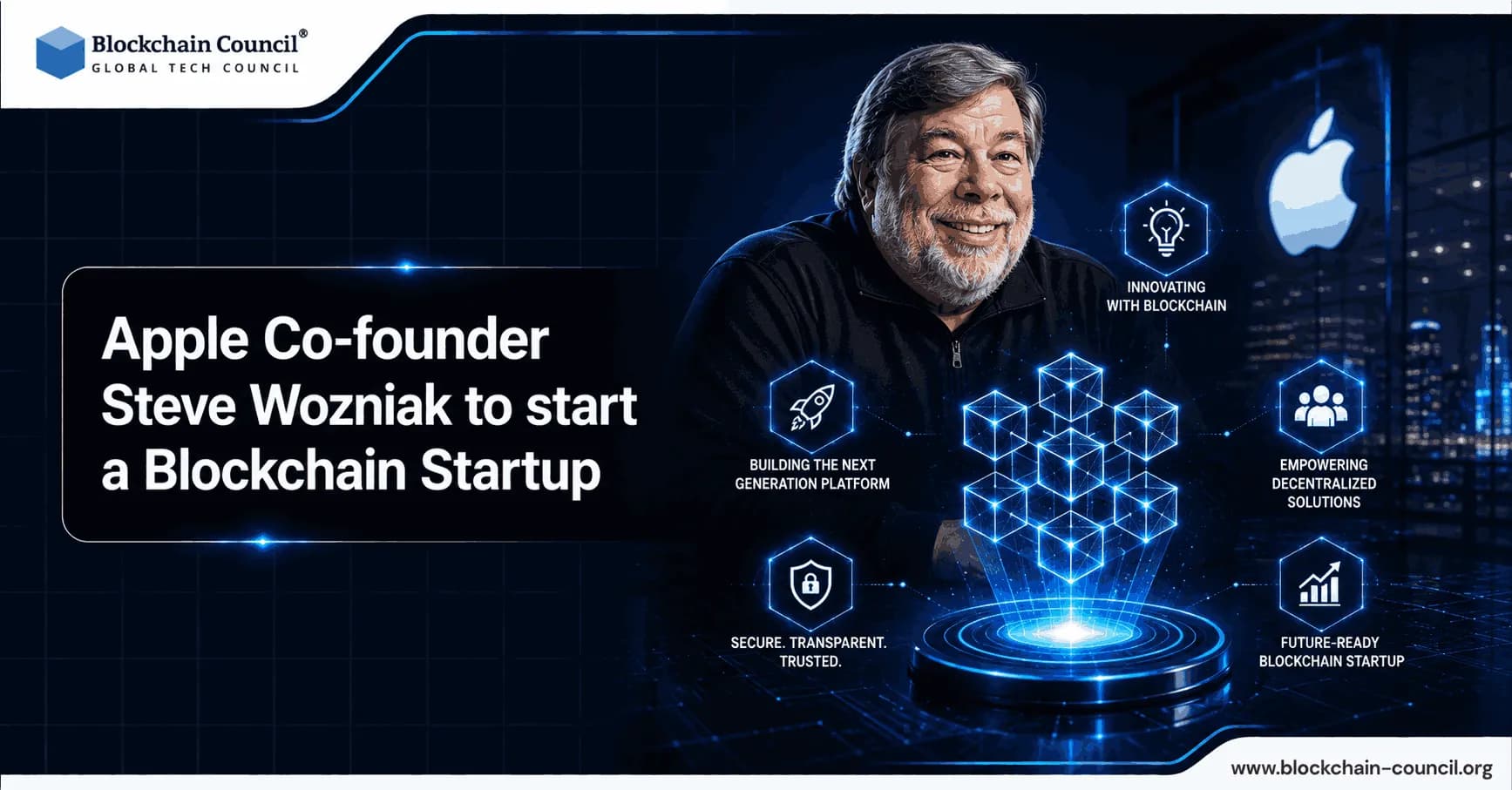
Introduction: A Tech Icon Turns Toward Blockchain
Steve Wozniak, the engineer who built the first Apple computer alongside Steve Jobs, is stepping into a very different world four decades later. The man who once shaped the personal computing revolution is now preparing to launch a blockchain-based investment venture, and the announcement has caught the attention of technologists, investors, and blockchain enthusiasts alike. For professionals who want to understand this shift with the same depth Wozniak brings to his own projects, earning a Certified Blockchain Expert credential offers a structured way to grasp the technology driving his new venture.
Wozniak's move signals something larger than a single startup. It reflects how blockchain has evolved from a speculative experiment into a technology serious innovators are willing to stake their reputation on. His involvement lends credibility to an industry that has spent years fighting perceptions of hype and instability.

Why Wozniak's Blockchain Venture Matters for the Industry
Wozniak was not always a blockchain believer. He once compared the technology to an internet bubble that would eventually fade. His change of heart came gradually, shaped by his growing fascination with Bitcoin's fixed supply and decentralized structure. He has spoken publicly about admiring the mathematical purity of a currency that operates without a company or a central authority controlling it.
That shift in thinking led him to co-found EQUI Global, a blockchain-based investment platform designed to make it easier for investors of varying capacity to fund promising startups. The platform aims to combine transparency, security, and accessibility, qualities that traditional venture capital structures often struggle to deliver to smaller investors. Wozniak's role centers on identifying promising technology startups and mentoring their founders, drawing on his own experience of building a company from nothing.
Professionals who follow this space closely often pair their blockchain knowledge with broader artificial intelligence skills, since many modern platforms blend both fields. Pursuing a Certified Artificial Intelligence (AI) Expert certification helps bridge that gap, giving learners insight into how AI-driven analytics and blockchain security increasingly work together inside investment platforms like the one Wozniak is building.
The Platform's Structure and Purpose
EQUI Global is expected to register in Malta, a jurisdiction known for its blockchain-friendly regulatory framework. Malta has actively positioned itself as a hub for cryptocurrency and blockchain companies by offering clearer legal guidelines than many other regions. This regulatory clarity gives startups the confidence to build compliant products without the uncertainty that plagues blockchain ventures elsewhere.
The platform itself is designed around a token-based investment model. Rather than issuing a purely speculative cryptocurrency, the venture represents actual shares in a company, giving investors a stake tied to real business performance. This structure sets it apart from many blockchain projects that rely on price speculation rather than tangible value.
What This Means for Everyday Investors
One of the more compelling aspects of Wozniak's venture is its focus on accessibility. Traditional venture capital has long favored institutional investors and high-net-worth individuals, leaving smaller investors on the sidelines. A blockchain-based structure can lower those barriers by fractionalizing investment opportunities and reducing the administrative overhead typically required to participate.
Future-Ready Skills
As technology becomes increasingly important across industries, students need opportunities to develop future-ready skills early in their education. A World Tech Olympiad can introduce students to areas such as artificial intelligence, coding, cybersecurity, robotics, and computational thinking while encouraging curiosity and continuous learning. Building this kind of early exposure helps the next generation approach emerging technologies like blockchain with confidence rather than unfamiliarity.
Skills Professionals Need to Understand This Shift
Wozniak's pivot toward blockchain is a reminder that technology careers rarely stay confined to one discipline for long. Engineers, marketers, and business leaders alike are being asked to understand distributed ledger systems, smart contracts, and tokenized investment models, even if their primary expertise lies elsewhere.
For technology professionals who want a broader foundation before specializing further, a general Tech Certification provides exposure to the wider technology landscape, covering areas like cloud computing, data science, and emerging platforms that often intersect with blockchain ventures. This kind of well-rounded knowledge base makes it easier to evaluate whether a new blockchain platform, like the one Wozniak is building, is technically sound and strategically viable.
Building Trust in a Skeptical Market
Blockchain still carries a mixed reputation among mainstream investors. Years of speculative trading, failed projects, and regulatory uncertainty have made some people cautious about putting money into anything labeled as blockchain-based. Wozniak's involvement could help shift that perception simply because of who he is. His track record with Apple gives him a level of credibility that few technology figures possess, and his willingness to publicly back a blockchain venture sends a signal that the technology has matured beyond its early volatility.
Still, trust in blockchain will not be built on reputation alone. Companies entering this space need clear communication strategies, transparent investor education, and marketing approaches that explain complex technology in accessible terms.
The Broader Business Impact
Beyond the technical side, ventures like EQUI Global require strong business strategy, compliance planning, and market positioning to succeed. Marketing plays a significant role in helping such platforms reach the right investors and communicate value clearly. Business professionals who want to support this kind of growth often benefit from a Marketing Certification, which builds the skills needed to position emerging technology products effectively and connect with audiences who may still be unfamiliar with blockchain-based investment models.
Wozniak's entry into blockchain is unlikely to be the last major move of its kind. As more established technology figures explore decentralized platforms, the industry will likely see increased investment, tighter regulation, and greater public understanding of how blockchain can function beyond cryptocurrency speculation. His journey from skeptic to active participant mirrors a broader trend across the technology world, where blockchain is steadily earning its place as a legitimate tool for building the future of finance and investment.
FAQs
1. Did Steve Wozniak start a blockchain startup?
Yes. Apple co-founder Steve Wozniak became a co-founder of Efforce, a blockchain-based energy-efficiency venture. The project was designed to use blockchain and digital tokens to help finance energy-efficiency projects.
2. What is Steve Wozniak's blockchain startup called?
Steve Wozniak's blockchain venture is called Efforce. It focuses on energy efficiency and uses blockchain technology to connect investment with energy-saving projects.
3. When did Steve Wozniak become involved with Efforce?
Wozniak became involved with Efforce around 2018, working with the founders on developing the concept. The company was later publicly launched and introduced its WOZX token in December 2020.
4. What does Efforce do?
Efforce is designed as a marketplace for energy-efficiency projects. Companies can undertake energy-saving improvements while investors and participants can gain exposure to the resulting energy savings through the platform's blockchain-based system.
5. Why did Steve Wozniak choose blockchain technology?
Wozniak was interested in using blockchain to improve efficiency, transparency, and participation in energy-saving projects. The concept aims to use decentralized technology to connect energy efficiency with investment opportunities while creating measurable records of energy savings.
6. How does blockchain help Efforce?
Blockchain can provide a shared record for transactions and energy-saving data associated with projects. Efforce's model uses blockchain and smart contracts to help record and distribute energy savings to participants.
7. What is the WOZX token?
WOZX is the cryptocurrency token associated with the Efforce platform. It was introduced to facilitate participation in Efforce's blockchain-based energy-efficiency ecosystem and the tokenization of energy savings.
8. How does the WOZX token relate to energy efficiency?
The Efforce model connects WOZX with energy-efficiency projects and the resulting energy savings. According to the platform's described model, energy savings can be measured and represented as energy credits, creating a digital mechanism for participants to access or transact around those savings.
9. Can blockchain make energy efficiency more accessible?
Blockchain can potentially make participation in energy-efficiency projects more accessible by creating digital records, automated processes, and tokenized participation mechanisms. Efforce was designed around the idea of allowing a wider range of participants to engage with energy-efficiency investments.
10. What problem is Efforce trying to solve?
Energy-efficiency projects can require significant upfront financing and involve complex financial and operational processes. Efforce aims to simplify access to financing and create a marketplace in which energy savings can be measured and connected with participants through blockchain technology.
11. How can blockchain support sustainable businesses?
Blockchain can help sustainable businesses by creating traceable records of environmental or energy-related activities. When reliable data is connected to blockchain systems, organizations can potentially improve transparency around energy savings, environmental projects, and related transactions.
12. Is Efforce a cryptocurrency?
Efforce is primarily a blockchain-based energy-efficiency platform, while WOZX is its associated cryptocurrency token. Therefore, it is more accurate to distinguish between the Efforce platform and the WOZX digital asset.
13. What makes Steve Wozniak's blockchain project different?
Rather than focusing primarily on payments or financial speculation, Efforce was designed around energy efficiency and sustainability. Its objective is to use blockchain, smart contracts, and tokenization to connect capital with projects intended to reduce energy consumption.
14. Did Steve Wozniak have an engineering role in Efforce?
Yes. Wozniak said he had worked with the team for several years and contributed to the project's blockchain thinking and accessibility. He was not described as being operationally involved in the company's financial management.
15. Why was Efforce based in Malta?
Efforce selected Malta as its base partly because of the country's supportive environment for blockchain businesses and digital-token regulation at the time. Wozniak also highlighted Malta's willingness to support blockchain-related initiatives when discussing the company's location.
16. Can Efforce help companies reduce energy costs?
The Efforce model is intended to finance and facilitate energy-efficiency improvements that can reduce energy consumption. The platform's approach involves evaluating projects, estimating savings, implementing efficiency measures, and tracking resulting energy savings.
17. How are energy savings measured on the Efforce platform?
Efforce's described model uses smart meters and blockchain-based records to measure energy savings from participating projects. The resulting savings can be represented as energy credits measured in megawatt-hours.
18. Why is Steve Wozniak's involvement important for blockchain adoption?
Wozniak's involvement attracted attention because of his history as an influential technology entrepreneur and Apple co-founder. His participation also demonstrated how blockchain could be explored beyond cryptocurrency trading, including applications involving energy efficiency and sustainability.
19. What can businesses learn from Steve Wozniak's blockchain startup?
Businesses can learn that blockchain may have value when it addresses a specific operational or financial problem. Efforce demonstrates a use case where blockchain is combined with smart contracts, tokenization, measurement technology, and energy-efficiency services rather than being used simply as a standalone cryptocurrency system.
20. What is the significance of Steve Wozniak entering the blockchain industry?
Steve Wozniak's involvement helped bring mainstream technology attention to blockchain applications outside conventional cryptocurrency markets. Efforce illustrated how blockchain could be applied to areas such as energy efficiency, environmental initiatives, investment, and the digital representation of real-world savings.
Related Articles
View All
Blockchain
Beyond Cryptocurrency: How Blockchain Is Transforming Real-World Industries
Explore how blockchain works beyond cryptocurrency in banking, supply chains, healthcare, tokenisation, CBDCs, and government, plus key challenges and career paths.
Blockchain
Smart Contracts & dApps: How Blockchain Becomes Programmable
Learn how smart contracts and dApps make blockchain programmable, from Ethereum and tokens to DeFi, NFTs, real use cases, benefits, and key risks.

Blockchain
Behind the Blocks: How Blockchain Transactions Actually Work
Go behind the blocks to see how a blockchain transaction really works: wallets and keys, digital signatures, verification, hashing, blocks, consensus, proof of work vs proof of stake, and how miners and validators secure the network.
Trending Articles
The Role of Blockchain in Ethical AI Development
How blockchain technology is being used to promote transparency and accountability in artificial intelligence systems.

Top 5 DeFi Platforms
Explore the leading decentralized finance platforms and what makes each one unique in the evolving DeFi landscape.
How to Install Claude Code
Learn how to install Claude Code on macOS, Linux, and Windows using the native installer, plus verification, authentication, and troubleshooting tips.