

What is Bitcoin or Cryptocurrency or Virtual Currency?
 Toshendra Kumar Sharma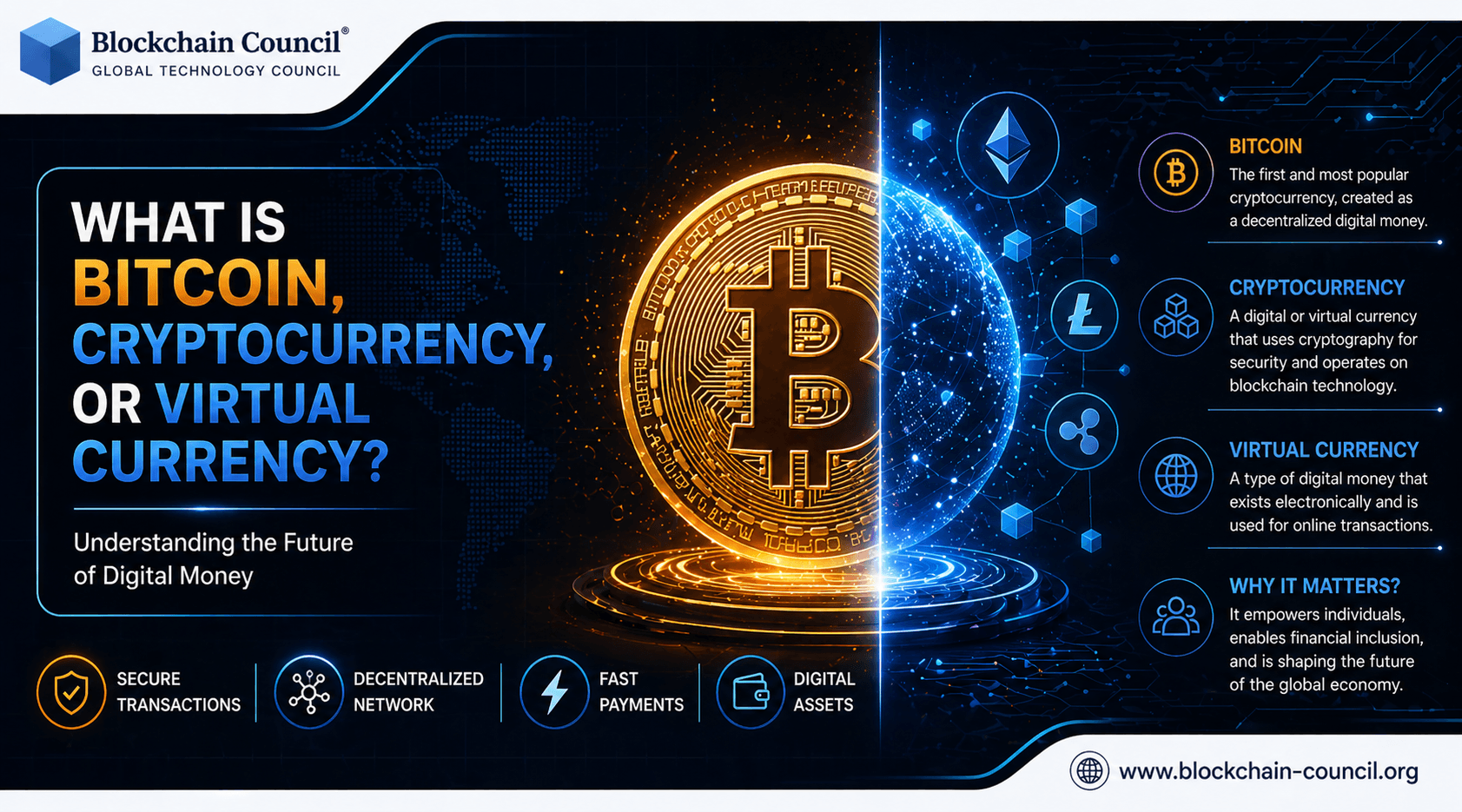
Bitcoin and cryptocurrencies have transformed how people think about money, payments, and financial systems. What started as an experimental digital currency has evolved into a global financial ecosystem used by individuals, businesses, and institutions.
This guide explains what Bitcoin, cryptocurrency, and virtual currency are, how they work, and why they matter in today’s digital economy.

What Is Bitcoin?
Bitcoin is a decentralized digital currency that allows people to send and receive money over the internet without relying on banks or intermediaries.
It was introduced in 2009 by an anonymous developer known as Satoshi Nakamoto. Unlike traditional currencies, Bitcoin is not issued or controlled by any government or central authority.
Instead, Bitcoin operates on a technology called blockchain, where all transactions are recorded in a secure and transparent digital ledger. Learn how Bitcoin and cryptocurrencies work as decentralized, trustless financial systems powered by cryptography by gaining expertise through a Cryptocurrency Expert, analyzing price trends and blockchain data using a Python certification, and monetizing crypto knowledge through a Digital marketing course.
What Is Cryptocurrency?
Cryptocurrency is a broader term that refers to digital or virtual currencies that use cryptography for security.
Bitcoin was the first cryptocurrency, but today there are thousands of others, including Ethereum, Solana, and Cardano. Each cryptocurrency may serve different purposes, such as payments, smart contracts, or decentralized applications.
Cryptocurrencies are typically decentralized and operate on blockchain networks, making them resistant to censorship and fraud.
What Is Virtual Currency?
Virtual currency is a general term for any digital representation of value used online. It includes cryptocurrencies but also covers non-blockchain digital currencies, such as in-game currencies or platform-based credits.
The key difference is that cryptocurrencies are decentralized and secured by blockchain, while virtual currencies may be controlled by a central entity.
How Bitcoin Works
Bitcoin operates on a peer-to-peer network where users can transact directly without intermediaries.
Blockchain Technology
The blockchain is a distributed ledger that records all Bitcoin transactions. Each transaction is grouped into a block, which is then added to a chain of previous blocks.
This system ensures:
Transparency
Security
Immutability
Once recorded, transactions cannot be altered.
Mining and Validation
Bitcoin transactions are validated through a process called mining. Miners use powerful computers to solve complex mathematical problems.
In 2026, mining is highly competitive and typically performed by specialized hardware and large mining operations. Miners are rewarded with newly created Bitcoin and transaction fees.
Key Features of Bitcoin
Decentralization
Bitcoin operates without a central authority. The network is maintained by thousands of nodes worldwide, reducing the risk of control or manipulation.
Transparency
All transactions are recorded on the blockchain and can be viewed publicly. This ensures accountability and trust.
Security
Bitcoin uses advanced cryptographic techniques to secure transactions and wallets. The decentralized network makes it highly resistant to attacks.
Limited Supply
Bitcoin has a maximum supply of 21 million coins. This scarcity contributes to its value and positions it as a digital store of value.
Global Accessibility
Anyone with an internet connection can use Bitcoin. It enables cross-border transactions without relying on traditional banking systems.
Bitcoin vs Traditional Currency
Bitcoin differs significantly from traditional (fiat) currencies.
Fiat currency is issued and regulated by governments
Bitcoin is decentralized and not controlled by any authority
Bank transactions can be reversed, while Bitcoin transactions are irreversible
Fiat relies on trust in institutions, while Bitcoin relies on mathematical proof
These differences make Bitcoin both innovative and disruptive.
Advantages of Bitcoin and Cryptocurrency
Fast and Borderless Transactions
Bitcoin enables international transfers without delays caused by banks. Transactions can be completed within minutes.
Lower Transaction Fees
Compared to traditional banking systems, Bitcoin often offers lower fees, especially for cross-border payments.
Financial Inclusion
Cryptocurrency provides access to financial services for people without bank accounts, especially in developing regions.
Ownership and Control
Users have full control over their funds through private keys. There is no need for intermediaries.
Limitations and Challenges
Price Volatility
Bitcoin prices can fluctuate significantly. This makes it less stable compared to traditional currencies.
Irreversible Transactions
Once a Bitcoin transaction is completed, it cannot be reversed. Users must be careful when sending funds.
Regulatory Uncertainty
Cryptocurrency regulations vary by country and continue to evolve. Compliance is essential for users and businesses.
Technical Complexity
New users may find wallets, keys, and transactions difficult to understand initially.
Security and Regulatory Compliance
Using Bitcoin requires careful attention to security and legal requirements.
Store private keys securely
Use trusted wallets and exchanges
Enable two-factor authentication
Maintain transaction records
Real-World Use Cases of Bitcoin
Bitcoin is widely used across various sectors.
Payments
Businesses accept Bitcoin for goods and services, enabling fast and global payments.
Investment
Bitcoin is often viewed as a digital asset or store of value, similar to gold.
Remittances
People use Bitcoin to send money across borders quickly and at lower costs.
Institutional Adoption
Companies and financial institutions are increasingly integrating Bitcoin into their operations and investment portfolios.
Understand wallets, mining, exchanges, and real-world crypto use cases by mastering digital asset ecosystems through a Cryptocurrency Expert, building crypto-related tools using a Node JS Course, and growing your presence in the crypto space using an AI powered marketing course.
The Future of Cryptocurrency
Cryptocurrency continues to evolve with advancements in blockchain technology, regulation, and adoption.
Key trends include:
Increased institutional involvement
Integration with traditional finance
Development of scalable solutions
Growth of decentralized finance (DeFi)
Bitcoin remains a leading force in shaping the future of digital finance.
Conclusion
Bitcoin, cryptocurrency, and virtual currency represent a major shift in how money and financial systems operate. Bitcoin introduced a decentralized alternative to traditional currencies, while cryptocurrencies expanded the possibilities of blockchain technology.
Understanding these concepts is essential for anyone looking to participate in the digital economy. While challenges remain, the impact of cryptocurrency continues to grow across industries worldwide.
FAQs
1. What is Bitcoin in simple terms?
Bitcoin is a digital currency that allows people to send and receive money online without using banks or intermediaries.
2. What is the difference between Bitcoin and cryptocurrency?
Bitcoin is a type of cryptocurrency. Cryptocurrency is a broader category that includes many digital currencies.
3. What is virtual currency?
Virtual currency is any digital form of money used online. It includes cryptocurrencies and other digital assets like game currencies.
4. Who created Bitcoin?
Bitcoin was created by an anonymous person or group known as Satoshi Nakamoto in 2009.
5. How does Bitcoin work?
Bitcoin works on a blockchain network where transactions are recorded securely and verified by miners or validators.
6. Is Bitcoin legal?
Bitcoin is legal in many countries, but regulations vary. Users should check local laws before using it.
7. What is blockchain?
Blockchain is a digital ledger that records transactions in a secure and transparent way across a distributed network.
8. Can Bitcoin be converted to cash?
Yes, Bitcoin can be converted into fiat currency through exchanges, ATMs, or peer-to-peer platforms.
9. What are the benefits of Bitcoin?
Bitcoin offers decentralization, lower fees, fast transactions, and global accessibility.
10. What are the risks of Bitcoin?
Risks include price volatility, security issues, and regulatory uncertainty.
11. What is Bitcoin mining?
Mining is the process of validating transactions and adding them to the blockchain using computational power.
12. How do I store Bitcoin?
Bitcoin is stored in digital wallets, which can be software-based, hardware-based, or custodial.
13. What are private keys?
Private keys are secret codes that allow access to your Bitcoin. They must be kept secure at all times.
14. Can Bitcoin transactions be reversed?
No, Bitcoin transactions are irreversible once confirmed on the blockchain.
15. Is Bitcoin safe to use?
Bitcoin is secure, but users must follow best practices such as protecting private keys and using trusted platforms.
16. What is the supply limit of Bitcoin?
Bitcoin has a maximum supply of 21 million coins, making it a scarce digital asset.
17. How long do Bitcoin transactions take?
Transactions typically take 10 to 60 minutes, depending on network congestion and fees.
18. Can beginners use Bitcoin?
Yes, beginners can start using Bitcoin with basic knowledge and a secure wallet setup.
19. Why is Bitcoin important?
Bitcoin provides a decentralized financial system and enables global, peer-to-peer transactions.
20. What is the future of Bitcoin?
Bitcoin is expected to remain a key digital asset, with growing adoption and integration into global financial systems.
Related Articles
View All
Bitcoin
Bitcoin Price Prediction: Key Support and Resistance Levels to Watch
Explore Bitcoin price prediction with key support and resistance levels for October 2026, from $85,000 and $87,400 to $90,000, explained in simple language.

Bitcoin
Bitcoin ETF vs Buying Bitcoin Directly: Pros, Cons and Risks
Compare Bitcoin ETFs and buying Bitcoin directly: fees, taxes, custody, flexibility, and risks, explained in simple language to help you choose.

Bitcoin
Bitcoin On-Chain Analysis: 10 Metrics Every Crypto Investor Should Know
Learn Bitcoin on-chain analysis in simple language. Explore 10 key metrics, from realized price and MVRV to SOPR and exchange reserves, and what they say now.
Trending Articles
The Role of Blockchain in Ethical AI Development
How blockchain technology is being used to promote transparency and accountability in artificial intelligence systems.

Top 5 DeFi Platforms
Explore the leading decentralized finance platforms and what makes each one unique in the evolving DeFi landscape.
What is AWS? A Beginner's Guide to Cloud Computing
Everything you need to know about Amazon Web Services, cloud computing fundamentals, and career opportunities.