

How Does Bitcoin Mining Work and Why is it Done?
 Toshendra Kumar Sharma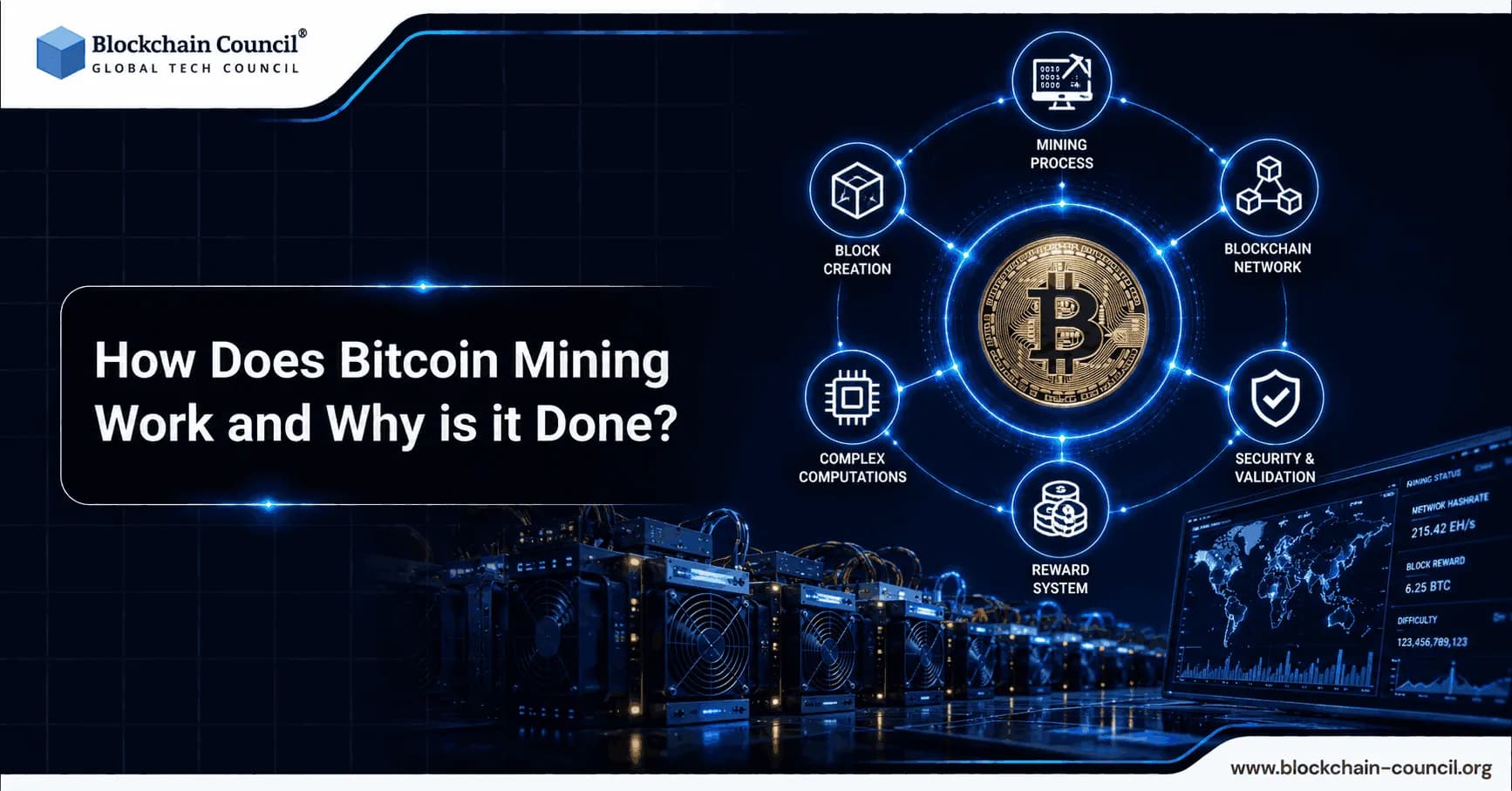
Somewhere right now, a global network of specialized computers is racing to solve a puzzle that has no shortcut burning through roughly 170 TWh of electricity a year, more than many mid-sized countries consume, just to keep confirming that Bitcoin transactions are real. That process is Bitcoin mining, and in 2026 it's running at a scale most people outside the industry never fully grasp: the network's combined computing power, or hashrate, has repeatedly crossed 900 exahashes per second this year, with a brief spike above 1 zettahash per second in January alone. Understanding what all that computing power is actually doing and why the network needs it at all is the key to understanding how Bitcoin works as a whole.
For anyone looking to go beyond the basics and actually understand mining economics, hardware, and network mechanics in depth, a focused Certified Bitcoin Mining Expert credential is a practical way to build that specialized knowledge systematically, rather than piecing it together from scattered forum posts and outdated guides.

What Bitcoin Mining Actually Is
Bitcoin mining is the process by which new transactions are verified and added to the blockchain, and new bitcoins are created as a reward for doing that work. It relies on a system called Proof of Work, where computers ("miners") compete to solve a computational puzzle. Here's the step-by-step process:
Transactions are broadcast. When someone sends Bitcoin, the transaction enters a waiting pool called the mempool until a miner picks it up.
Miners select transactions for a block. Miners typically prioritize transactions offering higher fees, bundling a batch of them into a candidate block.
Hashing begins. The block's header data is run through the SHA-256 cryptographic hashing algorithm, repeatedly, at a staggering rate trillions of attempts per second across the network.
A valid hash is found. The goal is to find a specific number (called a "nonce") that, when combined with the block data and hashed, produces a result below a certain target value set by the network's current difficulty level.
The block is verified and added to the chain. Once a miner finds a valid hash, other nodes on the network quickly verify it's correct, and the new block along with all its transactions becomes a permanent part of the blockchain.
The miner is rewarded. The successful miner receives newly created bitcoins (the "block subsidy") plus the transaction fees from everyone whose transactions were included in that block.
This entire cycle repeats roughly every ten minutes, 144 times a day, non-stop, across a global network of competing machines.
To really understand why this system was designed this way and how it fits into Bitcoin's broader monetary policy and security model a Certified Bitcoin Expert credential is a strong next step for anyone who wants a complete picture of Bitcoin beyond just the mining mechanics.
Why Bitcoin Mining Is Actually Done
Mining isn't just how new bitcoins enter circulation it's the mechanism that makes the entire network trustworthy without needing a bank or central authority. It serves several critical functions at once:
Securing the network. Because altering a past transaction would require redoing the computational work for that block and every block after it, mining makes the blockchain extremely resistant to tampering or fraud.
Achieving decentralized consensus. Instead of one company or government deciding which transactions are valid, miners compete to propose the next block, and the network agrees on whichever chain has the most accumulated computational work behind it.
Controlling coin issuance. Mining is the only way new bitcoins are created, and the rate at which they're issued is governed by strict, predictable rules written into the protocol itself not by a central bank's discretion.
Processing and confirming transactions. Miners are effectively the network's accountants, bundling and permanently recording every transaction that moves through the system.
This is also why mining "difficulty" exists and adjusts automatically. As more computing power joins the network, the puzzle gets harder to solve, keeping block production steady at roughly one every ten minutes regardless of how much total hashrate is competing. As of mid-2026, that difficulty sits close to 125 trillion, though it has swung significantly this year jumping 15% in a single adjustment in February before falling by double digits later in the same half, reflecting real volatility in mining economics.
Bitcoin's Halving: The Middle of Mining's Economic Design
One of the most important forces shaping Bitcoin mining is the "halving" a built-in event, occurring roughly every four years, that cuts the block reward in half. The most recent halving, in April 2024, reduced the reward from 6.25 BTC to 3.125 BTC per block, cutting daily new bitcoin issuance from around 900 BTC to roughly 450 BTC. The next halving is expected around April 2028.
Halvings create a defining tension in mining economics: the total computing power securing the network doesn't automatically decrease when rewards fall, but the energy cost of producing each individual bitcoin effectively rises, since the network still produces blocks at the same steady pace. This compression has pushed mining profitability toward operators with the cheapest electricity and the most efficient hardware, while less efficient miners have increasingly struggled or exited entirely several public mining companies have reported sharply divergent results through 2026, with some setting revenue records while others pivot toward AI data center hosting or shut down operations altogether.
The Hardware Behind Modern Bitcoin Mining
Bitcoin mining today is almost exclusively done using ASICs (Application-Specific Integrated Circuits) chips purpose-built to do nothing but compute SHA-256 hashes as fast and efficiently as possible. Leading hardware in 2026 can achieve hundreds of terahashes per second at efficiency levels near 9.5 to 13.5 joules per terahash, roughly double the efficiency of hardware from just a few years earlier. For comparison, a high-end gaming GPU manages a tiny fraction of that output, which is why general-purpose computers stopped being competitive for Bitcoin mining years ago.
Most individual miners today don't mine solo they join mining pools, combining computing power with thousands of other participants and sharing rewards proportionally. This matters for network health too: a small number of large pools currently control the majority of blocks mined, a centralization concern the mining community is actively working to address through protocol-level solutions that shift more control back toward individual miners.
Understanding and evaluating this hardware, hashrate economics, and infrastructure decisions requires genuine technical fluency not just familiarity with the concepts. A structured Tech Certification covering blockchain and distributed systems fundamentals gives serious miners, investors, and infrastructure teams the grounding needed to evaluate hardware, siting, and efficiency decisions with real technical confidence.
The Energy and Environmental Question
Bitcoin mining's electricity use draws consistent scrutiny, and the numbers are genuinely large estimates for 2026 range from roughly 138 TWh to 180 TWh annually, depending on methodology and the point-in-time hashrate used for the calculation. That said, the energy mix powering this activity has shifted meaningfully: recent data suggests over half of Bitcoin mining now runs on sustainable energy sources, including a substantial mix of hydropower, wind, solar, and nuclear power, up significantly from just a few years earlier. Many large-scale mining operations have also gravitated toward stranded or otherwise wasted energy sources, since minimizing electricity cost is directly tied to mining profitability.
Final Thoughts
Bitcoin mining is often reduced to "the process that creates new Bitcoin," but that undersells what it actually does. It's the mechanism that makes a decentralized, trustless currency possible in the first place turning raw computational effort into network security, transaction verification, and predictable, transparent monetary issuance, all without a central authority overseeing any of it. As hardware efficiency improves and the industry adapts to post-halving economics, mining will keep evolving, but its core purpose stays the same: making Bitcoin's ledger something the world can trust without having to trust any single participant in it.
For companies and platforms operating in this space mining hardware providers, energy partners, crypto exchanges explaining these mechanics clearly to a non-technical audience is its own challenge. That's where a solid Marketing Certification genuinely helps, giving teams the skills to translate complex mining economics and infrastructure decisions into messaging that investors, customers, and partners can actually follow and trust.
FAQs
1. What is Bitcoin mining?
Bitcoin mining is the process by which specialized computers validate Bitcoin transactions and add new blocks to the Bitcoin blockchain. Miners compete to solve complex cryptographic puzzles, helping secure the network while earning potential rewards in the form of newly issued bitcoins and transaction fees.
2. Why is Bitcoin mining done?
Bitcoin mining serves several important purposes:
Verifies and confirms transactions
Secures the Bitcoin network
Prevents double spending
Maintains blockchain consensus
Introduces new bitcoins into circulation according to the protocol
Without mining, Bitcoin's Proof of Work network could not function as designed.
3. How does Bitcoin mining work?
Miners collect unconfirmed transactions into a candidate block and repeatedly calculate cryptographic hashes until one meets the network's difficulty target. The first valid block is broadcast to the network, verified by other nodes, and added to the blockchain.
4. What is Proof of Work (PoW)?
Proof of Work (PoW) is Bitcoin's consensus mechanism. It requires miners to perform computational work before proposing a new block. This makes it costly to attack the network and helps maintain security and decentralization.
5. What is a Bitcoin block?
A block is a collection of verified Bitcoin transactions. Each block includes a reference to the previous block through a cryptographic hash, creating a continuous blockchain.
6. What equipment is used for Bitcoin mining?
Modern Bitcoin mining is primarily performed using Application-Specific Integrated Circuits (ASICs). These specialized machines are designed specifically to perform the SHA-256 hashing calculations required by the Bitcoin network.
7. What is a hash in Bitcoin mining?
A hash is a fixed-length output generated by a cryptographic hashing algorithm. In Bitcoin mining, miners repeatedly compute hashes while changing specific values until they find one that satisfies the network's current difficulty requirement.
8. What is mining difficulty?
Mining difficulty is a network parameter that adjusts approximately every 2,016 blocks to help keep the average block creation time close to 10 minutes, regardless of changes in the total mining power on the network.
9. What rewards do Bitcoin miners receive?
Successful miners receive:
Newly created bitcoins (the block subsidy)
Transaction fees paid by users included in the block
The block subsidy decreases over time through scheduled Bitcoin halving events.
10. What is the Bitcoin halving?
The Bitcoin halving is a protocol event that occurs approximately every 210,000 blocks (roughly every four years). During a halving, the block subsidy awarded to miners is reduced by 50%, gradually limiting the rate at which new bitcoins enter circulation.
11. Can anyone mine Bitcoin?
Technically, anyone with compatible hardware and internet access can participate. In practice, profitable Bitcoin mining usually requires specialized ASIC hardware, access to competitively priced electricity, and participation in mining pools because of the network's high level of competition.
12. What is a Bitcoin mining pool?
A mining pool is a group of miners who combine their computational resources to increase the likelihood of successfully mining blocks. Rewards are then distributed among participants according to the pool's payout method and each miner's contributed work.
13. What are the advantages of Bitcoin mining?
Benefits include securing the Bitcoin network, validating transactions, maintaining decentralization, preventing double spending, introducing new bitcoins into circulation, and supporting the overall operation of the blockchain.
14. What are the challenges of Bitcoin mining?
Challenges include high electricity consumption, hardware costs, increasing mining difficulty, equipment maintenance, cooling requirements, regulatory uncertainty, environmental considerations, and fluctuating mining profitability due to Bitcoin price movements and transaction fee dynamics.
15. Is Bitcoin mining environmentally friendly?
Bitcoin mining consumes significant energy because of its Proof of Work design. The environmental impact depends on the energy sources used. Many mining operations increasingly utilize renewable energy, stranded energy, or surplus electricity, though energy use remains an ongoing topic of discussion and research.
16. What common mistakes should new miners avoid?
Common mistakes include purchasing outdated mining equipment, underestimating electricity costs, ignoring hardware cooling requirements, failing to calculate profitability, joining unreliable mining pools, neglecting cybersecurity, and expecting guaranteed financial returns.
17. What are best practices for Bitcoin mining?
Best practices include using efficient ASIC miners, selecting reputable mining pools, optimizing energy efficiency, monitoring hardware performance, securing mining infrastructure, keeping firmware updated, evaluating electricity costs, and complying with local regulations.
18. How does Bitcoin mining fit into the blockchain ecosystem?
Bitcoin mining works alongside full nodes, wallets, cryptographic hashing, public key cryptography, and the Proof of Work consensus mechanism to maintain the integrity, security, and decentralization of the Bitcoin network.
19. What trends are shaping Bitcoin mining in 2025-2026?
Major trends include energy-efficient ASIC hardware, renewable energy adoption, AI-assisted mining optimization, immersion cooling systems, grid balancing partnerships, methane gas capture mining, sustainable mining initiatives, improved mining pool technologies, and increasing institutional participation in mining infrastructure.
20. What is the future of Bitcoin mining?
Bitcoin mining is expected to remain essential to the Bitcoin network as long as it continues using the Proof of Work consensus mechanism. Over time, miners are likely to rely increasingly on efficient hardware, renewable energy sources, and advanced cooling technologies to remain competitive. As block subsidies continue to decrease through future halvings, transaction fees are expected to play a progressively larger role in miner revenue. While the economics of mining will continue to evolve, its core purpose will remain the same: securing the network and validating transactions in a decentralized manner. After all, Bitcoin mining is less about "creating money" than about maintaining one of the world's largest decentralized computing networks, with new coins serving as the incentive for doing the work.
Related Articles
View All
Bitcoin
Bitcoin Minor Codes: Roblox Rewards, Not Bitcoin Mining
Bitcoin minor codes are Roblox Bitcoin Miner promo codes, not real Bitcoin tools. Learn what they do, how to redeem them, and how they differ from real mining.
Bitcoin
Top Bitcoin Mining Software Trends You Must Check Out
Bitcoin mining is a process of digitally validating transactions and adding them to the blockchain ledger by solving cryptographic hash puzzles, rewarded with bitcoin for their efforts.
Bitcoin
How to set Bitcoin Mining Rig
BTC Mining Setting up a Bitcoin mining rig may sound complex, but with the right steps and components, anyone can get started. If you’re looking to mine Bitcoin from home or want to scale into a larger setup, this guide walks you through everything clearly. From choosing hardware to configuring…
Trending Articles
The Role of Blockchain in Ethical AI Development
How blockchain technology is being used to promote transparency and accountability in artificial intelligence systems.

Top 5 DeFi Platforms
Explore the leading decentralized finance platforms and what makes each one unique in the evolving DeFi landscape.
How Blockchain Secures AI Data
Understand how blockchain technology is being applied to protect the integrity and security of AI training data.