
Recursive Self-Improvement vs Self-Learning AI: Key Differences Explained
Understand recursive self-improvement vs self-learning AI, including definitions, technical differences, risks, governance needs, and learning paths.



2320 articles published
Understand recursive self-improvement vs self-learning AI, including definitions, technical differences, risks, governance needs, and learning paths.

OpenAI has not achieved fully autonomous recursive self-improvement, but it is using AI to improve training, evaluation, red teaming, and safety workflows.
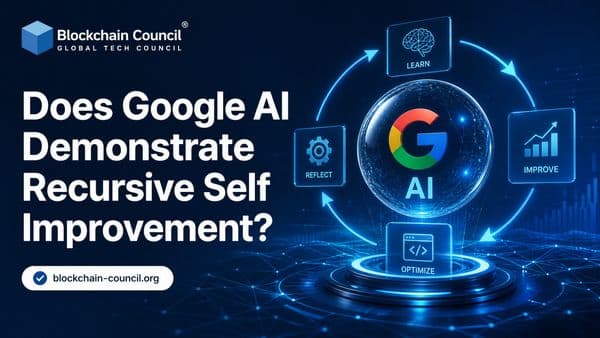
Google uses AI to optimize parts of its model training stack, but public evidence does not show fully autonomous recursive self improvement.

Large language models can improve reasoning, agents, and pipelines, but strong recursive self-improvement remains limited by data, verification, and architecture.

AI can perform bounded recursive self-improvement today, but open-ended autonomous self-redesign remains limited by evaluation, safety, compute, and introspection barriers.
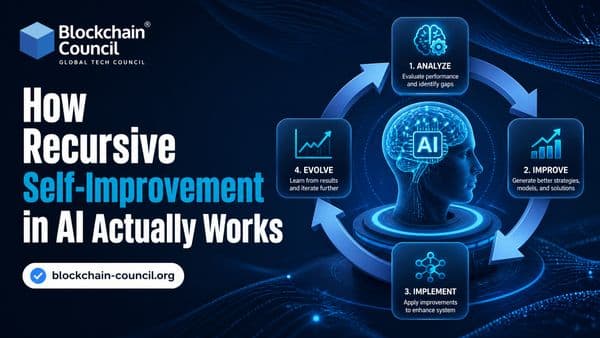
Learn how recursive self-improvement in AI works, where current systems are bounded, and how developers can build safer improvement loops.

Learn what recursive self-improvement in AI means, how RSI loops work, where current systems stand, and why evaluation and safety matter.

Learn how to use Meta Muse for free, access Meta’s new AI agent, and explore its capabilities for shopping, travel booking, emails, scheduling, and everyday tasks.

Find out whether Claude Fable 5.1 is available for free, which Claude plans provide access, and what users need to know before trying Anthropic’s latest AI model.

Find out whether GPT-6 Astra is available for free, which ChatGPT plans currently include access, and what options users have for trying OpenAI’s latest AI model.

Meta has launched Muse, a new AI agent designed to help users book trips, send emails, shop online, and handle everyday digital tasks more efficiently.

A practical Fable vs GPT comparison covering Fable 5.1, GPT-6 Astra, Claude, ChatGPT, benchmarks, pricing, and real enterprise use cases.