

Built to Catch AI Cheating: Rethinking Pre-Employment Assessments with HireValid
 Suyash Raizada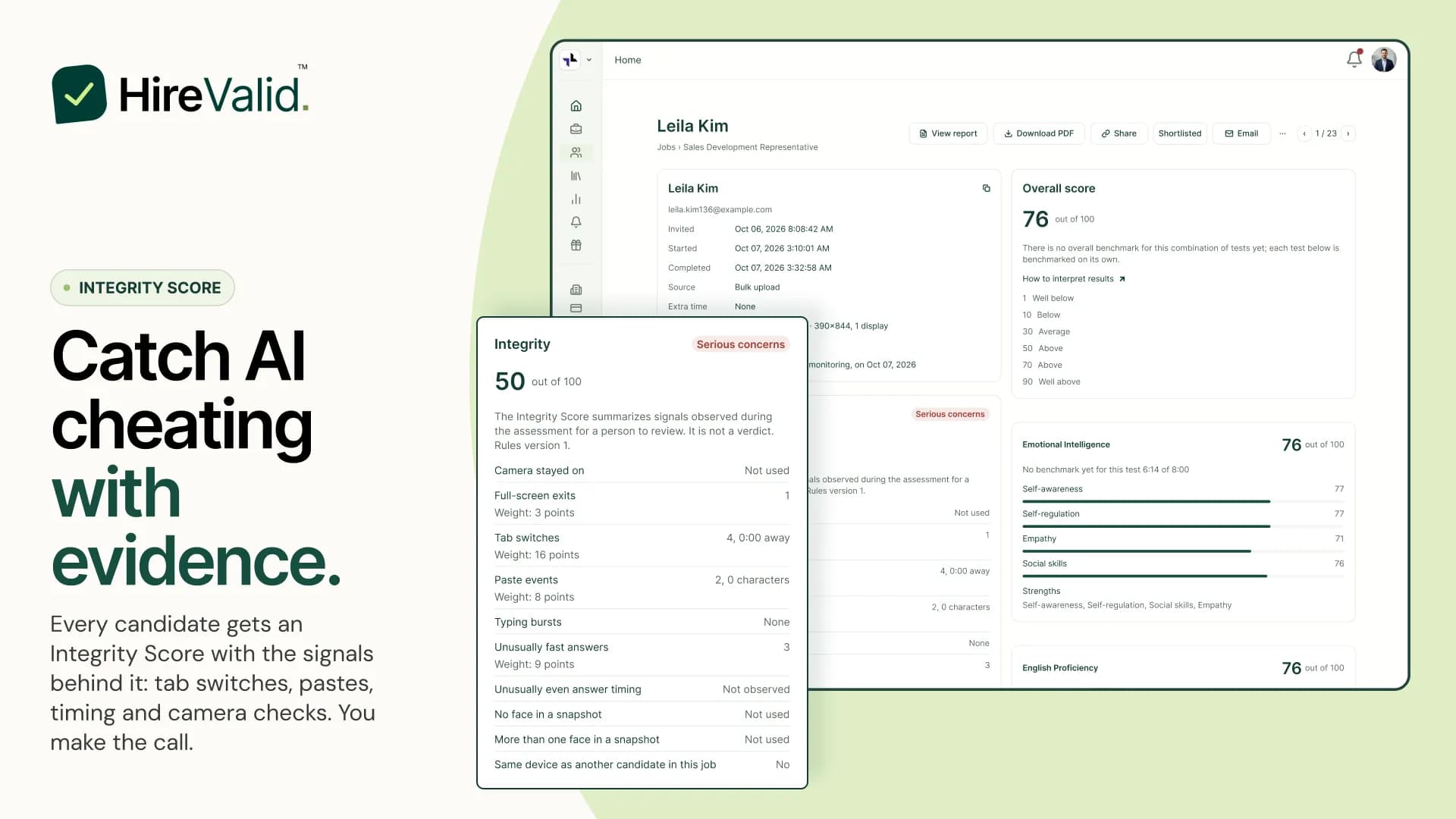
Hiring the right candidate requires more than reviewing an impressive CV or a well-written assessment response. As artificial intelligence makes it easier to generate answers and complete online tasks, employers need better ways to evaluate genuine job skills. HireValid helps small and medium-sized businesses assess candidates, flag potential AI assistance and review assessment integrity through evidence-backed results.
By combining cognitive, skills and language tests with an Integrity Score and ranked candidate results, HireValid gives employers a structured way to compare candidates. Its monthly plans also allow businesses to assess candidates without committing to an annual contract.

Why do pre-employment assessments need to change?
Pre-employment assessments help employers evaluate candidates before investing time in interviews and onboarding. They can measure cognitive ability, communication, practical skills and other capabilities relevant to a job.
However, AI tools have changed the environment in which these assessments take place.
Candidates can use AI to generate written answers, solve problems, improve application materials and prepare for interviews. These tools can support legitimate learning, but unauthorised assistance during an assessment may make it difficult to determine what a candidate can do independently.
Consider a small business hiring a marketing coordinator. Several candidates submit polished applications and complete written exercises. One candidate may have strong practical marketing skills, while another may rely heavily on AI-generated responses without understanding the underlying concepts.
If the employer evaluates only the quality of the final answers, these differences may remain hidden.
This creates three practical challenges:
Uncertain assessment results: Employers may struggle to determine whether responses reflect a candidate's own capabilities.
Time-consuming screening: Reviewing numerous candidates manually can delay hiring.
Poor hiring decisions: A candidate who performs well on paper may not have the skills needed for the actual role.
These challenges are especially relevant to small businesses that receive many applications but have limited HR resources.
The solution is not to abandon pre-employment testing. It is to improve assessment design, review integrity signals and combine test results with other evidence.
What does it mean to build assessments that catch AI cheating?
Assessments built to catch AI cheating are designed to discourage unauthorised assistance and make potentially suspicious activity visible for review.
No assessment can guarantee that every form of AI assistance will be prevented or detected. Effective testing instead combines multiple measures to make the assessment process more dependable.
These measures may include timed questions, randomised question pools, practical exercises, short reasoning prompts and activity-based integrity checks.
For example, a candidate completing a numerical reasoning test may face a time limit for each question. Randomised questions can make it harder for candidates to share identical answers. A short explanation of the reasoning behind an answer can provide additional information about the candidate's understanding.
Integrity checks can also identify events that deserve further review, such as unexpected changes to the testing window or unusual answer timing.
The distinction is important: a suspicious signal is not proof of cheating. Employers should examine the available evidence and consider legitimate explanations before deciding how to proceed.
How does HireValid approach pre-employment assessment integrity?
HireValid is a self-service assessment platform for small and medium-sized businesses. It combines tests with integrity signals and candidate comparison tools to help employers make more informed hiring decisions.
Its approach covers five stages.
1. Select assessments relevant to the role
Employers can choose available tests from the library or use ready-made role bundles.
For example, a customer support agent may need English proficiency, attention to detail and customer-service judgement. An office administrator may need cognitive ability, time management and spreadsheet skills.
Selecting relevant assessments ensures that candidates are evaluated on capabilities connected to the job.
2. Invite candidates through a simple process
Employers can invite candidates using a unique assessment link or email. Candidates complete the tests in their browser without creating a HireValid account.
The employer should explain the assessment format, expected completion time and applicable integrity checks before the test begins.
Clear instructions help candidates understand what is expected and whether AI tools are permitted.
3. Evaluate cognitive, skills and language capabilities
HireValid supports cognitive, skills and language assessments. Depending on the available tests, employers can evaluate numerical reasoning, attention to detail, English proficiency, typing and other practical capabilities.
The purpose is to assess skills that matter for the position, rather than relying entirely on CVs or generic interview questions.
For instance, an employer hiring a junior data analyst may need evidence of numerical reasoning and spreadsheet skills. A customer support employer may place greater emphasis on communication and situational judgement.
4. Review the Integrity Score
HireValid provides an Integrity Score from 0 to 100, an integrity band and supporting evidence.
Potential signals include tab switches, paste events, unusual answer timing and other recorded assessment activity. The platform also considers AI-written text likelihood as a weak signal that should never be used alone.
These indicators help employers identify attempts that may need closer review. They do not establish misconduct automatically.
A candidate might switch tabs because of a technical issue or another legitimate reason. Employers should therefore review the timeline and available evidence rather than relying only on a numerical score.
5. Compare results and make a human-led decision
HireValid presents ranked results, individual test scores, benchmark percentiles and candidate reports.
Employers can use this information to compare candidates, identify strengths and decide whom to interview. The platform supports the decision-making process but does not automatically reject candidates.
Explore the platform at HireValid.
Which assessment techniques help discourage unauthorised AI use?
Different roles require different assessment methods. Employers should select techniques based on the skills being measured and the risks associated with the assessment.
Technique | Purpose | Important limitation |
Timed questions | Make external assistance more difficult during the allotted time | Time limits must be reasonable |
Randomised question pools | Vary the questions and order presented to candidates | Different versions should measure comparable skills |
Practical tasks | Evaluate relevant job capabilities | Tasks should reflect real responsibilities |
Short explanation prompts | Ask candidates to explain their reasoning | Written explanations can also be AI-assisted |
Activity-based integrity checks | Flag behaviour that may need investigation | Signals can have legitimate explanations |
Structured follow-up interviews | Explore understanding and practical judgement | Interviewers should use consistent, job-related criteria |
A junior developer assessment, for example, could combine a practical programming task with questions about the candidate's approach. A follow-up discussion may help the employer understand how the candidate reached a solution.
A marketing coordinator assessment could include a practical exercise involving campaign analysis, with a clear policy about whether AI tools are allowed.
These methods provide different forms of evidence. No single technique should be treated as a complete solution to AI-assisted cheating.
Employers should also avoid assuming that all AI use is inappropriate. If a job requires candidates to work with AI tools, the assessment should measure the ability to use those tools effectively and responsibly.
How can businesses make pre-employment testing fairer?
A more secure assessment process should also be relevant, accessible and fair.
Employers should begin by identifying the essential requirements of the role. They should then choose tests that measure those requirements and communicate the rules clearly.
A practical checklist includes:
Define the skills needed to perform the job.
Select assessments that measure those skills.
Explain whether AI assistance is allowed.
Inform candidates about relevant integrity checks.
Consider accessibility needs and reasonable accommodations.
Review flagged activity using the available evidence.
Compare results alongside interviews and work experience.
Document the reasons behind the final hiring decision.
Employers should also consider whether assessments unfairly disadvantage particular groups. In the United States, the Equal Employment Opportunity Commission's guidance on employment tests and selection procedures explains relevant discrimination concerns.
The NIST AI Risk Management Framework provides additional general guidance on AI reliability, transparency and accountability. It is not a specific certification for hiring assessments, but its principles can help organisations think about responsible technology use.
Fair assessment is not simply about detecting misconduct. It is also about ensuring that candidates are evaluated against appropriate job-related criteria.
Why do small businesses need flexible assessment solutions?
Small businesses often hire in bursts rather than continuously. A company may recruit several employees during expansion and then go months without opening another position.
An annual subscription can be difficult to justify when the business only needs assessment software occasionally.
HireValid offers monthly plans without a required annual contract. Businesses can start free, evaluate the available assessments and choose a plan that fits their hiring needs. A pause option is also designed for periods between hiring rounds.
This approach allows employers to align their use of assessment software with actual recruitment activity.
Before subscribing, businesses should review the live pricing page and confirm current plan limits and features.
How can AI and technology certifications complement skills-based hiring?
AI-assisted recruitment is part of a wider change in the skills employers need. Professionals increasingly need to understand AI, apply technical knowledge and solve problems in practical workplace settings.
Structured learning can help individuals develop these capabilities, while role-related assessments help employers evaluate current skills.
The Blockchain Council offers technology-focused learning, including the Certified Agentic AI Expert™ programme. This provides a relevant learning path for professionals interested in agentic AI concepts and applications.
Readers can also explore:
Deep-tech certifications: Available through Blockchain Council.
Technology certifications: Available through Global Tech Council.
Marketing and business certifications: Available through Universal Business Council.
These programmes support complementary development goals. A certification can demonstrate learning and subject knowledge, but it does not automatically prove that a person can perform every responsibility of a specific job.
A practical learning path is to understand the fundamentals, build specialist knowledge, apply that knowledge through projects and demonstrate relevant capabilities during recruitment.
For employers, this creates a useful connection between learning and hiring. Professional development helps people build skills, while structured assessments help organisations evaluate how those skills align with a role.
What should employers look for in an assessment platform?
Before choosing a pre-employment assessment platform, businesses should consider the quality of the assessment process rather than focusing only on the number of available tests.
The platform should offer relevant assessments, understandable results and a clear explanation of how integrity signals are used.
Employers should ask:
Are the assessments relevant to the position?
Can candidates complete the tests through a straightforward process?
Are benchmark scores and percentiles explained clearly?
Does the Integrity Score include supporting evidence?
Can flagged activity be reviewed by a person?
Are candidate instructions and accommodation options clear?
Are the subscription terms suitable for occasional hiring?
Does the employer retain responsibility for the final decision?
HireValid combines assessment results, benchmark information and integrity signals in a structured workflow. Its monthly plans also address the needs of businesses that do not recruit continuously.
The objective is to improve the quality of hiring decisions, not to promise perfect detection or guaranteed outcomes.
Conclusion: Rethink pre-employment assessments for the AI era
AI has made it easier to generate convincing applications and assessment responses. Employers therefore need ways to evaluate real job skills and identify assessment attempts that may require further review.
A stronger pre-employment process combines role-relevant testing, appropriate assessment design, integrity signals and human judgement. It also communicates expectations clearly and treats candidates fairly.
HireValid supports this process with cognitive, skills and language assessments, ranked candidate results, benchmark percentiles and an Integrity Score with supporting evidence. Its flexible monthly plans offer an option for small businesses that want structured testing without a required annual contract.
For employers looking to improve candidate assessment in the AI era, the first step is to focus on the skills that matter and use evidence carefully.
Ready to assess real job skills? Visit HireValid to explore the platform and start free.
Frequently Asked Questions
1. What are pre-employment assessments?
Pre-employment assessments are tests used before hiring to evaluate candidates' job-related skills, cognitive abilities, language proficiency or other relevant capabilities. They provide additional evidence to consider alongside CVs and interviews.
2. How can pre-employment assessments discourage AI cheating?
Employers can combine timed questions, randomised question pools, practical tasks and integrity checks. These measures can make unauthorised assistance more difficult and help flag suspicious activity, but they cannot guarantee that every instance will be detected.
3. How does HireValid help identify potential AI assistance?
HireValid uses assessment design measures and activity signals, including tab switches, paste events and unusual answer timing. Its Integrity Score and supporting evidence help employers identify attempts that may need review.
4. What is the HireValid Integrity Score?
The Integrity Score is a score from 0 to 100 that summarises signals about how trustworthy an assessment attempt appears. It includes supporting evidence for human review and should not be treated as definitive proof of cheating.
5. Does HireValid automatically reject candidates flagged for suspicious activity?
No. HireValid provides assessment results and integrity signals for human review. Employers remain responsible for the final hiring decision.
6. Can AI detection identify every AI-generated answer?
No. AI-text detection and activity-based checks have limitations. Employers should consider multiple sources of evidence and avoid treating any single indicator as conclusive proof.
7. Which roles can benefit from pre-employment testing?
Testing can support recruitment for customer service, sales, administration, marketing coordination, junior development, data roles and other positions where relevant skills can be assessed.
8. Are AI-resistant assessments suitable for small businesses?
Yes. Small businesses can use structured assessments to compare candidates more consistently. HireValid's self-service approach and monthly plans are designed to support businesses that need assessment tools without a required annual contract.
9. How do technology certifications support recruitment?
Technology certifications help individuals develop and demonstrate subject knowledge. Employers can consider them alongside practical assessments, work experience and interviews, rather than treating a certification as proof of every job-related skill.
10. How can employers get started with HireValid?
Employers can visit hirevalid.com, explore the available assessments, select tests relevant to a role and invite candidates. They can then review assessment results and integrity evidence before making hiring decisions.
Related Articles
View All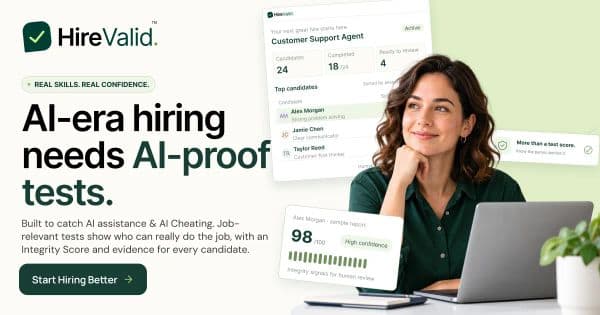
AI & ML
AI-Era Hiring Needs AI-Proof Tests: How HireValid Is Redefining Talent Assessment
Explore how HireValid is rethinking talent assessment for the AI era with job-relevant tests, anti-cheating design, integrity signals, and human-reviewed evidence of candidate ability.

AI & ML
Google Launches Gemini 4 Argon: Features and Capabilities
Google has launched Gemini 4 Argon, its flagship AI model for coding, finance, law, cybersecurity and science. Learn its key features, availability, pricing and safety details.

AI & ML
Meta Launches Muse Wonder: Its New AI Model Explained
Meta has launched Muse Wonder and Muse Wonder Full, new AI models built for personal and professional agents. Learn the features, pricing, access options and how they compare with rivals.
Trending Articles
The Role of Blockchain in Ethical AI Development
How blockchain technology is being used to promote transparency and accountability in artificial intelligence systems.
How Blockchain Secures AI Data
Understand how blockchain technology is being applied to protect the integrity and security of AI training data.
What is AWS? A Beginner's Guide to Cloud Computing
Everything you need to know about Amazon Web Services, cloud computing fundamentals, and career opportunities.