

Reverse Engineering
 Suyash Raizada
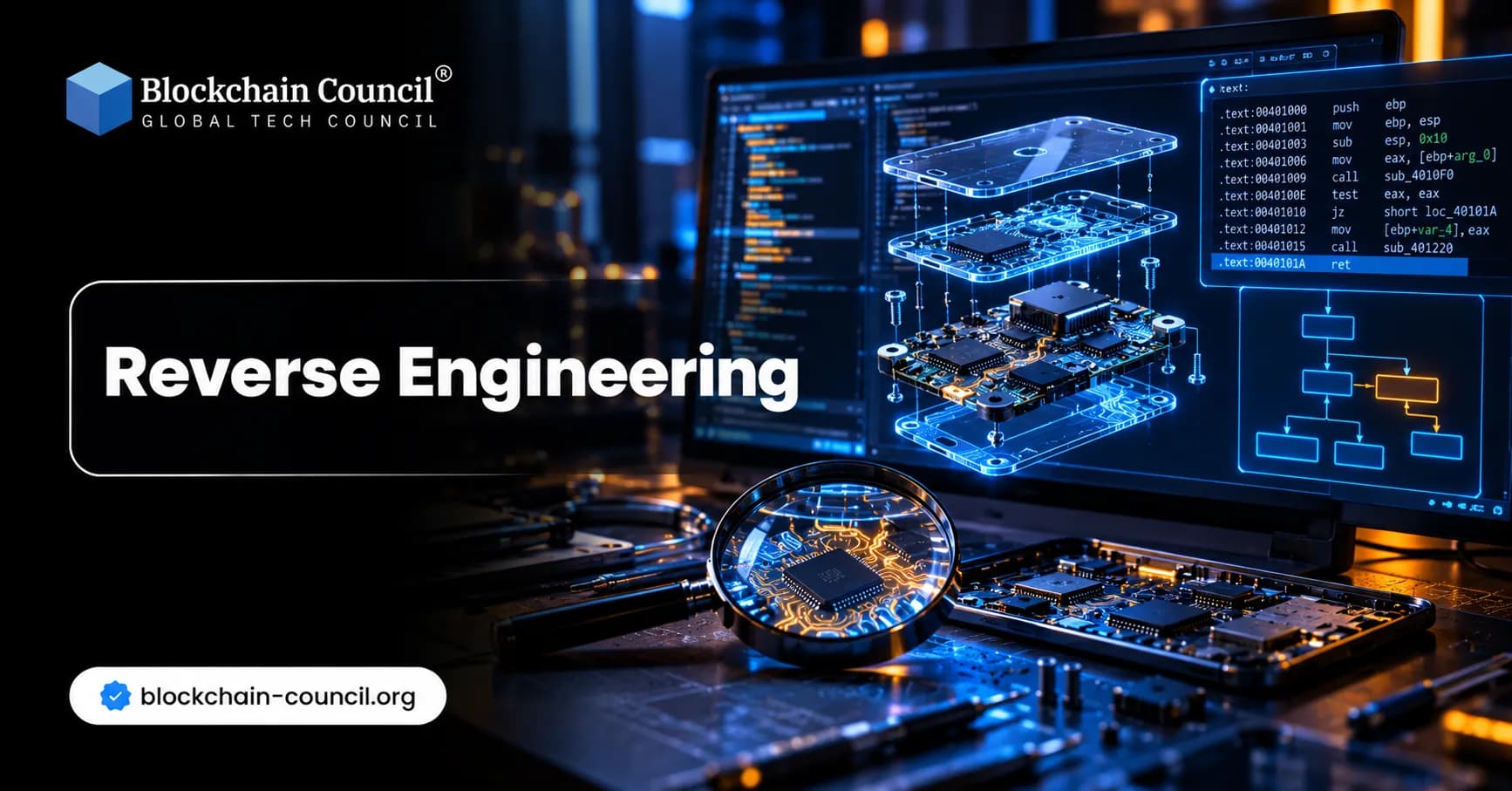
Reverse engineering is the practice of taking something finished, such as a machine, a piece of software or a digital protocol, and working backward to understand how it was made and how it works. Engineers do it to repair old equipment, security experts do it to find weaknesses before attackers do, and students do it to learn how great designs come together. It is also becoming a core skill in blockchain, where anyone can inspect how a smart contract behaves on a public network. If you want to explore that world in a structured way, the Certified Cryptocurrency Expert program is a helpful place to start. This guide explains reverse engineering in plain language, from the basics to the professional methods, legal limits and career paths.
What Is Reverse Engineering?
Reverse engineering is the process of analyzing a finished product, system or piece of code to discover its design, structure and function, usually without access to the original plans or source material. Instead of going from idea to product, you go from product back to idea.

A simple example is a mechanic who disassembles a broken gearbox to learn how its parts fit together, then uses that knowledge to build a replacement. In software, a developer might study how a program behaves to understand how it handles data, even if the original source code is not available.
Key points to remember:
It starts with a finished object, not a blueprint.
It aims to understand, document or recreate behavior and design.
It is used in hardware, software, networks, manufacturing and security.
It is legal and valuable in many situations, but not all.
Reverse Engineering vs Forward Engineering
Feature | Forward engineering | Reverse engineering |
|---|---|---|
Starting point | Idea, requirements, design | Finished product or system |
Direction | Design to build to product | Product to analysis to design knowledge |
Main goal | Create something new | Understand, repair, improve or verify |
Typical output | A working product | Documentation, models, diagrams, insights |
Example | Writing a new app from scratch | Studying an old file format to read it again |
Both approaches often work together. Teams may reverse engineer a legacy system and then forward engineer a modern replacement.
Why Reverse Engineering Matters
Reverse engineering solves problems that ordinary development cannot. Companies lose documentation, original developers leave, suppliers shut down and old systems keep running long after anyone remembers how they were built. At the same time, attackers study software to look for flaws, so defenders must study it too.
The digital asset world makes this even more important. On public blockchains, smart contract code is visible to everyone, and security researchers regularly analyze it to understand how funds move and where risks may hide. Many learners who want to understand these systems also explore wider Cryptocurrency Certifications to see how protocols, wallets and tokens are designed, which gives context for the analysis itself.
Benefits at a glance:
Security: Finding weaknesses before criminals do.
Compatibility: Making different systems work together.
Preservation: Keeping old software and hardware usable.
Learning: Understanding how great designs work.
Quality checks: Verifying that a product behaves as claimed.
A Short History of Reverse Engineering
The idea is as old as engineering itself. Craftspeople have long studied competitors’ tools to learn how they were made. In wartime, armies examined captured equipment to copy its best features and find its weak points.
In computing, one famous early example came in the 1980s, when companies built compatible versions of the IBM personal computer. To avoid copying code, they used a “clean room” method: one team studied how the original behaved and wrote a specification, and a separate team, which never saw the original code, built a new version from that specification. Courts later considered cases such as Sega v. Accolade and Sony v. Connectix, which helped shape how reverse engineering for compatibility is viewed in law.
In recent decades, the practice has grown through open-source analysis tools, security research communities and public programs that reward researchers who responsibly report flaws. The release of the free Ghidra software analysis framework by the US National Security Agency in 2019 made professional-grade tools widely available to students and researchers.
How Reverse Engineering Works: Step by Step
The exact methods depend on whether you study hardware, software or a protocol, but most projects follow a similar path.
Step 1: Define the Goal and Scope
Decide what you want to learn and why. Are you trying to repair a device, understand a file format, verify security or document a legacy system? A clear goal keeps the work focused and helps confirm that it is legal and ethical.
Step 2: Gather Information
Collect everything you can without taking things apart. This includes manuals, public specifications, behavior observed in normal use, and any official documentation. Many problems get solved at this stage.
Step 3: Observe Behavior
Watch what the system does under different conditions. For hardware, that might mean measuring signals. For software, it could mean recording how it reacts to different inputs and what data it reads or writes. The idea is to form hypotheses about how it works.
Step 4: Analyze the Structure
Next comes a deeper look inside. Mechanical engineers disassemble parts and measure them. Software analysts may use specialized tools that translate compiled programs back into a readable form, or that show the flow of data. Network analysts study how devices talk to each other.
Step 5: Build a Model
Turn what you have found into diagrams, notes and flow charts. A good model explains how components connect and what each one does. At this point, teams often discover differences between what the product claims to do and what it actually does.
Step 6: Test Your Understanding
Check your model by predicting what the system will do and then comparing the prediction with reality. If your model is wrong, refine it and repeat.
Step 7: Document and Use the Findings
Write up the results clearly. Depending on the goal, you may build a compatible replacement, fix a bug, report a vulnerability to the vendor, create training material or write a security report.
Main Types of Reverse Engineering
Software Reverse Engineering
This focuses on understanding programs, apps and libraries, often when source code is unavailable. It is common in security research, malware analysis for defense, compatibility work and legacy modernization.
Hardware Reverse Engineering
Here, engineers study circuit boards, chips and devices to understand how components connect. It helps with repair, counterfeit detection and security evaluation.
Mechanical Reverse Engineering
This covers physical parts and machines. Teams measure, scan and test items such as engine parts or tools so they can recreate discontinued components.
Protocol and Data Analysis
Analysts study how systems communicate and how files are structured so that other software can read or work with them. This is how many open file converters and compatibility layers come into being.
Smart Contract and Blockchain Analysis
Because blockchain code and transactions are public, researchers examine contract behavior, token flows and protocol logic. This is used for audits, investigations and education.
Common Tools and Resources
Without going into step-by-step technique, here are the categories of tools professionals use:
Disassemblers and decompilers: Programs that translate compiled code into forms people can read. Examples include Ghidra and IDA.
Debuggers: Tools that let analysts pause a program and inspect its state.
Network analyzers: Software such as Wireshark that records and displays network traffic for analysis.
Hardware tools: Multimeters, logic analyzers and microscopes for studying devices.
3D scanners and CAD software: Used to measure and model mechanical parts.
Blockchain explorers: Websites that display public transactions and contract code.
Always use these tools only on systems you own or are explicitly permitted to study.
Skills You Need
Reverse engineering rewards patience, curiosity and strong fundamentals. Useful skills include:
Understanding of computer architecture and operating systems
Programming knowledge, especially in C, Python or similar languages
Networking basics
Data structures and algorithms
Careful note-taking and documentation
Ethical judgement
If you are building a general technical base before specializing, a broad Tech Certification can strengthen your understanding of core topics such as data, software and cloud systems, which makes advanced analysis much easier to learn.
Real-World Uses
Cybersecurity
Security teams analyze software to find vulnerabilities, understand how attacks work and build defenses. Defensive malware analysis helps organizations recover quickly and protect others.
Interoperability
Reverse engineering lets different products communicate. This is how many open-source tools learned to read proprietary file formats and how some hardware drivers were created.
Legacy System Support
Banks, factories and governments often rely on old systems with no documentation. Analysts reverse engineer them so they can maintain, migrate or replace them safely.
Education and Research
Students learn how real systems are built by taking them apart. Researchers also reverse engineer products to verify safety and privacy claims.
Blockchain Audits
Auditors read and test smart contracts to confirm they behave as intended. Investigators trace transactions to understand how digital assets move.
Product Analysis and Repair
Teardowns of consumer devices reveal materials and design choices, and repair communities rely on them to keep products running longer.
Is Reverse Engineering Legal?
The answer depends on what you do, where you are and what agreements apply. Laws differ across countries, and this is general information, not legal advice. In broad terms:
Often allowed: Studying something you own for learning, repair, or to achieve interoperability, in many places.
Possibly restricted: Copying protected code or designs, bypassing technical protection, or breaking license terms.
Not allowed: Using findings to steal trade secrets, pirate software or attack systems you do not have permission to test.
For example, in the European Union, software law contains specific rules that allow decompilation under limited conditions to achieve interoperability. In the United States, copyright law, anti-circumvention rules and contract terms can all affect what is permitted, and the rules include specific exemptions for security research that are updated over time.
The practical advice is clear: read the license terms, get written permission when in doubt and consult a qualified lawyer before starting any project that could be sensitive.
Ethical Best Practices
Get authorization. Only analyze systems you own or have permission to test.
Follow responsible disclosure. If you find a vulnerability, report it privately to the vendor and give them reasonable time to fix it.
Protect user data. Never expose personal information you find.
Avoid harm. Do not publish details that make attacks easy.
Keep records. Document what you did and why.
Respect licenses and laws. Check contracts and regional rules first.
Careers in Reverse Engineering
Skills in this area open the door to several roles: security researcher, vulnerability analyst, malware analyst, firmware engineer, embedded systems developer, digital forensics investigator and smart contract auditor.
As artificial intelligence becomes part of everyday business operations, employers increasingly need people who can apply AI knowledge responsibly and effectively. Evaluating candidates on relevant skills, reasoning, and practical understanding can support stronger hiring decisions. HireValid can be explored by organisations seeking structured candidate assessments.
For learners, a strong path is to start with programming and computer basics, practice on legal training challenges and open-source projects, keep a portfolio of write-ups and join respected security communities.
Reverse Engineering and AI
AI is changing the field in two ways. First, assistants can help analysts summarize unfamiliar code, label functions and speed up documentation. Second, AI models themselves can be studied to understand their behavior and limits. In both cases, human judgement remains essential, because AI tools can make confident mistakes. Analysts should treat AI suggestions as leads to verify, not as final answers.
Challenges and Limitations
Time and complexity: Large systems can take weeks or months to understand.
Protection measures: Some products use obfuscation or encryption to make analysis harder.
Incomplete information: Without original documents, some design reasons stay unclear.
Legal risk: Mistakes about permission can cause serious trouble.
Accuracy: Wrong assumptions can lead to flawed copies or fixes.
Reverse Engineering Thinking in Marketing and Business
Even outside engineering, the mindset is powerful. Marketers reverse engineer successful campaigns by studying their message, timing, audience and channels to learn why they worked. Product teams analyze competitors’ offerings to find gaps. Content creators study top-ranking pages to understand what readers want. The key is to learn from patterns, not to copy. If you want to turn this analytical habit into a career skill, a Marketing Certification can help you connect research, strategy and creativity.
Final Thoughts
Reverse engineering is one of the most useful ways to learn how the world is built. It helps engineers repair and modernize, helps defenders protect people and helps students understand technology from the inside. It also demands care, because the same skills can be misused if ethics and law are ignored. Start with a clear goal, work only on systems you are allowed to study, document everything and keep learning the fundamentals. With patience and good habits, reverse engineering can turn mysterious products into understood, improvable ones.
FAQs
1. What Is Reverse Engineering?
Reverse engineering is the process of analyzing an existing product, system, software, or device to understand how it works. Instead of building something from scratch, engineers examine its components, structure, and behavior to discover how it was designed and implemented.
2. How Does Reverse Engineering Work?
Reverse engineering typically begins with collecting information about the target system. Engineers then inspect its components, observe its behavior, analyze its structure, and develop a model of how it operates. The process may involve testing, disassembly, debugging, documentation, and validation.
3. What Are the Main Types of Reverse Engineering?
The main types include software reverse engineering, hardware reverse engineering, mechanical reverse engineering, and data or protocol analysis. Software engineers study programs and executable files, while hardware engineers examine circuit boards and electronic components. Mechanical engineers may analyze physical products to understand their design and manufacturing methods.
4. What Is Software Reverse Engineering?
Software reverse engineering involves analyzing an existing software application to understand its functionality, architecture, and internal logic. Developers may examine source code when available, or inspect compiled programs using disassemblers and decompilers. It can support debugging, compatibility work, security research, and legacy software maintenance.
5. What Is the Difference Between Reverse Engineering and Forward Engineering?
Forward engineering moves from requirements and designs toward a finished product or system. Reverse engineering works in the opposite direction by examining an existing implementation to understand its underlying design. The two approaches can complement each other when documenting, improving, or rebuilding older systems.
6. Why Is Reverse Engineering Important?
Reverse engineering helps organizations understand systems when original documentation is missing, incomplete, or outdated. It can reveal security weaknesses, support interoperability, help diagnose defects, and make it easier to maintain legacy technology. It can also help engineers learn from existing designs.
7. What Are the Main Steps in the Reverse Engineering Process?
A typical reverse engineering process includes defining the objective, collecting the target system, gathering documentation, inspecting its structure, analyzing its behavior, developing a model, and validating the findings. The exact steps depend on whether the target is software, hardware, a mechanical product, or a communication protocol.
8. What Tools Are Used for Software Reverse Engineering?
Common tools include Ghidra, IDA, Binary Ninja, GDB, WinDbg, and x64dbg. Disassemblers help translate machine instructions into readable assembly, while debuggers let researchers examine program execution. Tools such as Wireshark can help analyze network traffic when protocol behavior is part of the investigation.
9. What Is the Difference Between Disassembly and Decompilation?
Disassembly converts machine code into assembly-language instructions that correspond to the processor's operations. Decompilation attempts to reconstruct higher-level code, such as C-like pseudocode, from a compiled program. Decompiled output is generally an approximation because compilation often removes names, comments, and other information from the original source.
10. What Is Binary Analysis in Reverse Engineering?
Binary analysis examines executable files and compiled libraries to understand their structure and behavior. Analysts may inspect file formats, machine instructions, imported functions, strings, control flow, and dependencies. This helps identify program functionality, troubleshoot compatibility issues, and investigate potentially malicious software.
11. How Is Reverse Engineering Used in Cybersecurity?
Cybersecurity professionals use reverse engineering to analyze suspicious files, investigate malware, identify vulnerabilities, and understand how software behaves under different conditions. It can reveal hidden functionality and help defenders develop detection rules or remediation strategies. Such analysis should be performed in an isolated environment with appropriate authorization.
12. Is Reverse Engineering Used to Analyze Malware?
Yes. Malware analysts reverse engineer suspicious programs to understand how they execute, communicate, persist, and affect systems. They may use static analysis, dynamic analysis, debugging, and memory inspection. Findings can support incident response and help security teams improve their defenses.
13. What Is Hardware Reverse Engineering?
Hardware reverse engineering involves examining a physical device to understand its components, circuitry, design, and operation. Techniques can include visual inspection, circuit tracing, component identification, electrical measurements, and specialized imaging. It is used in electronics research, repair, compatibility studies, and product development.
14. How Is Reverse Engineering Used in Manufacturing?
Manufacturers can reverse engineer existing components to recreate unavailable parts, inspect product designs, improve performance, or support maintenance. Techniques such as 3D scanning, dimensional measurement, and computer-aided design help turn a physical object into a digital model. The resulting model can support prototyping and manufacturing, subject to applicable intellectual property restrictions.
15. What Is the Difference Between Reverse Engineering and Replication?
Reverse engineering aims to understand how an existing system works and how it is structured. Replication involves producing another system or product with similar or identical behavior. Reverse engineering may provide the information needed for replication, but it does not automatically mean the resulting product is an exact copy.
16. What Are the Benefits of Reverse Engineering?
Reverse engineering can reduce troubleshooting time, improve documentation, support legacy system maintenance, identify security problems, and help engineers understand complex products. It can also inform interoperability and product improvement. The benefits depend on the quality of the analysis and the purpose for which the findings are used.
17. What Are the Challenges of Reverse Engineering?
Challenges include complex code, missing documentation, obfuscation, anti-debugging mechanisms, hardware limitations, and incomplete access to the target system. Compiled programs may not preserve the original variable names or design comments. Reverse engineering can therefore require significant technical expertise, time, and specialized equipment.
18. Is Reverse Engineering Legal?
The legality of reverse engineering depends on the jurisdiction, the target, the method used, contractual obligations, and the intended purpose. Security research, interoperability, and maintenance may be permitted in some circumstances, while bypassing technical protections, copying protected material, or violating applicable laws may create legal risks. Researchers should obtain authorization and seek jurisdiction-specific legal advice when necessary.
19. What Skills Are Needed to Learn Reverse Engineering?
Useful skills include programming, computer architecture, operating systems, assembly language, debugging, and data structures. Cybersecurity researchers may also need knowledge of networking, executable formats, and malware analysis. Beginners can start with small open-source programs, practice binaries designed for learning, and basic debugging exercises.
20. What Is the Future of Reverse Engineering?
Reverse engineering is likely to remain important as software, connected devices, embedded systems, and artificial intelligence become more complex. Automation and AI-assisted analysis may help researchers understand code and identify suspicious behavior more quickly. Human expertise will still be needed to validate findings, assess context, and make responsible technical decisions.
Related Articles
View All
Cybersecurity
Cybersecurity tips for remote workers
Learn essential cybersecurity tips for remote workers to protect data, secure devices, and avoid online threats while working from home.
Cybersecurity
Cybersecurity companies in Dubai for small business
Find top cybersecurity companies in Dubai offering protection for small businesses against cyber threats.

Cybersecurity
Cybersecurity course for beginners India online
Explore beginner-friendly cybersecurity courses in India to learn ethical hacking and security fundamentals.
Trending Articles
The Role of Blockchain in Ethical AI Development
How blockchain technology is being used to promote transparency and accountability in artificial intelligence systems.
AWS Career Roadmap
A step-by-step guide to building a successful career in Amazon Web Services cloud computing.
How Blockchain Secures AI Data
Understand how blockchain technology is being applied to protect the integrity and security of AI training data.