

AI-Era Hiring Needs AI-Proof Tests: How HireValid Is Redefining Talent Assessment
 Suyash Raizada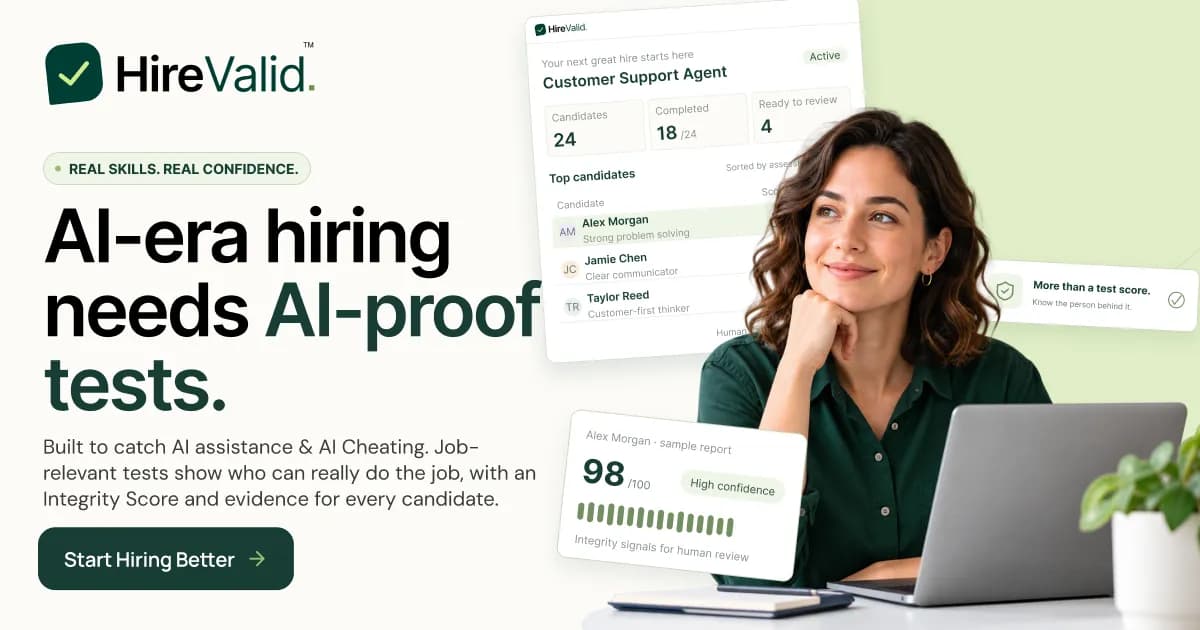
Artificial intelligence has made it easier to write CVs, prepare application answers and complete online assessments. For small businesses, this creates a practical hiring challenge: how can you identify candidates who genuinely have the skills to perform a job?
AI-proof hiring tests help employers assess real job skills while making AI assistance easier to flag and review. HireValid combines cognitive, skills and language tests with an Integrity Score, ranked candidate results and flexible monthly plans, helping small businesses make more informed hiring decisions.

Why is AI changing the hiring process?
AI tools can help candidates prepare polished CVs, write persuasive cover letters and generate answers to common interview questions. These tools can be useful for communication and preparation, but they also make it harder for employers to distinguish a candidate's actual abilities from AI-generated responses.
A well-written application does not necessarily demonstrate that someone can solve a problem, communicate with a customer or complete a technical task. Similarly, an impressive answer during an online assessment may not always reflect the candidate's independent ability.
This challenge is particularly important for small businesses. A founder or office manager may receive dozens of applications for a single position without having a dedicated HR team to evaluate every candidate.
The result can be a lengthy recruitment process, inconsistent screening and a greater risk of making decisions based on incomplete information.
Employers need a practical way to evaluate candidates on relevant skills, understand the reliability of assessment attempts and compare results before deciding whom to interview.
What are AI-proof hiring tests?
AI-proof hiring tests are pre-employment assessments designed to make unauthorised AI assistance more difficult and help employers identify signals that may require further review.
No online test can guarantee that every form of cheating will be prevented or detected. Effective assessment combines appropriate test design, relevant questions, integrity checks and human judgement.
A strong AI-resistant assessment process can include:
Timed questions: Limits that make it more difficult to look up answers during an assessment.
Randomised questions: Different question sets or question orders for candidates.
Practical tasks: Questions that measure skills relevant to the actual role.
Reasoning questions: Tasks that assess how candidates approach a problem.
Integrity signals: Evidence such as unusual answer timing, paste events or unexpected changes in the testing window.
Human review: A process for evaluating flagged activity before drawing conclusions.
The objective is not simply to catch AI use. It is to establish a more dependable picture of a candidate's capabilities.
Employers should also distinguish between authorised and unauthorised AI use. If a role involves working with AI tools, using AI may be a legitimate job skill. Assessment instructions should make it clear whether AI assistance is permitted for a particular test.
Why do traditional hiring methods need to evolve?
Traditional hiring methods still have value, but each has limitations when used alone.
Hiring method | Potential limitation | A more useful approach |
CV screening | AI can help produce polished applications | Verify relevant skills through assessments |
Cover letters | Writing quality may not reflect job performance | Evaluate practical communication skills |
Unstructured interviews | Different candidates may receive different questions | Use consistent, role-related questions |
Take-home assignments | Candidates may receive outside assistance | Combine work samples with timed or follow-up tasks |
Online multiple-choice tests | Answers may be searched or shared | Use question variation, timing and integrity signals |
A CV remains useful for understanding a candidate's experience. Interviews help employers explore motivation, judgement and communication. Skills assessments add another source of evidence.
The strongest approach combines these methods rather than expecting any single tool to make the hiring decision.
For example, a business hiring a customer support agent could review the candidate's experience, assess written English and customer-service judgement, and conduct a structured interview. The combination offers a more rounded view than a CV alone.
How does HireValid help businesses assess candidates?
HireValid is a self-service pre-employment testing platform for small and medium-sized businesses. Its purpose is to help employers identify candidates who can perform the work, review assessment integrity and compare results without committing to an annual contract.
The process is designed to be straightforward.
1. Select tests relevant to the role
Employers can choose tests from the available library or use a ready-made role bundle. Examples include assessments for customer support agents, sales development representatives, office administrators, marketing coordinators and junior developers.
Selecting tests based on the job helps keep the process focused on skills that matter.
2. Invite candidates
Employers invite candidates using a unique link or email. Candidates take their assessments in a browser without needing to create a HireValid account.
Clear instructions should explain the expected time, the tests involved and any integrity checks that may apply.
3. Assess job skills and cognitive ability
HireValid supports cognitive, skills and language assessments. Depending on the available tests and role, employers can evaluate areas such as numerical reasoning, attention to detail, English proficiency, typing and practical skills.
A customer support role, for instance, may require communication, attention to detail and customer-service judgement. A junior data analyst position may require numerical reasoning and spreadsheet skills.
The important principle is to choose assessments that match the work rather than testing candidates on unrelated abilities.
4. Review the Integrity Score
HireValid provides an Integrity Score from 0 to 100, alongside supporting evidence and an integrity band. Signals may include tab switches, paste events, unusual answer timing and other recorded assessment activity.
These signals are intended to help employers decide whether an attempt needs closer review. They should not be treated as definitive proof of cheating.
For example, a candidate leaving the assessment window may have a legitimate explanation. Employers should consider the available evidence and relevant circumstances before drawing conclusions.
5. Compare results and make the decision
HireValid presents ranked results, individual test scores, benchmark percentiles and candidate reports. Employers can use these results to identify candidates for further consideration.
The employer remains responsible for the final decision. An assessment score or integrity signal should be one input in the hiring process, not an automatic reason to reject a candidate.
You can learn more about the platform at HireValid.
What makes an effective AI-resistant assessment?
AI-resistant assessment requires more than an AI detector. It involves designing tests around the skills being measured and collecting relevant evidence about how the assessment was completed.
Test the skill that the job requires
A good assessment starts with the responsibilities of the role. A customer support candidate may need to interpret a customer complaint and select an appropriate response. A junior developer may need to solve a programming problem.
Questions should reflect realistic tasks and the level of ability expected from a new hire.
Combine different assessment formats
A mixture of cognitive questions, practical tasks and short written responses can provide a broader picture of performance than a single question type.
Timed reasoning, randomised question pools, visual tasks and short explanations can also make it harder to outsource every response to an external tool during an assessment.
Use integrity signals carefully
Activity signals can help identify attempts that deserve further review. However, a single signal should not automatically determine whether a candidate acted improperly.
AI-text likelihood, in particular, is an imperfect indicator. It should not be treated as standalone proof that a candidate used AI.
Keep the assessment fair and accessible
Tests should be relevant to the job, understandable and appropriate for the intended candidates. Employers should consider accessibility needs, reasonable accommodations and the possibility that a test could disadvantage certain groups.
The US Equal Employment Opportunity Commission explains that employment tests and other selection procedures can raise discrimination concerns if they unfairly exclude people based on protected characteristics. Employers should review its guidance on employment tests and selection procedures.
These principles are useful when designing recruitment processes in other markets too, although employers must follow the laws that apply in their own jurisdictions.
How can small businesses build a better hiring process?
A small business does not need an extensive HR department to make recruitment more structured. A repeatable process can help employers evaluate candidates consistently while keeping the workload manageable.
A practical hiring workflow includes five steps:
Define the role: List the skills, responsibilities and essential requirements.
Choose relevant assessments: Select tests that measure those requirements.
Set consistent instructions: Explain the assessment format, timing and rules about AI assistance.
Review candidate results: Compare scores, benchmarks and integrity evidence alongside CVs and interviews.
Make a human-led decision: Use all relevant information to determine who should progress.
Businesses should also review whether the assessments remain relevant as job requirements change. The National Institute of Standards and Technology's AI Risk Management Framework emphasises characteristics such as reliability, transparency, accountability and fairness when managing AI-related risks. Although the framework is not a hiring-test certification or a specific standard for HireValid, its principles provide useful context for responsible technology use.
Why do flexible plans matter for occasional hiring?
Many small businesses hire in bursts. They may recruit several employees during a growth period and then go months without opening another position.
A testing platform that requires a full year of payment may be difficult to justify when assessments are only needed occasionally.
HireValid offers monthly plans, with the option to cancel or pause between hiring rounds. Businesses can start free and evaluate the platform before deciding whether a paid plan fits their needs.
This model allows employers to align testing costs more closely with recruitment activity. Exact prices and plan limits should be checked on the live pricing page before making a purchase decision.
For smaller teams, flexibility matters because recruitment tools should support the hiring process rather than create an unnecessary long-term commitment.
How do AI skills and technical certifications fit into the future of hiring?
AI is changing both how employers assess candidates and the skills employees need once they are hired. Businesses increasingly need people who can understand technology, use AI responsibly and apply sound judgement to practical problems.
For professionals who want to build those capabilities, structured learning can complement practical experience. Technology certifications from Global Tech Council offer learning opportunities across areas such as artificial intelligence, machine learning, cybersecurity and software development.
The Blockchain Council offers technology-focused learning, including the Certified Agentic AI Expert™ programme. Professionals interested in technology skills can also explore the programmes available through Blockchain Council, while those looking to strengthen marketing and business capabilities can explore Universal Business Council.
These learning paths serve a different purpose from HireValid. Certifications support learning and professional development, while HireValid helps employers assess candidates against role-related skills. A certification alone does not establish that a candidate can perform every task required for a particular job.
A practical development path could look like this:
Understand AI: Learn the fundamentals of artificial intelligence and how AI tools are used at work.
Develop specialist skills: Explore agentic AI, technical subjects or business applications relevant to a chosen career.
Practise real tasks: Apply the knowledge through projects, exercises and work samples.
Demonstrate capabilities: Use relevant assessments and interviews to show how the skills apply to a role.
Continue learning: Update knowledge as tools, responsibilities and workplace expectations evolve.
For employers, the broader lesson is that hiring and professional development should work together. Assessments help identify current capabilities, while learning helps people develop new ones.
What should employers look for in a hiring assessment platform?
Before choosing a pre-employment testing platform, businesses should consider the following checklist.
Does it assess skills that are relevant to the role?
Can candidates complete the assessments through a straightforward process?
Does it provide useful comparisons and benchmark information?
Are integrity signals explained with supporting evidence?
Can employers review flagged activity before making decisions?
Are candidate instructions and accommodation options clear?
Are the pricing and contract terms suitable for occasional hiring?
Can the assessment results be considered alongside interviews and work experience?
A platform should help employers make better-informed decisions, not promise perfect detection or guaranteed hiring outcomes.
Conclusion: Hire people who can really do the job
AI has made it easier to produce convincing applications and assessment responses. For employers, the challenge is to look beyond polished answers and evaluate the capabilities that matter for the role.
AI-resistant tests, practical assessments, benchmarked results and carefully reviewed integrity signals can strengthen the hiring process. They work best when combined with relevant interviews, clear instructions and human judgement.
HireValid brings these elements together through cognitive, skills and language tests, ranked candidate results, an Integrity Score and flexible monthly plans.
For small businesses that need a practical way to assess candidates without committing to an annual contract, it offers a structured place to begin.
Ready to assess real job skills? Explore HireValid and start free.
Frequently Asked Questions
1. What are AI-proof hiring tests?
AI-proof hiring tests are assessments designed to make unauthorised AI assistance more difficult and help employers flag activity that may require review. No assessment can guarantee that every form of AI use or cheating will be prevented or detected.
2. Can employers detect whether a candidate used ChatGPT during a test?
Employers can use assessment design and activity signals to identify potentially suspicious behaviour. However, no single signal can reliably prove that ChatGPT or another AI tool was used. Results require context and human review.
3. How does HireValid help with AI-assisted cheating?
HireValid combines test-design measures with integrity signals, such as tab switches, paste events and unusual answer timing. It provides an Integrity Score with supporting evidence to help employers review assessment attempts.
4. What is an Integrity Score in recruitment?
An Integrity Score is a score from 0 to 100 that summarises signals about how trustworthy a candidate's assessment attempt appears. HireValid provides supporting evidence so employers can review the result rather than relying on the score alone.
5. Does HireValid automatically reject candidates who are flagged?
No. HireValid provides assessment results and integrity signals for human review. The employer makes the final hiring decision.
6. What types of skills can employers assess with HireValid?
Depending on the available tests, employers can assess cognitive ability, numerical reasoning, attention to detail, English proficiency, typing, practical skills and role-related abilities.
7. Are AI-resistant hiring tests suitable for small businesses?
Yes. Small businesses can use role-relevant assessments to compare candidates more consistently without relying entirely on CV screening. The tests should match the job and be combined with other hiring evidence.
8. Can candidates use AI during a hiring assessment?
That depends on the employer's instructions and the purpose of the assessment. Employers should clearly state whether AI tools are allowed. If AI use is part of the role, the assessment may need to evaluate that ability directly.
9. Does HireValid require an annual contract?
HireValid offers monthly plans without a required annual contract. Employers can review the current pricing and terms on the platform before choosing a plan.
10. How can I get started with HireValid?
Visit hirevalid.com to explore the platform and its available assessments. Select tests relevant to your role, invite candidates and review their results before making hiring decisions.
Related Articles
View All
AI & ML
Built to Catch AI Cheating: Rethinking Pre-Employment Assessments with HireValid
Explore how HireValid is rethinking pre-employment assessments with AI-resistant test design, integrity signals, candidate evidence, and human review to address AI-assisted cheating.
AI & ML
Why AI Needs System One Models
Explore why System One Models could matter for AI, how they address limitations of traditional LLMs, and why fast, structured decision-making is valuable for software automation.

AI & ML
Google Launches Gemini 4 Argon: Features and Capabilities
Google has launched Gemini 4 Argon, its flagship AI model for coding, finance, law, cybersecurity and science. Learn its key features, availability, pricing and safety details.
Trending Articles
AWS Career Roadmap
A step-by-step guide to building a successful career in Amazon Web Services cloud computing.

Top 5 DeFi Platforms
Explore the leading decentralized finance platforms and what makes each one unique in the evolving DeFi landscape.
Claude AI Tools for Productivity
Discover Claude AI tools for productivity to streamline tasks, manage workflows, and improve efficiency.