

Regulatory Challenges of AI-Powered Payments in Blockchain Ecosystems

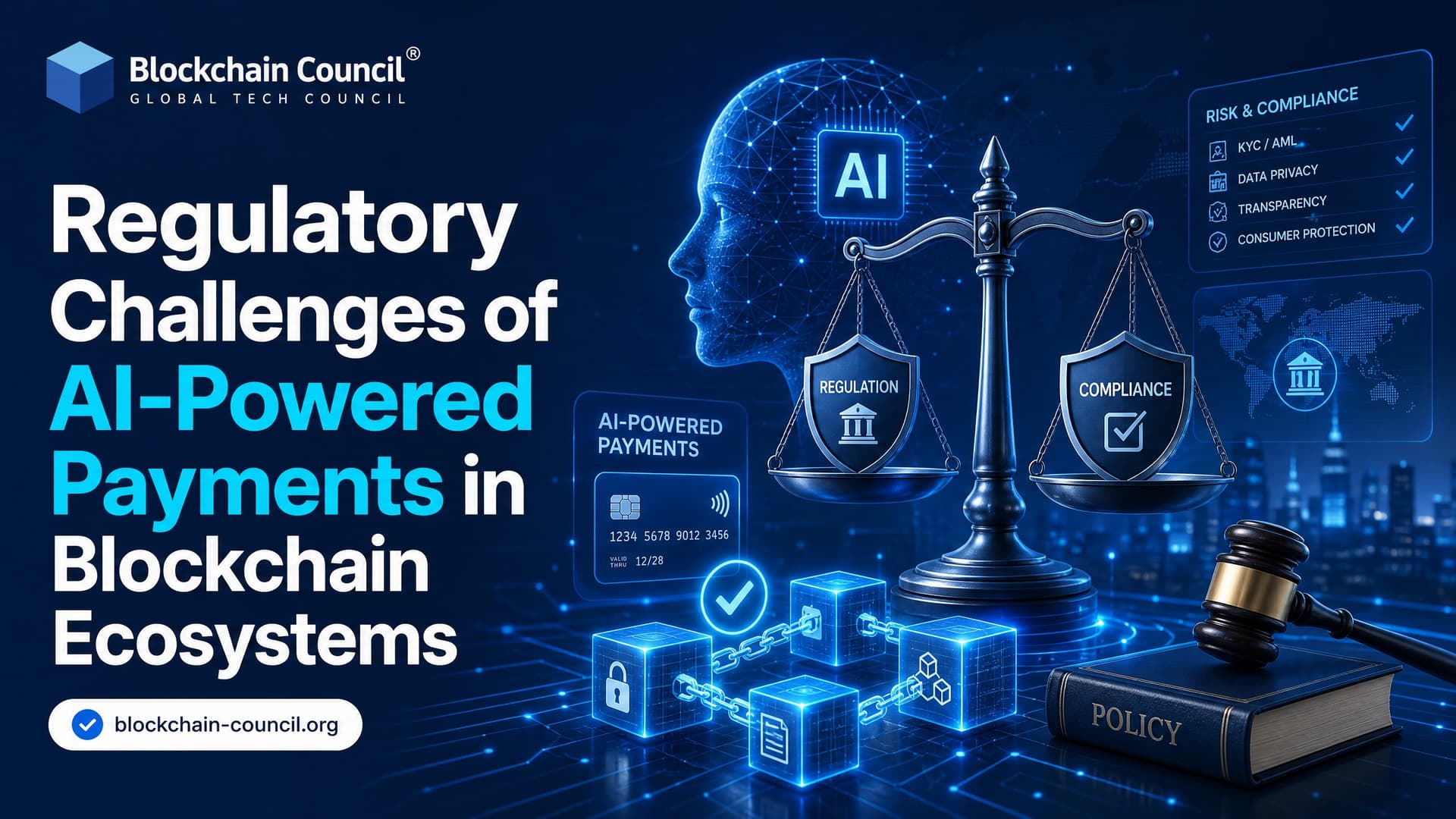
AI-powered payments in blockchain ecosystems are no longer a lab idea. They now sit inside crypto payment gateways, stablecoin settlement flows, DeFi risk engines, fraud monitoring tools, and agent-based trading systems. The regulatory problem is easy to state and hard to solve. Financial law expects accountable institutions, explainable controls, and identifiable customers. Blockchain systems often run across borders with pseudonymous users and autonomous code.
That gap is becoming one of the biggest barriers to mainstream adoption. If you build payment software, manage compliance, audit smart contracts, or advise a Web3 business, you need to know where regulators are pushing hardest. Professionals building this expertise may also explore Certified Blockchain Expert training.

What are AI-powered payments in blockchain ecosystems?
AI-powered payments combine machine learning, analytics, or autonomous agents with blockchain-based value transfer. The payment rail may be a public blockchain, a stablecoin network, a permissioned ledger, or a DeFi protocol. The AI layer may score risk, detect fraud, route transactions, adjust pricing, or trigger a smart contract.
In DeFi, the same pattern is often called DeFAI. AI agents can rebalance liquidity positions, manage collateral, scan lending rates, or execute trades across decentralized exchanges. Some of this is useful. Some of it is overhyped. To be blunt, an AI agent that signs transactions from a hot wallet without tight limits is not innovation. It is an incident report waiting to happen.
Here is a practical example. A payments team may use a model to flag wallet addresses linked to scams, mixers, bridge-hopping, or sanctioned entities before allowing a stablecoin payout. That sounds straightforward until the model blocks a legitimate user, cannot explain the reason, and the transaction has already touched three chains and two front ends.
Why regulation is difficult here
Understanding the assets involved is equally important for payment and compliance teams, making Certified Cryptocurrency Expert a relevant learning option for professionals working with digital currencies.
AI and blockchain each create governance challenges. Together, they create a dual-technology compliance problem. Regulators usually do not write a separate rulebook for AI crypto payments. They apply existing payment laws, anti-money laundering rules, consumer protection standards, sanctions regimes, securities rules, data protection laws, and newer AI governance frameworks.
That means a single product can trigger several compliance questions at once:
Is the business a payment service provider, money transmitter, broker, or virtual asset service provider?
Who performs KYC if the user interacts through a wallet and not a bank account?
Can the model explain why a payment was blocked?
Where is the user data processed, stored, and shared?
Who is liable if an AI agent sends funds to the wrong address?
FATF guidance on virtual assets, FinCEN expectations in the United States, the EU's MiCA framework, GDPR, and the EU AI Act all point in the same direction. Automated financial systems need accountable governance. The hard part is mapping that expectation onto decentralized infrastructure.
AML and KYC: the first regulatory pressure point
AML and KYC remain the most immediate regulatory challenges for AI-powered payments in blockchain ecosystems. Traditional finance starts with customer identity. Many blockchain systems start with an address.
AI helps. Chainalysis and other blockchain analytics providers use machine learning and graph analysis to identify suspicious flows, detect scams, lower false positives, and connect activity across wallets, bridges, and exchanges. Chainlink has also discussed compliance tooling where AI and oracles feed sanctions checks, KYC attestations, or rule-based compliance signals into smart contracts.
But regulators still ask a sharper question: who is responsible?
The protocol developer?
The DAO?
The user interface operator?
The wallet provider?
The AI model vendor?
The validator set?
That answer changes by jurisdiction and by control point. A front end that screens users may be treated very differently from a fully autonomous protocol. Even so, regulators rarely accept the argument that no one is responsible just because the system is decentralized.
The Travel Rule problem
The FATF Travel Rule expects certain originator and beneficiary information to move with qualifying virtual asset transfers. This fits awkwardly with non-custodial wallets, cross-chain transfers, and AI agents that route payments dynamically. If a model chooses a cheaper path through a bridge, an aggregator, and a stablecoin swap, compliance teams must still know what happened and why.
Data protection and privacy risks
AI payment systems feed on data. Transaction histories, device signals, behavioral patterns, IP data, wallet clusters, merchant categories, and identity records can all improve risk scoring. They also create privacy exposure.
Blockchain makes the issue harder because on-chain data is persistent. If you store personal data, KYC details, or detailed risk scores on-chain, you may create a data protection problem that cannot be fixed with a simple delete request. Even hashed identifiers can become linkable when combined with other datasets.
In practice, the safer pattern is boring but effective:
Keep personal data off-chain wherever possible.
Store only minimal attestations or proofs on-chain.
Separate identity data from transaction logic.
Use short retention periods for model training data.
Document lawful basis, consent, and cross-border transfer mechanisms.
Privacy-preserving compliance is gaining attention for this reason. Selective disclosure, zero-knowledge proofs, and off-chain AI processing can let a smart contract verify that a user passed a required check without publishing the user's identity or full risk profile.
Algorithmic transparency and explainability
Regulators do not want black-box systems making high-impact financial decisions with no audit trail. If an AI model blocks a payment, labels a wallet high-risk, changes limits, or triggers enhanced due diligence, the business must usually explain the decision.
This is where many teams get caught. A fraud model may work well in testing, but if the only explanation is that a neural network assigned a score of 0.91, that may not satisfy a supervisor, an auditor, or a customer complaint process.
Professionals who want to broaden their technical understanding of emerging tools can also review available Tech Certification programs.
Model governance should cover:
Training data sources and data quality checks
Feature selection and prohibited attributes
False positive and false negative rates
Threshold setting and change logs
Bias testing across user groups and regions
Human review procedures for disputed decisions
A small configuration change can matter. I have seen review queues jump sharply when a risk threshold moved from 0.82 to 0.87, because the model had many borderline wallet clusters around bridge activity. That is not a theoretical compliance issue. It affects support tickets, liquidity, user trust, and regulatory reporting.
Liability for AI agents and smart contracts
Autonomous agents add another layer of legal uncertainty. If an AI agent initiates a payment to a sanctioned wallet, who carries liability? If it liquidates a user's collateral because it misread oracle data, who pays?
Developers often say smart contracts are neutral tools. Regulators usually care more about control, benefit, and user harm. If a company markets the agent, hosts the interface, collects fees, updates the model, and can pause parts of the system, it should expect scrutiny.
There is also a technical lesson here. Access controls are not paperwork. They are part of compliance architecture. A common deployment failure in Solidity 0.8.x systems using OpenZeppelin AccessControl is the revert: AccessControl: account ... is missing role .... Annoying during testing, yes. But role design decides who can pause payment execution, update sanctions lists, rotate model keys, or disable an agent after a bad transaction. That is governance in code.
Cross-border supervision and fragmented rules
AI-powered blockchain payments are global by design. Laws are not. A stablecoin payment from a European customer to an Asian merchant through a US-hosted interface may involve multiple AML, sanctions, privacy, foreign exchange, and licensing regimes.
Data localization adds friction. AI models often improve when trained on broad transaction data, but privacy laws may restrict where personal data can move. Sanctions rules also differ, and screening obligations can change quickly. A payment system that cannot update controls in near real time is exposed.
This is one reason enterprises tend to prefer permissioned designs or controlled access layers for regulated payment use cases. Public chains have strong transparency and settlement benefits, but fully permissionless access is a poor fit for some regulated payment corridors.
Regulatory touchpoints by use case
AI-enhanced AML monitoring
Crypto exchanges, payment firms, and financial institutions use AI to detect fraud, scams, and laundering patterns across blockchain data. The regulatory test is whether the model is validated, documented, monitored, and tied to proper suspicious activity reporting.
AI-driven cross-border payments
AI can optimize routing, screen counterparties, and reduce manual review. The compliance burden includes payment licensing, sanctions screening, local AML rules, FX controls, and data protection obligations across the full payment corridor.
DeFAI protocols
AI agents that manage yield, liquidity, or collateral raise investor protection concerns. Retail users may not understand strategy risk, oracle risk, liquidation mechanics, or who handles losses after a model failure.
On-chain compliance attestations
Attestations can help smart contracts consume compliance signals without exposing full identity data. Regulators will still ask how the attestation was generated, who audited the model, and how errors are corrected.
Assessing blockchain talent and practical skills
As blockchain technology continues to transform industries, organisations need professionals who understand its practical applications and technical foundations. Hiring the right talent requires more than reviewing qualifications; employers must also evaluate relevant knowledge and problem-solving skills. Platforms like HireValid can help organisations explore structured candidate assessments for more informed hiring decisions.
What professionals and enterprises should do now
If you are building or evaluating AI-powered payments in blockchain ecosystems, treat compliance as part of the product architecture, not a legal review at the end. Start with these steps:
Map regulated activities. Identify payment, custody, exchange, lending, securities, AML, and data protection triggers in every market you serve.
Define accountable parties. Assign responsibility for model updates, sanctions screening, incident response, user complaints, and smart contract controls.
Minimize on-chain personal data. Use off-chain identity systems, attestations, and privacy-preserving proofs where suitable.
Document model decisions. Keep logs, threshold histories, validation reports, and human review records.
Set agent limits. Use spending caps, allowlists, circuit breakers, pausable contracts, and multi-signature controls for high-risk actions.
Plan for audits. Smart contract audits are not enough. You also need model audits, data protection reviews, and AML control testing.
For structured learning, Blockchain Council readers can explore certifications such as Certified Blockchain Expert™, Certified Blockchain Developer™, Certified Smart Contract Auditor™, Certified DeFi Expert™, and Certified Artificial Intelligence (AI) Expert™. Developers should pair blockchain engineering skills with model governance and AML knowledge. Compliance professionals should learn enough Solidity, wallet architecture, and DeFi mechanics to ask better questions.
The next move
The winning AI payment systems will not be the ones with the flashiest agent demo. They will be the ones that can prove who is responsible, why a model acted, what data was used, how users are protected, and how controls work across borders.
If you work in this space, build a small compliance-by-design prototype next: one smart contract, one off-chain risk model, one privacy-preserving attestation, one audit log, and one manual override process. Then test it on a local chain before you touch real funds. That exercise will teach you more about AI-powered payments in blockchain ecosystems than any slide deck.
For teams communicating blockchain products and services to wider audiences, a Marketing Certification may also support the skills needed to explain complex technologies clearly.
FAQs
1. What Are AI-Powered Payments in Blockchain Ecosystems?
AI-powered payments in blockchain ecosystems use artificial intelligence to automate or optimize transactions recorded on distributed ledgers. AI can support fraud detection, transaction monitoring, payment routing, and risk assessment, while blockchain provides a shared record of transactions. These systems must still comply with applicable financial regulations.
2. Why Are AI-Powered Blockchain Payments Difficult to Regulate?
These systems combine several technologies that may fall under different legal frameworks, including AI, crypto-assets, payment services, and data protection. Their cross-border nature can make it difficult to determine which regulator has jurisdiction. Decentralized governance and automated decisions can also complicate accountability and enforcement.
3. Which Regulations Apply to AI-Powered Blockchain Payments?
Applicable rules depend on the countries involved, the assets being transferred, and the services provided. Relevant requirements may include anti-money laundering laws, payment services regulations, crypto-asset licensing rules, consumer protection, data privacy, cybersecurity, and AI governance requirements. Businesses must assess each jurisdiction rather than assume one global framework applies.
4. How Do Anti-Money Laundering Rules Affect AI-Powered Payments?
Anti-money laundering and counter-terrorist financing rules require covered businesses to identify and manage financial crime risks. AI can help identify unusual transaction patterns and flag potentially suspicious activity on blockchain networks. However, automated alerts do not replace required investigations, suspicious transaction reporting, or other legal obligations.
5. What Is Know Your Customer (KYC) Compliance in Blockchain Payments?
Know Your Customer (KYC) refers to procedures used by regulated businesses to verify customer identities and understand relevant financial risks. AI can help assess identity documents, detect inconsistencies, and prioritize reviews. Blockchain addresses alone generally do not establish a person's legal identity, so businesses may need additional verification procedures.
6. What Is the FATF Travel Rule, and Why Does It Matter?
The Financial Action Task Force (FATF) Travel Rule requires covered virtual asset service providers to obtain, hold, and transmit specified originator and beneficiary information for qualifying transfers. Implementation varies by jurisdiction and transaction type. AI may help validate information and detect compliance gaps, but it cannot remove the underlying legal obligation.
7. How Do Cross-Border Payments Create Regulatory Challenges?
Cross-border blockchain payments may involve customers, intermediaries, wallets, and service providers located in different countries. Each jurisdiction may have different licensing, reporting, sanctions, tax, and consumer protection requirements. Businesses need a clear method for determining applicable laws and coordinating compliance across borders.
8. How Does AI Governance Affect Blockchain Payment Systems?
AI governance involves establishing clear responsibilities, risk controls, documentation, testing, and oversight for AI systems. Payment providers should assess how AI models make decisions, monitor performance, and respond to failures or unexpected outcomes. The Financial Stability Board's October 2026 guidance emphasizes organization-wide governance and risk management throughout the AI lifecycle.
9. What Are the Regulatory Risks of AI-Based Fraud Detection?
AI-based fraud detection can produce false positives, miss sophisticated fraud, or treat legitimate customers unfairly. These errors may cause unnecessary payment blocks or allow suspicious transactions to proceed. Organizations should test models, monitor accuracy, document decisions, and provide appropriate human review and dispute procedures.
10. How Do Smart Contracts Complicate Regulatory Compliance?
Smart contracts automatically execute programmed instructions when specified conditions are met. Their code may not account for every legal requirement, unexpected event, or change in regulatory obligations. Businesses should test smart contracts, assess their legal effects, establish appropriate controls, and plan for incidents that automated execution cannot resolve.
11. Who Is Responsible When an AI-Powered Blockchain Payment Fails?
Responsibility depends on the applicable law, contractual arrangements, system design, and roles of the participants. Potentially responsible parties may include payment providers, AI developers, wallet operators, crypto-asset service providers, or other intermediaries. Decentralization does not automatically eliminate legal responsibility, so roles and escalation procedures should be documented clearly.
12. How Do Data Privacy Laws Affect AI-Powered Blockchain Payments?
AI payment systems may process identity records, transaction histories, behavioral data, and other personal information. Privacy laws can impose requirements for lawful processing, data minimization, security, access rights, and retention. Because blockchain records can be difficult to alter or erase, organizations should carefully assess what personal data is stored on-chain and what should remain off-chain.
13. What Are the Regulatory Challenges of Stablecoin Payments?
Stablecoin payments can raise questions about issuer authorization, reserve backing, redemption rights, custody, consumer disclosures, and financial crime controls. Requirements vary according to the asset and jurisdiction. The Bank for International Settlements has highlighted the importance of robust prudential, conduct, and anti-money laundering controls as stablecoin use expands.
14. How Do Sanctions Rules Apply to Blockchain Transactions?
Sanctions rules may prohibit transactions involving designated people, entities, jurisdictions, or prohibited activities. AI and blockchain analytics can help identify suspicious wallet activity and trace transaction flows, but attribution may be uncertain. Businesses must follow the applicable sanctions requirements and have procedures for escalation, blocking, reporting, and handling potential false matches.
15. What Cybersecurity Risks Do AI-Powered Payment Systems Face?
These systems may face phishing, compromised wallet keys, smart contract exploits, model manipulation, malicious data inputs, and attacks against third-party infrastructure. AI can strengthen monitoring, but it can also introduce new vulnerabilities through automated decision-making and external model dependencies. Security testing, key management, access controls, incident response, and independent audits are important safeguards.
16. Why Is Regulatory Licensing Important for Blockchain Payment Providers?
Licensing or registration may be required when a business performs regulated payment services, custody, crypto-asset exchange, transfers, or other covered activities. Requirements depend on the service, asset, business structure, and jurisdiction. Operating without required authorization can result in enforcement actions, financial penalties, or restrictions on business activities.
17. How Can Regulators Audit AI Decisions on Blockchain Networks?
Auditing requires evidence of how an AI system was designed, trained, tested, deployed, and used in specific decisions. Organizations can maintain model documentation, transaction logs, decision records, version histories, and records of human overrides. Public blockchain data can support transaction tracing, but it does not necessarily explain why an AI model made a particular decision.
18. What Is the Difference Between Blockchain Transparency and Regulatory Compliance?
Blockchain transparency refers to the visibility and traceability of transactions on a particular network. Regulatory compliance involves meeting legal requirements, including identity verification, reporting, consumer protection, licensing, and data privacy. A publicly visible transaction is not automatically lawful, and a transparent ledger does not by itself establish who controls a wallet.
19. How Can Businesses Reduce Regulatory Risks in AI-Powered Blockchain Payments?
Businesses should map applicable laws, determine licensing obligations, assess financial crime risks, and establish clear AI governance. They should test models and smart contracts, secure sensitive information, maintain audit records, and provide human oversight for high-impact decisions. Legal and compliance teams should review changes in the services, assets, and jurisdictions involved.
20. What Is the Future of Regulation for AI-Powered Blockchain Payments?
Regulation is likely to evolve as AI agents, stablecoins, tokenized assets, and decentralized finance become more widely used. Regulators are increasingly focusing on governance, accountability, operational resilience, financial crime prevention, and cross-border cooperation. Businesses that build compliance into their systems from the beginning will be better positioned to adapt to new requirements.
Related Articles
View All
Web3
AI-Powered Crypto Payments: Benefits, Use Cases, and Challenges
AI-powered crypto payments combine blockchain settlement, fraud analytics, and AI agents to improve speed, risk controls, automation, and payment intelligence.

Web3
AI and Blockchain in Digital Payments: The Future of Web3 Transactions
AI and blockchain in digital payments are reshaping Web3 transactions with stablecoins, CBDCs, fraud analytics, and programmable settlement.

Web3
Regulatory Challenges in Web3 Identity: KYC, Privacy, and Compliance
A practical guide to Web3 identity regulation, covering KYC, AML, GDPR privacy risks, zero knowledge proofs, SSI, and hybrid compliance models.
Trending Articles
Top 5 DeFi Platforms
Explore the leading decentralized finance platforms and what makes each one unique in the evolving DeFi landscape.
How Blockchain Secures AI Data
Understand how blockchain technology is being applied to protect the integrity and security of AI training data.
What is AWS? A Beginner's Guide to Cloud Computing
Everything you need to know about Amazon Web Services, cloud computing fundamentals, and career opportunities.