

Tesla Unveils Its New Flying Roadster: What We Know
 Suyash Raizada
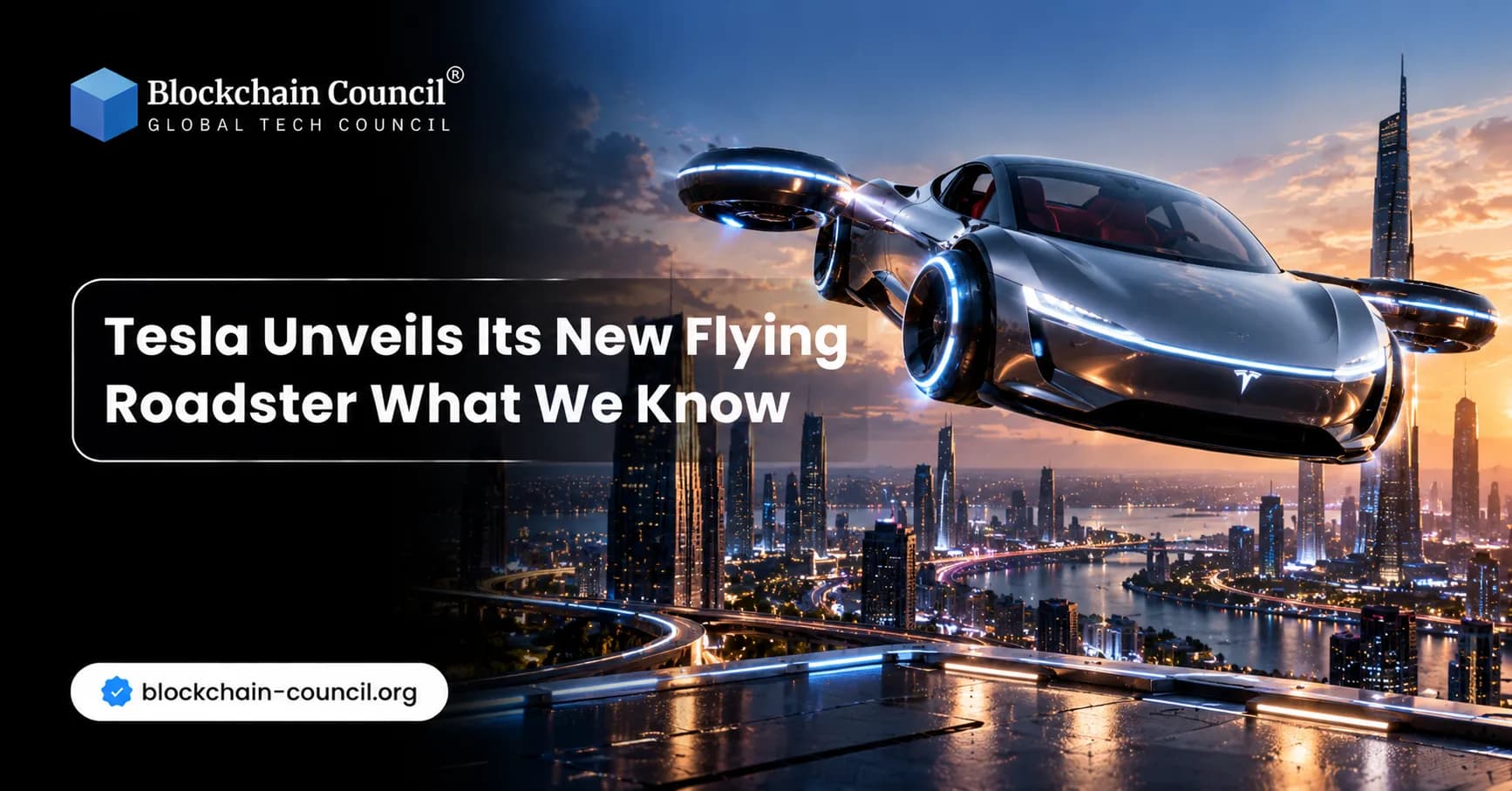
On October 15, 2026, Elon Musk showed the world a new Tesla Roadster that can launch itself into the air using rocket-style thrusters. Within hours, headlines called it the first real Tesla flying car. The truth is more nuanced, and also more interesting. The car does leave the ground, but only for short, controlled hops, and the airborne features are not approved for public roads. This guide explains what Tesla actually showed, how the technology works, what it may cost and what is still unproven. If you are curious about the science behind projects like this, a Deep Tech Certification can help you understand how advanced technologies connect across industries.
What Did Tesla Unveil?
Tesla unveiled a redesigned, next-generation Roadster at SpaceX’s rocket test site in McGregor, Texas. The Roadster is a two-seat electric sports car, first promised back in 2017. The new version adds technology developed with SpaceX, including high-pressure cold-gas thrusters and a fan-based suction system.

In the demonstration, a prototype drove up a huge curved ramp that rolled over like half of a roller coaster loop. The car clung to the surface while upside down, shot off the end, flipped through the air and landed on its wheels. In another stunt, it lifted off and flew over a row of Tesla vehicles, including a Cybercab, a Cybertruck, a Semi, a Model Y and a Model 3. According to Fox News, no one was inside the car during these stunts, and Tesla used automated controls for safety.
Quick facts:
Date: October 15, 2026
Location: SpaceX test facility, McGregor, Texas
Technology: cold-gas thrusters and electric suction fans
Production target: 2028, according to Musk
Status: prototype, with no final price announced
Is the Tesla Flying Car Really Flying?
It depends on what you mean by flying. The Roadster does become airborne, but it does not fly like a plane or a helicopter. CNN reported that an aviation expert described the demonstration as closer to hopping. Tech Insider also noted that the demo showed only a brief aerial hop, not sustained or long-distance flight.
Musk himself was candid. According to CBS News, he said success was not guaranteed but that it would probably work. Tesla’s website also notes that the flying model is not approved for public road use. For readers who work in technology, this gap between a polished demo and a market-ready product is a familiar story. A broad Tech Certification can help you learn to separate real engineering progress from marketing excitement across many fields.
A simple way to judge any flying car claim is to ask four questions:
Can it fly for a meaningful distance, or only hop?
Has an aviation or road authority approved it?
Can ordinary customers buy and use it today?
Has independent testing confirmed the numbers?
For the Tesla Roadster, the honest answers today are no, no, no and not yet.
How the Tesla Roadster Technology Works
Cold-Gas Thrusters
Unlike a normal rocket, cold-gas thrusters do not burn fuel. They release highly compressed gas through nozzles to push the vehicle in a chosen direction. Think of letting go of an inflated balloon, but with far more pressure and much better control. Tesla and SpaceX developed the system together.
Suction Fans for Grip
The car also has four powerful electric fans near the rear. They pull air from beneath the vehicle to create suction, which pushes the tires harder onto the road. This is what allowed the prototype to stay stuck to the upside-down ramp. A ground-sealing system helps keep the suction in place.
High-Pressure Gas Storage
Tesla engineering executive Lars Moravy said the standard thruster setup uses a 200 liter high-pressure tank behind the seats. The most advanced version adds another 400 liters, for about 600 liters total. That extra equipment takes over the passenger seat area. Moravy also said refilling the full 600 liter system currently takes about six to seven hours, though Tesla hopes to cut that time.
Other Design Details
The Roadster uses a steer-by-wire yoke, which sends steering inputs electronically instead of through a mechanical link. Tesla also uses lightweight materials such as magnesium and carbon fiber. A Track Mode lowers the suspension for sharper handling.
Three Versions of the New Roadster
Tesla plans three configurations, based on reports from NBC News and Fox News:
Version | Main features | Claimed 0 to 60 mph | Availability |
|---|---|---|---|
Performance | Road-ready, suction system, no thrusters | Under 1.6 seconds | Standard model |
Thrust | Adds four rear thrusters, race-ready | Under 0.9 seconds | Limited release |
Rocket | About 10 thrusters, one seat, full flight system | Under 0.59 seconds | Invitation only, not road approved |
The Rocket version is the closest thing to a flying car, and it is the one with the biggest limits. It seats only one person and is not approved for public roads.
Performance Claims and Reality Checks
Tesla claimed a zero to 60 mph time of about 0.81 seconds during the demonstration. It also says higher-end versions can exceed 230 mph and that the car may offer more than 300 miles of range. Musk even talked about eventually reaching half the speed of sound.
Keep three points in mind:
These figures come from Tesla’s own demonstration and projections.
Independent testing of a production car has not happened yet.
The projected range is much lower than the roughly 620 miles promised when the second-generation Roadster was first introduced in 2017, and the original concept had four seats.
When a company controls the test, the conditions, and the measuring tools, treat the numbers as goals rather than proven facts.
Price, Reservations and Release Date
Tesla did not announce a final price at the unveiling. When it first revealed the car in 2017, it talked about a starting price near $200,000, and it originally expected deliveries around 2020. Musk now says production should begin in 2028.
Reports about reservations differ slightly, so read Tesla’s current terms before paying anything:
NBC News and CBS News report that buyers can reserve a non-flying model online with a $5,000 deposit.
Fox News reports that the Performance version needs a $5,000 payment followed by $45,000 within 10 days, for $50,000 total, and that the Thrust version needs $250,000 total.
Tesla has not disclosed pricing for the invitation-only Rocket version.
Fox News says Tesla’s agreement allows refunds until a customer completes a configuration, but that the money is not held in escrow or earning interest. The agreement also states that Tesla cannot guarantee delivery dates, or even delivery at all.
What the Roadster Reveal Teaches Marketers
Whatever happens to the car, the unveiling was a masterclass in attention. Tesla paired a spectacular live stunt with a simple message, turned an eight-year delay into suspense and used a shared event with SpaceX to build a bigger story. It also created clear product tiers, from road-ready to invitation-only, to attract different buyers.
Marketers can learn several lessons:
Show, do not tell: A live demonstration beats a slide deck.
Use a bold, simple line: The phrase flying cars are real spread instantly.
Build tiers: Different versions allow different audiences to participate.
Stay honest: Overpromising can hurt trust if delivery slips again.
If you want to turn lessons like these into a career skill, a Marketing Certification can help you learn how strategy, storytelling and measurement work together.
Regulation and Safety Challenges
CBS News points out that technical and regulatory challenges have kept the flying car sector from taking off for years. Several hurdles stand in the way of a true Tesla flying car:
Road approval: Tesla says the flying features are not approved for public roads.
Aviation rules: Aircraft-like operation typically requires certification from aviation authorities. Tech Insider notes the FAA has not signed off on this vehicle.
Safety: Musk acknowledged that safety was not the only priority for the most extreme features, and he was unsure where they would be legal to use.
Practical limits: Gas storage takes space, and refilling takes hours.
Noise and public risk: Thrusters near people, buildings and traffic raise obvious concerns.
None of these problems is necessarily impossible to solve, but each one takes time.
The Talent Behind Breakthrough Projects
A project that blends electric vehicles, rocket engineering, controls, software and manufacturing needs people with an unusual mix of skills. Companies hiring for such roles face a challenge: how do you fairly judge who can do the work?
AI tools can support parts of the hiring process, but employers still need transparent, job-relevant methods to evaluate applicants. Combining appropriate technology with human judgement can help maintain a thoughtful recruitment process. HireValid can be explored by organisations reviewing their candidate assessment approach.
For job seekers, the lesson is similar. Build real projects, learn the fundamentals of your field and be ready to explain your work clearly.
Pros, Cons and What to Watch Next
What looks promising
A bold collaboration between two major engineering companies
Impressive live demonstrations of thrust and suction grip
A real attempt to build an exciting, driver-focused electric car
What remains uncertain
Production timing, since the 2028 date is only a target
Final pricing and the value of reservation payments
Independent verification of performance claims
Legal approval for any airborne use
Real-world practicality of refilling and storing high-pressure gas
Over the coming months, watch for an official price, independent tests, regulatory statements and updated delivery timelines.
Final Thoughts
The Tesla Roadster unveiling was a spectacular piece of engineering theater. A sports car that flips off an upside-down ramp and lands on its wheels is hard to ignore, and the SpaceX technology behind it is genuinely interesting. But the label flying car should be used carefully. Today, this is a prototype that performs controlled hops, with unconfirmed numbers, no final price and no approval for road or air use of its most extreme features. If you are thinking of making a reservation, read the terms closely and remember that delivery is not guaranteed. For everyone else, this is a fascinating glimpse of where electric performance cars and rocket-inspired technology might meet.
FAQs
1. What Is Tesla's New Flying Roadster?
Tesla's new Roadster is a next-generation electric sports car unveiled by Elon Musk on October 15, 2026, at a SpaceX facility in Texas. The demonstration featured a vehicle that used rocket-inspired thrusters to perform brief aerial maneuvers. Tesla presents it as an ambitious combination of electric-car engineering and aerospace technology.
2. Can Tesla's New Roadster Really Fly?
During the unveiling, the Roadster prototype briefly became airborne, performed an aerial maneuver, and landed back on its wheels. The demonstration used cold-gas thrusters and took place in a controlled environment without a driver inside the vehicle. This shows a demonstrated aerial maneuver, but it does not establish that the Roadster can fly over long distances or operate as a conventional aircraft.
3. When Did Tesla Unveil the Flying Roadster?
Tesla unveiled the next-generation Roadster on October 15, 2026. The event took place at a SpaceX facility in Texas and featured a demonstration of the vehicle's unusual capabilities. The unveiling attracted attention because the Roadster had been anticipated for years.
4. What Are the Main Features of Tesla's New Roadster?
The announced features include an electric sports-car platform, active aerodynamics, a multi-mode suction system, and cold-gas thrusters on selected configurations. Tesla also describes advanced steering and lightweight materials intended to improve performance. The most dramatic flight-related features are associated with the special Rocket configuration rather than every version of the car.
5. How Does the Tesla Flying Roadster Work?
The Roadster combines conventional electric-vehicle technology with aerospace-inspired systems. Cold-gas thrusters use pressurized gas to produce thrust, while the multi-mode fan and ground-sealing system generates suction beneath the vehicle. These technologies are intended to support extreme performance and, in the special Rocket configuration, limited aerial maneuvers.
6. What Are Cold-Gas Thrusters in the Tesla Roadster?
Cold-gas thrusters generate thrust by releasing pressurized gas through nozzles. Unlike rocket engines that burn propellant, these systems can produce thrust without combustion. Tesla describes the thrusters as a way to support rapid adjustments and aerial movement, although practical flight capability depends on the complete system and its operating limits.
7. Can the Tesla Roadster Drive Upside Down?
Tesla demonstrated the prototype moving along an inverted section of a curved ramp. The vehicle used a suction system designed to generate enough downforce to hold it against the surface. This is an unusual demonstration of vehicle aerodynamics, but it does not mean the Roadster can drive upside down on ordinary roads.
8. How Fast Is Tesla's New Roadster?
Elon Musk has claimed that the specially equipped Roadster can accelerate from zero to 60 miles per hour in less than one second. This is an exceptionally ambitious performance claim and should be distinguished from independently verified production-vehicle testing. Real-world acceleration will depend on the final configuration and test conditions.
9. Is the Flying Roadster Fully Electric?
The Roadster is presented as an electric sports car, with the flight-related systems adding aerospace-inspired propulsion technology. Tesla's announced configuration uses cold-gas thrusters for aerial maneuvers rather than relying solely on the car's electric drivetrain. The detailed production specifications and operating limits will determine how these systems work together.
10. What Is the Difference Between the Roadster, Thrust, and Rocket Versions?
Tesla describes different configurations with different capabilities. The standard Roadster focuses on road performance, while the Thrust configuration adds performance-oriented features and cold-gas thrusters. The Rocket configuration is the most specialized version, designed for limited flight-related capability and described by Tesla as an invite-only offering.
11. When Will the Tesla Flying Roadster Be Available?
Tesla has indicated that production is targeted for 2028. However, a production target is not a guaranteed delivery date, and the flying configuration faces additional technical and regulatory questions. Buyers should wait for confirmed production schedules and final specifications before assuming the vehicle will be available on a particular date.
12. How Much Will the Tesla Flying Roadster Cost?
Tesla has not confirmed a final retail price for the special flying Rocket configuration. The company has offered reservations for a non-flying Roadster configuration, with a reported $5,000 deposit. Reservation terms, final prices, configuration availability, and delivery timelines should be verified directly with Tesla before making a financial commitment.
13. Can Anyone Buy the Flying Tesla Roadster?
Not at present. Tesla describes the Rocket configuration as invite-only, and its official website states that this version is not approved for public road use. A reservation for a conventional Roadster configuration does not necessarily provide access to the flight-capable version.
14. Is Tesla's Flying Roadster Street Legal?
The Rocket configuration is explicitly listed by Tesla as not approved for public road use. The legal status of a vehicle capable of aerial maneuvers also raises questions about road-vehicle and aviation regulation. Buyers should not assume that the demonstrated flight capabilities are approved for use on public roads or in public airspace.
15. Is the Tesla Flying Roadster Safe?
The demonstration was conducted under controlled conditions without a driver inside the vehicle. A successful demonstration does not establish that the technology is safe for everyday driving or passenger flight. Safety would require extensive testing of propulsion systems, vehicle stability, emergency procedures, and the risks to passengers and bystanders.
16. How Is the Flying Roadster Different From an Ordinary Electric Car?
An ordinary electric car relies on its electric drivetrain, tires, brakes, and road-based aerodynamics. The Roadster adds systems intended to generate substantial downforce and, in the Rocket configuration, produce thrust for aerial maneuvers. These additional systems make the vehicle more complex and introduce engineering and regulatory challenges beyond those of a conventional EV.
17. Is Tesla's Flying Roadster the World's First Flying Car?
Tesla and Elon Musk have promoted the Roadster as a flying car, but the description depends on how the term is defined. Other companies have developed experimental flying vehicles and roadable aircraft. The Roadster's demonstration is notable, but it does not establish that it is the first vehicle capable of flight or a commercially available flying car.
18. How Does Tesla's Roadster Compare With Other Flying Cars?
Many flying-car projects use propellers, electric vertical takeoff and landing systems, or designs that combine road travel with aircraft functionality. Tesla's approach uses cold-gas thrusters and a suction system for a highly specialized sports-car concept. A meaningful comparison would require verified information about flight duration, range, passenger capacity, safety certification, and practical usability.
19. What Are the Biggest Challenges Facing Tesla's Flying Roadster?
Major challenges include validating the propulsion system, managing vehicle stability, protecting occupants, and establishing clear regulatory requirements. The vehicle must also demonstrate that its unusual capabilities can be produced and maintained reliably. Until these issues are addressed, the prototype demonstration should not be treated as proof of a fully practical flying car.
20. What Does Tesla's Flying Roadster Mean for the Future of Transportation?
The Roadster demonstrates how electric-vehicle development can intersect with aerospace-inspired engineering. If its technologies become practical and pass the necessary safety and regulatory requirements, they could influence future high-performance vehicle design. For now, the Roadster is best understood as an ambitious prototype and product concept rather than evidence that everyday flying cars are ready for widespread use.
Related Articles
View All
News
Institutional Tokenized Asset Adoption Hits New Milestones in 2026
Institutional tokenized asset adoption is moving from pilots to production, led by tokenized treasuries, stablecoins, private credit, and real estate.

News
Japan Crypto Reclassification as Financial Assets: What Investors and Exchanges Need to Know
Japan crypto reclassification moves digital assets under FIEA, with investor protections, planned 20 percent tax, ETF potential, and tougher exchange rules.

News
CleanSpark's $6.6 Billion AI Deal Signals a New Era for Crypto Mining Infrastructure
CleanSpark's $6.6B AI data center lease turns a Bitcoin mining campus into long-term digital infrastructure and may reshape miner economics for years ahead.
Trending Articles
AWS Career Roadmap
A step-by-step guide to building a successful career in Amazon Web Services cloud computing.

Top 5 DeFi Platforms
Explore the leading decentralized finance platforms and what makes each one unique in the evolving DeFi landscape.
How Blockchain Secures AI Data
Understand how blockchain technology is being applied to protect the integrity and security of AI training data.