

How AI Can Optimize Gas Fees and Transaction Costs in Web3 Payments
 Suyash Raizada
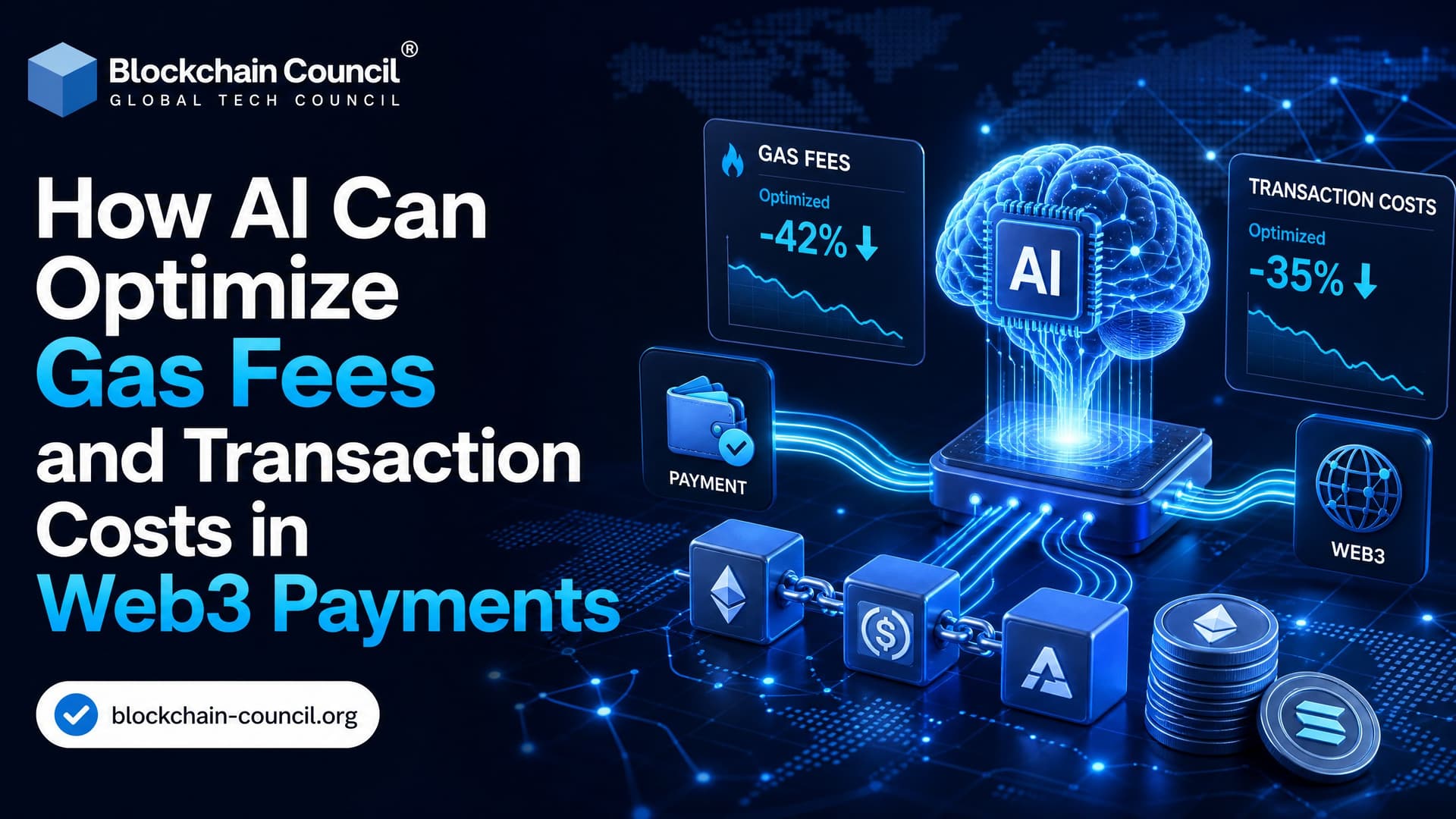
AI can optimize gas fees in Web3 payments by predicting network congestion, choosing cheaper execution routes, tuning wallet fee parameters, and cutting unnecessary smart contract computation. If you run a payment gateway, treasury wallet, DeFi checkout flow, or token settlement system, this is not a future-only idea. The building blocks already exist: fee estimation APIs, EIP-1559 transaction settings, layer 2 networks, batching, paymasters, and multichain routing.
The hard part is not sending a transaction. The hard part is sending it at the right time, on the right network, with the right fee settings, without creating failed transactions or a bad user experience. AI helps because gas markets are noisy. Rules help too, but rules break during NFT mints, airdrops, liquidations, bridge congestion, and sudden token volatility. Professionals exploring this intersection can build relevant foundations through Certified Artificial Intelligence (AI) Expert learning.

Why Gas Fees Hurt Web3 Payments
Gas fees are a direct cost of using public blockchains. On Ethereum, EIP-1559 introduced a base fee that changes block by block and a priority fee paid to validators. Wallets usually expose this through parameters such as maxFeePerGas and maxPriorityFeePerGas. Set them too low and the transaction waits. Set them too high and the user overpays.
For a one-off transfer, this is annoying. For a business handling thousands of payments, refunds, subscription renewals, or settlement transactions, it becomes a margin problem.
Transaction cost is broader than gas, too. Reducing fraud, improving routing, automating compliance checks, and speeding reconciliation all cut back-office cost, not just on-chain fees. AI and Web3 together can lower the marginal cost of serving users in financial applications, which matters most for payment products aimed at high-volume, low-value transactions.
How AI Optimizes Gas Fees in Web3 Payments
Understanding how blockchain networks, wallets, and payment flows work together is also valuable, and Certified Web3 Expert is a relevant learning path for building that broader knowledge.
Predicting Gas Prices Before You Send
A basic wallet looks at recent blocks and suggests a fee. An AI model can go further. It can learn from historical gas patterns, mempool activity, time of day, token price volatility, previous failed transactions, and contract-specific usage.
For example, a payment processor may split transactions into three groups:
Urgent: checkout payments, withdrawals, liquidation protection, and time-sensitive settlement.
Flexible: internal treasury movements, non-urgent payouts, and scheduled vendor payments.
Batchable: rewards, payroll-style crypto payouts, loyalty tokens, and recurring micro-transactions.
AI can recommend a different policy for each class. Urgent payments may accept a higher priority fee. Flexible payments can wait for a cheaper window. Batchable payments can be grouped and executed when gas drops.
A practical note: on Ethereum and EVM-compatible chains, beginner systems often fail because they retry with the same nonce and too small a fee bump. Nodes then return errors such as replacement transaction underpriced or replacement fee too low. A good AI-assisted fee engine should learn from these failures and raise replacement fees according to the chain's actual mempool behavior, not just a fixed percentage.
Dynamic Routing Across Chains and Rollups
Web3 payments do not need to live on one chain. If your user can accept USDC on Polygon, Arbitrum, Base, Optimism, Solana, or another supported network, the cheapest path may change every few minutes.
AI-driven multichain routing compares:
Current gas price and expected near-term gas movement
Finality time and confirmation reliability
Bridge cost, if funds must move between chains
Liquidity depth for swaps
Token support, compliance policy, and wallet compatibility
Historical failure rate for the route
This is where AI beats a static rule such as 'always use the cheapest chain.' Cheapest can be wrong. A chain with low fees but poor liquidity or delayed finality may produce a worse outcome for the user. For retail checkout, latency matters. For internal settlement, waiting 20 minutes may be fine if it cuts cost.
AI agents are starting to act as decision-makers in multichain crypto payments, picking routes based on gas and latency. That direction makes sense. Payment routing is an optimization problem, and AI is good at ranking imperfect options under changing conditions.
Smarter Wallet Fee Management
Wallets such as MetaMask, Rabby, and Phantom already help users avoid bad fee choices through estimations, route suggestions, and layer 2 support. The next step is wallet logic that learns your behavior.
If you normally send low-value payments and accept delays, the wallet should not push a high-cost fee profile. If you are signing a time-sensitive DeFi transaction, it should warn you that cheap gas may fail or arrive too late. Different user, different fee policy.
MPC wallets add another layer. Institutional wallets often rely on fee estimation endpoints that calculate cost using asset type, destination, network, and transaction parameters. AI can sit above those endpoints and ask better questions. Is this fee spike abnormal? Should this payout queue wait? Is another network cheaper after swap and bridge costs? Did yesterday's fee policy create too many pending transactions?
AI-Guided Smart Contract Design
Gas optimization is not only a wallet problem. It starts in the contract.
Solidity 0.8.x includes checked arithmetic by default, which removed the old need for SafeMath in many contracts. That one change affects both gas and code style. Developers who copy older patterns often waste gas without realizing it.
AI tools can review contracts for costly patterns such as:
Repeated storage reads inside loops
Unnecessary writes to storage
Large arrays processed on-chain
Events that log more data than the payment flow needs
Contract calls that could be handled through batching or off-chain computation
For Web3 payments, this can be material. A subscription contract that loops over hundreds of users on-chain is usually a bad design. A better approach is often off-chain calculation, Merkle proofs, batched claims, or pull-based withdrawals. AI can suggest these patterns, but a developer still has to verify them. Do not let a model rewrite financial logic without tests.
If you are building this skill set, Blockchain Council's Certified Smart Contract Developer™ and Certified Blockchain Developer™ connect Solidity, contract testing, and deployment decisions with real fee behavior.
What an AI Gas Optimization System Looks Like
A practical architecture is simpler than people expect. Start with five layers. Professionals looking to expand their wider technical skills can also explore available Tech Certification programs.
Data ingestion: collect gas prices, base fees, mempool data where available, transaction receipts, failed transaction reasons, route latency, and bridge costs.
Prediction model: forecast near-term fee ranges and classify congestion risk.
Policy engine: apply business rules for urgency, maximum fee, supported chains, compliance limits, and user preference.
Execution layer: send transactions through wallets, MPC infrastructure, smart accounts, or payment gateway contracts.
Feedback loop: compare predicted fee, actual fee, confirmation time, and failure rate.
Use AI where uncertainty is high. Use deterministic rules where safety matters. An AI model can recommend a route, but your policy engine should still block unsupported jurisdictions, non-approved tokens, or routes that depend on unaudited contracts.
Where AI Should Not Be Used Blindly
To be blunt, AI will not fix a bad payment architecture.
If every $2 payment settles directly on Ethereum mainnet, AI can reduce waste, but it cannot make that design cheap during congestion. Use layer 2 networks, batching, or account abstraction first. Then apply AI.
There are security risks too. An AI agent that can move funds across chains needs strict spending limits, human approval thresholds, audit logs, and an emergency shutoff. Transparent decision rules matter. Work on AI in decentralized platforms keeps pointing to governance and auditability as central requirements, especially as AI shifts from decision support to autonomous execution.
Best Use Cases for AI in Web3 Payment Cost Reduction
Merchant checkout: route stablecoin payments to low-cost networks based on user wallet support and current fees.
Creator payouts: batch payments and select low-fee windows automatically.
Gaming payments: move high-volume, low-value actions to layer 2 or app-specific chains.
Enterprise treasury: schedule internal transfers when fees fall and avoid abnormal spikes.
DeFi payments: tune gas for time-sensitive transactions where failed execution can cost more than a higher fee.
Specialized AI analysis is already being applied to on-chain cost reduction. The broader trend is clear: gas optimization is becoming a data problem, not just a wallet setting.
Assessing Blockchain Skills and Practical Readiness
As blockchain technology continues to transform industries, organisations need professionals who understand its practical applications and technical foundations. Hiring the right talent requires more than reviewing qualifications; employers must also evaluate relevant knowledge and problem-solving skills. Platforms like HireValid can help organisations explore structured candidate assessments for more informed hiring decisions.
Skills Professionals Need to Build Cost-Aware Web3 Payments
If you want to work in this area, learn both sides: blockchain execution and AI decision systems.
Understand EIP-1559, nonces, gas limits, priority fees, and transaction replacement.
Build with Hardhat or Foundry and inspect actual gas reports, not estimates alone.
Compare payment flows across Ethereum, Polygon, Arbitrum, Optimism, Base, and Solana.
Learn model evaluation basics: prediction error, false positives, drift, and feedback loops.
Study wallet architecture, MPC wallets, account abstraction, and paymaster models.
For structured learning, consider Blockchain Council's Certified Web3 Expert™ for payment architecture and ecosystem knowledge, Certified Blockchain Expert™ for blockchain fundamentals, and Certified AI Expert™ if you want to design AI-assisted routing and prediction systems.
What to Build Next
Build a small gas-aware payment router. Keep it simple. Pull fee data from two or three EVM networks, classify a payment as urgent or flexible, estimate total cost, then recommend a route and fee policy. Log the result after confirmation. You will learn more from ten real transactions than from a month of theory.
AI can optimize gas fees in Web3 payments, but the winning systems combine prediction, routing, contract design, and clear governance. Start with the payment flow. Measure every failed transaction. Then let AI improve decisions where the data proves it can.
For teams explaining Web3 payment solutions to customers and business audiences, a Marketing Certification may also help strengthen their ability to communicate technical value clearly.
FAQs
1. What Are Gas Fees in Web3 Payments?
Gas fees are charges users pay to process transactions and execute smart contracts on blockchain networks. On Ethereum, these fees depend on the computational work required and the prevailing network fee market. More complex transactions generally require more gas than simple transfers.
2. How Can AI Optimize Gas Fees in Web3 Payments?
AI can analyze historical transaction data, network congestion, fee trends, and transaction requirements to recommend cost-effective execution strategies. It can estimate when fees may be lower, compare supported networks, and identify opportunities for batching transactions. These recommendations can reduce costs, although savings depend on network conditions and implementation quality.
3. How Does AI Predict Blockchain Gas Prices?
AI models can analyze historical gas prices, transaction volumes, block utilization, and other network indicators to estimate future fee levels. Time-series forecasting and machine learning can help identify patterns that simple fixed-price rules may miss. Predictions are estimates, not guarantees, because sudden demand spikes can change fees quickly.
4. Can AI Help Choose the Best Time to Send a Transaction?
Yes. An AI-powered payment system can estimate whether waiting for lower congestion is likely to reduce transaction costs. It can balance potential savings against urgency, confirmation requirements, and the risk of changing market conditions. Time-sensitive payments should not be delayed solely to pursue a potentially lower fee.
5. How Can AI Reduce Smart Contract Gas Consumption?
AI-assisted development tools can analyze smart contract code and suggest more efficient data structures, storage operations, loops, and execution paths. Developers can use these suggestions to reduce unnecessary computation and storage writes. Any optimization must be benchmarked and tested to ensure that it preserves functionality and security.
6. What Is Transaction Batching, and How Can AI Improve It?
Transaction batching combines multiple operations into a single transaction or bundled execution flow when the network and application support it. AI can identify compatible operations and determine when batching may be worthwhile. This can reduce repeated overhead, but batching may introduce additional complexity, failure dependencies, or contract execution costs.
7. How Can AI Use Layer 2 Networks to Reduce Costs?
Layer 2 networks process transactions outside Ethereum's main execution layer and use different mechanisms to settle or secure results. AI can compare supported networks using estimated fees, confirmation times, liquidity, and application compatibility. Moving to Layer 2 can reduce costs, but users should also consider bridge risks, withdrawal delays, and network-specific security assumptions.
8. Can AI Optimize Cross-Chain Payment Routing?
AI can evaluate eligible blockchain networks and payment routes using estimated transaction fees, exchange rates, liquidity, settlement times, and bridge costs. It can recommend a route that balances cost and reliability rather than selecting the network with the lowest advertised gas fee alone. Cross-chain execution still involves technical, liquidity, and security risks.
9. What Role Does Account Abstraction Play in Gas Optimization?
Account abstraction allows smart contract wallets to support features such as batched operations, flexible validation, and sponsored transaction fees. Standards such as ERC-4337 provide mechanisms that can make Web3 payments easier to use. AI can help select suitable workflows, while account abstraction provides the underlying transaction capabilities.
10. Can AI Enable Gasless Web3 Payments?
AI can help payment applications decide when to sponsor a user's transaction, but it does not eliminate the underlying network cost. In account abstraction systems, a paymaster can cover eligible gas fees on behalf of a user. The application or sponsor must still fund those fees and manage abuse, eligibility, and spending limits.
11. How Can AI Reduce Failed Transaction Costs?
AI can help estimate gas requirements, simulate transactions, check balances, and identify likely execution errors before submission. These checks may reduce avoidable failures that consume fees. However, blockchain state can change between simulation and execution, so accurate estimation cannot guarantee success.
12. How Can AI Improve Gas Fee Management for Web3 Businesses?
Businesses can use AI to forecast transaction expenses, monitor network fee changes, prioritize payments, and compare transaction costs across supported networks. Analytics can also identify unusually expensive workflows and help finance teams plan operating budgets. Businesses should validate predictions against actual transaction receipts and total settlement costs.
13. How Does AI Help Optimize DeFi Transaction Costs?
In decentralized finance, AI can compare estimated fees and execution conditions for activities such as token swaps, lending operations, and liquidity management. It may identify inefficient transaction sequences or recommend alternative execution routes. Strategies must account for slippage, liquidity, protocol fees, and smart contract risk, not gas costs alone.
14. Can AI Help Reduce Costs in Stablecoin Payments?
AI can compare eligible stablecoin payment routes, estimate network fees, and identify options that meet settlement requirements. It may also help batch payouts or select a supported Layer 2 network. Businesses must consider token liquidity, issuer and redemption risks, compliance obligations, and the recipient's ability to use the selected network.
15. What Data Does AI Need to Optimize Blockchain Transaction Fees?
Useful data includes historical gas prices, block utilization, transaction complexity, network congestion, execution estimates, and transaction receipts. Cross-chain routing may also require exchange rates, liquidity, bridge fees, and settlement information. Reliable data and regular model evaluation are essential for meaningful cost estimates.
16. What Are the Risks of Using AI for Gas Optimization?
AI recommendations may be inaccurate when network conditions change suddenly or when historical patterns no longer apply. An optimizer may also select a cheap route that introduces greater security, liquidity, or settlement risk. Systems should enforce fee limits, validate transactions, simulate important operations, and require approval for high-value transfers.
17. How Can Developers Measure AI-Driven Gas Savings?
Developers can compare actual transaction fees before and after optimization using equivalent workloads and comparable network conditions. Useful metrics include average fee per successful transaction, failure rate, confirmation time, and total cost across all networks and services involved. Savings should be calculated from actual costs rather than predicted estimates alone.
18. Which Tools Can Support AI-Based Gas Optimization?
Developers can combine blockchain analytics, RPC fee estimation, transaction simulation, smart contract profiling, and machine learning frameworks. Ethereum documentation explains gas estimation and fee mechanics, while tools such as Foundry support smart contract testing and gas benchmarking. AI can complement these tools, but it does not replace deterministic tests or security audits.
19. Does AI Make Web3 Payments Cheaper on Every Blockchain?
No. AI can improve decision-making, but the potential savings depend on the blockchain's fee model, congestion, transaction design, and available scaling options. Some transactions may already be close to the minimum practical cost. Optimizers must also account for bridging, conversion, service, and settlement fees to assess the true total cost.
20. What Is the Future of AI in Web3 Payment Optimization?
AI is likely to play a growing role in fee forecasting, transaction simulation, automated routing, payment scheduling, and cost monitoring. Combined with account abstraction and Layer 2 scaling, these capabilities could make blockchain payments more efficient and accessible. The strongest solutions will balance cost savings with security, transparency, reliability, and user control.
Related Articles
View All
Web3
AI Agents in Web3 Payment Networks: How Autonomous Payments Work
AI agents are becoming autonomous payment actors in Web3, using wallets, smart contracts, stablecoins, and oracles to execute controlled on-chain transactions.

Web3
Fraud Detection in Web3 Payments Using Artificial Intelligence
Learn how AI detects fraud in Web3 payments through graph analytics, real-time scoring, anomaly detection, and on-chain compliance monitoring.

Web3
AI-Driven Cross-Border Payments in the Web3 Era
AI-driven cross-border payments combine real-time risk models, FX optimization, smart contracts, stablecoins, and Web3 settlement for faster global value transfer.
Trending Articles
Top 5 DeFi Platforms
Explore the leading decentralized finance platforms and what makes each one unique in the evolving DeFi landscape.
How to Install Claude Code
Learn how to install Claude Code on macOS, Linux, and Windows using the native installer, plus verification, authentication, and troubleshooting tips.

Claude Code Vs Cursor
Claude Code vs Cursor compares two AI coding tools based on features, automation, and developer workflows.