

Google Launches Gemini 4 Argon: Features and Capabilities
 Suyash Raizada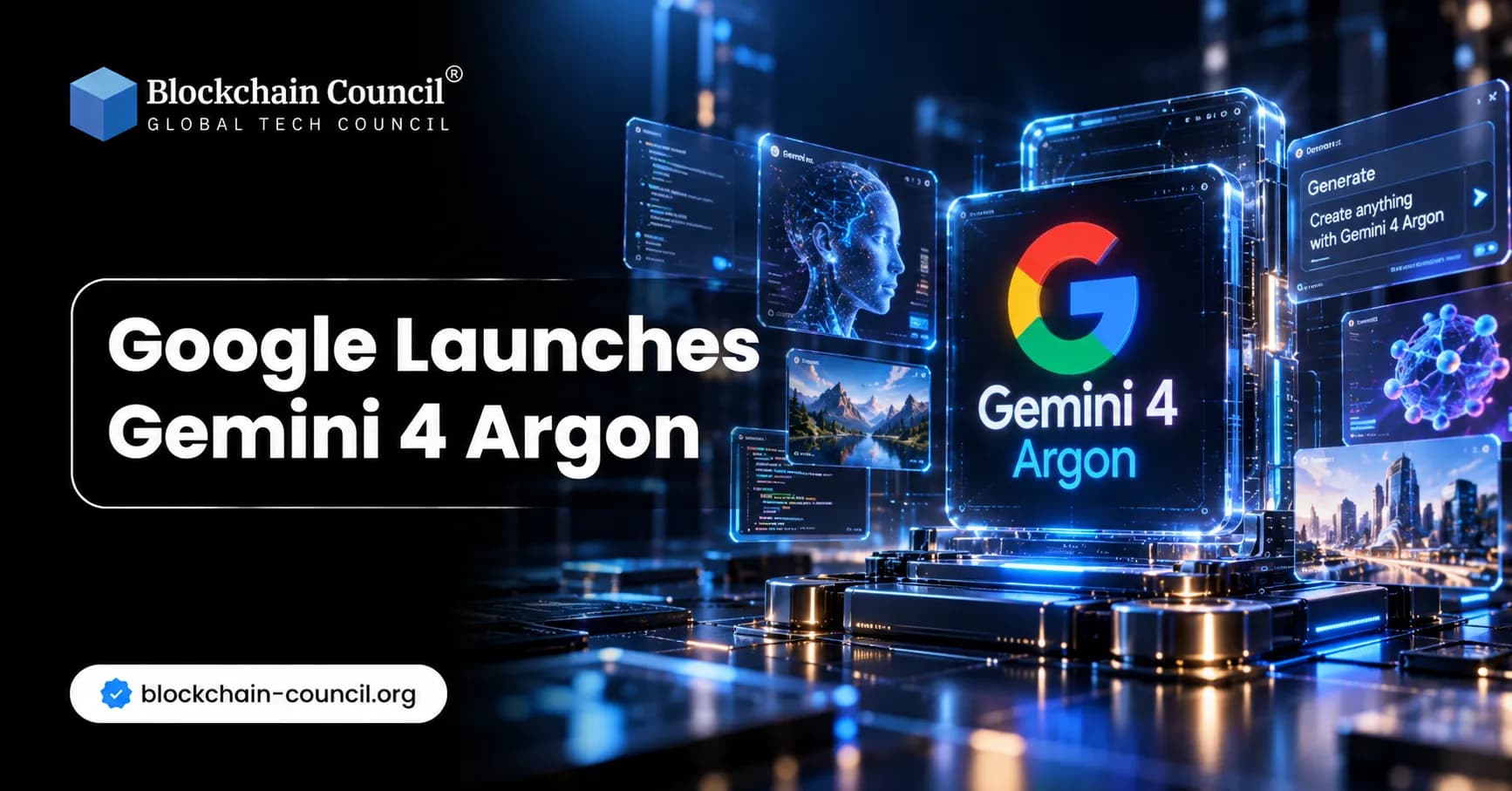
Google has released Gemini 4 Argon, its newest flagship AI model, and this time it is open to developers, businesses and everyday paying users around the world. First announced for a small group of security partners on September 30, 2026, Gemini 4 Argon reached wider availability on October 13. Google says it is built for deep work on hard, multi-step problems in coding, finance, law, cybersecurity and science. Whether you are a beginner curious about the latest AI news or a professional comparing tools, this guide explains what the model does, where to use it and what it costs. If you want to build serious skills around Google’s AI tools, the Certified Google Gemini Professional program is a helpful place to begin.
What Is Gemini 4 Argon?
Gemini 4 Argon is the first model in Google DeepMind’s Gemini 4 family. Google calls it its most powerful model yet and describes it as built to sustain deep reasoning across long, complex workflows. In simple terms, it is an AI that is meant to keep working through a hard job from start to finish, not just answer one question at a time.

Quick facts:
Developer: Google DeepMind
First announced: September 30, 2026 (trusted partners only)
Wider release: October 13, 2026
Best for: complex coding, professional knowledge work, science and defensive cybersecurity
Token limit: 1 million unified input and output tokens through the Gemini API
Introductory API price: $2 per million input tokens and $10 per million output tokens
Reuters reported that the launch comes as Google tries to regain ground against OpenAI and Anthropic after months of delays and a leadership shakeup at DeepMind.
Gemini 4 Argon Availability and Rollout
The rollout happened in two stages. On September 30, Google gave Argon only to vetted cyber defenders in its Fairwind Program. On October 13, it opened access much more widely. Here is where you can use it today:
Audience | Where to access |
|---|---|
Developers and businesses | Gemini API in AI Studio and the Gemini platform |
Google AI Ultra subscribers | Google Antigravity (Google’s coding tool) |
Google AI Ultra and Pro subscribers | Gemini app and AI Mode in Search |
Cybersecurity defenders | Fairwind Program, on a rolling basis |
Scientists and researchers | Application for free Antigravity access |
As AI models move into search, apps and workplace tools, knowing how they actually work becomes a real advantage. A credential such as the Certified Artificial Intelligence (AI) Expert program can help you understand the core ideas behind models like Argon and judge claims with confidence.
Key Features of Gemini 4 Argon
Deep Work and a 1 Million Token Limit
Google says Argon is meant to work longer and harder on difficult tasks. It supports a 1 million token unified limit for input and output through the Gemini API, along with a new continuation protocol for very long outputs. A token is a small piece of text, roughly a short word or part of one. A larger limit gives the model more room to read long documents, think through problems and produce big pieces of work.
Clearer, More Direct Writing
Not every improvement is about code. Google says Argon follows style instructions better than earlier Gemini models, answers more directly with less hedging, avoids needless repetition and skips clichés. Android Authority highlights that this makes the model more useful for ordinary users, not only developers.
Strong Visual and Spatial Reasoning
Argon is described as having deep visual perception and stronger spatial reasoning. Google reports an 87% score on ERQA, a test of physical and spatial problem solving in 3D environments, and says this beats other frontier models. In demos, it turned photos of a desk into a playable miniature racing game and built detailed 3D scenes using multi-agent loops in Antigravity.
Coding With Antigravity
Coding is a headline strength. Google says teams using Argon in Antigravity raised agentic code submissions by more than 35% and cut code rollbacks by nearly a third. Antigravity itself is limited to Google AI Ultra subscribers.
Apps, Tasks and Everyday Help
In the Gemini app, Google shows Argon turning a folder of project notes into a client proposal deck, emailing it and setting up a scheduled workflow for future requests. Android Authority also notes new task management features and integrations with more than 40 apps.
Real-World Results Google Has Reported
Google shared several examples of Argon at work. These are company reports, so they are best read as promising early evidence.
Chrome: Argon helped separate core webpage handling from a legacy folder of about 6 million lines inside Chromium’s roughly 40 million line codebase, finishing months of work in weeks.
Agent Development Kit: Working autonomously overnight, Argon cut session preparation time by 40% in long sessions and sped up cold imports by 21%.
Quantum chemistry: Researchers made the xTB package up to 2.3 times faster at predicting molecular structures.
Gemma models: Argon helped deliver a 2.85 times faster inference speed with no quality drop.
Drug discovery: Isomorphic Labs uses Argon to pull key facts from complex patents and papers, shrinking weeks of reading into hours.
For anyone working in IT or engineering, these examples show why broad technical knowledge matters. A general Tech Certification can help you prove you understand the building blocks, such as data, software and cloud systems, that make such results possible.
Science, Security and Robotics
Cybersecurity
Google says Argon was trained for defensive cyber work and can find, validate and patch serious software vulnerabilities. Security company Wiz used early access to help fix a gap that risked exposing government data and a flaw that exposed a master key at a healthcare provider. Google is also expanding the Fairwind Program to hundreds more partners, giving vetted defenders a version without cyber guardrails.
Scientific Research
Google reports uses in quantum computing, nuclear fusion math, rare disease research and enzyme design. It is also offering 10,000 scientists the highest Antigravity usage tier free for six months, subject to eligibility and selection.
Robotics
In an internal test, Argon watched a video of a person playing cornhole, built a simulation and helped a humanoid robot sink seven shots in a row in a real trial. Google calls this a “video to sim to real” pipeline.
Gemini 4 Argon Pricing
The launch price is $2 per million input tokens and $10 per million output tokens, with cached input tokens 95% cheaper. Reuters notes that these rates double after November 30, 2026, to $4 and $20. If you plan a big project, factor in that change. In the Gemini app and AI Mode, access requires a Google AI Pro or Ultra subscription, and Antigravity is limited to Ultra.
Safety and Security in Gemini 4 Argon
Because Argon is powerful, Google says it built its most comprehensive safety stack yet. Highlights from Google’s report include:
Misuse defenses: External biology red teams could unlock under 1% of the tested sub-tasks, and violations on an adversarial test set dropped nearly two-fold compared with earlier models.
Honest agents: Shortcut attempts on coding benchmarks fell to 2%, and the model is trained to pause for human confirmation before irreversible steps.
Real-time monitoring: An automated monitor reads the agent’s reasoning and actions to catch unintended workarounds.
Prompt injection resistance: Google reports a 0.7% attack success rate on a prompt injection benchmark across 15 adaptive attempts.
These figures come from Google’s own testing, so independent checks will be valuable.
How Does Gemini 4 Argon Compare With Rivals?
Google says Argon ranks first on the Vals Index, a benchmark covering finance, coding, legal and tax work. TechCrunch reports that Google also claims higher scores than OpenAI’s GPT-6 Astra and Anthropic’s Fable and Opus models across many benchmarks. Treat those results with care. Benchmarks are useful, but vendors choose which ones to highlight, and real tasks can differ. The best method is to run a small trial on your own work, such as summarizing documents, fixing a bug or drafting a report, and compare results across tools.
Who Should Use Gemini 4 Argon?
Developers: for large refactors, performance tuning and agent building.
Business teams: for legal, finance and research workflows that need careful reasoning.
Scientists: for data analysis, literature review and simulation code.
Security teams: for vulnerability discovery, through the Fairwind Program.
Everyday users: for clearer writing help, planning and task automation in the Gemini app.
Agentic AI systems can plan tasks, use tools, and execute multi-step workflows with varying degrees of autonomy. As organisations explore these capabilities, they also need professionals who can design, monitor, and evaluate such systems. HireValid can be explored by employers looking for structured ways to assess candidates for emerging technology roles.
Limitations to Keep in Mind
Self-reported results: Most numbers come from Google and its partners.
Paid access: The best features need Pro, Ultra or paid API plans.
Price change: Introductory rates end on November 30.
Human oversight: Agents can still make mistakes, so review important outputs.
Data care: Share only what a task needs, especially with sensitive files.
What Marketers Can Learn From Gemini 4 Argon
Marketing teams can use a model like Argon to summarize research, draft campaign ideas, build reports and automate recurring tasks. The improved writing style, with fewer clichés and more direct answers, is especially useful for content work, though a human editor should always check facts and brand voice. If you want to combine creative strategy with AI-powered workflows, a Marketing Certification can help you build practical skills.
Final Thoughts
Gemini 4 Argon shows how quickly AI is moving from simple chat toward agents that handle long, complex work. It offers a huge token limit, stronger writing, impressive coding results and a serious safety push, all backed by Google’s own data. The smart way to approach it is to start small, test it on real tasks you understand, watch the pricing and keep a person in charge of important decisions. As Google adds more models to the Gemini 4 family, the gap between curious beginners and confident professionals will depend on one thing: who takes the time to learn how these tools really work.
FAQs
1. What Is Google Gemini 4 Argon?
Gemini 4 Argon is Google's advanced AI model introduced for complex reasoning, software engineering, scientific problem-solving, and enterprise workflows. It is designed to handle tasks that require multiple steps, detailed analysis, and extended interactions. The model also supports agentic workflows that combine reasoning with tools and external information.
2. What Are the Main Features of Gemini 4 Argon?
Gemini 4 Argon offers advanced reasoning, coding assistance, multimodal understanding, computer use, and function calling. It supports text, images, audio, video, and PDF inputs, enabling applications to analyze different types of information. Its large context capacity also helps with lengthy documents and complex tasks.
3. How Does Gemini 4 Argon Work?
Gemini 4 Argon processes instructions and supplied information to generate responses or determine appropriate actions. When connected to tools, it can retrieve information, execute code, and work through multi-step tasks. Developers can use the model within an agent framework that manages tool execution, context, permissions, and task completion.
4. What Is the Context Window of Gemini 4 Argon?
Gemini 4 Argon supports a combined input-and-output token limit of up to 1,048,576 tokens in supported API configurations. This is approximately one million tokens and can accommodate substantial documents, codebases, and task histories. The standard synchronous API output limit is lower, while longer output generation requires the supported long-decode configuration.
5. How Much Does Gemini 4 Argon Cost?
Google announced introductory API pricing of $2 per million input tokens and $10 per million output tokens. Cached input tokens receive a 95% discount under the announced pricing. Actual costs depend on usage, configuration, and applicable service terms, so developers should consult the official pricing documentation before deployment.
6. What Makes Gemini 4 Argon Different From Earlier Gemini Models?
Gemini 4 Argon emphasizes sustained reasoning across complex, long-running workflows. Google highlights improvements in software engineering, professional knowledge work, scientific tasks, and agentic execution. Its expanded context and output capabilities also support tasks that may require more extensive analysis than a short conversational response.
7. Can Gemini 4 Argon Write and Debug Code?
Yes. Gemini 4 Argon is designed to support code generation, debugging, software refactoring, and complex engineering tasks. With suitable development tools, it can inspect code, propose modifications, run tests, and use the results to refine its work. Developers should still review the code and validate its security, correctness, and performance.
8. Can Gemini 4 Argon Build Applications and Games?
Gemini 4 Argon can help developers create application prototypes, interactive browser experiences, visualizations, and game components. It can generate code and work through implementation steps when connected to suitable tools. The quality of the final application depends on the requirements, testing process, and additional development needed.
9. How Does Gemini 4 Argon Support AI Agents?
Gemini 4 Argon supports agentic workflows through reasoning, function calling, computer use, and tool integration. An agent can use these capabilities to break a goal into steps, gather information, execute actions, and evaluate results. Reliable operation also requires an appropriate harness, permissions, and clear stopping conditions.
10. What Is Computer Use in Gemini 4 Argon?
Computer use allows an appropriately configured AI system to interact with graphical interfaces through supported tools. This can help automate tasks involving websites and desktop applications. Google lists computer use as a preview capability in the API documentation, so developers should check current availability and apply safeguards before enabling consequential actions.
11. Does Gemini 4 Argon Support Multimodal Inputs?
Yes. Gemini 4 Argon accepts text, images, audio, video, and PDF inputs. This allows applications to analyze documents, interpret visual information, and work with different media types within a broader workflow. Its output is text, and results should be verified when accuracy is important.
12. Can Gemini 4 Argon Help With Scientific Research?
Gemini 4 Argon is designed for scientific and mathematical problem-solving, including analyzing complex information and supporting technical workflows. Researchers can use it to explore hypotheses, interpret data, assist with calculations, and optimize code used in scientific applications. Scientific findings still require independent validation and appropriate expert review.
13. How Can Businesses Use Gemini 4 Argon?
Businesses can explore Gemini 4 Argon for financial analysis, legal document review, research, software development, and enterprise knowledge work. It can help analyze large collections of information and prepare structured outputs. Organizations should evaluate confidentiality, access permissions, accuracy, compliance requirements, and costs before using it for critical business decisions.
14. How Does Gemini 4 Argon Support Cybersecurity?
Gemini 4 Argon is designed to support defensive cybersecurity work, including identifying software vulnerabilities and assisting with code remediation. Security teams can use it to analyze code, investigate potential weaknesses, and develop patches within controlled environments. All findings and proposed fixes should be verified through established security testing and review processes.
15. Can Gemini 4 Argon Analyze Long Documents and Large Codebases?
Yes. Its large context capacity is intended to support extended documents, technical reports, and substantial coding contexts. This can help the model connect information across multiple sections or files. However, supplying more information does not guarantee that every detail will be interpreted correctly, so important findings should be checked.
16. How Can Developers Access Gemini 4 Argon?
Developers can access Gemini 4 Argon through the Gemini API in Google AI Studio and the Gemini platform. Google also provides access through selected development and coding products, subject to eligibility and subscription requirements. Developers should consult the official documentation for the model identifier, configuration options, and current access terms.
17. Is Gemini 4 Argon Available in the Gemini App?
Yes. Google announced access through the Gemini app and AI Mode in Search for eligible Google AI Pro and Ultra subscribers. Availability and feature access can vary by product, subscription, and rollout. Users should check the Gemini interface and Google's official announcements for current details.
18. How Does Gemini 4 Argon Compare With Other AI Models?
Gemini 4 Argon competes in areas such as coding, reasoning, long-context processing, scientific problem-solving, and agentic workflows. Google has published benchmark results and performance claims for selected tasks. Comparisons should account for benchmark methodology, model configuration, cost, latency, and practical performance rather than relying on a single score.
19. What Are the Limitations of Gemini 4 Argon?
Like other advanced AI models, Gemini 4 Argon can generate inaccurate information, misinterpret context, or make mistakes during complex tasks. Long-running workflows may also encounter delays, timeouts, or tool failures. Human review, independent testing, and clear execution limits remain important, especially in legal, financial, scientific, and cybersecurity applications.
20. What Does Gemini 4 Argon Mean for the Future of AI?
Gemini 4 Argon reflects Google's focus on AI systems that can handle complex professional tasks and coordinate multi-step workflows. Advances in reasoning, context capacity, coding, and tool use may make AI agents more useful across industries. Wider adoption will depend on reliability, security, cost, and effective human oversight.
Related Articles
View All
AI & ML
Can Gemini Improve Itself? Google AI and Recursive Self-Improvement Explained
Can Gemini improve itself? Learn why Google AI does not self-rewrite its model today, but can power controlled recursive self-improvement loops.

AI & ML
Meta Launches Muse Wonder: Its New AI Model Explained
Meta has launched Muse Wonder and Muse Wonder Full, new AI models built for personal and professional agents. Learn the features, pricing, access options and how they compare with rivals.

AI & ML
Google Playground: Create AI Games Without Coding
Learn what Google Playground is, how it uses generative AI to turn text prompts into browser games, how to create your first game, what it costs, how it compares with other no-code tools, and what limits to expect.
Trending Articles
The Role of Blockchain in Ethical AI Development
How blockchain technology is being used to promote transparency and accountability in artificial intelligence systems.
Top 5 DeFi Platforms
Explore the leading decentralized finance platforms and what makes each one unique in the evolving DeFi landscape.
How to Install Claude Code
Learn how to install Claude Code on macOS, Linux, and Windows using the native installer, plus verification, authentication, and troubleshooting tips.