
Can Code-Generating AI Improve Its Own Code? The Path to RSI
Code-generating AI can improve code artifacts through tests, tools, and agent loops, but true recursive self improvement remains experimental.



2318 articles published
Code-generating AI can improve code artifacts through tests, tools, and agent loops, but true recursive self improvement remains experimental.

Learn how recursive self-improvement changes AI safety risk, from misalignment and weak oversight to practical safeguards for developers and enterprises.

Recursive self-improvement in AI faces hard limits from evaluators, data grounding, scaling laws, compute, economics, and governance.

Current AI can refine prompts, debug code, and assist model development, but full recursive self-improvement remains unproven and tightly constrained.

Explore real-world examples of recursive self-improvement in AI, from code agents and AutoML to model evaluation and AI research workflows.

AI can train AI models through self-play, synthetic data, and AI feedback, but humans still set goals, safety rules, and deployment limits.

Recursive self-improvement in LLMs works in bounded loops today, but open-ended autonomous optimization remains unproven and needs strict evaluation.

Recursive self-improvement in AI could speed research and automation, but open-ended loops raise serious safety, auditability, and control challenges.
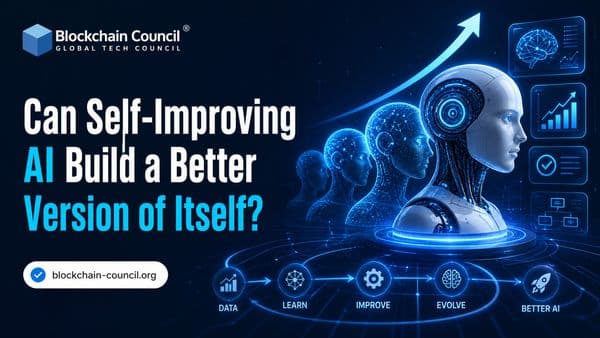
Self-improving AI can refine code, prompts, tools, and workflows today, but open-ended recursive AI successors remain experimental and constrained.

Learn how RSI and AGI connect, why current recursive self-improvement is bounded, and what professionals should know about safety, evaluation, and governance.

Understand recursive self-improvement vs self-learning AI, including definitions, technical differences, risks, governance needs, and learning paths.

OpenAI has not achieved fully autonomous recursive self-improvement, but it is using AI to improve training, evaluation, red teaming, and safety workflows.