

What are Decentralized Autonomous Organizations DAO in Blockchain
 Toshendra Kumar Sharma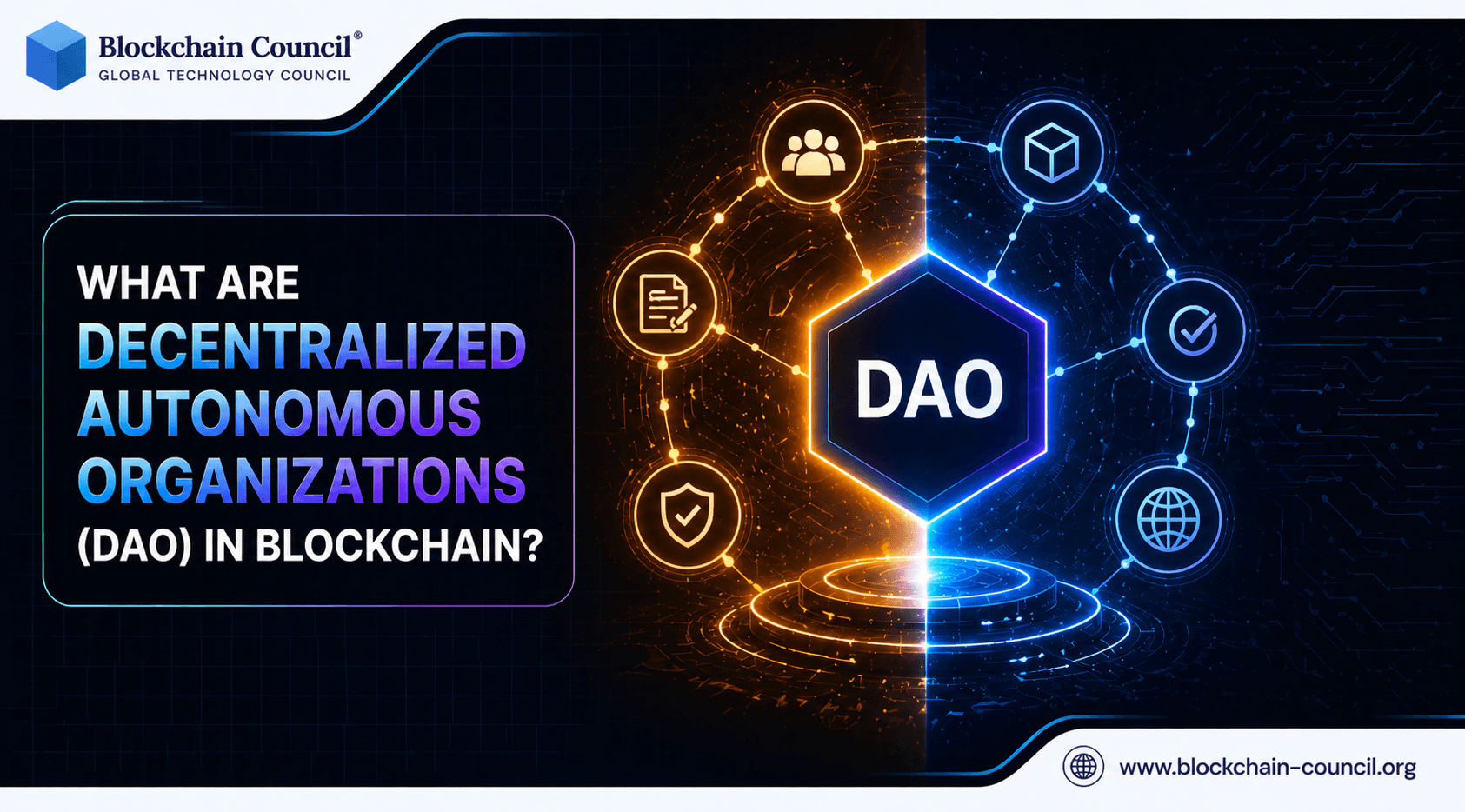
Decentralized Autonomous Organizations (DAOs) are a modern organizational structure built on blockchain technology. Unlike traditional companies, DAOs operate through smart contracts and community governance rather than centralized leadership.
First introduced alongside early blockchain platforms like Ethereum, DAOs have evolved into a key component of Web3 ecosystems. Today, they manage billions of dollars in digital assets, govern decentralized finance (DeFi) protocols, and coordinate global communities without relying on traditional corporate hierarchies. Understand how DAOs operate using governance tokens, voting mechanisms, and smart contracts to enable decentralized decision-making by building expertise through a Certified Blockchain Expert, analyzing DAO structures using a Python certification, and applying DAO models in real-world projects via a Digital marketing course.

This guide explains what DAOs are, how they work, and why they are becoming increasingly relevant in the digital economy.
Understanding Traditional Organizational Structures
Before understanding DAOs, it helps to look at how traditional organizations function.
A typical company consists of shareholders, a board of directors, and executives. Shareholders own the company through equity, while the board makes strategic decisions. Executives, such as the CEO, manage day-to-day operations.
These organizations operate under legal frameworks defined by governments. Their rules are documented in legal agreements such as bylaws or articles of association. Decision-making is often centralized, and processes can be slow due to regulatory and administrative requirements.
Ownership and control are usually tied to shares, and voting power is distributed based on shareholding percentages.
What Is a DAO?
A Decentralized Autonomous Organization (DAO) is an organization governed by code and community consensus rather than centralized authority.
Instead of relying on executives or boards, DAOs use smart contracts deployed on a blockchain to define rules and automate operations. These rules are transparent, publicly accessible, and executed automatically when predefined conditions are met.
Members of a DAO typically hold governance tokens, which represent voting power. These tokens allow participants to propose and vote on decisions, making DAOs inherently democratic in structure.
How DAOs Work
DAOs operate through a combination of blockchain technology, smart contracts, and token-based governance.
Smart Contracts as Rules
Smart contracts are self-executing programs stored on the blockchain. They define how the DAO operates, including voting mechanisms, fund allocation, and governance processes.
Once deployed, these contracts cannot be easily changed, ensuring consistency and transparency.
Token-Based Governance
DAO members hold governance tokens that represent their stake and voting power. The more tokens a member holds, the greater their influence in decision-making.
However, many modern DAOs are experimenting with alternative models, such as quadratic voting, to reduce the dominance of large token holders.
Proposal and Voting Process
Any eligible member can submit a proposal. This proposal is then voted on by the community.
Common decisions include:
Allocating funds to projects
Changing protocol rules
Hiring contributors or service providers
Adjusting governance parameters
If a proposal meets the required voting threshold, it is automatically executed by the smart contract.
On-Chain Execution
Once approved, actions are carried out directly on the blockchain. This removes the need for intermediaries and reduces the risk of human error or manipulation.
Key Features of DAOs
DAOs differ from traditional organizations in several important ways.
Decentralization
Control is distributed among members rather than concentrated in a single authority. This reduces reliance on centralized leadership.
Transparency
All transactions, proposals, and voting results are recorded on the blockchain and can be publicly verified.
Automation
Smart contracts automate processes such as fund distribution and rule enforcement, improving efficiency.
Global Participation
Anyone with internet access and governance tokens can participate, enabling borderless collaboration.
Types of DAOs
DAOs are not one-size-fits-all. Different types serve different purposes.
Protocol DAOs
These govern blockchain protocols such as MakerDAO and Uniswap. They manage upgrades, fees, and system parameters.
Investment DAOs
Members pool funds to invest in projects, startups, or digital assets. Decisions are made collectively.
Service DAOs
These function like decentralized agencies, offering services such as development, marketing, or design.
Social DAOs
Focused on communities and shared interests, these DAOs often manage memberships and cultural initiatives.
Grant DAOs
They fund projects and innovation by distributing grants to developers and creators.
Real-World Examples of DAOs
Several DAOs have demonstrated the practical value of decentralized governance.
MakerDAO: Manages the DAI stablecoin and governs its monetary policy
Uniswap DAO: Oversees one of the largest decentralized exchanges
Aave DAO: Controls a leading DeFi lending protocol
ENS DAO: Governs the Ethereum Name Service
Early experiments like “The DAO” in 2016 faced security issues, but modern DAOs have improved significantly in design and risk management.
Benefits of DAOs
DAOs offer several advantages over traditional organizations.
Increased transparency and trust through blockchain records
Faster decision-making with automated execution
Reduced reliance on intermediaries
Global and inclusive participation
Programmable governance structures
These benefits make DAOs particularly attractive for digital-native ecosystems.
Build and manage DAO frameworks with tokenomics and governance systems by mastering decentralized ecosystems through a Certified Blockchain Expert, developing smart contract integrations using a Node JS Course, and scaling DAO adoption using an AI powered marketing course.
Challenges and Risks of DAOs
Despite their advantages, DAOs face several challenges.
Governance Issues
Token-based voting can lead to concentration of power among large holders, raising concerns about fairness.
Security Risks
Smart contract vulnerabilities can result in financial losses if not properly audited.
Regulatory Uncertainty
Legal recognition of DAOs varies across jurisdictions, creating compliance challenges.
Participation Barriers
Many token holders do not actively vote, leading to low governance participation.
The Future of DAOs
DAOs are expected to play a significant role in the future of work, finance, and digital coordination.
Emerging trends include:
Integration with artificial intelligence for automated decision-making
Legal DAO frameworks in jurisdictions like Wyoming and Switzerland
Cross-chain DAOs operating across multiple blockchains
Improved governance models to increase participation and fairness
As blockchain adoption grows, DAOs may redefine how organizations are structured and managed globally.
FAQs
1. What is a DAO in simple terms?
A DAO is an organization run by code on a blockchain. Decisions are made collectively by members through voting instead of a central authority.
2. How is a DAO different from a traditional company?
A DAO operates without centralized leadership and uses smart contracts for governance. Traditional companies rely on executives and legal structures.
3. What are governance tokens?
Governance tokens are digital assets that give holders voting power in a DAO. They determine how decisions are made within the organization.
4. Can anyone join a DAO?
Most DAOs are open to anyone who holds their governance tokens. Some may require approval, contributions, or specific eligibility criteria.
5. What is the role of smart contracts in DAOs?
Smart contracts define the rules of the DAO and automatically execute decisions. They remove the need for manual oversight.
6. Are DAOs legally recognized?
Some jurisdictions recognize DAOs as legal entities, but global regulations are still developing and vary by region.
7. What are examples of popular DAOs?
Examples include MakerDAO, Uniswap DAO, Aave DAO, and ENS DAO. These govern major blockchain protocols and ecosystems.
8. How do DAOs make decisions?
Members submit proposals and vote using governance tokens. Approved proposals are executed automatically through smart contracts.
9. What is token-based voting?
Token-based voting assigns voting power based on the number of tokens a member holds. More tokens generally mean more influence.
10. What is quadratic voting in DAOs?
Quadratic voting reduces the dominance of large token holders by making additional votes increasingly costly, promoting fairer participation.
11. Can DAOs hire people?
Yes, DAOs can fund contributors, freelancers, or teams through proposals approved by the community.
12. What is a DAO treasury?
A DAO treasury holds funds controlled by the community. Spending decisions are made through voting and executed on-chain.
13. Are DAOs secure?
DAOs can be secure if their smart contracts are properly audited. However, vulnerabilities and exploits are still possible.
14. What is a proposal in a DAO?
A proposal is a formal suggestion submitted by a member. It outlines an action that requires community approval.
15. What industries use DAOs?
DAOs are used in finance, investment, gaming, social communities, and decentralized governance systems.
16. What is a protocol DAO?
A protocol DAO governs a blockchain-based platform. It manages upgrades, fees, and system parameters.
17. Can DAOs raise funds?
Yes, DAOs can raise funds by issuing tokens to participants. This is often done through community-driven fundraising.
18. What is delegation in DAOs?
Delegation allows members to assign their voting power to trusted individuals who vote on their behalf.
19. What are the risks of DAOs?
Risks include smart contract bugs, governance manipulation, low participation, and regulatory uncertainty.
20. What is the future of DAOs?
DAOs are expected to grow with Web3 adoption, offering improved governance models and expanding into new industries and use cases.
Related Articles
View All
Trending Articles
The Role of Blockchain in Ethical AI Development
How blockchain technology is being used to promote transparency and accountability in artificial intelligence systems.
AWS Career Roadmap
A step-by-step guide to building a successful career in Amazon Web Services cloud computing.
How Blockchain Secures AI Data
Understand how blockchain technology is being applied to protect the integrity and security of AI training data.