

Solidity
 Suyash Raizada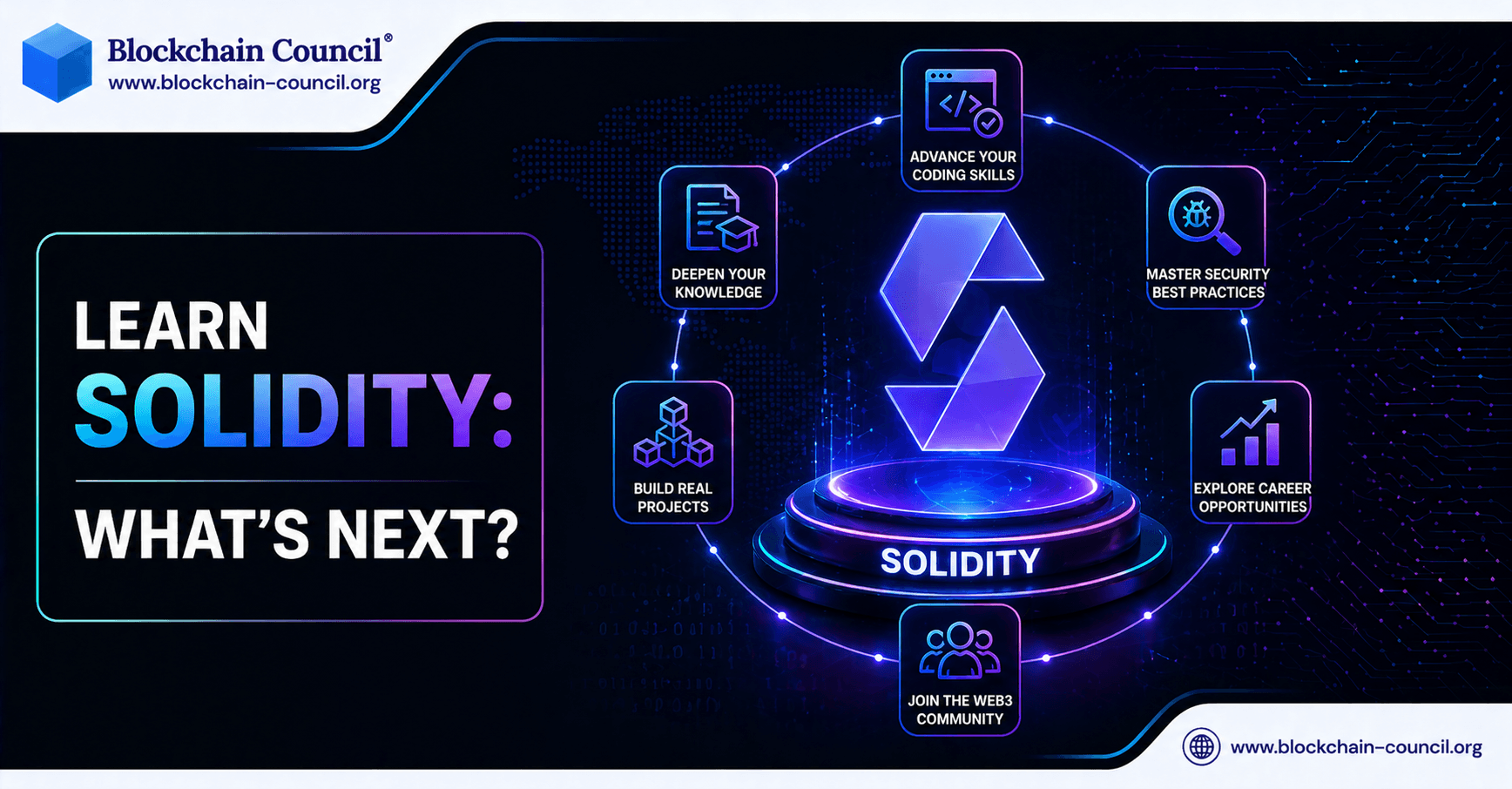
Learning Solidity is an important step toward building decentralized applications on blockchain platforms like Ethereum. However, writing simple smart contracts is only the beginning. To become proficient, you need to apply your knowledge in real-world scenarios, understand the broader Web3 ecosystem, and follow modern development practices.
This guide outlines the next steps after learning Solidity, including practical projects, advanced skills, and career-focused paths.

Why Learning Solidity Is Just the Starting Point
Solidity enables developers to create smart contracts, but production-ready blockchain applications require more than just contract logic.
You also need to understand:
Security best practices
Testing and debugging tools
Blockchain architecture and gas optimization
Frontend integration with Web3 frameworks
Deployment and monitoring
Without these skills, even well-written contracts can fail in real-world use.
Step 1: Build Real-World Projects
The fastest way to improve is by building practical applications.
Create Your Own Token
Start by creating an ERC-20 or ERC-721 token. This helps you understand token standards, supply mechanisms, and contract deployment.
Build a Crowdfunding DApp
Develop a decentralized crowdfunding platform using smart contracts. Include features like funding goals, refunds, and contributor tracking.
Develop a Voting System
Create a decentralized voting application with transparent and tamper-proof results.
Build a Proof-of-Existence Application
This type of app allows users to store hashes of documents on the blockchain to prove ownership or existence at a specific time.
Step 2: Learn Smart Contract Security
Security is critical in blockchain development because smart contracts are immutable once deployed.
Common Vulnerabilities
Reentrancy attacks
Integer overflow and underflow
Front-running attacks
Access control issues
Tools for Security
OpenZeppelin contracts
Slither and Mythril for static analysis
Hardhat and Foundry for testing
Understanding security is essential if you want your applications to be trusted and widely used.
Step 3: Master Development Frameworks
Modern Solidity development relies on frameworks that simplify testing and deployment.
Hardhat
A widely used development environment for compiling, testing, and deploying smart contracts.
Foundry
A fast and increasingly popular toolkit for Solidity development and testing.
Truffle (Legacy)
Still used in some projects, but less common compared to newer tools.
Learning these frameworks improves productivity and code quality.
Step 4: Integrate Frontend with Web3
Smart contracts alone are not enough. Users interact with decentralized applications through web interfaces.
Key Technologies
Ethers.js or Web3.js for blockchain interaction
React or Next.js for frontend development
Wallet integrations like MetaMask
Understanding how to connect smart contracts to user interfaces is essential for building complete applications.
Step 5: Explore Layer 2 and Scaling Solutions
High gas fees and scalability challenges have led to the rise of Layer 2 solutions.
Popular Layer 2 Networks
Arbitrum
Optimism
Polygon
Deploying contracts on Layer 2 networks reduces costs and improves performance.
Step 6: Learn About Other Blockchain Platforms
While Solidity is primarily used on Ethereum, expanding your knowledge increases opportunities.
Hyperledger
Used for enterprise blockchain solutions with permissioned networks.
MultiChain
Focuses on private blockchain deployments.
Other Ecosystems
Solana (Rust-based development)
Cosmos (modular blockchain design)
Polkadot (multi-chain interoperability)
Understanding multiple platforms helps you choose the right tool for each use case.
Step 7: Work with DeFi and NFTs
Decentralized finance and NFTs remain major use cases for Solidity.
DeFi Applications
Lending and borrowing platforms
Decentralized exchanges
Yield farming protocols
NFT Applications
Digital collectibles
Gaming assets
Tokenized ownership
Studying existing protocols can provide insights into advanced contract design.
Step 8: Understand Testing and Deployment
Testing ensures your smart contracts behave as expected before deployment.
Testing Methods
Unit testing
Integration testing
Gas optimization testing
Deployment Tools
Hardhat scripts
Foundry deployment tools
Remix for quick testing
Proper testing reduces the risk of costly errors.
Step 9: Learn Governance and DAOs
Modern blockchain projects often include governance mechanisms.
DAO Development
Create governance tokens
Implement voting systems
Manage treasury funds
Understanding DAOs helps you build decentralized applications with community control.
Step 10: Stay Updated with Industry Trends
Blockchain evolves rapidly. Staying updated is essential.
Key Trends in 2026
Account abstraction and smart wallets
Zero-knowledge proofs and privacy solutions
Real-world asset tokenization
Cross-chain interoperability
Following these trends helps you remain relevant in the industry.
Career Opportunities After Learning Solidity
Once you gain experience, several career paths open up.
Smart contract developer
Web3 frontend developer
Blockchain security auditor
DeFi protocol developer
Technical consultant
Building a strong portfolio is more valuable than certifications.
Best Practices for Solidity Developers
Write clean and well-documented code
Use audited libraries like OpenZeppelin
Test extensively before deployment
Avoid unnecessary complexity
Keep security as a top priority
These practices improve reliability and trust in your applications.
Frequently Asked Questions (FAQs)
1. What should I do after learning Solidity?
Start by building real-world projects such as tokens, crowdfunding apps, or voting systems. This helps reinforce your understanding and build a portfolio.
2. Is Solidity enough to become a blockchain developer?
No, you also need to learn frontend integration, security practices, and blockchain fundamentals.
3. Which framework is best for Solidity development?
Hardhat and Foundry are the most popular frameworks in 2026. They offer powerful tools for testing and deployment.
4. What is the best project for beginners?
Creating an ERC-20 token or a simple voting application is a good starting point.
5. How important is smart contract security?
It is critical. Vulnerabilities can lead to financial losses and damage your reputation.
6. What is OpenZeppelin?
OpenZeppelin provides secure and reusable smart contract libraries widely used in blockchain development.
7. How do I test Solidity contracts?
You can use tools like Hardhat or Foundry to write and run automated tests.
8. What is gas optimization?
Gas optimization involves reducing transaction costs by writing efficient smart contract code.
9. Can I build full applications with Solidity alone?
No, you need frontend technologies like React and Web3 libraries to build complete applications.
10. What are Layer 2 solutions?
Layer 2 solutions are networks built on top of blockchains to improve scalability and reduce fees.
11. Should I learn other blockchains after Solidity?
Yes, learning platforms like Hyperledger or Solana broadens your skill set and career opportunities.
12. What is a DAO in Solidity?
A DAO is a decentralized organization governed by smart contracts and community voting.
13. What is a DApp?
A decentralized application is software that runs on a blockchain and uses smart contracts.
14. How do I deploy a smart contract?
You can deploy contracts using tools like Hardhat, Foundry, or Remix.
15. What is Web3 development?
Web3 development involves building decentralized applications that interact with blockchain networks.
16. What are NFTs in Solidity?
NFTs are unique digital tokens created using standards like ERC-721 or ERC-1155.
17. How do I become a blockchain developer?
Learn Solidity, build projects, understand security, and create a strong portfolio.
18. What is account abstraction?
It simplifies wallet interactions by enabling smart contract-based accounts.
19. Is blockchain development a good career?
Yes, it offers high demand, competitive salaries, and opportunities in emerging technologies.
20. How can I stay updated in blockchain?
Follow developer communities, read documentation, and contribute to open-source projects.
Related Articles
View All
Solidity
Solidity Design Patterns for Web3 Apps: Access Control, Pausability, and Modular Architecture
Learn Solidity design patterns for access control, pausability, and modular architecture, including RBAC, governance admin, and upgrade-safe Web3 contract design.

Solidity
Writing ERC-20 and ERC-721 Tokens in Solidity: Standards, Extensions, and Real-World Pitfalls
Learn how to write ERC-20 and ERC-721 tokens in Solidity with key extensions like permit and royalties, plus real-world pitfalls in security, gas, UX, and compliance.

Solidity
Solidity Events and Logs Explained: Building Indexable On-Chain Analytics for dApps
Learn how Solidity events and logs work, how indexed topics enable fast off-chain queries, and how to design event schemas for scalable dApp analytics.
Trending Articles
How Blockchain Secures AI Data
Understand how blockchain technology is being applied to protect the integrity and security of AI training data.
What is AWS? A Beginner's Guide to Cloud Computing
Everything you need to know about Amazon Web Services, cloud computing fundamentals, and career opportunities.
Claude AI Tools for Productivity
Discover Claude AI tools for productivity to streamline tasks, manage workflows, and improve efficiency.