

Skills Needed For A Blockchain Architect
 Toshendra Kumar Sharma
Every successful blockchain project starts with a plan, and the person who creates that plan is the Blockchain Architect. This professional decides which network to use, how data should flow, how security is handled, and how the system will grow. It is one of the most respected roles in the field, and it requires a rare mix of technical depth and business thinking. In this guide, we explain the skills needed to become a Blockchain Architect in plain language, so beginners can see the path and professionals can find gaps to fill. If you want a structured way to build and prove these skills, the Certified Blockchain Architect program focuses on design, infrastructure, consensus, and security for enterprise systems.
What Does a Blockchain Architect Do?
A Blockchain Architect designs, plans, and oversees blockchain solutions from the first idea to deployment. Blockchain Council describes the role as designing, implementing, and securing enterprise-grade blockchain solutions, translating business needs into technical architecture, and making sure systems meet performance, scalability, and security standards.

Think of an architect who designs a building. Developers lay the bricks, but the architect decides the structure, the materials, and how every part connects. A Blockchain Architect does the same for a digital system.
Typical Responsibilities
Understand the business problem and decide whether blockchain is the right tool.
Choose the right platform, such as Ethereum, Hyperledger Fabric, or R3 Corda.
Design the network, including nodes, roles, and permissions.
Define how data is stored on-chain and off-chain.
Plan security, identity, and compliance controls.
Guide developers, testers, and operations teams.
Review performance and plan for future growth.
Core Blockchain Knowledge Every Architect Needs
Before you can design anything, you must understand how blockchain works at a deep level. Beginners can start with the fundamentals and then move toward enterprise design. Many professionals begin with the Certified Blockchain Expert course, which covers blockchain fundamentals, business applications, and enterprise strategy for both technical and non-technical learners.
How Blockchains Work
You should be able to explain, in simple words, how blocks are created, linked, and verified. This includes transactions, hashes, digital signatures, wallets, and the role of nodes. If you cannot explain it clearly, you cannot design it well.
Types of Blockchain Networks
An architect must know when to use each type.
Public blockchains: Open to everyone, highly decentralized, suited to open applications.
Private blockchains: Controlled by one organization, faster, and more private.
Consortium blockchains: Governed by several organizations, common in industries like banking and logistics.
Hybrid models: Combine private data with public verification.
Choosing the wrong type is one of the most expensive mistakes in a project, so this knowledge matters from day one.
Consensus Mechanisms
Consensus is how a network agrees on the correct state of the ledger. Architects need to understand proof of work, proof of stake, and fault-tolerant methods used in enterprise networks such as Raft and Byzantine fault tolerant designs. Each choice affects speed, cost, security, and decentralization.
Technical Skills for a Blockchain Architect
1. Knowledge of Major Blockchain Platforms
A strong architect is not tied to one tool. The Certified Blockchain Architect program covers platforms such as Ethereum, Hyperledger Fabric, R3 Corda, Cardano, and Quorum, as well as storage platforms. Knowing the strengths of each lets you recommend the best fit.
Ethereum: Smart contracts and a large developer ecosystem.
Hyperledger Fabric: Permissioned networks with channels and private data.
R3 Corda: Built for regulated financial use cases with privacy between parties.
Quorum: Enterprise-focused, based on Ethereum technology.
Cardano: A proof of stake network with a research-driven approach.
2. Smart Contract Design
Smart contracts are programs that run on a blockchain and enforce rules automatically. An architect may not write every line, but must understand languages like Solidity, Go, or JavaScript well enough to review designs, spot risks, and define standards. Good design includes upgrade plans, access controls, and clear separation of duties.
3. Cryptography Basics
Cryptography protects blockchain data. You should understand hashing, public and private keys, digital signatures, encryption, and, at a higher level, zero-knowledge proofs. You do not need to invent new algorithms, but you must know which tools protect which assets and how keys should be stored and rotated.
4. Network and Node Design
Architects decide how many nodes are needed, who runs them, where they are hosted, and how they communicate. They plan ordering services, validators, and peer roles, and they think about availability, backups, and disaster recovery. The Certified Blockchain Architect curriculum includes developing your own network nodes, which reflects how practical this skill is.
5. Data Architecture
Not all data belongs on a blockchain. Storing large files on-chain is expensive and can create privacy problems. A good architect decides what stays on-chain, such as hashes, proofs, and permissions, and what stays in off-chain storage or databases. Knowledge of storage platforms and database design is essential.
6. Integration and Interoperability
Blockchain must work with existing systems like ERP software, databases, payment systems, and identity providers. Architects design APIs, middleware, and oracles, which bring outside data to smart contracts. They also consider how different blockchains might connect through bridges and standards.
7. Scalability and Performance
Architects plan for growth. Skills include understanding transaction throughput, latency, block size, layer 2 solutions, sharding concepts, and testing under load. A design that works for ten users may fail for ten thousand.
Security and Risk Management Skills
Security is the heart of blockchain architecture. Blockchain Council's program includes a dedicated risk management module, which shows how central this topic is.
Threat Awareness
You should know common risks such as smart contract bugs, private key theft, phishing, 51 percent attacks on smaller networks, insider threats, and weak access controls.
Secure Design Principles
Least privilege: Give each user and system only the access it needs.
Defense in depth: Use many layers of protection, not just one.
Key management: Use hardware security modules or secure custody for critical keys.
Audits and testing: Review code and architecture before launch and after each major change.
Compliance and Governance
Enterprise blockchains must follow laws such as data protection rules and industry regulations. Architects work with legal and compliance teams to design consent, data deletion strategies, audit trails, and governance models that define who can join, vote, and upgrade the network.
Infrastructure, Cloud, and DevOps Skills
Blockchain runs on real infrastructure, so architects need strong operations knowledge. This includes cloud platforms, containers, Kubernetes, monitoring, logging, automation, and continuous integration and delivery. Professionals who build a wider technology profile around blockchain often look at the Tech Certification catalog, which includes programs in areas that complement architecture work, such as cloud, security, and emerging technologies.
Why This Matters
Many blockchain failures are not caused by the technology itself but by poor deployment and monitoring. An architect who understands infrastructure can design systems that are reliable, observable, and easy to maintain.
Business and Soft Skills
Technical skill alone does not make a great architect. The role sits between business leaders and engineers, so communication and judgment are just as important.
Business Analysis
Start with the problem, not the technology. Ask who the users are, what is slow or costly today, and whether blockchain truly improves the situation. Sometimes a regular database is the better answer, and a good architect has the honesty to say so.
Communication
You must explain complex ideas to executives, developers, lawyers, and customers. Diagrams, clear documents, and simple language build trust and speed up decisions.
Leadership and Collaboration
Architects guide teams without always managing them directly. They resolve disagreements, review designs, mentor developers, and keep the vision consistent.
Problem Solving and Critical Thinking
Every design involves trade-offs. Faster usually means less decentralized. More privacy can mean less transparency. Strong architects weigh these trade-offs and explain their reasoning.
Project and Stakeholder Management
Large blockchain projects involve many partners. Skills in planning, risk tracking, and stakeholder alignment help move a project from pilot to production.
Skills by Career Level
Level | Focus | Key Skills |
|---|---|---|
Beginner | Learn the basics | Blockchain fundamentals, one programming language, Git, basic cryptography |
Intermediate | Build and deploy | Smart contracts, a major platform, testing, APIs, cloud basics |
Advanced | Design systems | Multi-platform design, security architecture, scalability, governance |
Senior Architect | Lead strategy | Enterprise integration, compliance, team leadership, stakeholder communication |
Tools and Technologies to Know
Languages: Solidity, Go, JavaScript or TypeScript, Python, Rust
Platforms: Ethereum, Hyperledger Fabric, R3 Corda, Quorum, Cardano
Development tools: Hardhat, Truffle, Remix, Web3 libraries
Infrastructure: Docker, Kubernetes, cloud services, monitoring tools
Design tools: Diagramming software for architecture maps and data flows
Testing tools: Unit testing frameworks, security analyzers, and load testing tools
You do not need to master every item at once. Start with one language and one platform, then expand.
How to Build These Skills: A Simple Roadmap
Learn the fundamentals. Understand blocks, hashes, consensus, wallets, and smart contracts.
Pick a programming language. Start with JavaScript or Python, then add Solidity or Go.
Build small projects. Deploy a token, a voting contract, or a simple supply chain tracker on a test network.
Study multiple platforms. Compare public and permissioned networks with hands-on practice.
Learn infrastructure. Practice with Docker, cloud services, and node setup.
Focus on security. Study common vulnerabilities and practice code reviews.
Design real architectures. Draw diagrams for case studies in finance, healthcare, and supply chain.
Earn recognized credentials. A structured program gives you milestones and validation. The Certified Blockchain Architect course, for example, runs about 12 hours across 16 modules and requires no prior specialized experience.
Keep learning. The field changes quickly, so follow updates, communities, and new standards.
Common Mistakes New Architects Make
Using blockchain for everything. It is not always the best tool.
Putting too much data on-chain. This raises cost and privacy risks.
Ignoring governance. Without clear rules, consortium networks stall.
Skipping security reviews. Fixing a flaw after launch is far harder.
Designing without users. A technically perfect system that nobody wants fails.
Forgetting integration. Systems that cannot connect to existing tools stay in the lab.
Showcasing Your Skills and Growing Your Career
Once you have the skills, make them visible. Share diagrams, write short articles, speak at meetups, and publish projects on GitHub. Clear communication helps you win trust and opportunities. Professionals who want to sharpen personal branding, content, and promotion skills can explore the Marketing Certification, which supports technical and business leaders who need to present ideas persuasively and grow their professional reach.
Conclusion
The path to becoming a Blockchain Architect combines deep technical knowledge with strong business and communication skills. You need to understand how blockchains and consensus work, know the major platforms, design secure and scalable systems, manage risk, and connect everything to real business needs. Start with the fundamentals, build small projects, learn multiple platforms, and practice designing complete solutions. With steady effort and the right learning path, you can move from beginner to a trusted architect who shapes the future of enterprise blockchain.
FAQs
1. What is a blockchain architect?
A blockchain architect is a technology professional who designs the overall architecture of blockchain-based systems. Their responsibilities can include selecting blockchain platforms, designing network components, defining data flows, planning integrations, and addressing scalability, security, and performance requirements.
2. What skills are needed to become a blockchain architect?
A blockchain architect needs knowledge of blockchain fundamentals, distributed systems, cryptography, consensus mechanisms, smart contracts, databases, networking, cloud infrastructure, cybersecurity, and software architecture. Strong problem-solving and system-design skills are also important.
3. Why is blockchain architecture knowledge important?
Blockchain architecture determines how components such as nodes, smart contracts, applications, storage, consensus mechanisms, and external services work together. A well-designed architecture can help address requirements involving security, performance, scalability, availability, and data integrity.
4. Which programming languages should a blockchain architect know?
The required languages depend on the blockchain platform and project. Solidity and Vyper are important for Ethereum smart contracts, while languages such as JavaScript, TypeScript, Python, Go, Rust, and Java can be useful for applications, infrastructure, APIs, and blockchain development.
5. Does a blockchain architect need to understand smart contracts?
Yes. Blockchain architects should understand how smart contracts are designed, deployed, executed, and integrated with applications. On Ethereum, smart contracts are programs containing code and data that execute at blockchain addresses.
6. What cryptography skills does a blockchain architect need?
A blockchain architect should understand cryptographic hashing, public-key cryptography, digital signatures, key management, and related security concepts. These concepts help architects design systems that protect identities, transactions, and digital assets.
7. Should a blockchain architect understand consensus mechanisms?
Yes. Architects should understand mechanisms such as Proof of Work, Proof of Stake, and Byzantine fault-tolerant approaches. Choosing or evaluating a consensus model requires understanding its effects on security, decentralization, performance, validator participation, and operational requirements.
8. What distributed systems skills are required for blockchain architecture?
Blockchain architects should understand peer-to-peer networks, distributed state, fault tolerance, replication, synchronization, and consensus. These concepts help them design systems that continue operating across multiple independent or geographically distributed nodes.
9. Why is smart contract security important for blockchain architects?
Smart contracts can control assets and execute logic on-chain, making security a critical architectural concern. Architects should understand vulnerabilities, access control, secure design patterns, testing, auditing, and upgrade strategies.
10. Does a blockchain architect need cybersecurity skills?
Yes. Cybersecurity knowledge helps architects identify risks involving private keys, wallets, smart contracts, nodes, APIs, identity systems, and infrastructure. Security should be considered throughout the architecture rather than added only after development.
11. What scalability skills should a blockchain architect have?
A blockchain architect should understand transaction throughput, latency, network congestion, storage requirements, execution costs, and scaling approaches. Knowledge of Layer 2 networks, rollups, sidechains, sharding concepts, and off-chain processing can also be valuable depending on the architecture.
12. Should a blockchain architect understand cloud computing?
Yes. Many blockchain applications require cloud infrastructure for nodes, APIs, databases, monitoring, deployment, and supporting services. Knowledge of platforms such as AWS, Microsoft Azure, and Google Cloud can help architects design scalable and resilient blockchain environments.
13. What database skills are useful for blockchain architects?
Architects should understand relational and NoSQL databases, data modeling, indexing, caching, replication, and data-storage strategies. Blockchain data may also need to be combined with off-chain databases to support application requirements that are not suitable for on-chain storage.
14. Does a blockchain architect need to understand APIs and system integration?
Yes. Blockchain applications commonly interact with wallets, nodes, exchanges, databases, cloud services, enterprise applications, and external data providers. Understanding APIs, RPC interfaces, middleware, authentication, and integration patterns helps architects connect these components effectively. Ethereum applications, for example, can communicate with nodes through JSON-RPC APIs.
15. What role do blockchain nodes play in architecture?
Nodes are computers running blockchain client software that participate in network operations such as verifying transactions and blocks. A blockchain architect should understand node types, communication, deployment, availability, storage, synchronization, and operational monitoring.
16. Should a blockchain architect understand oracles?
Yes, particularly when applications need external or real-world data. Blockchain smart contracts generally cannot directly access off-chain information, so oracle systems can provide external data to smart contracts.
17. What system design skills are important for a blockchain architect?
Important system-design skills include component modeling, data-flow design, API design, fault tolerance, security architecture, scalability planning, observability, disaster recovery, and technology selection. Architects should also be able to evaluate trade-offs between on-chain and off-chain components.
18. Does a blockchain architect need knowledge of decentralized applications?
Yes. Understanding decentralized applications helps architects connect blockchain infrastructure with user-facing applications. A typical decentralized application can combine a frontend interface with smart contracts running on a decentralized network.
19. What soft skills are important for a blockchain architect?
Communication, leadership, analytical thinking, documentation, collaboration, and decision-making are important. Blockchain architects often need to explain complex technical trade-offs to developers, security teams, business stakeholders, and executives.
20. How can I develop the skills needed to become a blockchain architect?
Start with blockchain fundamentals, programming, distributed systems, cryptography, smart contracts, and cybersecurity. Then gain hands-on experience designing blockchain applications, working with nodes and APIs, studying scalability solutions, and building complete system architectures. A specialized blockchain certification can also provide structured learning alongside practical projects.
Related Articles
View All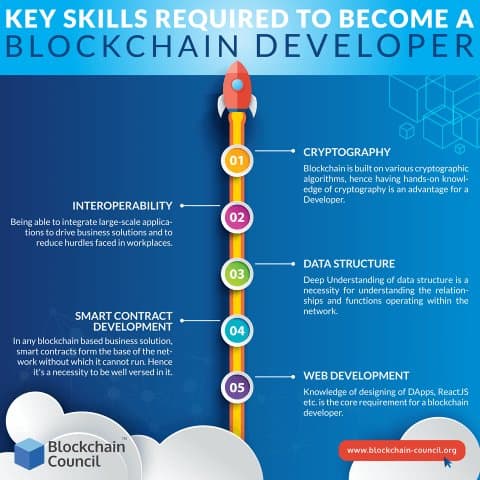
Infographics
Key Skills Required To Become A Blockchain Developer
Blockchain Developers are in demand. Kick start your career as a Blockchain Developer with Certified Blockchain Developer program.
Infographics
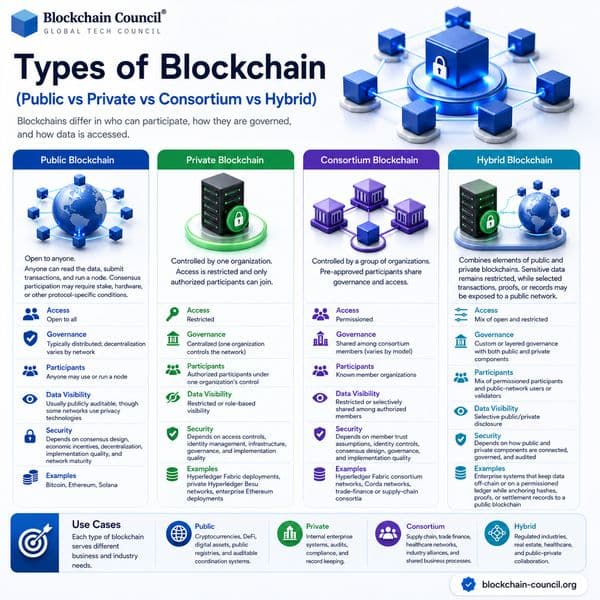
Types of Blockchain
Blockchain networks come in different forms, each designed to meet specific business and technical requirements. From fully decentralized public blockchains to permissioned private and consortium networks, understanding the different types of blockchain helps organizations choose the right solution for security, scalability, governance, and performance.
Infographics
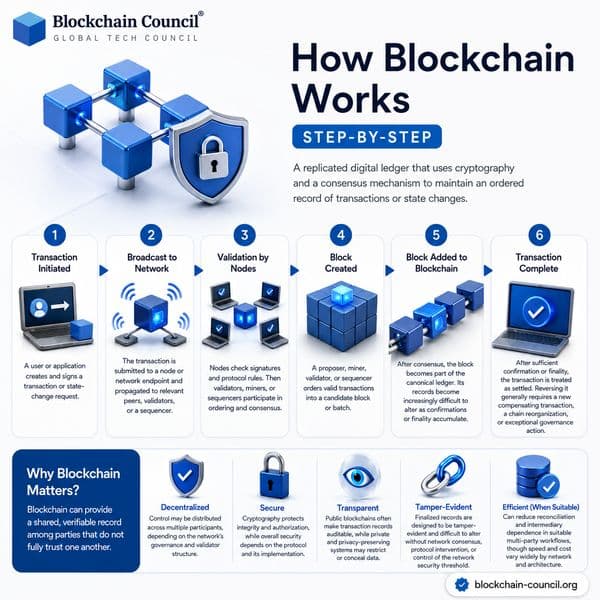
How Blockchain Works?
Blockchain works by recording transactions in blocks that are securely linked using cryptographic hashes. Each transaction is verified by network participants through consensus mechanisms before being added to an immutable ledger. This guide explains the blockchain process step by step, helping beginners understand how decentralized networks maintain transparency, security, and trust.
Trending Articles
The Role of Blockchain in Ethical AI Development
How blockchain technology is being used to promote transparency and accountability in artificial intelligence systems.
Top 5 DeFi Platforms
Explore the leading decentralized finance platforms and what makes each one unique in the evolving DeFi landscape.
How Blockchain Secures AI Data
Understand how blockchain technology is being applied to protect the integrity and security of AI training data.