

How Do Nodes Work In Corda Network?
 Toshendra Kumar Sharma
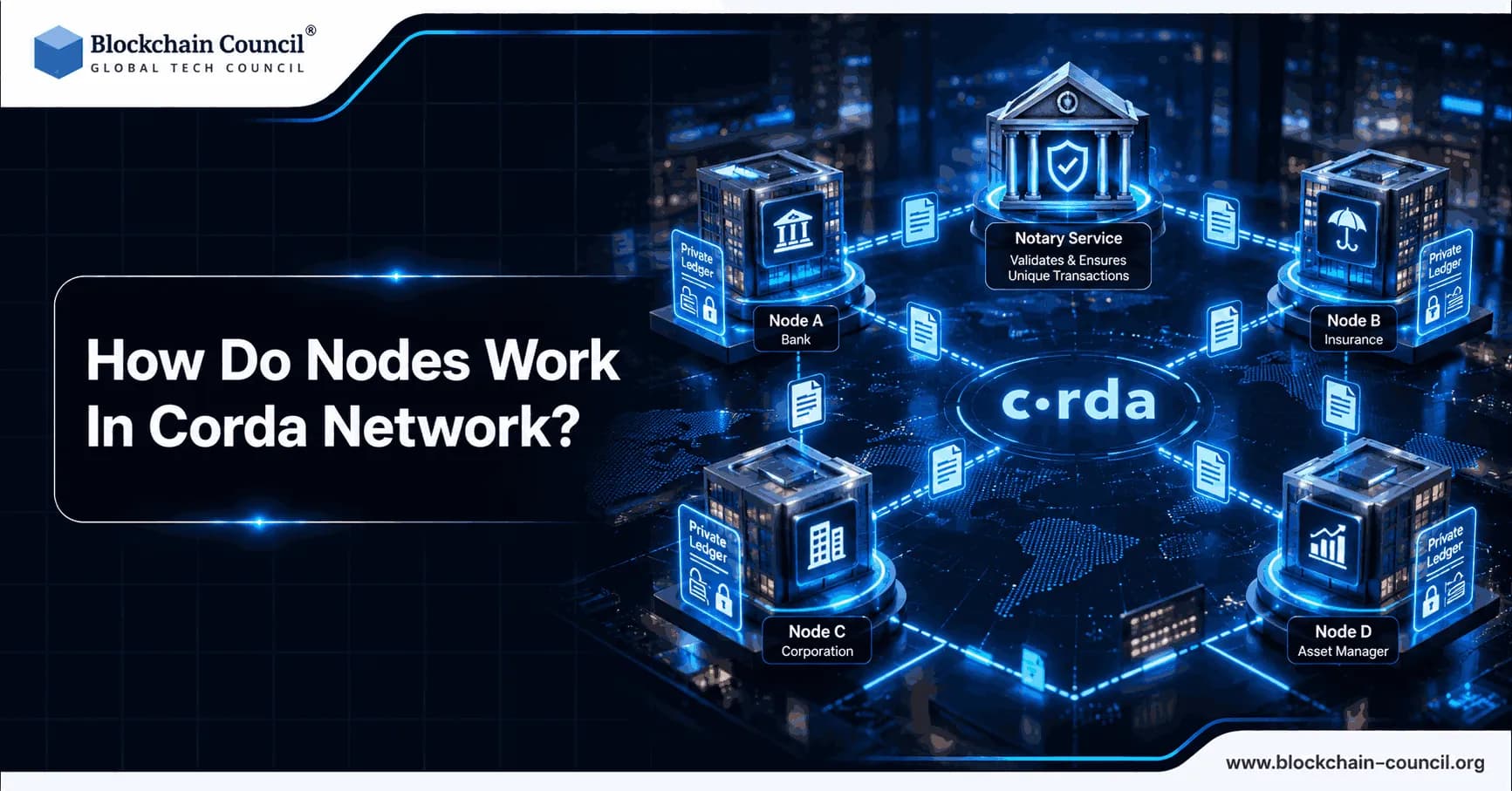
In most blockchains, every computer keeps a copy of the same giant ledger. Corda takes a different path. It is built for businesses, so each participant sees only the information it needs to see. The building block that makes this possible is the node. Understanding how nodes work in Corda network is the key to understanding the whole platform, from how deals are agreed to how double-spending is prevented. If you want to go deeper after reading, the Certified Corda Expert program focuses on exactly this ecosystem.
This guide explains nodes step by step in plain language, with enough technical detail for developers and architects.

Quick Answer: What Is a Node in Corda?
A Corda node is a software runtime that represents one organization in a Corda network. According to R3's documentation, it usually represents one party in a business network, and it runs on the Java Virtual Machine. The node handles the hard parts for you, such as key management, storage, identity, and messaging, and it runs CorDapps, which are Corda distributed applications.
In short, each organization runs its own node, talks directly to the nodes of its business partners, and stores only the data it is entitled to see.
What Is Corda and Why Does It Use Nodes?
Corda is a permissioned distributed ledger platform. Permissioned means only approved participants can join, which suits banks, insurers, and trade networks that must know who they are dealing with. It also does not broadcast every transaction to everyone. Corda's documentation states that no node on the network has read access to the entire ledger. Each node keeps its own view, made up of the facts it is a party to.
This design matters for privacy and for compliance. Two companies agreeing on a loan do not need to share that loan with every other company on the network.
Building applications for this environment takes careful design and testing. Developers who want a structured path into building blockchain applications can look at the Certified Blockchain Developer program, which teaches how to create and test secure blockchain applications.
Anatomy of a Corda Node
Think of a node as a small server with several built-in services. Here is what sits inside.
The JVM Runtime and CorDapps
The node itself is software that runs on the JVM, and it is written in Kotlin with its source code open to inspection in the community edition. You extend it by installing CorDapps, which are packaged as JAR files and placed in the node's cordapps folder. A CorDapp usually contains states, contracts, flows, and optional services.
The Vault and the Database
Every node needs a relational SQL database. It stores operational data, the transactions the node has created or used, and the vault. The vault is the node's private store of states, which are the outputs of transactions, such as a loan agreement or an asset balance. The vault service lets flows and applications query the node's unconsumed states, meaning the ones that are still current and not yet spent.
Messaging
Nodes communicate peer to peer. Corda uses AMQP 1.0 over TLS, built on Apache ActiveMQ Artemis, for node-to-node messaging. The Artemis broker is embedded by default, and the node uses it to create reliable inbound and outbound queues. This is also why messages are not lost if a node is briefly offline, because they can be buffered and delivered later.
Identity and Keys
Each node has a unique identity, expressed as an X.500 name, and certificates that prove who it is. Other nodes look up this identity through the network map, so you can address a counterparty by name and not by an IP address.
The Optional Corda Firewall
In production, organizations often add the Corda firewall, an optional reverse proxy that sits in a network buffer zone. It enables secure AMQP and TLS communication with other nodes while keeping the node itself better protected.
The Network Around Nodes: Doorman, Network Map, and Notary
A node does not work alone. Three network services support it.
The Doorman
Before a node can join a Corda network, it must be approved. The operator of the network, often called the doorman, issues the identity certificate that lets the node take part. This is the permissioning step, and it uses HTTPS for registration.
The Network Map
The network map service is the directory of the network. It lists node identities, certificates, and addresses, so nodes can find each other. Nodes download this information over HTTPS. Production networks run by the Corda Network Foundation include the main Corda Network and a pre-production network, while other organizations can run their own private networks with custom doorman and network map services.
The Notary
The notary is a special service that provides uniqueness consensus. Its job is to check that a transaction is not a double-spend, meaning that the same input has not already been used elsewhere. If a transaction tries to reuse an input that is already spent, the notary rejects it. A notary can be a single node, or a cluster for high availability. Corda separates two kinds of agreement: contracts provide validity consensus, deciding whether a transaction follows the rules, and the notary provides uniqueness consensus.
How a Transaction Moves Between Nodes: Step by Step
Here is a simple example. Alice's company wants to transfer an asset to Bob's company.
Start a flow. Alice's node starts a flow, which is a script that defines the steps of the business process.
Build the transaction. The flow gathers the needed states from Alice's vault and builds a proposed transaction.
Check the rules. Contract code verifies that the transaction is valid, for example that the amounts add up and the right parties are involved.
Collect signatures. Alice signs, then sends the proposal to Bob's node. Bob's node checks it, runs the same contract verification, and signs if it agrees.
Ask the notary. The transaction is sent to the notary, which checks that the inputs have not been spent before.
Notary signs. If it is unique, the notary adds its signature. Otherwise, it rejects the transaction.
Record the result. Both nodes store the finalized transaction, and each vault updates. Only the involved parties see the details.
This peer-to-peer process is quite different from broadcasting to the whole network, and it explains how Corda keeps data private.
Running this reliably in real organizations involves databases, networking, monitoring, backups, and security hardening. That is why many professionals pair blockchain study with a broader Tech Certification, which covers the infrastructure skills that enterprise platforms depend on.
Types of Nodes You Will Hear About
Regular participant node: Represents a business, runs CorDapps, and keeps a vault.
Notary node: A node that also runs the notary service to prevent double-spending.
Oracle node: A node or service that supplies outside information, such as a market rate, which a transaction can rely on.
Network operator services: The doorman and network map, which are run by the network's operator or foundation.
Corda 5: Virtual Nodes and Workers
If you read newer Corda documentation, you will see a change. In Corda 4, the identity and the process were tied together in a single node running in one JVM. In Corda 5, R3 moved to a cloud-native design based on stateless workers, which are containerized processes designed to run on Kubernetes. One Corda deployment can now host multiple virtual nodes, each representing an identity, with different workers handling tasks such as running flows, checking uniqueness, persistence, and messaging.
Networks are now described as application networks, and a Membership Group Manager, which is itself a virtual node, manages who belongs. Scaling means adding more worker replicas. Corda 5 also uses PostgreSQL databases for state between workers.
The core ideas, permissioned membership, flows, contracts, and notarization, stay the same. If you are learning for a job, check which version your employer uses, because the deployment details differ a lot between Corda 4 and Corda 5.
Advantages and Honest Limits
Advantages:
Privacy by design. Data goes only to the parties that need it.
Clear identity. Every participant is known and approved.
Business-friendly workflows. Flows model real agreements between companies.
Strong double-spend protection through notaries.
Limits:
Learning curve. Concepts such as states, flows, and notaries differ from Ethereum-style smart contracts.
Notary trust. A notary is a trusted service for uniqueness, so its design and governance matter.
Operational effort. Running nodes, databases, and firewalls takes skilled staff.
Version differences. Corda 4 and Corda 5 architectures differ, which can confuse beginners.
Smaller developer community than the largest public blockchains.
Practical Tips for Learning Corda Nodes
If you want to explore this hands-on, follow this path:
Learn the vocabulary. Know states, contracts, flows, vault, notary, and network map.
Run a local test network. Start a few nodes on your laptop and watch them connect.
Read the node folder. See where certificates, CorDapps, and configuration live.
Build a simple flow. Make a basic asset transfer between two nodes.
Study the notary. Try a double-spend attempt in a test and watch it fail.
Check your version. Decide whether you are learning Corda 4 or Corda 5.
Technical knowledge is only part of a successful career or project. You also need to explain what you built in clear language to managers, partners, and customers. A Marketing Certification can help professionals present their projects, grow a personal brand, and describe complex technology in simple, credible terms.
Conclusion
To summarize how nodes work in Corda network, each organization runs its own node, which holds a private vault, runs CorDapps, and talks directly to its counterparties over secure messaging. Network services support those nodes: the doorman approves members, the network map lets them find each other, and the notary prevents double-spending. Transactions are built and signed through flows, so only the parties involved see the details. With Corda 5, the same ideas are delivered through virtual nodes and workers designed for cloud deployment. Learn the basics first, practice on a small test network, and match your study to the version you will actually use.
FAQs
1. What is a node in the Corda network?
A node is a software environment that represents a participant in a Corda network. It provides the infrastructure needed to store states and transactions, run Corda applications, communicate with other participants, and execute business logic.
2. How do Corda nodes communicate with each other?
Corda nodes communicate directly with the counterparties involved in a transaction rather than broadcasting transaction data across the entire network. This peer-to-peer approach helps Corda maintain transaction privacy.
3. What is the main purpose of a Corda node?
A Corda node enables an organization to participate in a distributed ledger application. It can store relevant ledger states, execute flows and contracts, communicate with counterparties, and interact with network services.
4. What information does a Corda node store?
A node can maintain a vault containing relevant current and historical states as well as transaction and other application data. The exact information available to a participant depends on the transactions and states in which it is involved.
5. What is the Corda vault?
The vault is the component used by a Corda node to store states that are relevant to that node. Applications can query the vault to retrieve and manage ledger states associated with their activities.
6. What are Corda flows?
Flows are programs that coordinate multi-party business processes between Corda participants. They manage communication, negotiation, transaction construction, verification, signing, and other steps required to complete a transaction.
7. How does a Corda node process a transaction?
A transaction is typically initiated by an application flow and coordinated with the required counterparties. Participants verify the transaction and provide signatures according to the applicable rules, while a notary can provide uniqueness and finality services before the transaction is recorded by the relevant participants.
8. What is the role of a notary in Corda?
A notary is a network service responsible for providing transaction uniqueness and, depending on the notary configuration, additional validation. It helps prevent the same input state from being consumed in conflicting transactions. Corda 5 supports different notary service configurations.
9. Do all Corda nodes receive every transaction?
No. Corda is designed around need-to-know data sharing. Transaction information is generally exchanged directly between the parties involved rather than being globally broadcast to every node on the network.
10. How does Corda maintain privacy between nodes?
Corda uses direct peer-to-peer communication and only shares transaction information with participants that need it. This architecture allows organizations to keep unrelated business transactions private from other network participants.
11. What is a Corda network identity?
A Corda participant has a network identity that allows other participants and network services to identify it. In traditional Corda architecture, a node has a unique network identity associated with its legal or organizational identity.
12. What is a CorDapp and how does it work with a node?
A CorDapp is a Corda distributed application containing the business logic needed for a particular use case. Nodes run CorDapps to define states, contracts, and flows that enable participants to conduct transactions. Corda supports CorDapps written using Java and other JVM-compatible languages.
13. What is the difference between a Corda node and a Corda account?
A node represents a participant or hosting environment in the network, while an account can represent a separate identity hosted by a node. Multiple accounts can be hosted by a node, with their own keys and associated ledger states.
14. What is a virtual node in Corda 5?
In Corda 5, a virtual node represents a network identity and the context in which a distributed application runs. A single Corda deployment can host multiple virtual node identities while keeping their keys, data, and application contexts separated.
15. How are Corda 5 nodes different from earlier Corda nodes?
Corda 5 introduces a cloud-native architecture in which functionality is divided among workers rather than relying on the older single JVM node model. Virtual nodes provide network identities and application contexts, while workers perform processing tasks such as flow execution, database operations, and cryptographic services.
16. What are workers in Corda 5?
Workers are processing components within the Corda 5 architecture. Different workers handle functions such as flow execution, database access, RPC operations, and cryptographic processing, allowing the platform to support horizontal scaling and high availability.
17. Can multiple virtual nodes run on one Corda deployment?
Yes. Corda 5 supports multiple virtual node identities within a single deployment or cluster. This multi-tenancy capability allows different network identities and applications to operate while maintaining separation of keys, data, and code.
18. How do nodes contribute to Corda's distributed ledger?
Nodes maintain and update the ledger states relevant to their transactions. Instead of requiring every participant to maintain a complete copy of every transaction, Corda allows participants to maintain the information relevant to their business relationships.
19. Is the Corda network permissioned?
Corda networks are designed around identified participants and controlled membership rather than unrestricted anonymous participation. In Corda 5, application network membership is managed through the Membership Group Manager, or MGM.
20. Why are Corda nodes important for enterprise blockchain applications?
Corda nodes allow organizations to transact directly while maintaining participant identity, privacy, and controlled data sharing. This makes the architecture suitable for business processes where different organizations need to coordinate transactions without exposing unrelated transaction information to the entire network.
Related Articles
View All
Infographics
GPT 5.5 Spud: A New Intelligence for Real Work
GPT 5.5 Spud introduces a new level of AI intelligence focused on executing real-world tasks efficiently.

Infographics
What Makes Corda Enterprise Better Than Others?
Corda Enterprise brings greater enterprise capabilities to the Corda platform. Built upon the existing Corda’s functionality, it is thereby enhancing availability and performance. Take a look at this infographic to know more about corda enterprise.

Infographics
Proof Of Work VS Proof Of Stake
Most of the Blockchains adopts a mix of both Proof-of-Work and Proof-of-Stake. To know more about proof of work and stake check this infographic.
Trending Articles
How Blockchain Secures AI Data
Understand how blockchain technology is being applied to protect the integrity and security of AI training data.
What is AWS? A Beginner's Guide to Cloud Computing
Everything you need to know about Amazon Web Services, cloud computing fundamentals, and career opportunities.
How to Install Claude Code
Learn how to install Claude Code on macOS, Linux, and Windows using the native installer, plus verification, authentication, and troubleshooting tips.