

Top 5 Blockchain Platforms
 Toshendra Kumar Sharma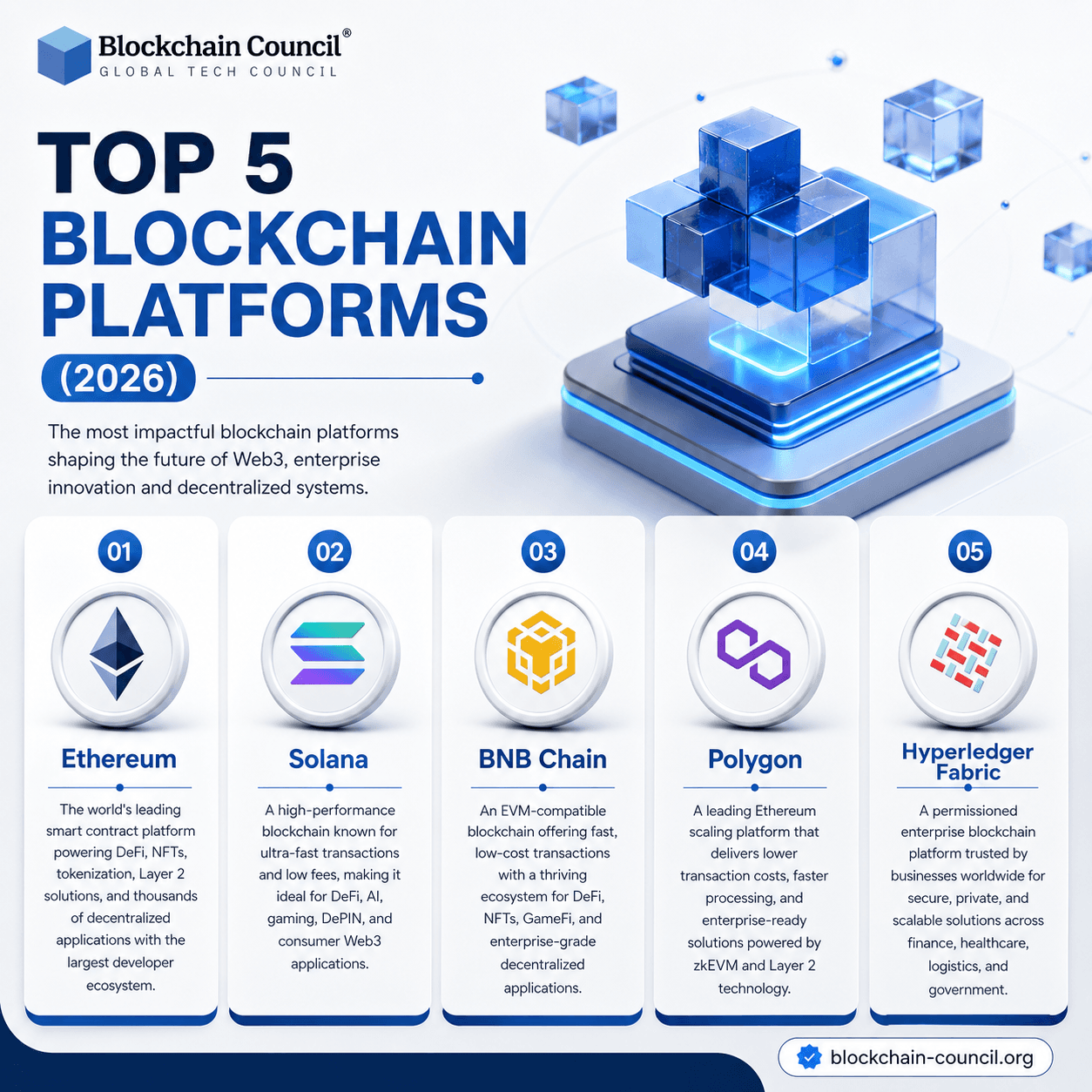
Blockchain technology has matured into one of the most transformative innovations of the digital era. No longer limited to powering cryptocurrencies, blockchain platforms now serve as the backbone for decentralized finance (DeFi), NFTs, gaming, enterprise applications, tokenization, artificial intelligence integration, and secure digital infrastructure.
As organizations continue adopting blockchain solutions, selecting the right platform has become increasingly important. Each blockchain offers unique strengths, whether it's scalability, security, transaction speed, interoperability, or enterprise capabilities.

Here are the top five blockchain platforms shaping the future of Web3 and enterprise innovation in 2026.
1. Ethereum
Ethereum continues to be the world's leading smart contract platform. It pioneered decentralized applications (dApps) and remains the foundation of thousands of Web3 projects.
Its ecosystem includes decentralized finance protocols, NFT marketplaces, Layer 2 scaling solutions, decentralized autonomous organizations (DAOs), and enterprise blockchain applications. Thanks to its robust developer community and continuous upgrades, Ethereum remains the preferred choice for blockchain innovation.
Key Features
Smart contract functionality
Largest Web3 developer ecosystem
Strong DeFi and NFT infrastructure
Extensive Layer 2 scaling solutions
High security and decentralization
2. Solana
Solana has established itself as one of the fastest blockchain platforms available today. Designed for high throughput and low transaction costs, it supports applications requiring speed and scalability.
From decentralized exchanges and AI-powered applications to blockchain gaming and payment solutions, Solana has become a favorite platform for developers building high-performance decentralized systems.
Key Features
Extremely fast transaction processing
Low transaction fees
Ideal for gaming and DeFi
Growing ecosystem of decentralized applications
High scalability
3. BNB Chain
BNB Chain offers a developer-friendly environment that combines fast performance with affordability. Being Ethereum Virtual Machine (EVM) compatible, developers can easily migrate existing Ethereum applications while benefiting from lower costs.
The platform supports decentralized finance, NFTs, GameFi, AI projects, and enterprise blockchain applications.
Key Features
EVM compatibility
Fast and affordable transactions
Large developer community
Strong DeFi ecosystem
Enterprise-ready infrastructure
4. Polygon
Polygon has become one of Ethereum's most successful scaling solutions. It significantly reduces transaction costs while improving speed without sacrificing compatibility with Ethereum.
Its zkEVM technology and Layer 2 architecture make it an attractive choice for businesses and developers looking to build scalable decentralized applications.
Key Features
Ethereum Layer 2 platform
Lower gas fees
Faster transaction processing
zkEVM technology
Enterprise-ready blockchain infrastructure
5. Hyperledger Fabric
Unlike public blockchains, Hyperledger Fabric focuses on enterprise use cases. It is a permissioned blockchain framework designed for organizations that require privacy, security, and compliance.
Businesses across healthcare, banking, logistics, manufacturing, insurance, and government sectors use Hyperledger Fabric to build secure blockchain networks tailored to organizational needs.
Key Features
Permissioned blockchain
Enterprise-grade security
Private transactions
Highly scalable architecture
Flexible modular design
Which Blockchain Platform Should You Learn?
The ideal blockchain platform depends on your career goals.
Learn Ethereum if you're interested in Web3, DeFi, NFTs, and smart contracts.
Choose Solana for high-performance decentralized applications and blockchain gaming.
Explore BNB Chain if you want affordable blockchain development with Ethereum compatibility.
Study Polygon to build scalable Layer 2 applications.
Learn Hyperledger Fabric if you're pursuing enterprise blockchain development.
Professionals who understand multiple blockchain ecosystems are better positioned to work across industries as blockchain adoption continues to expand worldwide.
Whether you're a blockchain developer, enterprise architect, Web3 entrepreneur, or technology enthusiast, mastering these leading platforms will help you stay ahead in the rapidly evolving decentralized economy.Modern blockchain platforms are evolving beyond cryptocurrencies to support artificial intelligence, decentralized finance (DeFi), tokenization, digital identity, and intelligent automation. Becoming a Deeptech Expert helps professionals understand how blockchain integrates with AI, cloud computing, Web3, and distributed systems to create secure and scalable digital ecosystems. This interdisciplinary expertise enables professionals to evaluate emerging blockchain platforms, architect decentralized applications, and contribute to the next generation of intelligent digital infrastructure.
Frequently Asked Questions (FAQs)
1. What is a blockchain platform?
A blockchain platform is a technology framework that enables developers and organizations to create decentralized applications, smart contracts, digital assets, and enterprise blockchain solutions.
2. Why are blockchain platforms important?
Blockchain platforms provide the infrastructure needed to build secure, transparent, and decentralized systems for industries ranging from finance to healthcare.
3. Which blockchain platform is the most widely used?
Ethereum remains the most widely adopted blockchain platform due to its extensive developer ecosystem, smart contract functionality, and large number of decentralized applications.
4. Why is Ethereum considered the leader in Web3?
Ethereum introduced programmable smart contracts and supports thousands of DeFi, NFT, DAO, and enterprise blockchain projects.
5. What makes Solana unique?
Solana is known for its high-speed transaction processing, low fees, and ability to support high-performance decentralized applications.
6. What industries commonly use Solana?
Solana is widely used in blockchain gaming, decentralized finance, digital payments, NFTs, artificial intelligence applications, and consumer Web3 services.
7. What is BNB Chain?
BNB Chain is an EVM-compatible blockchain platform that enables developers to build scalable decentralized applications with lower transaction costs.
8. Why do developers choose BNB Chain?
Developers appreciate its affordability, Ethereum compatibility, strong developer ecosystem, and support for DeFi, GameFi, and NFT applications.
9. What is Polygon?
Polygon is a Layer 2 blockchain scaling solution that enhances Ethereum by improving transaction speed and reducing gas fees.
10. What are the advantages of Polygon?
Polygon offers faster transactions, lower costs, Ethereum compatibility, zkEVM technology, and enterprise-ready infrastructure.
11. What is Hyperledger Fabric?
Hyperledger Fabric is an open-source permissioned blockchain framework designed specifically for enterprise applications requiring privacy and security.
12. Which industries use Hyperledger Fabric?
It is widely adopted across banking, healthcare, insurance, manufacturing, logistics, supply chain management, and government organizations.
13. What is the difference between public and permissioned blockchains?
Public blockchains are open to everyone, while permissioned blockchains restrict participation to authorized users, making them ideal for enterprise environments.
14. Which blockchain platform is best for smart contract development?
Ethereum continues to be the preferred platform for smart contract development due to its mature ecosystem and extensive tooling.
15. Which blockchain platform is best for enterprise applications?
Hyperledger Fabric is considered one of the best enterprise blockchain platforms because of its privacy, scalability, and modular architecture.
16. Which blockchain is best for DeFi projects?
Ethereum remains the leading choice for DeFi, while Solana, BNB Chain, and Polygon also host rapidly growing decentralized finance ecosystems.
17. Can developers build the same application on different blockchain platforms?
Yes. Many applications can be deployed across multiple blockchain platforms depending on scalability, transaction costs, security requirements, and business objectives.
18. What skills should blockchain developers learn alongside these platforms?
Developers should understand smart contracts, Solidity, blockchain architecture, cryptography, consensus mechanisms, tokenization, Web3 development, and decentralized application design.
19. How do I choose the right blockchain platform?
Consider your project's goals, transaction volume, scalability requirements, security needs, ecosystem support, development tools, and industry use cases before selecting a blockchain platform.
20. Why should professionals learn multiple blockchain platforms?
Each blockchain serves different purposes and industries. Understanding multiple platforms enables professionals to design better solutions, work on diverse projects, and expand career opportunities across the growing blockchain ecosystem.
Related Articles
View All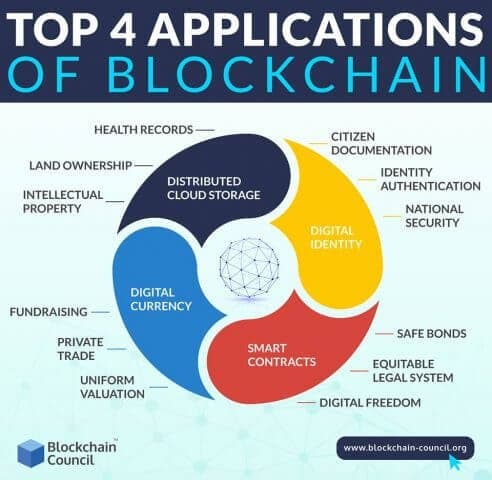
Infographics
Top 4 Applications Of Blockchain
Whenever people talk about blockchain, everyone thinks about its application in the future. Here are top 4 applications that might gain your interest.
Infographics
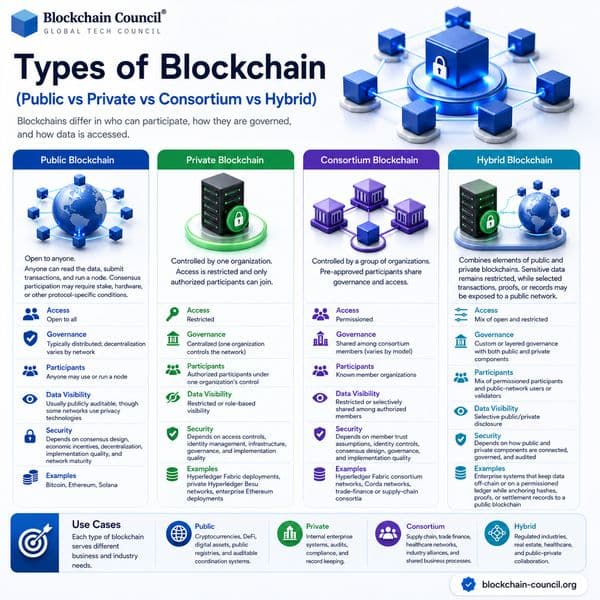
Types of Blockchain
Blockchain networks come in different forms, each designed to meet specific business and technical requirements. From fully decentralized public blockchains to permissioned private and consortium networks, understanding the different types of blockchain helps organizations choose the right solution for security, scalability, governance, and performance.
Infographics
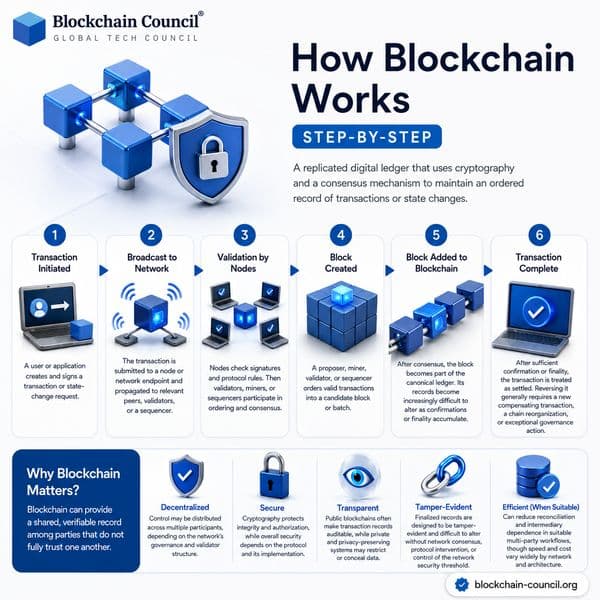
How Blockchain Works?
Blockchain works by recording transactions in blocks that are securely linked using cryptographic hashes. Each transaction is verified by network participants through consensus mechanisms before being added to an immutable ledger. This guide explains the blockchain process step by step, helping beginners understand how decentralized networks maintain transparency, security, and trust.
Trending Articles
The Role of Blockchain in Ethical AI Development
How blockchain technology is being used to promote transparency and accountability in artificial intelligence systems.

Top 5 DeFi Platforms
Explore the leading decentralized finance platforms and what makes each one unique in the evolving DeFi landscape.
How Blockchain Secures AI Data
Understand how blockchain technology is being applied to protect the integrity and security of AI training data.