

Jobs in EOS
 Toshendra Kumar Sharma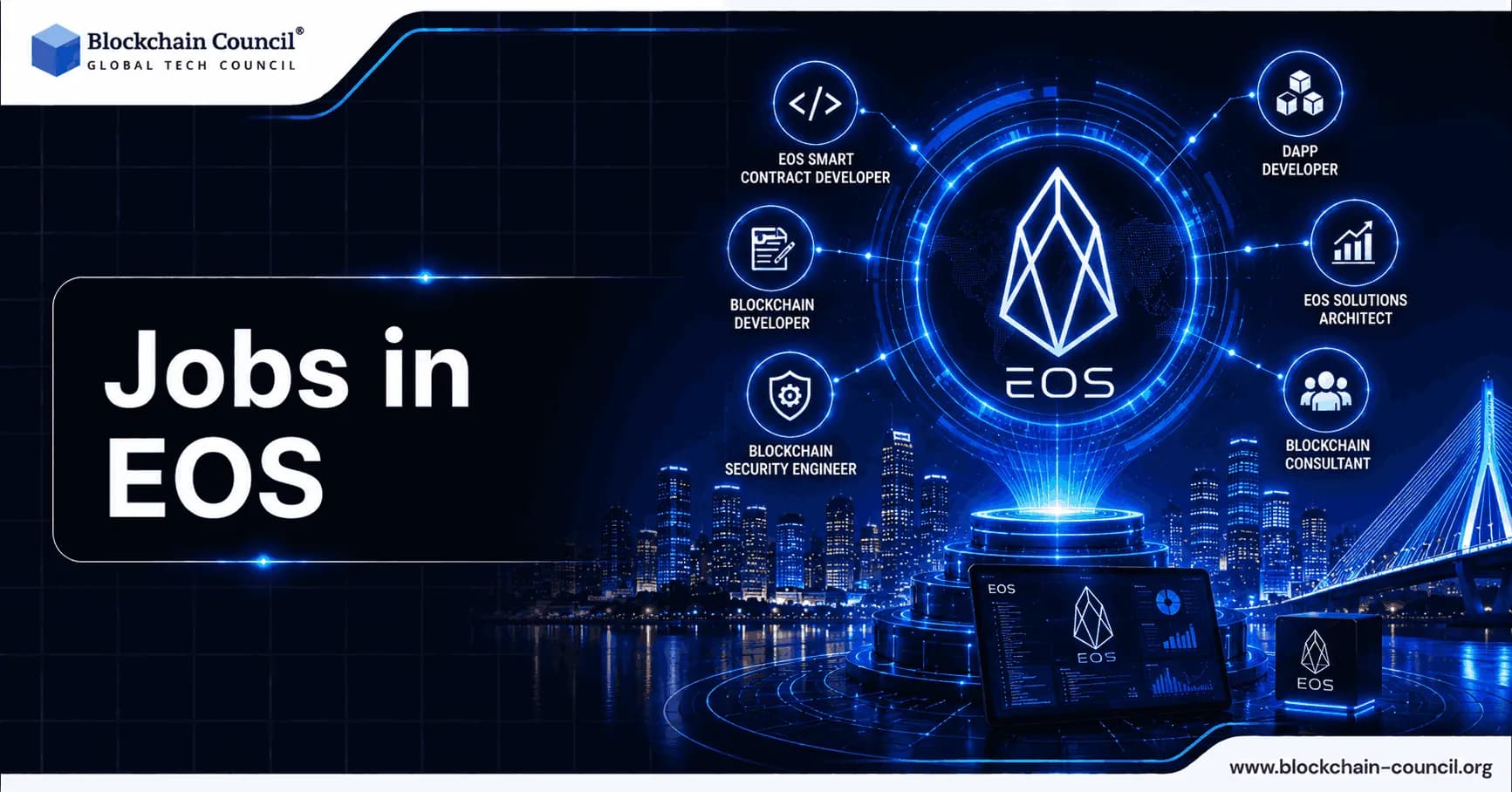
EOS is a blockchain platform designed to support decentralized applications, smart contracts, digital assets, and Web3 solutions. As blockchain technology continues to develop, EOS has created opportunities for professionals with expertise in software development, smart contracts, blockchain infrastructure, cybersecurity, research, and business operations. A career in this ecosystem can be suitable for both experienced technology professionals and graduates who want to specialize in blockchain.
For individuals interested in developing blockchain applications, a Certified Smart Contract Developer program can provide structured knowledge of smart contract concepts and development practices. Along with practical experience, specialized learning can help candidates build a stronger foundation for EOS-related careers.

What Are EOS Jobs?
EOS jobs are professional positions connected with the development, maintenance, security, research, or business use of applications and solutions built around the EOS blockchain ecosystem.
These positions can include:
EOS blockchain developer
Smart contract developer
Blockchain engineer
dApp developer
Blockchain security specialist
Blockchain researcher
Blockchain consultant
Product manager
Community manager
Blockchain marketing specialist
Technical roles generally require programming and blockchain knowledge, while non-technical positions can focus on research, communications, business development, marketing, or product management.
Why Choose a Career in EOS?
EOS provides an environment for developing blockchain applications and decentralized solutions. Learning the EOS ecosystem can help professionals understand blockchain infrastructure, smart contract development, decentralized applications, digital assets, and Web3 technologies.
EOS-related knowledge can be useful for professionals interested in:
Blockchain development
Smart contracts
Decentralized applications
Digital assets
Web3
Blockchain security
Software engineering
The skills gained through EOS projects can also be transferred to other blockchain platforms and broader technology careers.
Popular Jobs in EOS
EOS Blockchain Developer
An EOS blockchain developer builds and maintains applications that interact with the EOS network. Responsibilities may include developing blockchain applications, writing and testing smart contracts, integrating APIs, debugging software, and maintaining blockchain-related systems.
A strong programming foundation and understanding of blockchain architecture are important for this position.
EOS Smart Contract Developer
Smart contract developers create blockchain programs that execute predefined instructions. They may design contract logic, test applications, deploy contracts, and connect smart contracts with decentralized applications.
Professionals in this field should understand programming, blockchain transactions, testing, and smart contract security.
EOS dApp Developer
dApp developers create decentralized applications that interact with blockchain networks. Their work can involve frontend interfaces, backend services, smart contracts, APIs, and wallet integrations.
Knowledge of web development combined with blockchain skills can be valuable for this career.
Blockchain Engineer
Blockchain engineers work on technical infrastructure supporting blockchain applications. Their responsibilities may include network integration, application architecture, performance improvements, infrastructure management, and technical troubleshooting.
Blockchain Security Specialist
Security specialists help protect blockchain applications, smart contracts, wallets, and infrastructure. They may conduct vulnerability assessments, security testing, access reviews, and incident analysis.
Blockchain Researcher
Blockchain researchers study blockchain protocols, applications, market developments, and emerging use cases. They may prepare reports, analyse technologies, and support strategic decisions.
Skills Required for EOS Jobs
A successful EOS career requires a combination of technical knowledge, blockchain understanding, and professional skills.
Blockchain Fundamentals
Candidates should understand distributed ledgers, blockchain transactions, consensus mechanisms, nodes, cryptography, wallets, digital assets, smart contracts, and decentralized applications.
These concepts provide the foundation needed to understand EOS and other blockchain networks.
Programming Skills
Programming is essential for most technical EOS roles. Developers should understand programming fundamentals, data structures, algorithms, debugging, testing, APIs, databases, and version control.
Knowledge of programming languages relevant to the EOS development environment can further improve a candidate's technical capabilities.
Smart Contract Development
Smart contract developers need to understand how contracts are designed, tested, deployed, and maintained. Security should also be considered throughout the development process because errors in blockchain applications can have significant consequences.
How to Become an EOS Developer
Aspiring EOS developers can follow a structured learning path.
Step 1: Learn Programming: Build strong knowledge of programming fundamentals and software development.
Step 2: Study Blockchain: Understand transactions, blocks, wallets, nodes, consensus, and smart contracts.
Step 3: Explore EOS: Study the EOS ecosystem, development tools, documentation, and smart contract environment.
Step 4: Build Projects: Create practical applications such as digital asset systems, decentralized applications, or blockchain verification platforms.
Step 5: Create a Portfolio: Publish suitable projects on GitHub and document the technologies and development process.
Practical projects can demonstrate technical ability more effectively than theoretical knowledge alone.
EOS Jobs for Freshers
Fresh graduates can enter the EOS ecosystem by first developing transferable technology or business skills and then specializing in blockchain.
Computer science graduates can explore software development, blockchain internships, smart contract development, and junior engineering positions.
Business and finance graduates can consider blockchain research, business analysis, operations, or digital asset-related roles.
Marketing and communications graduates can explore blockchain content, community management, social media, and Web3 marketing.
Freshers can strengthen their profiles by participating in hackathons, creating blockchain projects, contributing to open-source initiatives, completing relevant training, and building professional portfolios.
Future-Ready Skills
As technology becomes increasingly important across industries, students need opportunities to develop future-ready skills early in their education. A Tech Olympiad can introduce students to areas such as artificial intelligence, coding, cybersecurity, robotics, and computational thinking while encouraging curiosity and continuous learning.
These skills can help students develop logical reasoning, creativity, technical awareness, and problem-solving abilities. Such capabilities can provide a foundation for future careers in EOS development, blockchain, cybersecurity, artificial intelligence, software engineering, and other technology-focused fields.
EOS and Decentralized Application Development
Decentralized applications are an important part of the blockchain industry. A dApp generally combines a user interface with blockchain functionality and may interact with smart contracts, digital assets, wallets, and blockchain APIs.
EOS developers working on decentralized applications need knowledge of both conventional software development and blockchain technology.
This makes dApp development an attractive career direction for software developers who want to specialize in Web3 applications.
Technology Skills That Complement EOS Careers
Blockchain professionals often work with technologies beyond blockchain itself. Cloud computing, cybersecurity, artificial intelligence, databases, data analytics, DevOps, networking, and software engineering can complement EOS expertise.
Professionals who want to broaden their technical capabilities can explore Tech Certification options that align with their career objectives.
Combining EOS knowledge with broader technical skills can also make it easier to move into software engineering, cloud computing, cybersecurity, or Web3 development roles.
How to Find EOS Jobs
Candidates should search for both EOS-specific and broader blockchain positions. Useful job titles include:
EOS Developer
Blockchain Developer
Smart Contract Developer
Web3 Developer
Blockchain Engineer
dApp Developer
Blockchain Security Engineer
Blockchain Research Analyst
Blockchain Consultant
Blockchain Product Manager
Some employers may value EOS experience without mentioning EOS directly in the job title.
A strong resume should highlight programming languages, blockchain projects, certifications, internships, open-source contributions, and relevant achievements.
EOS Career Growth
A professional can progress through several stages as experience increases.
A possible technical career path is:
Junior Blockchain Developer → EOS Developer → Senior Blockchain Engineer → Blockchain Architect → Technical Lead
Professionals can also transition into blockchain consulting, cybersecurity, research, product management, developer relations, or blockchain strategy.
The most sustainable approach is to develop transferable blockchain and software engineering skills rather than depending exclusively on one blockchain platform.
EOS Security Careers
Security is an important consideration for blockchain applications. Smart contract vulnerabilities, compromised credentials, poor access controls, and application weaknesses can create significant risks.
Professionals interested in this area can develop skills in secure programming, vulnerability assessment, smart contract testing, cryptography, access management, and blockchain infrastructure security.
These capabilities can lead to opportunities beyond EOS, including wider Web3 security and cybersecurity careers.
Business and Marketing Careers in EOS
The EOS ecosystem also requires professionals outside technical development. Blockchain companies need marketing specialists, content creators, community managers, business development professionals, partnership managers, and product marketers.
These professionals help organizations communicate technical products, engage communities, attract users, build partnerships, and expand their market presence.
For professionals interested in combining blockchain knowledge with business communication and marketing expertise, a Marketing Certification can complement their professional development and support careers in blockchain marketing, Web3 communications, community management, and business development.
Future Scope of EOS Careers
The future of EOS-related careers will depend on the continued development of blockchain applications, decentralized services, digital assets, and Web3 technologies.
Professionals who understand EOS while also developing skills in programming, cybersecurity, cloud computing, data analytics, or business can remain adaptable as the technology landscape changes.
Potential career opportunities can include blockchain architecture, smart contract development, decentralized application development, blockchain security, technical consulting, research, and product management.
Conclusion
Jobs in EOS cover a wide range of technical and business opportunities. Developers, smart contract specialists, dApp developers, security professionals, researchers, consultants, product managers, marketers, and community professionals can all contribute to the wider blockchain ecosystem.
Aspiring professionals should begin by developing strong programming or business fundamentals and then build specialized knowledge of EOS and blockchain technology. Practical projects, open-source contributions, professional training, networking, and continuous learning can strengthen a candidate's career profile.
EOS expertise can also provide a foundation for broader blockchain careers. By combining platform knowledge with transferable skills in software development, cybersecurity, cloud technology, research, or business, professionals can prepare for diverse opportunities in the evolving blockchain and Web3 industry.
FAQs
1. What are EOS blockchain jobs?
EOS blockchain jobs are career opportunities involving the EOS Network, EOS Native, EOS EVM, smart contracts, decentralized applications, blockchain infrastructure, and Web3. Roles can include blockchain developers, smart contract developers, software engineers, protocol engineers, ecosystem specialists, and Web3 professionals.
2. What is EOS used for?
EOS is a blockchain ecosystem designed for developing decentralized applications and blockchain-based services. Developers can build using EOS Native or EOS EVM, giving them access to both EOS-specific and Ethereum-compatible development approaches.
3. What types of jobs are available in EOS?
Common EOS-related roles include:
EOS Blockchain Developer
EOS EVM Developer
Smart Contract Developer
Blockchain Software Engineer
Protocol Engineer
dApp Developer
Blockchain Security Engineer
Web3 Developer
Blockchain Researcher
Ecosystem Developer
Developer Relations Specialist
Business Development Manager
Community Manager
Web3 Marketing Specialist
4. What skills are required for EOS blockchain jobs?
The required skills depend on the EOS technology stack. EOS Native development involves C++ and WebAssembly (WASM), while EOS EVM enables developers to build Solidity-based applications. Knowledge of blockchain architecture, smart contracts, APIs, cryptography, Git, testing, and Web3 development is also useful.
5. Which programming languages are used for EOS development?
EOS Native is based on C++ and WebAssembly, while EOS EVM supports Solidity-based applications because it provides compatibility with the Ethereum Virtual Machine. Developers can therefore choose between EOS-native development and Ethereum-compatible development depending on their project.
6. Is Solidity useful for EOS jobs?
Yes. Solidity is particularly useful for developers targeting EOS EVM. Developers with existing Ethereum and EVM experience can use their Solidity knowledge to build applications on EOS EVM.
7. Can freshers get EOS blockchain jobs?
Yes. Freshers can start by learning blockchain fundamentals, Solidity or C++, and EOS development tools. The EOS developer ecosystem provides beginner-friendly tutorials, a learning portal, developer challenges, and technical documentation, which can help newcomers build practical experience.
8. What does an EOS blockchain developer do?
An EOS developer can build smart contracts, decentralized applications, blockchain integrations, infrastructure, and Web3 tools. Depending on the specialization, developers may work with EOS Native, EOS EVM, C++, Solidity, JavaScript SDKs, APIs, and blockchain testing environments.
9. What is EOS EVM?
EOS EVM is an Ethereum Virtual Machine implementation built on EOS that enables Solidity-based applications to run within the EOS ecosystem. This makes EOS EVM relevant for developers who already have Ethereum or EVM development experience.
10. What is the difference between EOS Native and EOS EVM?
EOS Native is the base EOS blockchain stack and uses C++ and WebAssembly. EOS EVM provides an Ethereum-compatible environment that supports Solidity-based applications.
This gives developers two different technical approaches for building within the EOS ecosystem.
11. Can EOS developers build smart contracts?
Yes. Smart-contract development is an important part of the EOS ecosystem. Developers can create contracts using EOS Native technologies or build Solidity-based applications through EOS EVM.
12. Can EOS developers build decentralized applications?
Yes. EOS provides developer resources specifically for building Web3 applications and dApps. Its learning resources include practical projects and tutorials designed to help developers create applications on both EOS Native and EOS EVM.
13. Are there EOS jobs in DeFi and Web3?
Yes. EOS-related career opportunities can involve DeFi, decentralized applications, digital assets, smart contracts, infrastructure, and other Web3 applications. Developers can also use EOS EVM to bring Solidity-based applications into the EOS ecosystem.
14. What is the salary for EOS blockchain jobs?
There is no standardized global salary specifically for EOS developers. Compensation depends on experience, location, programming skills, employer, job responsibilities, and whether the opportunity is employment, contracting, or ecosystem contribution.
For example, EOS Network Foundation has previously offered fully remote roles, demonstrating that EOS-related employment can also be distributed geographically.
15. How can I become an EOS blockchain developer?
A practical learning path is:
Learn blockchain fundamentals.
Choose EOS Native or EOS EVM.
Learn C++ for EOS Native or Solidity for EOS EVM.
Study EOS architecture.
Learn smart-contract development.
Build a simple EOS application.
Practice using EOS developer tools.
Deploy and test your project.
Publish your work on GitHub.
Participate in EOS developer challenges and communities.
Apply for blockchain and Web3 positions.
EOS provides beginner tutorials, technical documentation, developer challenges, and learning resources to support this process.
16. What projects should I build for an EOS developer portfolio?
Good EOS portfolio projects include:
EOS token application
EOS EVM dApp
NFT marketplace
DAO voting application
DeFi lending prototype
Digital identity application
Supply-chain tracking platform
Tokenized asset application
Blockchain explorer
Web3 wallet integration
Document your architecture, code, testing process, and deployment details to demonstrate practical skills.
17. Can I contribute to EOS without getting a traditional job?
Yes. Developers can participate through open-source contributions, developer challenges, ecosystem projects, and community activities. EOS also provides developer resources and monthly challenges through its developer-relations ecosystem.
18. Where can I find EOS blockchain jobs?
Candidates can monitor the EOS Network's official opportunities, developer community, LinkedIn, Web3 job boards, blockchain recruitment platforms, and ecosystem projects. EOS Network Foundation has also offered remote positions in the past.
19. Is EOS suitable for blockchain students and beginners?
Yes. Beginners can start with the EOS learning resources and gradually move from basic blockchain concepts to smart contracts, dApp development, EOS Native, or EOS EVM. The official developer portal specifically provides beginner-friendly tutorials and more advanced technical resources.
20. What is the future of EOS blockchain jobs?
EOS-related opportunities can develop around EVM development, smart contracts, decentralized applications, DeFi, digital assets, blockchain infrastructure, Web3 tooling, and ecosystem development.
Developers who combine EOS knowledge with transferable skills such as Solidity, C++, WebAssembly, blockchain security, cloud infrastructure, and Web3 development can broaden their career opportunities beyond a single blockchain ecosystem.
Related Articles
View All
Info
Part And Time Jobs
Part-time jobs provide flexibility and work-life balance for students, professionals, and anyone seeking additional income. Explore a variety of part-time employment options today.

Info
Front Desk Jobs Near Me
Front desk jobs offer excellent opportunities in hospitality, healthcare, corporate offices, and more. Discover local receptionist and front office positions near you and apply today.
Info
Daycare Jobs Near Me
Looking for daycare jobs near you? Discover opportunities for daycare teachers, childcare assistants, preschool staff, and early childhood educators. Learn where to find local openings and start a rewarding career in childcare.
Trending Articles
The Role of Blockchain in Ethical AI Development
How blockchain technology is being used to promote transparency and accountability in artificial intelligence systems.
AWS Career Roadmap
A step-by-step guide to building a successful career in Amazon Web Services cloud computing.
What is AWS? A Beginner's Guide to Cloud Computing
Everything you need to know about Amazon Web Services, cloud computing fundamentals, and career opportunities.