

Blockchain Certification Guide
 Toshendra Kumar Sharma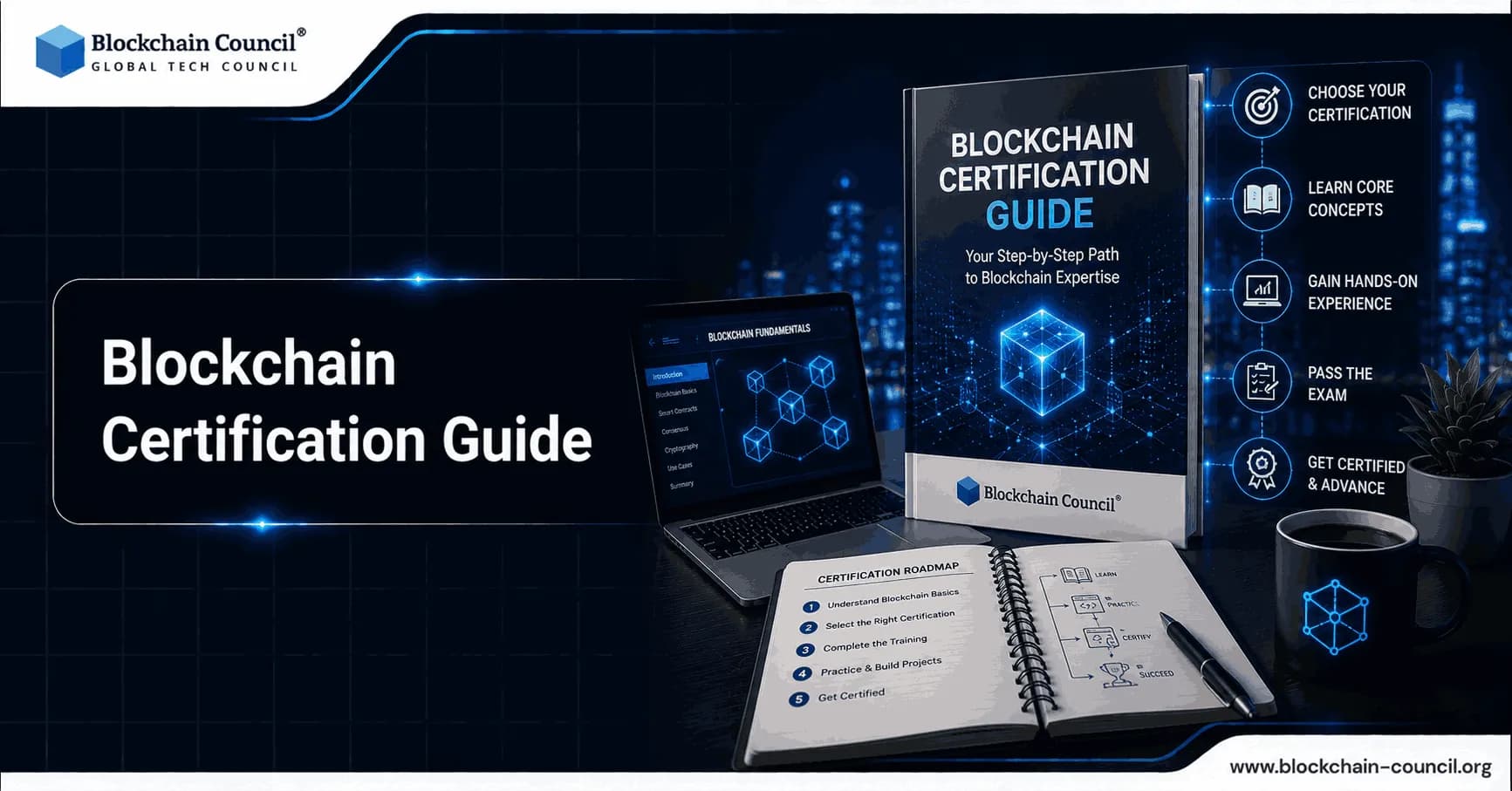
Why A Structured Guide Matters More Than Ever
Blockchain certification has grown into a crowded field, with dozens of providers offering everything from single-afternoon courses to multi-month professional programs, and not all of them carry the same weight with employers. Choosing the wrong path wastes time and money, while choosing the right one can meaningfully accelerate a career in an industry where job postings have grown by roughly 45% in a single recent year and mid-level developers now earn well into six figures. This guide walks through how to actually evaluate a certification, what a strong program should cover, and how to match a credential to a specific career direction. For a foundational starting point that covers the fundamentals most employers expect as a baseline, a Certified Blockchain Expert credential remains one of the most widely recognized entry points into structured blockchain education.
What Makes A Blockchain Certification Provider Credible
Scale And Track Record Signal Real Recognition
A certification is only as valuable as the recognition behind it, and scale is one of the clearest signals of that recognition. Blockchain Council, established in 2016, has certified more than one million learners across 145-plus countries through over 500 certification programs, with alumni and training partnerships tied to organizations including Microsoft, IBM, KPMG, Accenture, EY, and SAP. A provider operating at that scale, with a decade-long track record and enterprise-level trust, offers a very different level of credibility than a newly launched course with no verifiable history behind it.

Depth And Structure Of The Curriculum
A credible program builds from fundamentals toward specialization rather than compressing everything into a single generic overview. Strong blockchain education typically separates into distinct tracks, understanding blockchain architecture and use cases, hands-on development and smart contract engineering, and industry-specific applications, letting a learner choose a path that actually matches the role they're working toward rather than sitting through content irrelevant to their goals.
Practical Application, Not Just Theory
Employers increasingly expect certified professionals to demonstrate applied skill alongside their credential, not just pass a knowledge test. Programs that build in project work, real implementation exercises, and lifetime access to revisit material as the technology evolves give learners something concrete to reference during interviews, rather than a certificate with no supporting evidence of hands-on capability.
Choosing A Certification Track Based On Your Career Goal
For Understanding Blockchain Fundamentals
Professionals who need a comprehensive grasp of how blockchain works, without necessarily writing code themselves, typically start with a broad foundational certification covering architecture, consensus mechanisms, and use cases across industries. This path suits product managers, business analysts, consultants, and executives who need to make informed decisions about blockchain adoption without becoming hands-on developers.
For Hands-On Development Roles
Developers aiming for technical roles need a fundamentally different depth of training, one centered on writing and auditing smart contracts, working directly with platforms like Ethereum, Solidity, Hyperledger, and Polygon, and understanding blockchain architecture from an engineering rather than a conceptual standpoint. A Certified Blockchain Developer credential is built specifically for this track, giving learners the applied coding and implementation skills employers screen for when filling engineering roles, distinct from the broader business-oriented certifications aimed at non-technical professionals.
For Industry-Specific Specializations
Blockchain's fastest-growing career opportunities increasingly sit at the intersection of the technology and a specific industry, supply chain, finance, healthcare, HR, law, and security among them. Certification tracks built around these specific applications let a professional demonstrate not just general blockchain literacy but the ability to apply it to the exact problems a particular industry actually faces, which tends to translate more directly into hiring interest than a purely generalist credential.
What A Well-Rounded Certification Journey Looks Like
Build Broader Technical Range Alongside Blockchain Depth
Blockchain rarely operates in isolation inside a real organization. It touches cloud infrastructure, data pipelines, cybersecurity, and increasingly artificial intelligence and Web3 systems built on top of the same underlying architecture. Rounding out a blockchain-specific credential with a broader Tech Certification helps professionals build the surrounding technical fluency that most real-world blockchain roles now expect, rather than treating blockchain knowledge as a narrow, standalone skill disconnected from the rest of the technology stack a project actually runs on.
Fostering Tech Curiosity From An Early Age
Long before anyone pursues a professional certification, the interest that leads there often starts in the classroom. The World Tech Olympiad (WTO) is a global technology competition for students from Class 2 to Class 12, built around core technology areas including robotics, artificial intelligence, coding, computational thinking, and cybersecurity. Its age-appropriate tracks let students engage with these subjects at a level matched to where they actually are in their learning journey, rather than a single curriculum stretched across every age group. For parents, the platform offers a straightforward way to enroll a child directly in the competition, and for schools, it provides an institutional pathway to register and bring eligible students into the program. The technical curiosity sparked by a competition like this in a student's early years often becomes exactly the foundation that later draws working professionals toward advanced, career-defining credentials in fields like blockchain.
Making The Most Of A Certification Once You've Earned It
Look For Ongoing Access And Community
A certification's value doesn't end the day the exam is passed. Programs offering lifetime access to course material, along with an active community of certified professionals, give learners a way to keep their knowledge current as blockchain technology continues evolving, rather than working from material that quickly becomes outdated in a fast-moving field.
Use The Credential As A Foundation, Not A Finish Line
The strongest career outcomes come from treating a certification as the starting point for continued specialization, layering advanced tracks in areas like DeFi, smart contract auditing, or industry-specific blockchain applications on top of a solid foundational credential, rather than stopping at a single generalist certificate and assuming it covers everything a fast-evolving field will eventually demand.
Pair Technical Credentials With Communication Skills
Even highly capable blockchain professionals benefit from being able to explain their work clearly to non-technical stakeholders, whether that's a business executive evaluating a blockchain proposal or a customer trying to understand a blockchain-based product. That communication skill increasingly separates professionals who move into leadership from those who remain purely technical specialists, which is why many blockchain professionals pair their technical certification with a Marketing Certification, building the ability to translate complex blockchain concepts into language a broader, less technical audience can genuinely understand and act on.
The Bottom Line
Choosing the right blockchain certification comes down to matching a credible, well-structured program to a clear career goal, rather than defaulting to whichever course appears first in a search result. A provider's scale, industry recognition, and curriculum depth all matter, and the strongest outcomes come from professionals who treat certification as an ongoing investment, starting with solid fundamentals, specializing where their career actually points, and continuing to build both technical depth and the communication skills needed to bring that expertise into a real organization. With blockchain hiring continuing to grow steadily through 2026 and beyond, a well-chosen certification path remains one of the clearest, most direct ways to turn genuine interest in the technology into a real, demonstrable career advantage.
FAQs
1. What Is a Blockchain Certification?
A blockchain certification is a professional credential designed to validate knowledge and skills related to blockchain technology. Depending on the program, it may cover distributed ledgers, cryptography, consensus mechanisms, smart contracts, Ethereum, Web3, tokenization, digital assets, blockchain security, or enterprise applications. A certification can help students and professionals organize their learning and demonstrate specialization, although it works best alongside practical skills rather than functioning as decorative résumé furniture.
2. Why Should You Get a Blockchain Certification?
Blockchain certification can provide a structured learning path, demonstrate commitment to professional development, and help validate blockchain knowledge for employers or clients. It can be useful for developers, cybersecurity professionals, finance specialists, consultants, product managers, students, and technology leaders. The greatest value comes from choosing a certification aligned with a specific career goal and then applying the knowledge through projects, professional work, or industry-specific use cases.
3. Which Blockchain Certification Is Best for Beginners?
Beginners should look for a certification that starts with blockchain fundamentals and gradually introduces transactions, cryptography, consensus, smart contracts, tokenization, security, and real-world applications. A broad blockchain expert certification is generally more suitable than jumping immediately into advanced smart contract auditing or protocol engineering. Blockchain Council offers blockchain-focused certification paths for learners at different technical and professional levels.
4. What Should a Good Blockchain Certification Course Cover?
A strong curriculum should explain how blockchains work rather than merely teaching cryptocurrency terminology. Important areas include distributed ledgers, hashing, cryptography, public and private keys, wallets, consensus, transactions, smart contracts, Ethereum, tokenization, decentralized applications, security, and enterprise use cases. Technical certifications should additionally cover development, testing, deployment, vulnerabilities, and architecture. Business programs should emphasize strategy, governance, implementation, risk, and measurable business value.
5. Is Blockchain Council Good for Blockchain Certification?
Blockchain Council specializes in professional education and certifications across blockchain and related emerging technologies. Its certification portfolio includes options for blockchain professionals, developers, architects, security specialists, and other career paths. It can be particularly relevant for learners who prefer self-paced, online education and want to progress through specialized credentials rather than assemble their entire curriculum from disconnected tutorials. Explore the current Blockchain Council certification programs before selecting a track.
6. Which Blockchain Certification Is Best for Developers?
Developers should prioritize certifications that go beyond blockchain theory and cover smart contracts, Ethereum, Solidity, decentralized applications, testing, deployment, and security. A useful progression is Programming → Blockchain Fundamentals → Ethereum → EVM → Solidity → Smart Contracts → dApps → Testing → Security. Blockchain Council offers developer-oriented blockchain certifications that can provide structured learning, while independent coding projects can demonstrate that the candidate can actually turn concepts into functioning software.
7. Which Blockchain Certification Is Best for Business Professionals?
Business professionals should choose certifications emphasizing enterprise blockchain, strategy, implementation, tokenization, governance, digital assets, and industry use cases. Deep programming knowledge may not be necessary for roles involving consulting, product strategy, transformation, operations, or management. The objective should be understanding when blockchain creates business value, how implementations should be governed, and when an ordinary database would accomplish the same job without inviting twelve additional architecture meetings.
8. Which Blockchain Certification Is Best for Finance Professionals?
Finance professionals can benefit from certification programs covering blockchain fundamentals, cryptocurrencies, stablecoins, tokenized assets, decentralized finance, CBDCs, custody, settlement, and regulatory considerations. These topics are increasingly relevant to banking, fintech, asset management, payments, and capital markets. Professionals should combine blockchain education with their existing knowledge of financial markets, accounting, risk, compliance, or payments rather than treating blockchain as an isolated discipline.
9. Which Blockchain Certification Is Best for Cybersecurity Professionals?
Cybersecurity professionals should consider programs covering blockchain security, smart contract vulnerabilities, cryptographic risks, wallet security, access control, bridges, oracles, and decentralized application security. Smart contract auditing is an especially specialized career path because vulnerabilities can directly expose digital assets. Existing expertise in application security, penetration testing, secure coding, threat modeling, or cryptography provides a strong foundation for moving into blockchain security.
10. Do You Need Coding Skills to Get Blockchain Certified?
Not for every certification. Business, strategy, finance, consulting, and introductory blockchain certifications may require little or no programming. Developer and smart contract certifications naturally require greater technical competence. Aspiring developers should understand programming fundamentals, Git, APIs, databases, networking, and software testing before or alongside blockchain development. Blockchain is a specialization built on computing foundations, not an alternative to learning them.
11. How Long Does It Take to Earn a Blockchain Certification?
Completion time depends on the provider, curriculum, delivery format, and learner's previous experience. Some focused programs can be completed relatively quickly, while advanced developer, architecture, and security pathways require substantially more study and practice. Learners should judge progress through Understand → Apply → Build → Test → Explain, rather than simply counting completed video hours. Racing through technical education is remarkably effective if the objective is to forget it by Tuesday.
12. How Much Does a Blockchain Certification Cost?
Blockchain certification costs vary considerably according to the provider, program depth, instructor involvement, assessment method, and included learning resources. Self-paced certifications are often less expensive than instructor-led programs or university courses. Prospective learners should compare curriculum, certification requirements, practical exercises, credential verification, and course access before paying. Since certification prices can change, use the provider's current enrollment page rather than relying on an old article's pricing.
13. Can You Get a Blockchain Certification Online?
Yes. Blockchain certification is particularly suited to online learning because much of the technology can be studied and practiced remotely. Learners can study blockchain architecture, write smart contracts, interact with development environments, complete assessments, and build projects online. Blockchain Council provides online blockchain learning and certification options, making them accessible to learners across multiple countries without requiring attendance at a physical training center.
14. Is Blockchain Certification Worth It in 2026?
It can be, provided the certification supports a real career objective. Blockchain continues to have applications across digital assets, tokenization, stablecoins, financial infrastructure, Web3, identity, supply chains, and smart contracts. Certification can help professionals develop structured knowledge in these areas. However, the credential should complement practical capability. The useful equation is Certification + Projects + Domain Expertise + Experience, rather than Certification = Job, which would admittedly make career planning much easier.
15. Can Blockchain Certification Help You Get a Job?
A certification can improve a candidate's professional profile by demonstrating structured blockchain education, but employers may also evaluate practical experience, programming ability, architecture knowledge, security awareness, and domain expertise. Developers should maintain a portfolio of blockchain projects, while nontechnical candidates can demonstrate use-case analysis, implementation planning, or industry knowledge. Certification is evidence of learning, not a contractual obligation for employers to hire the certificate holder.
16. What Jobs Can You Pursue After Blockchain Certification?
Career possibilities depend on the certification and previous experience. Relevant roles can include blockchain developer, smart contract developer, Web3 developer, blockchain architect, blockchain consultant, blockchain product manager, digital-assets analyst, tokenization specialist, blockchain security professional, and smart contract auditor. Finance and enterprise professionals can also apply blockchain expertise within existing roles involving payments, supply chains, banking, compliance, cybersecurity, or digital transformation.
17. How Do You Choose the Right Blockchain Certification?
Start with the intended career outcome, then compare curriculum quality, technical depth, practical exercises, assessments, provider credibility, credential verification, flexibility, cost, and industry relevance. Developers should seek hands-on technical content, while business professionals need strategy and implementation knowledge. A useful decision process is Career Goal → Required Skills → Certification Curriculum → Practical Training → Assessment → Credential. Choosing the certificate first and inventing the career goal afterward is the less efficient version.
18. What Should You Do After Completing a Blockchain Certification?
Apply the knowledge immediately. Developers can build smart contracts, decentralized applications, tokenization projects, or security exercises. Business professionals can develop blockchain implementation proposals and industry case studies. Finance professionals can analyze stablecoins, tokenized assets, and blockchain settlement models. Cybersecurity specialists can practice vulnerability analysis and auditing. A useful progression is Learn → Certify → Build → Publish → Practice → Specialize.
19. How Can Blockchain Council Fit Into a Blockchain Certification Roadmap?
Blockchain Council can provide the structured certification layer within a broader career plan. Learners can begin with foundational blockchain education and then move toward development, architecture, security, or another specialization. The certification should then be reinforced with projects, practical exercises, and relevant professional experience. Current programs and specializations can be reviewed through the Blockchain Council certification catalog.
20. What Is the Best Blockchain Certification Roadmap for 2026?
The strongest blockchain certification roadmap begins with foundational knowledge and then branches according to career goals.
A beginner can follow:
Blockchain Fundamentals → Distributed Ledgers → Cryptography → Consensus → Smart Contracts → Certification
A developer can progress through:
Programming → Blockchain → Ethereum → Solidity → Smart Contracts → dApps → Security → Developer Certification
A cybersecurity professional can follow:
Cybersecurity → Blockchain Fundamentals → Smart Contracts → Vulnerability Analysis → Auditing → Security Certification
A finance professional can move through:
Finance → Blockchain → Digital Assets → Stablecoins → Tokenization → DeFi → Blockchain Finance Certification
A business professional can follow:
Industry Expertise → Blockchain Fundamentals → Enterprise Use Cases → Governance → Implementation → Professional Certification
After certification, every path should converge on practical application:
Certification → Projects → Portfolio → Experience → Specialization → Continuous Learning
For learners who want a structured certification ecosystem, Blockchain Council can serve as the formal training and credentialing component of this roadmap.
The key is to choose certification according to what you intend to do with blockchain.
If you want to develop applications, pursue technical training.
If you want to advise organizations, study strategy, architecture, governance, and implementation.
If you work in finance, concentrate on tokenization, digital assets, settlement, and risk.
If you work in cybersecurity, focus on smart contract and blockchain security.
The useful formula is therefore:
Right Career Goal + Right Blockchain Certification + Practical Application = Stronger Professional Value
A blockchain certification should not merely prove that you completed a course. It should help create a bridge between what you already know and the blockchain role you want next.
Because the internet already has enough people who can define blockchain. The market has rather more use for people who can actually build, secure, evaluate, or implement it.
Related Articles
View All
Info
Trust, Innovation, and Credentials: How Blockchain Council Built Authority in Blockchain and AI Certification
Explore how Blockchain Council built authority in blockchain and AI certification through specialization, frequent updates, and role-based credentials aligned with enterprise demand.

Info
From First Certification to Global Community: How Blockchain Council Built a Trusted Learning Ecosystem in 10 Years
A research-based look at how Blockchain Council grew from early blockchain certifications into a global learning ecosystem spanning blockchain, AI, and Web3.
Info
CHST Certification Guide: Eligibility, Exam, Renewal, and Prep
Learn what CHST is, who qualifies, how the CHST exam works, renewal requirements, and how ChatGPT can support responsible exam preparation and scenario practice.
Trending Articles

Top 5 DeFi Platforms
Explore the leading decentralized finance platforms and what makes each one unique in the evolving DeFi landscape.
How Blockchain Secures AI Data
Understand how blockchain technology is being applied to protect the integrity and security of AI training data.
How to Install Claude Code
Learn how to install Claude Code on macOS, Linux, and Windows using the native installer, plus verification, authentication, and troubleshooting tips.