

Ethereum Developer Salary in India
 Toshendra Kumar Sharma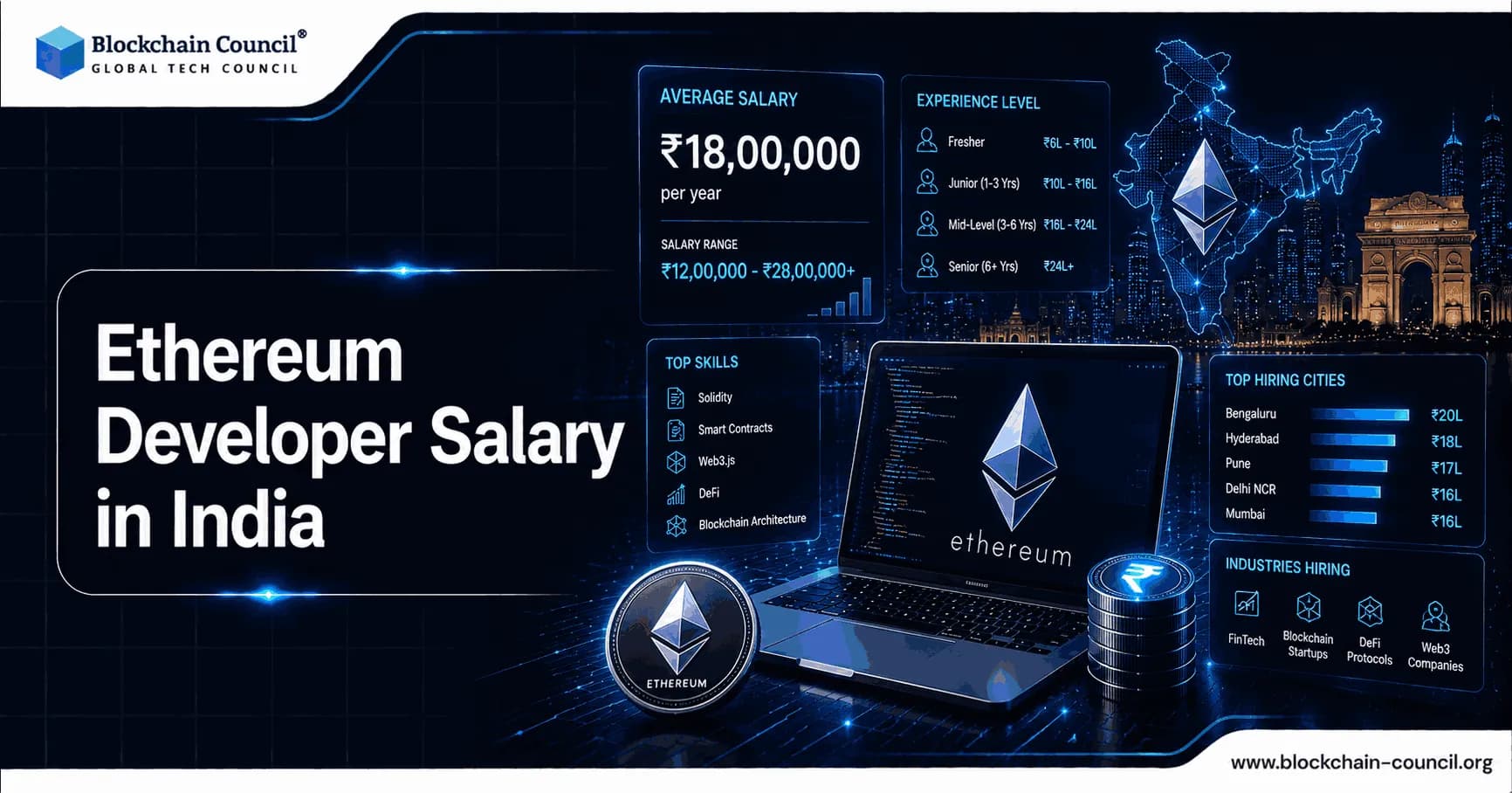
India has become one of the fastest growing hubs for blockchain talent anywhere in the world, and Ethereum developers are sitting right at the center of that growth. From fintech startups in Bengaluru to global Web3 companies hiring remote talent across the country, the demand for developers who understand Solidity, smart contracts, and decentralized application architecture keeps climbing. Anyone exploring this career path will find that becoming a Certified Ethereum Developer is one of the clearest ways to stand out in a job market that is growing faster than the supply of genuinely skilled engineers.
Average Ethereum Developer Salary Ranges in India
Salaries for Ethereum developers in India vary considerably based on experience, city, and whether the employer is an Indian company, a foreign remote employer, or a Web3 native startup. Entry level developers with a working knowledge of Solidity and smart contract basics typically start somewhere between 6 and 10 lakhs per annum. Developers with two to four years of experience, especially those who have shipped production smart contracts, often earn between 12 and 20 lakhs per annum. Senior developers leading protocol architecture or smart contract security audits can cross 30 lakhs per annum, and those working for international companies or DeFi protocols sometimes earn significantly more once token based compensation is factored in.

Many developers in India increase their earning potential by broadening their expertise beyond Ethereum alone. Becoming a Certified Cryptocurrency Expert is a common next step, since it shows employers a working understanding of the wider crypto ecosystem, including trading systems, wallets, and cross chain infrastructure, which many Indian fintech and exchange companies specifically look for when hiring.
What Actually Drives These Salary Differences
City matters more than most job seekers expect. Developers based in Bengaluru, Hyderabad, and Pune tend to command higher salaries because of the concentration of tech companies and startups in those cities, though fully remote roles with international clients have started to close that gap for developers anywhere in the country. Currency arbitrage also plays a role, since many Indian developers working for US or European Web3 companies are paid in dollars or stablecoins, which can significantly boost effective take home pay compared to a domestic salary.
Depth of skill remains the biggest single factor. A developer who understands gas optimization, layer two solutions, and common security vulnerabilities earns considerably more than one who can only write basic contracts. This is exactly why so many developers in India pursue a broader Tech Certification alongside their blockchain specific training, since most real world blockchain products depend on a full technology stack that includes cloud systems, backend infrastructure, and data security, not just smart contract code.
Building Technical Skills From an Early Age
The strongest developers in India often started building problem solving skills years before their first internship, frequently through structured competitions rather than classroom learning alone. The World Tech Olympiad (WTO) is a global technology competition for students from Class 2 to Class 12. Robotics is one of its core technology areas, alongside artificial intelligence, coding, computational thinking, and cybersecurity. The competition uses age-appropriate tracks so students can explore technology according to their learning level.
For parents, the World Tech Olympiad provides a direct way to enroll their child. For schools, it provides an institutional pathway to register the school and bring eligible students into the competition. This kind of early exposure to structured technical thinking often becomes the foundation that later supports advanced credentials in fields like blockchain development.
Turning a Strong Salary Into Long Term Career Growth
A high starting salary is only the beginning of a strong Ethereum development career. The developers who keep advancing tend to pair their technical output with the ability to communicate clearly with clients, investors, and non technical teams, especially in a market like India where freelance and consulting work is common alongside full time roles. A Marketing Certification helps close that gap, giving developers the skills to position their work, build visibility on platforms where clients are actively hiring, and differentiate themselves in a market where technical knowledge alone is becoming more common every year. As India's blockchain ecosystem continues to expand, developers who combine strong technical foundations with clear communication and ongoing certification are the ones most likely to see consistent salary growth over time.
FAQs
1. What Is the Average Ethereum Developer Salary in India?
In 2026, a practical benchmark for Ethereum developers in India is around ₹6 lakh to ₹18 lakh per year, depending on experience, location, employer, and technical specialization. Direct Ethereum-specific salary datasets are thin, so Solidity and broader blockchain developer compensation provide more reliable benchmarks. Flexiple's August 2026 data reports a ₹8.8 lakh median annual CTC for Solidity developers in India, while Glassdoor reports approximately ₹7.35 lakh average annual pay for blockchain developers.
2. How Much Does an Ethereum Developer Earn in India in 2026?
Ethereum developers can reasonably earn from approximately ₹4 lakh to ₹25 lakh+ annually across junior through experienced roles. Specialized developers working with Solidity, DeFi, smart-contract security, Layer 2 networks, or protocol engineering can earn considerably more. Flexiple's current Solidity data shows the middle 50% earning approximately ₹4.9 lakh to ₹17.6 lakh, while the top 10% earn ₹31.1 lakh or more.
3. What Is the Entry-Level Ethereum Developer Salary in India?
Entry-level Ethereum developers can typically target around ₹4 lakh to ₹8 lakh per year. Flexiple reports a median of approximately ₹6.6 lakh annually for entry-level Solidity developers with 0-3 years of experience, with a typical range of about ₹4.3 lakh to ₹11.6 lakh. Strong JavaScript, TypeScript, backend, Solidity, and smart-contract testing skills can help beginners reach the upper end.
4. What Is the Mid-Level Ethereum Developer Salary in India?
Mid-level Ethereum developers with around three to six years of relevant experience can earn approximately ₹10 lakh to ₹20 lakh+ annually. Flexiple's August 2026 benchmark places the median for mid-level Solidity developers at about ₹15.4 lakh per year, with a typical range of ₹9.2 lakh to ₹23.8 lakh. Production smart-contract experience and security expertise can push compensation higher.
5. What Is the Senior Ethereum Developer Salary in India?
Senior Ethereum developers can potentially earn ₹20 lakh to ₹40 lakh+ annually. Flexiple reports a median of roughly ₹30.7 lakh for senior Solidity developers with six or more years of experience, with the middle range extending from about ₹17.8 lakh to ₹47.9 lakh. Developers specializing in audits, DeFi protocols, zero-knowledge systems, or architecture may command even stronger packages.
6. What Is the Ethereum Developer Salary in Bengaluru?
Bengaluru is one of India's strongest markets for Ethereum and Solidity talent. Flexiple's August 2026 dataset reports a ₹15.5 lakh median annual CTC for Solidity developers in Bengaluru, approximately ₹1.3 lakh per month, with the middle 50% earning about ₹7.6 lakh to ₹29.5 lakh. The top 10% exceed ₹47.5 lakh.
7. Why Are Ethereum Developer Salaries Higher in Bengaluru?
Bengaluru has a dense concentration of startups, global engineering centers, fintech firms, Web3 companies, and software talent. This creates greater competition for developers with Solidity, Ethereum, backend, security, and distributed-systems expertise. Flexiple tracks more than 4,000 Solidity developers in Bengaluru and reports a city median substantially above the nationwide ₹8.8 lakh figure.
8. What Is the Solidity Developer Salary in India?
Solidity is one of the clearest salary proxies for Ethereum development. Flexiple reports a ₹8.8 lakh median annual CTC across India in August 2026, equivalent to roughly ₹73,000 per month. The middle 50% earn approximately ₹4.9 lakh to ₹17.6 lakh, based on 2,847 verified compensation records.
9. How Does Ethereum Developer Salary Change With Experience?
Current Solidity salary data shows a sharp increase with experience. Flexiple reports roughly ₹6 lakh for 0-2 years, ₹12 lakh for 2-5 years, ₹24.9 lakh for 5-8 years, ₹34.5 lakh for 8-12 years, and ₹46.8 lakh for 12+ years. Experience becomes particularly valuable when it includes production smart contracts and security responsibility rather than simply years spent nearby.
10. Can Ethereum Developers in India Earn More Than ₹20 Lakh?
Yes. Developers with strong Solidity, DeFi, protocol, and security expertise can exceed ₹20 lakh annually. Flexiple reports a median of ₹24.9 lakh for Solidity developers with 5-8 years of experience, while senior professionals have a median around ₹30.7 lakh. Compensation can climb further for internationally funded Web3 companies and remote roles.
11. Can Ethereum Developers in India Earn More Than ₹30 Lakh?
Yes. Flexiple's current dataset places the top 10% of Solidity developers at ₹31.1 lakh+ per year nationally. Senior developers have a median around ₹30.7 lakh, and Bengaluru's top 10% exceed ₹47.5 lakh. These figures represent the upper market and should not be mistaken for beginner compensation merely because someone finished three Solidity tutorials over a weekend.
12. Which Skills Increase an Ethereum Developer's Salary in India?
High-value skills include Solidity, Ethereum/EVM, Foundry, Hardhat, JavaScript, TypeScript, smart-contract testing, DeFi, security auditing, backend development, Layer 2 networks, cryptography, and distributed systems. The strongest profiles combine Ethereum specialization with broad software engineering. Employers pay more for developers who can design, test, secure, deploy, and maintain systems rather than merely write contracts.
13. Does Smart Contract Security Increase Ethereum Developer Salary?
Often, yes. Smart-contract security is a valuable specialization because vulnerabilities can result in direct financial losses. Developers who understand reentrancy, access-control failures, oracle manipulation, signature security, fuzz testing, invariant testing, and auditing can target security-focused positions. In markets where contracts control significant assets, preventing one exploit can be rather more valuable than producing another hundred lines of Solidity.
14. Is Rust Useful for Ethereum Developers in India?
Yes, particularly for developers moving toward protocol engineering, infrastructure, cryptography, rollups, or zero-knowledge systems. Solidity remains central to EVM smart contracts, while Rust can broaden opportunities in systems-level blockchain development. A strong advanced profile might combine Solidity + Rust + Distributed Systems + Cryptography + Security.
15. Do Ethereum Developers Earn More Than General Blockchain Developers in India?
They can, especially when Ethereum developers possess strong Solidity and smart-contract expertise. Glassdoor's broader blockchain developer dataset reports approximately ₹7.35 lakh average annual compensation, with a 25th-to-75th-percentile range around ₹5.1 lakh to ₹10.55 lakh. Flexiple's more specialized Solidity dataset shows a ₹8.8 lakh national median and significantly higher pay at mid and senior levels.
16. Why Should Ethereum-Specific Glassdoor Salary Data Be Used Carefully?
Glassdoor's June 2026 Ethereum/Blockchain Developer page shows only one salary contributing to its calculated national average, even though it displays several historical submissions. One recent Calcutta submission reported ₹17-₹19 lakh for a developer with one to three years of experience. Because the sample behind the calculated average is extremely small, broader blockchain and verified Solidity datasets provide a more defensible salary benchmark.
17. Can Remote Ethereum Developers in India Earn More?
Yes. Indian Ethereum developers working remotely for global Web3 protocols, crypto firms, infrastructure companies, or startups may access compensation substantially above domestic averages. Remote packages may include salary, equity, tokens, or bonuses. Developers should compare guaranteed cash separately from speculative compensation, because ₹40 lakh in token-heavy “total value” and ₹40 lakh in cash are not identical creatures.
18. Do Ethereum Certifications Increase Developer Salary in India?
Certification can strengthen a developer's profile by validating structured Ethereum or blockchain knowledge, particularly for professionals transitioning from conventional software development. It does not guarantee a salary increase. The stronger formula is Ethereum Certification + Solidity + EVM + Smart Contract Security + GitHub Projects + Production Experience. Employers typically care most about evidence that the candidate can build reliable software.
19. How Can You Become a High-Paid Ethereum Developer in India?
Begin with conventional software engineering:
Programming → Data Structures → Algorithms → Git → Databases → APIs → Backend Development
Then specialize in Ethereum:
Blockchain Fundamentals → Ethereum → EVM → Solidity → Smart Contracts → Foundry/Hardhat → dApps → Testing
Then add higher-value expertise:
Smart Contract Security → DeFi → Layer 2 → Rollups → Zero-Knowledge Technology → Cryptography → Protocol Engineering
The developers at the upper end of the market generally understand Ethereum beneath the frontend-wallet layer and can take responsibility for production systems.
20. What Is the Ethereum Developer Salary Outlook in India for 2026?
The most useful 2026 benchmark comes from combining broader blockchain salary data with current Solidity-specific compensation.
Glassdoor reports approximately ₹7.35 lakh average annual pay for blockchain developers in India, with a typical range around ₹5.1 lakh to ₹10.55 lakh based on 362 salaries.
Flexiple's much more Ethereum-relevant Solidity dataset reports:
All-Level Median → ₹8.8 lakh/year
Entry Level, 0-3 years → ₹6.6 lakh/year
Mid-Level, 3-6 years → ₹15.4 lakh/year
Senior, 6+ years → ₹30.7 lakh/year
Bengaluru is stronger still, with a ₹15.5 lakh all-level median and a middle-50% range of approximately ₹7.6 lakh to ₹29.5 lakh.
A practical career-level estimate for Ethereum developers in India is therefore:
Junior Ethereum Developer → ₹4-₹8 lakh/year
Mid-Level Ethereum Developer → ₹10-₹20 lakh/year
Senior Ethereum Developer → ₹20-₹35 lakh+/year
Smart Contract Security/DeFi/Protocol Specialist → ₹25-₹50 lakh+ potential
International Remote Specialist → ₹30 lakh+ potential
These are market-oriented estimates rather than guaranteed salary bands.
The strongest salary drivers are:
Software Engineering + Solidity + EVM + Smart Contract Security + DeFi + Layer 2 + Distributed Systems + Production Experience
The career progression typically looks like:
Software Developer → Ethereum Developer → Senior Smart Contract Engineer → Security/DeFi/Protocol Specialist → Blockchain Architect
Ethereum development can be lucrative in India, especially at the specialist end of the market.
But the salary premium is not really for knowing Solidity.
It is for being trusted to write Solidity that doesn't accidentally convert somebody else's treasury into an attacker retirement fund.
Related Articles
View All
Info
AWS CEO AI Developer Replacement Comments
AWS CEO comments on AI highlight how automation and coding tools are changing developer roles and software development workflows.

Info
VeChain Price Prediction: Supply Chain Adoption and What It Means for VET
VeChain's future price potential depends on enterprise adoption, supply chain activity, and developments in its dual-token ecosystem. Explore VET's tokenomics, StarGate staking, Galactica upgrades, technical price levels, and the key factors that could influence its long-term outlook.

Info
Most Accessible Crypto Exchange VIP Programs for Derivatives Traders in 2026
Compare the most accessible crypto exchange VIP programs for derivatives traders, including VIP qualification requirements, maker and taker fees, asset thresholds, leverage, and trading cost advantages across leading exchanges.
Trending Articles

Top 5 DeFi Platforms
Explore the leading decentralized finance platforms and what makes each one unique in the evolving DeFi landscape.
Claude AI Tools for Productivity
Discover Claude AI tools for productivity to streamline tasks, manage workflows, and improve efficiency.
Blockchain in Supply Chain Provenance Tracking
Supply chains are under pressure to prove not just efficiency, but also authenticity, sustainability, and fairness. Customers want to know if their coffee really is fair trade, if the diamonds are con