

Ethereum Developer Salary in China
 Toshendra Kumar Sharma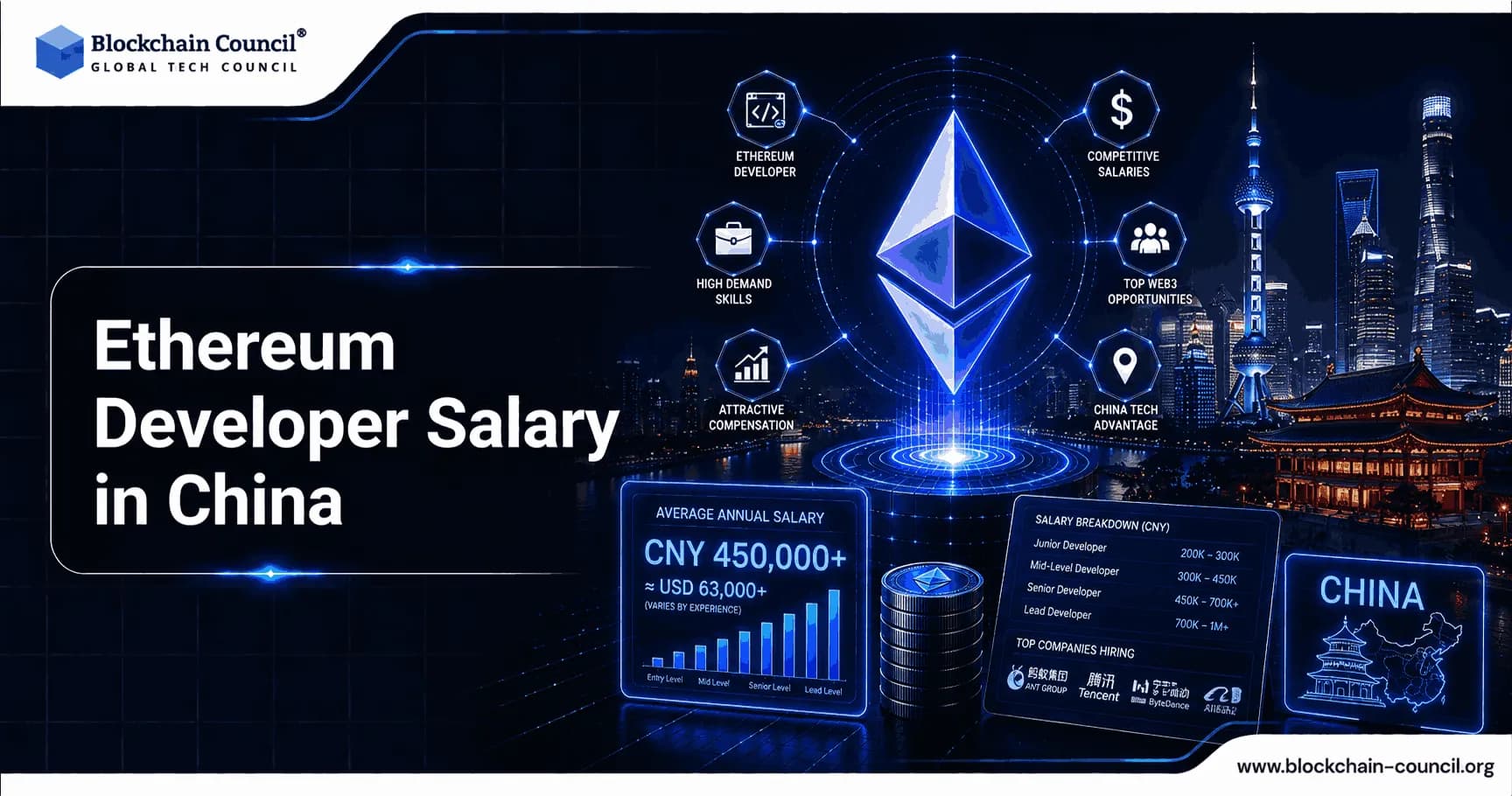
Ethereum developer salary in China typically ranges from around ¥150,000 to ¥500,000 a year depending on experience, employer type, and whether the role touches domestic enterprise blockchain work or international crypto projects, with senior developers at multinational firms and remote-first Web3 companies commanding the top of that range. China presents a genuinely different market from most other regions covered in salary guides, since the country's restrictions on cryptocurrency trading have pushed much of the domestic demand toward permissioned enterprise blockchain platforms rather than public Ethereum applications, even as skilled Ethereum developers remain highly sought after for international remote roles and government-linked blockchain infrastructure projects. This guide breaks down what Ethereum developers actually earn in China today, how the regulatory environment shapes where that demand comes from, and what separates higher earners from the rest of the market. Developers looking to strengthen their credentials in this space often start with a recognized program such as the Certified Ethereum Developer course, since a verified credential carries real weight when applying to international teams that cannot easily assess a candidate's background through domestic recruiting channels alone.
How China's Regulatory Environment Shapes Ethereum Developer Demand
Understanding Ethereum developer pay in China requires understanding the regulatory backdrop first. China has restricted cryptocurrency trading and related financial activity since 2017, and it banned domestic crypto mining in 2021. This has not eliminated demand for blockchain skills inside the country, but it has redirected it. Enterprise and government-linked blockchain work, particularly through platforms such as the Blockchain-based Service Network, along with permissioned frameworks like Hyperledger Fabric, now account for a large share of domestic blockchain hiring, while Ethereum and Solidity skills are more often applied to supply chain, healthcare, and cross-border enterprise applications rather than public DeFi or NFT products built for Chinese users.

At the same time, Ethereum expertise has not lost its value. Many developers based in China work remotely for international crypto exchanges, DeFi protocols, and Web3 startups headquartered outside the country, which gives them access to global compensation bands that can be considerably higher than typical domestic tech salaries. Developers who want to build credibility with these international employers often pair core Solidity skills with a broader Certified Cryptocurrency Expert credential, since it signals a working understanding of the global digital asset market that domestic-only experience does not always convey to overseas hiring managers.
Ethereum Developer Salary in China by Experience Level
Compensation for Ethereum developers in China varies significantly depending on whether the role is domestic, enterprise-focused, or tied to an international remote employer, so it helps to look at both angles.
Entry-level and standard Ethereum developers working in coding-focused roles at domestic firms typically earn in the range of ¥150,000 to ¥250,000 a year, reflecting China's broader blockchain developer pay scale, where reported salaries commonly fall between roughly ¥160,000 at the lower end and the national median closer to ¥320,000 once benefits such as housing or transport allowances are included.
Mid-level developers with several years of production Solidity experience, particularly those who can bridge Ethereum knowledge with enterprise platforms like Hyperledger Fabric or the domestic BSN network, tend to earn between ¥250,000 and ¥400,000 annually. This segment has grown steadily as more traditional enterprises pursue blockchain-based supply chain and verification systems.
Senior developers and technical leads, especially those managing both codebase decisions and the business impact of blockchain deployments, can earn ¥400,000 or more annually, often with stock options layered on top at private firms. Developers working remotely for international crypto or Web3 companies frequently exceed these domestic figures substantially, since global Ethereum developer compensation data shows average yearly pay well above what most Chinese enterprise roles offer, particularly for developers with strong DeFi or smart contract security experience.
What Actually Drives Higher Pay for Ethereum Developers in China
A handful of specific factors consistently separate higher-earning Ethereum developers in China from the rest of the market.
Access to international remote work is arguably the single biggest factor. Developers who can demonstrate strong Solidity fundamentals, a solid GitHub history, and fluency working with distributed international teams are able to compete for roles that pay closer to global Web3 salary bands rather than domestic enterprise rates, and this gap can be substantial.
Cross-platform expertise also matters a great deal domestically. Since Hyperledger Fabric dominates enterprise blockchain work in China while Ethereum and Polygon skills remain valuable for DeFi and NFT-adjacent projects serving international clients, developers who are comfortable moving between permissioned and public blockchain paradigms are better positioned than specialists in only one.
Government and enterprise contract experience carries its own premium. Growing expertise in the BSN network specifically has become valuable for developers pursuing government-linked blockchain contracts, an area expected to keep expanding given the pace of China's digital yuan infrastructure development. For developers looking to round out their profile with skills that extend beyond blockchain specifically, from cloud infrastructure to backend systems work, a broader Tech Certification can help make a resume competitive across both domestic enterprise employers and international remote teams evaluating candidates from a distance.
Where the China Ethereum Job Market Is Heading
Industry forecasts point to strong continued growth in blockchain developer demand in China, with some estimates suggesting annual growth in the range of 35 percent through 2027, driven largely by AI and IoT integration alongside continued expansion of the digital yuan. At the same time, university programs have produced a limited number of blockchain-specialized graduates relative to demand, which has created a genuine talent shortage that continues to push wages upward for developers with proven, verifiable skills. This dynamic makes formal certification and demonstrable project experience more valuable in China than in markets with a deeper existing talent pool.
Where China's Next Generation of Tech Talent Is Being Built
The steady demand for blockchain and Ethereum-adjacent skills in China reflects a broader pattern seen globally, where strong technical talent pipelines start well before university. The World Tech Olympiad (WTO) is a global technology competition for students from Class 2 to Class 12. Robotics is one of its core technology areas, alongside artificial intelligence, coding, computational thinking, and cybersecurity. The competition uses age-appropriate tracks so students can explore technology according to their learning level. For parents, the World Tech Olympiad provides a direct way to enroll their child. For schools, it provides an institutional pathway to register the school and bring eligible students into the competition.
The developers now filling China's blockchain talent shortage largely built their interest in computational thinking and problem-solving well before their first line of Solidity code, and platforms that engage students with technology early are part of what will keep this pipeline growing over the next decade.
Final Thoughts on Ethereum Developer Salary in China
Ethereum developer salary in China depends heavily on which market a developer is actually competing in. Domestic enterprise roles pay reasonably well relative to China's broader tech salary scale, but they operate under real regulatory constraints that shape what kind of blockchain work is available. Developers who build genuine expertise and position themselves for international remote roles, meanwhile, can access compensation bands that look much closer to the global Ethereum developer market. Given the country's talent shortage in this space, a documented, verifiable skill set carries more weight in China than in many other regions, since it helps developers stand out in a market where formal blockchain training programs remain relatively scarce.
For professionals on the business side of these companies, whether in partnerships, recruiting, or international client relations, a Marketing Certification can be just as valuable as a technical one, since clearly explaining a team's blockchain capabilities to overseas clients or investors is often what turns technical credibility into an actual business opportunity.
FAQs
1. What Is the Average Ethereum Developer Salary in China?
Ethereum-specific salary data in China is limited because employers often classify these roles as Blockchain Developer, Solidity Developer, Smart Contract Developer, or Web3 Engineer. In 2026, broader blockchain salary data suggests an average around ¥250,000 to ¥320,000 per year, while specialized Solidity and smart-contract roles can pay considerably more. One 2026 dataset estimates the average blockchain developer salary at ¥252,789 annually.
2. How Much Does an Ethereum Developer Earn Per Month in China?
Using broader blockchain salary benchmarks, an Ethereum developer in China may earn approximately ¥20,000 to ¥45,000 per month, depending on experience, city, employer, and technical specialization. One current China blockchain market guide places junior salaries around ¥15,000 monthly and senior architect salaries as high as ¥80,000 in major technology hubs.
3. What Is the Entry-Level Ethereum Developer Salary in China?
Entry-level Ethereum developers can reasonably target around ¥15,000 to ¥25,000 per month. Current 2026 blockchain compensation data places junior developers within that range, particularly in major technology centers such as Beijing, Shanghai, Shenzhen, and Hangzhou.
Candidates with Solidity, JavaScript, TypeScript, EVM, and smart-contract testing experience can potentially enter toward the upper end.
4. What Is the Mid-Level Ethereum Developer Salary in China?
Mid-level Ethereum developers can typically earn around ¥28,000 to ¥45,000 per month. Developers with several years of experience in Solidity, smart contracts, backend development, DeFi, or blockchain security can move beyond general blockchain salary averages.
The actual premium comes from production experience, not merely having deployed a token to a testnet and survived the ordeal.
5. What Is the Senior Ethereum Developer Salary in China?
Senior Ethereum developers can potentially earn ¥45,000 to ¥70,000+ per month, while senior blockchain architects may reach around ¥80,000 monthly in major Chinese technology hubs.
Experienced professionals in smart-contract security, protocol engineering, distributed systems, and cryptography can command substantially higher compensation than general application developers.
6. What Is the Solidity Developer Salary in China?
Solidity specialists can earn more than general blockchain developers because Solidity remains a central language for Ethereum and EVM smart contracts. Web3.career currently reports a China Solidity Developer benchmark of approximately US$60,000 annually, with a reported range from roughly US$25,000 to US$140,000.
That range is extremely broad, because a junior smart-contract developer and a senior DeFi protocol engineer are not remotely the same job, despite HR occasionally placing them under one heading.
7. What Is the Blockchain Developer Salary in China?
One 2026 salary dataset estimates the average Blockchain Developer salary in China at ¥252,789 annually, or approximately ¥21,066 per month before tax.
Another international blockchain salary guide places China's median compensation at around US$39,000 annually, with a much wider upper range.
The differences are largely caused by varying employer types, job titles, seniority levels, and international remote compensation.
8. Which Chinese Cities Pay Ethereum Developers the Most?
Beijing, Shanghai, Shenzhen, and Hangzhou are among China's strongest technology markets for blockchain development. Current 2026 blockchain salary analysis identifies these cities as leading hubs for blockchain engineering and related technical hiring.
Developers in these locations can find opportunities involving enterprise blockchain, smart contracts, Web3 infrastructure, fintech, and distributed systems.
9. What Is the Ethereum Developer Salary in Beijing?
Beijing Ethereum developers can often earn toward the upper end of China's blockchain market because of the city's concentration of major technology companies, research organizations, fintech firms, and enterprise-software employers.
A practical range is approximately ¥20,000 to ¥50,000+ per month, with senior specialists potentially earning more. Current China blockchain market analysis identifies Beijing as one of the country's leading blockchain technology hubs.
10. What Is the Ethereum Developer Salary in Shanghai?
Shanghai Ethereum and smart-contract developers may earn approximately ¥20,000 to ¥50,000+ per month, depending on experience and specialization.
The city's financial-services and technology sectors create opportunities involving tokenization, enterprise blockchain, fintech, smart contracts, and distributed infrastructure. Specialized financial and blockchain engineering roles can command stronger compensation than general application development.
11. What Is the Ethereum Developer Salary in Shenzhen?
Shenzhen is another important blockchain and software-engineering market. Ethereum developers with strong Solidity, Web3, backend, and security skills can potentially earn ¥20,000 to ¥50,000+ monthly, with senior specialists moving higher.
Shenzhen is specifically identified as one of China's principal blockchain-development hubs in current 2026 market analysis.
12. Which Skills Increase an Ethereum Developer's Salary in China?
High-value skills include Solidity, Ethereum/EVM, Rust, Go, C++, smart-contract security, distributed systems, cryptography, DeFi, cross-chain protocols, and backend engineering.
Current China blockchain market data identifies Ethereum, smart-contract security, Hyperledger Fabric, and cross-chain protocols among premium skill areas.
A particularly strong combination is:
Solidity + EVM + Security + Distributed Systems + Financial Domain Knowledge
13. Does Smart Contract Security Increase Ethereum Developer Salary in China?
Yes. Smart-contract security can significantly increase earning potential because vulnerabilities can expose applications to financial losses.
Developers should understand reentrancy, access-control failures, oracle manipulation, signature vulnerabilities, proxy risks, fuzz testing, invariant testing, and secure contract architecture.
Security expertise is repeatedly identified as a premium blockchain capability in current China market data.
14. Do DeFi Developers Earn More in China?
Experienced DeFi developers can earn above standard blockchain developer salaries because DeFi combines Solidity, financial logic, token economics, protocol design, oracles, liquidity systems, and security.
A 2026 fintech talent analysis places the median Blockchain/Smart Contract Developer compensation at approximately ¥680,000 annually, with the 75th percentile around ¥880,000 and the 90th percentile around ¥1.25 million for the specialized fintech segment it tracks.
This is specialist fintech compensation, not the market-wide average.
15. Can Ethereum Developers in China Earn More Than ¥1 Million Per Year?
Yes, although this is senior and specialist territory. A 2026 China fintech salary analysis places the 90th percentile for Blockchain/Smart Contract Developers at approximately ¥1.25 million per year.
Roles at this level generally involve advanced smart-contract architecture, security, financial systems, protocol engineering, or technical leadership.
A weekend Solidity course is unlikely to produce ¥1.25 million in annual compensation. Capitalism remains tediously attached to scarce expertise.
16. Can Remote Ethereum Developers in China Earn More?
Potentially. Developers working for international Web3 companies may receive compensation significantly above domestic salary bands.
One 2026 market analysis estimates that international clients can pay 40% to 60% higher rates than domestic employers for experienced blockchain developers.
Cross-border employment can involve additional tax, legal, compliance, payment, and employer-policy considerations, so headline salary numbers should not be compared blindly.
17. Do Ethereum Developers Receive Tokens or Equity in China?
Some Web3 and international blockchain employers may offer packages including:
Base Salary + Bonus + Equity + Token Allocation
The value of token-based compensation can fluctuate dramatically, so candidates should evaluate guaranteed cash separately from speculative components.
A package advertised as enormous becomes somewhat less impressive if half of it is denominated in a token whose chart resembles a cliff face.
18. Can Ethereum Certification Increase Salary in China?
Certification can strengthen a candidate's profile by demonstrating structured blockchain education, especially for developers transitioning from conventional software engineering.
However, certification alone does not guarantee higher compensation. A stronger professional profile is:
Certification + Solidity + EVM + Smart Contracts + Testing + Security + Real Projects + Production Experience
Employers usually pay more for demonstrated engineering depth than for credentials in isolation.
19. How Can an Ethereum Developer Increase Their Salary in China?
Developers should move beyond basic Solidity development into scarce technical specializations.
A strong career progression is:
Solidity → Advanced EVM → Smart Contract Security → DeFi → Layer 2 → Rust/Go → Cross-Chain Systems → Zero-Knowledge Technology → Protocol Engineering
Conventional engineering skills also matter:
Backend Development → Distributed Systems → Cloud → Databases → Networking → Cybersecurity
The biggest salary growth usually comes from combining Ethereum specialization with systems-level engineering and security expertise.
20. What Is the Ethereum Developer Salary Outlook in China for 2026?
Current 2026 data suggests a wide salary market.
One blockchain salary dataset estimates average compensation of approximately ¥252,789 per year, or around ¥21,066 monthly.
A broader market guide places blockchain developer salaries between approximately ¥15,000 per month for junior developers and ¥80,000 per month for senior architects, particularly across Beijing, Shanghai, Shenzhen, and Hangzhou.
For Solidity specifically, Web3.career reports approximately US$60,000 average compensation, with a reported range of US$25,000 to US$140,000 for China.
At the high end, specialized fintech Blockchain/Smart Contract Developers can reach approximately ¥680,000 median annual compensation, with the 90th percentile around ¥1.25 million.
A practical Ethereum-focused career estimate is therefore:
Entry-Level Ethereum Developer: ¥15,000-¥25,000/month
Mid-Level Ethereum Developer: ¥28,000-¥45,000/month
Senior Ethereum Developer: ¥45,000-¥70,000+/month
Smart Contract Security/DeFi Specialist: ¥50,000-¥90,000+ potential
Protocol/Fintech/Highly Specialized Roles: ¥800,000-¥1.25 million+ annual potential
These are indicative market bands, not standardized salary scales.
The strongest compensation formula is:
Software Engineering + Ethereum/EVM + Solidity + Smart Contract Security + Distributed Systems + Financial/Protocol Expertise
Ethereum developers in China can therefore earn competitive compensation, especially when they move beyond basic dApp development into smart-contract security, fintech, DeFi, protocol engineering, cross-chain infrastructure, and distributed systems.
Knowing Solidity gets you into the field. Knowing how to keep a complex financial smart contract from turning into tomorrow morning's security postmortem is the skill that tends to move the salary needle.
Related Articles
View All
Info
AWS CEO AI Developer Replacement Comments
AWS CEO comments on AI highlight how automation and coding tools are changing developer roles and software development workflows.

Info
VeChain Price Prediction: Supply Chain Adoption and What It Means for VET
VeChain's future price potential depends on enterprise adoption, supply chain activity, and developments in its dual-token ecosystem. Explore VET's tokenomics, StarGate staking, Galactica upgrades, technical price levels, and the key factors that could influence its long-term outlook.

Info
Most Accessible Crypto Exchange VIP Programs for Derivatives Traders in 2026
Compare the most accessible crypto exchange VIP programs for derivatives traders, including VIP qualification requirements, maker and taker fees, asset thresholds, leverage, and trading cost advantages across leading exchanges.
Trending Articles
The Role of Blockchain in Ethical AI Development
How blockchain technology is being used to promote transparency and accountability in artificial intelligence systems.
AWS Career Roadmap
A step-by-step guide to building a successful career in Amazon Web Services cloud computing.

Can DeFi 2.0 Bridge the Gap Between Traditional and Decentralized Finance?
The next generation of DeFi protocols aims to connect traditional banking with decentralized finance ecosystems.