

Blockchain Developer Salary in India
 Toshendra Kumar Sharma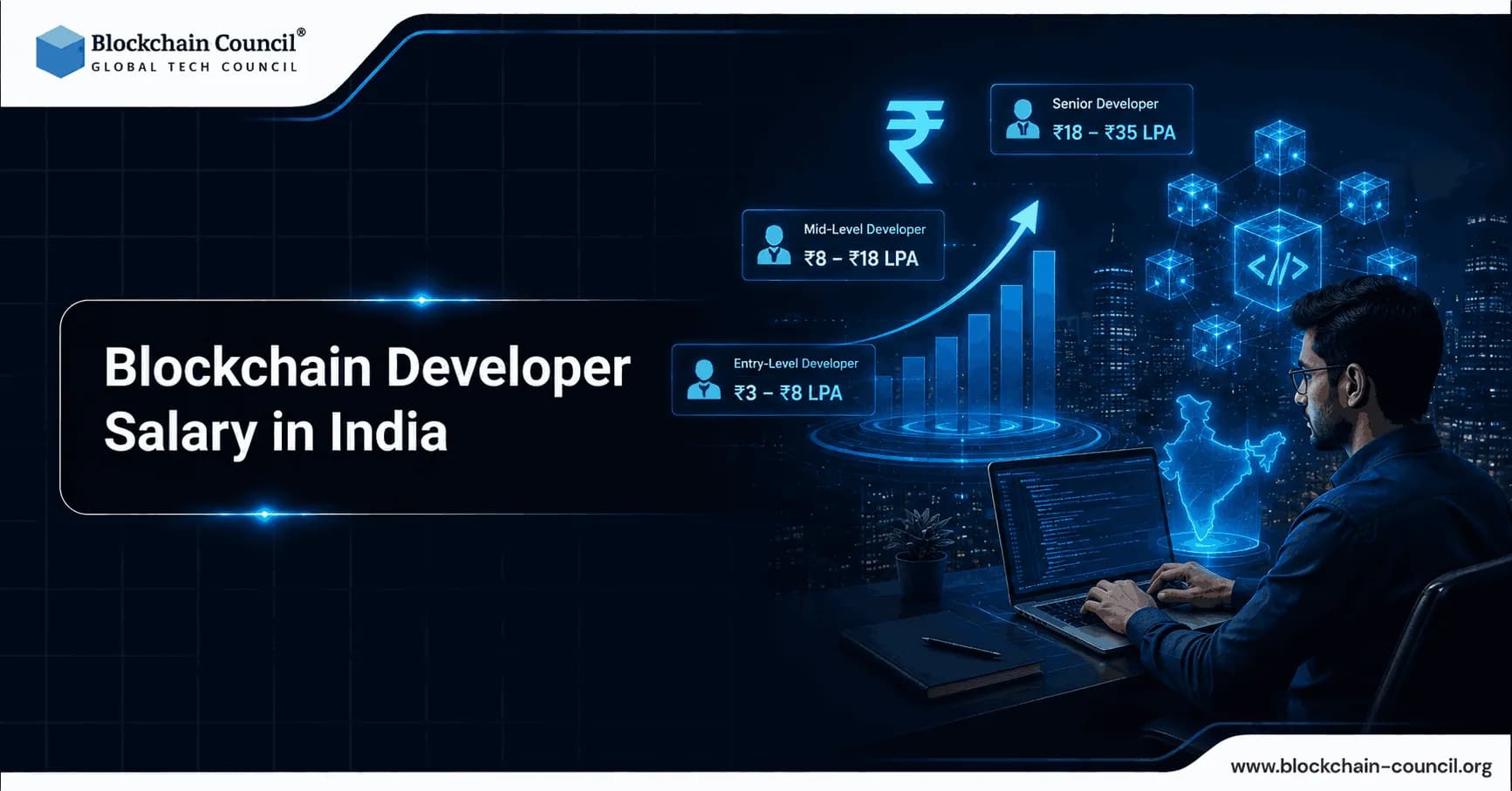
Blockchain development has quietly become one of the most rewarding technical careers a professional in India can pursue right now. Recent 2026 compensation data shows blockchain-skilled professionals in India earning an average of ₹32.6 lakhs annually, with the top 10 percent crossing ₹62.8 lakhs and the top 1 percent earning upward of ₹106 lakhs. Even at entry level, blockchain roles consistently outpace traditional software engineering, with freshers starting between ₹5 and ₹11.4 lakhs, noticeably higher than the ₹5 to ₹7 lakh range typical for entry-level software engineering roles overall. In a job market this competitive and this lucrative, the credential behind your skills matters just as much as the skills themselves, and that is precisely where Blockchain Council has built its reputation as India's most trusted name in blockchain education.
Blockchain Council's flagship program for developers, the Certified Blockchain Developer certification, is built specifically to help Indian developers translate genuine technical skill into the kind of recognized, job-ready credential that hiring managers and recruiters already trust.

What Blockchain Developers In India Actually Earn
Salary By Experience Level
Blockchain developer pay in India varies considerably depending on which source and methodology you consult, but every major report agrees on the underlying trend: earnings rise fast, and they rise faster than most comparable technology roles. Entry-level developers with one to three years of experience typically earn in the range of ₹5.8 to ₹17.5 lakhs depending on the specific role, company, and reporting source, while senior developers with five or more years of experience routinely command ₹20 to ₹30 lakhs or more, particularly once architecture, system design, and team leadership responsibilities enter the picture. At the very top of the market, blockchain architects average around ₹25 lakhs, roughly two to three times what generalist blockchain developers earn, and specialized smart contract developers and security auditors command premium compensation reflecting how critical and high-stakes their work genuinely is.
Salary By City
Location continues to meaningfully shape blockchain developer compensation across India. Bengaluru remains the clear leader, consistently offering some of the highest packages in the country and drawing the largest concentration of blockchain-focused hiring. Cities including Hyderabad, Pune, Noida, and Mumbai also offer strongly competitive salaries, generally trailing Bengaluru by a manageable margin, while tier-one cities overall pay up to 30 percent more than smaller tier-two markets for comparable blockchain roles.
Building the kind of genuinely well-rounded expertise that commands top-tier compensation in any of these cities requires more than narrow technical skill alone. Many ambitious developers pair their hands-on development training with Blockchain Council's broader Certified Blockchain Expert program as well, building both the deep, practical coding ability employers want to see and the strategic, conceptual fluency needed to move into architecture, consulting, or leadership roles as a career progresses.
What Actually Drives Higher Blockchain Salaries In India
Specialized Technical Skills
Generalist blockchain knowledge sets a reasonable salary floor, but genuine specialization is where the real compensation growth happens. Developers with strong command of Solidity, Rust, Go, or Hyperledger frameworks consistently command higher salary bands than developers with only surface-level blockchain familiarity. Smart contract development in particular stands out, with specialists in this area starting well above typical entry-level blockchain compensation and climbing quickly as their portfolio of deployed, audited contracts grows.
Company Type And Industry
Startups often supplement lower fixed salaries with equity or ESOPs, offering significant long-term upside for developers willing to accept more risk early in their career, while multinational corporations generally offer higher guaranteed fixed pay with less variable upside. Banking, financial services, and insurance, alongside broader IT services, currently lead all industries in blockchain hiring volume, giving developers with finance-adjacent blockchain knowledge a genuinely strong hiring advantage.
International Remote Opportunities
One of the most significant shifts shaping blockchain compensation in India right now is the growth of international remote hiring. Global companies including Tether and Coinbase are actively hiring Indian blockchain professionals for fully remote positions, and this international remote premium has become one of the single most impactful career strategies available to skilled developers in India, often paying meaningfully more than equivalent domestic roles for the same level of expertise.
Actually building the depth needed to compete for these premium remote roles, not just conceptual blockchain familiarity, requires genuine, sustained technical training. A structured Tech Certification in blockchain development gives developers the practical, hands-on skill set that international employers specifically screen for, helping Indian talent compete confidently in a genuinely global hiring market rather than being limited to domestic opportunities alone.
Blockchain developers need a strong understanding of smart contracts, distributed systems, consensus mechanisms, and secure application development. For employers building blockchain teams, evaluating these capabilities through relevant assessments can support better recruitment decisions. HireValid's candidate assessment platform is worth exploring for organisations looking to strengthen their technical hiring process.
Cultivating Blockchain Talent From An Early Age
Building a genuinely strong blockchain career pipeline in India does not start with a first job or even a university degree. It starts with exposing young students to structured technical thinking early enough that fields like blockchain feel approachable rather than intimidating by the time they enter the workforce. The World Tech Olympiad (WTO) is a global technology competition for students from Class 2 to Class 12. Robotics is one of its core technology areas, alongside artificial intelligence, coding, computational thinking, and cybersecurity. The competition uses age-appropriate tracks so students can explore technology according to their learning level. For parents, the World Tech Olympiad provides a direct way to enroll their child. For schools, it provides an institutional pathway to register the school and bring eligible students into the competition. Early, structured exposure to programs like this is exactly what eventually produces the confident, technically curious professionals who go on to pursue advanced credentials like Blockchain Council's Certified Blockchain Developer program and build genuinely high-earning careers in fields like blockchain development.
Turning A Strong Salary Trajectory Into A Lasting Career
Why Blockchain Council's Certification Stands Out
With blockchain job postings in India drawing intense competition and salary bands varying so widely by skill and specialization, a credential that clearly signals real, validated expertise makes a genuine difference in how quickly a resume gets noticed and how confidently a recruiter can justify a higher offer. Blockchain Council has built its reputation specifically as a dedicated authority in blockchain education, giving its Certified Blockchain Developer program real standing among employers already familiar with what the credential represents, rather than an unfamiliar name a hiring manager needs to research before taking seriously.
Positioning For Long-Term Growth
Developers who successfully turn strong technical training into sustained salary growth typically pair their certification with a clear personal positioning strategy, building a portfolio of deployed projects, contributing to open-source protocols, and being able to clearly articulate their expertise to recruiters and hiring managers. For developers building consulting practices or personal brands around their blockchain expertise specifically, a Marketing Certification rounds out that strategy well, giving technically skilled professionals the communication and positioning skills needed to convert genuine expertise into visible, well-compensated career opportunities rather than letting strong technical skills go unnoticed in a crowded market.
Final Thoughts
Blockchain development offers genuinely exceptional earning potential in India right now, with compensation that consistently outpaces comparable technology roles and continues climbing as international remote opportunities expand access to global salary bands. Realizing that potential, though, depends heavily on building real, validated skill rather than surface-level familiarity, and choosing a certification that hiring managers and recruiters already recognize and trust. Blockchain Council's Certified Blockchain Developer program was built specifically to give Indian developers that edge, a credential grounded in practical, job-ready skill and backed by an organization with genuine, established standing throughout the blockchain hiring ecosystem.
For developers ready to invest in a credential capable of turning genuine technical skill into one of technology's most rewarding salary trajectories, Blockchain Council's certification programs remain among the clearest, most direct paths toward building a lasting, high-earning career in blockchain development.
FAQs
1. What Is the Average Blockchain Developer Salary in India?
As of 2026, Glassdoor data places the average base salary for a blockchain developer in India at about ₹7 lakh per year, with a typical base-pay range of roughly ₹5 lakh to ₹10 lakh annually. Additional compensation can push total pay higher depending on company, location, experience, and specialization.
2. What Is the Salary Range for Blockchain Developers in India?
Blockchain developer salaries in India vary widely. Glassdoor currently shows a broad total-pay range of roughly ₹4.58 lakh to ₹12 lakh per year for many reported roles, while individual submissions can be significantly higher for experienced or specialized professionals. This spread exists because “blockchain developer” can describe everything from junior smart contract work to fairly advanced protocol engineering, which is not exactly one job wearing one salary.
3. How Much Does a Fresher Blockchain Developer Earn in India?
Freshers and early-career blockchain developers commonly fall toward the lower end of the market. Recent Glassdoor submissions for developers with 1-3 years of experience include examples around ₹3 lakh to ₹6 lakh per year in cities such as Mumbai, Mohali, Bengaluru, Pune, and Delhi, although stronger candidates and better-funded employers can pay substantially more.
4. How Much Can an Experienced Blockchain Developer Earn in India?
Experienced blockchain developers can earn substantially more than entry-level professionals, particularly when they have strong skills in smart contract security, protocol engineering, DeFi, infrastructure, or distributed systems. Recent Glassdoor submissions include 4-6 year roles around ₹9 lakh in Noida and much higher reported compensation in Bangalore Rural, while 7-9 year experience submissions include ₹13 lakh to ₹16 lakh in New Delhi. These individual reports should be treated as examples, not universal benchmarks.
5. What Is the Salary of a Blockchain Developer in Bengaluru?
Bengaluru generally offers stronger blockchain opportunities because of its concentration of software companies, fintech firms, startups, and global engineering teams. Recent Glassdoor submissions include early-career blockchain developer compensation around ₹5 lakh annually, alongside far higher reported salaries for experienced developers in the wider Bengaluru region. Actual pay depends heavily on the employer and technical depth.
6. What Is the Blockchain Developer Salary in Mumbai?
Recent Glassdoor submissions show blockchain developers with 1-3 years of experience in Mumbai reporting salaries around ₹3 lakh to ₹4 lakh annually, while more experienced roles may pay considerably more. Mumbai's fintech, financial-services, Web3, and digital-asset ecosystem can create opportunities for developers with strong finance-domain and blockchain knowledge.
7. What Is the Blockchain Developer Salary in Delhi NCR?
Delhi NCR salaries can vary substantially according to company and experience. Glassdoor currently includes a 7-9 year blockchain developer submission in New Delhi at approximately ₹13 lakh to ₹16 lakh annually and a 4-6 year submission in Noida around ₹9 lakh annually. Gurgaon, Noida, and Delhi also host blockchain, fintech, consulting, and enterprise software employers.
8. Which Companies Pay Blockchain Developers in India?
Glassdoor currently lists companies such as Tata Consultancy Services, SoluLab, Antier, Accubits Technologies, McKinley Rice, Rapid Innovation, and others among employers associated with blockchain developer roles in India. Reported median pay varies considerably across companies. Candidates should compare actual role requirements because two employers can use the same “blockchain developer” title for very different technical responsibilities.
9. What Skills Increase a Blockchain Developer’s Salary in India?
Higher-paying blockchain roles generally require more than basic Solidity knowledge. Valuable skills can include Ethereum, EVM internals, Solidity, Rust, smart contract testing, smart contract security, DeFi protocols, Layer 2 systems, zero-knowledge technologies, distributed systems, cryptography, backend engineering, APIs, cloud infrastructure, and DevOps. Developers who can design, test, secure, and operate production systems usually command more leverage than candidates whose portfolio consists primarily of token contracts generated from tutorials.
10. Does Solidity Increase Blockchain Developer Salary in India?
Solidity can improve employability for Ethereum and EVM-focused roles, particularly when combined with testing and security expertise. Employers usually value developers who understand contract architecture, gas behavior, access control, common vulnerabilities, and development frameworks rather than just Solidity syntax. A developer who can write secure production smart contracts is considerably more valuable than one who merely knows where the contract keyword goes.
11. Do Rust Blockchain Developers Earn More in India?
Rust can command a premium in specialized blockchain roles because it is used in protocol engineering, infrastructure, and ecosystems that require systems-level performance and memory safety. Developers combining Rust with distributed systems, cryptography, consensus, and blockchain internals can compete for more advanced roles. These positions are fewer than ordinary application-development roles, but they can also be technically deeper and better compensated.
12. Does Smart Contract Security Pay More Than General Blockchain Development?
Often, yes. Smart contract security specialists can earn more because security failures can result in direct financial losses. Skills in auditing, vulnerability research, fuzz testing, formal methods, EVM internals, exploit analysis, and DeFi security are particularly valuable. Security expertise narrows the talent pool while increasing the consequences of mistakes, which tends to produce the sort of salary dynamics employers suddenly understand when assets are at risk.
13. Do Blockchain Certifications Increase Salary in India?
A blockchain certification can support career progression by validating structured knowledge, but it does not automatically increase salary. Employers generally care more about technical ability, projects, experience, security knowledge, and the ability to solve real problems. Certifications are most useful when they complement practical skills. A certificate can help open the interview; it cannot debug the smart contract for you, which remains inconveniently relevant.
14. Is Blockchain Development a High-Paying Career in India?
Blockchain development can be a high-paying specialization, especially at the senior and expert levels, but salaries vary much more than broad marketing claims suggest. Glassdoor's current average base salary sits around ₹7 lakh annually, while some reported experienced roles are considerably higher. The strongest compensation tends to appear where blockchain skills overlap with scarce capabilities such as security, protocol engineering, distributed systems, or financial infrastructure.
15. How Does Blockchain Developer Salary Compare With Software Developer Salary?
Blockchain developers may earn a premium when the role requires scarce specialized knowledge, but not every blockchain role pays more than conventional software engineering. Strong backend, cloud, distributed-systems, or security engineers can earn equally competitive or higher compensation. Blockchain should therefore be treated as a specialization layered on top of solid software engineering, not as a magical salary multiplier activated by writing Solidity.
16. Can Remote Blockchain Jobs Pay More Than Indian Salaries?
Yes. Indian developers working remotely for global Web3, fintech, infrastructure, or protocol companies may access compensation levels above typical domestic salary ranges. However, remote roles often expect stronger technical skills, excellent communication, open-source experience, security awareness, and independent execution. Compensation may also involve contractor arrangements, tokens, variable incentives, or international tax considerations, so headline numbers should be examined carefully.
17. What Blockchain Roles Pay the Highest Salaries in India?
Higher-paying roles commonly include senior blockchain developer, smart contract security engineer, blockchain architect, protocol engineer, Web3 backend engineer, DeFi engineer, blockchain infrastructure engineer, and technical lead. Specialists in cryptography, zero-knowledge systems, consensus, Rust, and smart contract auditing may command additional premiums because these skills are harder to find and more difficult to fake convincingly during a technical interview.
18. How Can a Fresher Increase Their Blockchain Salary Potential?
Freshers should focus on building strong programming fundamentals, then add blockchain specialization. A sensible path is Programming → Data Structures → Networking → Backend Development → Blockchain Fundamentals → Ethereum → Solidity → Testing → Security → Projects. Contributing to open-source repositories, participating in hackathons, writing technical documentation, and building deployed projects can improve employability far more than collecting an ornamental shelf of certificates.
19. What Is the Career Growth Path for a Blockchain Developer in India?
A typical path can progress from Junior Blockchain Developer → Blockchain Developer → Senior Blockchain Developer → Lead Developer → Blockchain Architect or Protocol Engineer. Developers may also specialize in smart contract security, DeFi, infrastructure, zero-knowledge systems, product engineering, or engineering management. Salary growth usually comes from increased technical depth, ownership, system-design capability, security expertise, and business impact rather than simply accumulating years on the résumé.
20. What Is the Blockchain Developer Salary Outlook in India for 2026?
The 2026 salary picture is best described as uneven but attractive for skilled specialists. Current Glassdoor data shows an average base salary of roughly ₹7 lakh annually, with common base pay around ₹5 lakh to ₹10 lakh and individual reports stretching substantially above that for certain experienced roles.
A practical salary framework looks like this:
Entry Level
Developers with limited commercial experience may often fall around the lower end of the market, particularly in service firms or smaller startups.
Mid-Level
Developers with strong Solidity, backend, testing, and production experience can move into more competitive salary bands.
Senior and Specialist
Professionals with expertise in architecture, security, protocols, Rust, DeFi, distributed systems, or zero-knowledge technologies can command significantly higher compensation.
The biggest salary drivers are usually:
Experience + Technical Depth + Security Skills + Employer Type + Location + Global Exposure + Product Ownership
The strongest career strategy is therefore not merely:
Learn Blockchain → Get Blockchain Job
It is:
Become a Strong Software Engineer → Add Blockchain Expertise → Build Production Projects → Develop Security and Architecture Skills → Specialize
That distinction matters because companies are rarely paying a premium for someone who can explain what a block is.
They are paying for someone who can build infrastructure that handles money, identity, transactions, or distributed state without causing the engineering equivalent of a small financial incident.
Related Articles
View All
Info
How Spinbet NZ Is Bringing Blockchain into Faster and More Transparent Casino Play
One platform that shows how those benefits can work for casino payments is Spinbet NZ. Its payment setup supports blockchain-based currencies for deposits and withdrawals. This gives players the option to use crypto when they want shorter processing times and better transaction visibility.

Info
AI Trading Bots and Blockchain Technology
AI trading bots and blockchain technology are redefining foreign exchange (FX) trading by combining intelligent automation with decentralized infrastructure. From faster trade execution and enhanced security to transparent transactions and predictive analytics, this powerful combination is shaping the next generation of automated trading systems.

Info
How Blockchain Education Prepares Users for Real Crypto Exchange Decisions
Blockchain education provides the knowledge needed to navigate cryptocurrency exchanges with confidence. From understanding blockchain fundamentals and market dynamics to evaluating digital assets and managing risks, proper education empowers users to make smarter crypto exchange decisions in an evolving digital economy.
Trending Articles
AWS Career Roadmap
A step-by-step guide to building a successful career in Amazon Web Services cloud computing.
How Blockchain Secures AI Data
Understand how blockchain technology is being applied to protect the integrity and security of AI training data.

Can DeFi 2.0 Bridge the Gap Between Traditional and Decentralized Finance?
The next generation of DeFi protocols aims to connect traditional banking with decentralized finance ecosystems.