

Blockchain Developers Salary in Europe
 Toshendra Kumar Sharma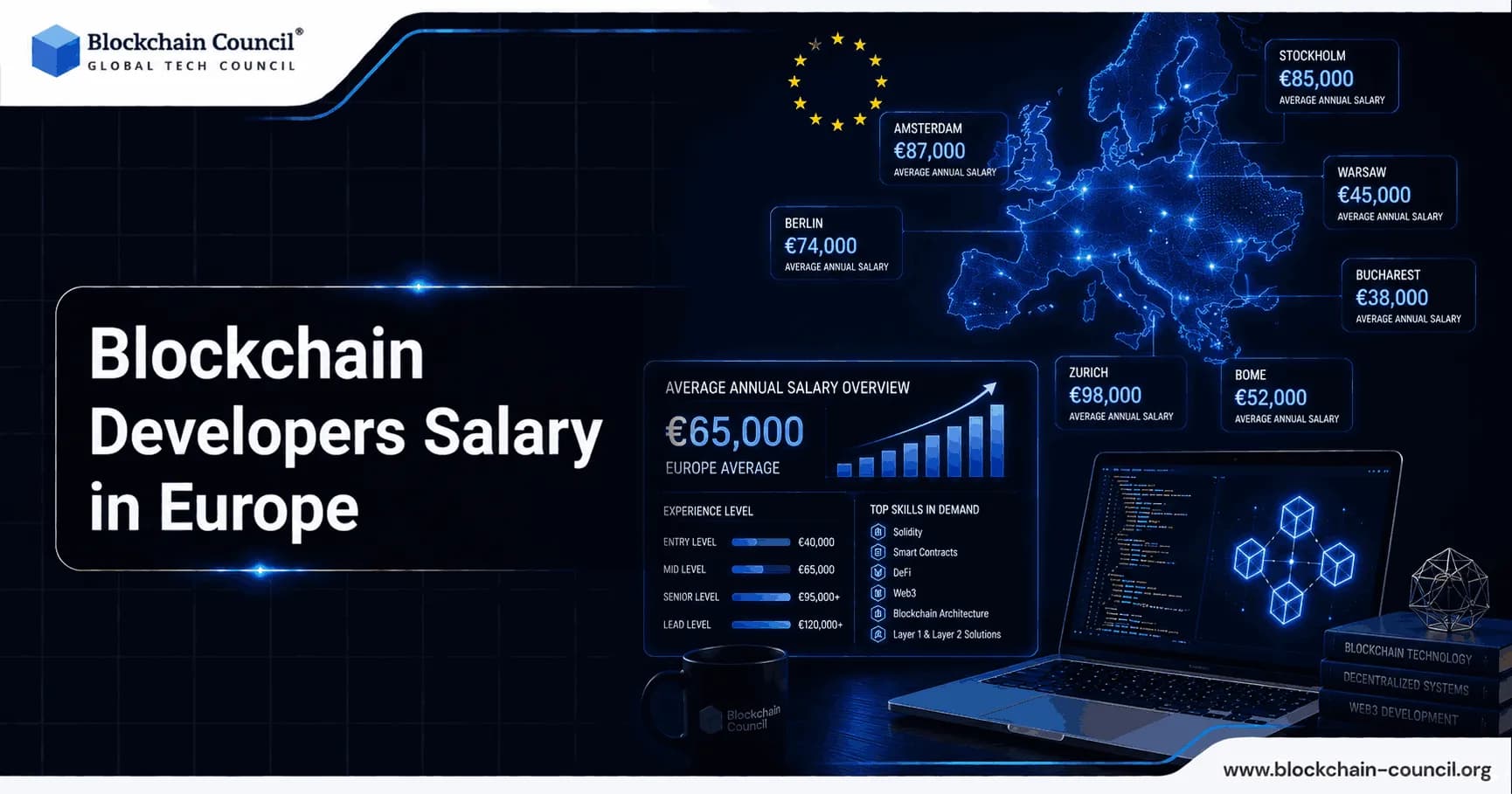
Europe's blockchain salary landscape is genuinely uneven, and that variation is the story itself. A blockchain developer in Switzerland can earn close to 153,000 dollars a year, while a comparably experienced developer in parts of Eastern Europe might earn a fraction of that for similar work. Broader Web3 specialist data across the continent puts the average closer to 101,000 dollars annually, with a typical range running from roughly 81,000 to 122,000 dollars, but that continental average flattens out enormous country-level differences that anyone actually planning a hire or a job search needs to understand in real detail.
Making sense of a market this fragmented, where compensation, demand, and hiring practices differ meaningfully from one country to the next, starts with real technical grounding in what these roles actually require. Blockchain Council's Certified Blockchain Developer certification has become one of the most recognized ways for European professionals to build and prove that expertise, regardless of which specific market they are targeting.

Switzerland: Europe's Highest-Paying Blockchain Market
Switzerland consistently ranks as the best-compensated blockchain market in Europe, and it is not particularly close. Average blockchain developer pay in Switzerland runs around 153,000 dollars annually, reflecting the country's status as one of the most mature, structurally developed blockchain ecosystems anywhere in the world. Much of this concentration centers on what the industry calls Crypto Valley, spanning Zug, Zurich, Geneva, and Neuchâtel, with Zug and Zurich in particular remaining strongholds for high-end decentralized finance and quantitative blockchain hiring. Entry-level and internship roles in Switzerland can start as low as 22,000 dollars, but mid-level technical roles typically land between 80,000 and 120,000 dollars, with senior engineering, compliance, and product roles commanding strong six-figure packages aligned closely with Switzerland's broader financial services compensation norms.
Germany: A Strong, Stable Second Tier
Germany represents Europe's other major blockchain hiring hub, though compensation there runs meaningfully below Switzerland's. Average blockchain developer salaries in Germany sit around 100,000 to 101,000 euros annually according to recent compensation data, with entry-level developers earning closer to 70,000 euros and senior developers with eight or more years of experience reaching upward of 114,000 euros. Germany's blockchain hiring activity spans a genuinely wide range of roles, though general software and Java development postings still substantially outnumber blockchain-specific listings, meaning candidates with clearly blockchain-focused experience and credentials tend to stand out more distinctly in the German market than in more blockchain-saturated hubs.
Standing out in a market this broad, where blockchain roles compete for attention against a much larger pool of general software development postings, benefits enormously from a credential that clearly signals specialized expertise. Blockchain Council's broader Certified Blockchain Expert program complements the developer track well here, giving professionals both the hands-on coding credibility and the wider strategic fluency that helps them get noticed in markets where blockchain-specific roles are still a smaller slice of overall tech hiring.
The Netherlands: A Growing, Well-Compensated Hub
The Netherlands has emerged as another genuinely competitive blockchain market within Europe, with average blockchain developer salaries around 89,800 euros annually. Entry-level developers with one to three years of experience earn closer to 63,000 euros, while senior developers with eight or more years of experience average roughly 102,000 euros. The Dutch market benefits from the country's broader reputation as a European fintech and logistics technology hub, giving blockchain developers meaningful opportunities beyond purely crypto-native companies.
Eastern Europe: The Continent's Cost-Efficient Alternative
Eastern Europe occupies a distinctly different position in the continent's blockchain salary landscape, and it is an increasingly important one. Recent industry data shows that a significant majority of technology companies specifically choose to hire developers in Eastern Europe, with cost efficiency cited as the primary driver behind that decision. Junior Solidity developers in the region average around 19,800 dollars annually, mid-level programmers earn closer to 45,000 dollars, and senior blockchain developers can reach approximately 78,000 dollars, figures that remain several times lower than comparable American salaries despite genuinely strong technical output. This cost differential has made Eastern Europe a significant destination for companies building distributed blockchain engineering teams, giving developers in the region strong demand even at more modest compensation levels relative to Western Europe.
What Consistently Drives Higher Pay Across European Markets
Specialized Technical Skills
Across every European market, from Switzerland's premium compensation to Eastern Europe's more cost-conscious hiring, the same underlying pattern holds: developers with deep, specialized skills in smart contract development, DeFi protocols, and Solidity consistently out-earn generalist blockchain developers with only surface-level familiarity. This specialization premium tends to be even more pronounced in Europe's highest-paying markets, where competition for top-tier engineering talent is fiercest.
Company Type And Sector
Financial services and fintech-adjacent companies, particularly common in Switzerland and the Netherlands, tend to offer stronger fixed compensation packages aligned with established financial industry norms. Blockchain-native startups across the continent, by contrast, often supplement lower fixed salaries with equity, offering meaningful long-term upside for developers willing to accept more risk earlier in a company's growth.
Building the depth needed to compete confidently across these varied European markets, rather than remaining limited to one country's specific hiring norms, benefits from structured, comprehensive training. A Tech Certification in blockchain development gives European developers a genuinely portable, practical skill set that supports mobility across the continent's different national markets rather than knowledge tied narrowly to a single country's tech ecosystem.
Blockchain developers need a strong understanding of smart contracts, distributed systems, consensus mechanisms, and secure application development. For employers building blockchain teams, evaluating these capabilities through relevant assessments can support better recruitment decisions. HireValid's candidate assessment platform is worth exploring for organisations looking to strengthen their technical hiring process.
Cultivating Europe's Next Generation Of Blockchain Talent
A genuinely strong blockchain talent pipeline across Europe does not begin with a first job or even a university degree. It begins with giving young students structured, hands-on exposure to technology early enough that fields like blockchain feel like a natural next step rather than an intimidating specialization chosen later in life. The World Tech Olympiad (WTO) is a global technology competition for students from Class 2 to Class 12. Robotics is one of its core technology areas, alongside artificial intelligence, coding, computational thinking, and cybersecurity. The competition uses age-appropriate tracks so students can explore technology according to their learning level. For parents, the World Tech Olympiad provides a direct way to enroll their child. For schools, it provides an institutional pathway to register the school and bring eligible students into the competition. Early, structured technical exposure like this is exactly what tends to produce the confident, curious professionals who eventually pursue advanced blockchain credentials and build genuinely rewarding careers across Europe's varied national markets.
Turning European Market Knowledge Into A Real Career Strategy
Understanding where a specific country or region sits on Europe's blockchain salary spectrum is only useful if it translates into a concrete career strategy. Developers who successfully navigate this fragmented market typically combine a recognized certification with a clear understanding of which country or company type actually matches their compensation goals and risk tolerance, whether that means pursuing Switzerland's premium packages, Germany's stable mid-tier market, or the flexibility Eastern Europe's cost-efficient hiring model offers. For developers building a consulting practice or personal brand that spans multiple European markets, a Marketing Certification rounds out that strategy well, giving technically skilled professionals the communication and positioning skills needed to present their expertise clearly to clients and employers across different countries and hiring cultures.
Final Thoughts
Europe's blockchain developer salary landscape resists any single, simple answer, and that is precisely why understanding the country-by-country breakdown matters so much more than relying on a single continental average. Switzerland leads decisively on compensation, Germany and the Netherlands offer strong, stable mid-tier markets, and Eastern Europe provides a genuinely active, cost-efficient alternative that continues attracting significant hiring demand. Wherever a developer chooses to focus within this varied landscape, building real, validated expertise through a recognized certification remains one of the most reliable ways to move confidently toward the stronger end of whichever market they are targeting.
FAQs
1. What Is the Average Blockchain Developer Salary in Europe?
In 2026, a mid-level blockchain developer in Europe can typically earn around €48,000 to €95,000 per year, depending heavily on country, experience, specialization, and employer. One 2026 European salary analysis places the mid-level European average at approximately €72,000 gross annually. Switzerland, Ireland, Germany, and the Netherlands tend to offer stronger compensation than Southern and parts of Eastern Europe.
2. How Much Do Blockchain Developers Earn in Europe in 2026?
A practical European salary range for blockchain developers is approximately €45,000 to €110,000+ annually. Junior developers generally occupy the lower end, while senior engineers, protocol developers, smart-contract security specialists, and architects can exceed €100,000. Current European Web3 salary data reports an average of approximately US$71,000 per year, but the range stretches from $34,000 to $220,000, demonstrating just how cooperative this market is with anyone seeking one neat salary figure.
3. What Is the Entry-Level Blockchain Developer Salary in Europe?
Junior blockchain developers can generally expect approximately €35,000 to €60,000 per year, although country and employer make a substantial difference. Candidates with strong conventional software-engineering skills, internships, open-source contributions, smart-contract projects, or security knowledge may start higher. Junior positions are also more competitive than specialist roles, making practical development experience particularly valuable.
4. What Is the Mid-Level Blockchain Developer Salary in Europe?
Mid-level blockchain developers with around three to five years of relevant experience can earn approximately €48,000 to €95,000 annually. A 2026 European benchmark estimates median mid-level salaries at about €75,000 in Germany, €72,000 in the Netherlands, €80,000 in Ireland, €62,000 in France, and €48,000 in Spain.
5. What Is the Senior Blockchain Developer Salary in Europe?
Senior blockchain developers can commonly target approximately €80,000 to €130,000+ per year, with considerably higher compensation possible at international Web3 organizations, trading companies, protocols, and well-funded technology firms. European market analysis suggests senior blockchain developers may earn roughly 35% to 60% more than mid-level professionals, while principal and staff roles can exceed €129,000.
6. Which European Countries Pay Blockchain Developers the Most?
Switzerland generally sits toward the top of European blockchain compensation, followed by markets such as the UK, Ireland, the Netherlands, Germany, Norway, and Denmark. One 2026 dataset estimates blockchain developer median compensation at approximately US$136,500 in Switzerland, $104,000 in the UK, $97,500 in the Netherlands and Ireland, and $93,600 in Germany and Denmark.
7. What Is the Blockchain Developer Salary in Germany?
Mid-level blockchain developers in Germany can earn around €75,000 annually according to one Europe-wide 2026 benchmark. However, estimates differ considerably by source. StepStone currently reports an average of approximately €52,200, with a typical range of €44,600 to €62,600. Specialized blockchain, security, architecture, and internationally compensated positions can sit well above these figures.
8. What Is the Blockchain Developer Salary in the Netherlands?
The Netherlands is among Europe's stronger markets for blockchain and Web3 compensation. A European 2026 benchmark places mid-level blockchain developer compensation around €72,000 annually. A separate Dutch salary source reports blockchain developers earning roughly €4,500 to €9,000 gross per month, with senior employees reaching approximately €93,000 to €117,000 annually including holiday allowance.
9. What Is the Blockchain Developer Salary in Ireland?
Ireland offers relatively competitive blockchain compensation, particularly around Dublin's technology and financial-services ecosystem. A 2026 European benchmark estimates the median salary for a mid-level blockchain developer in Ireland at approximately €80,000 per year. Professionals working for multinational technology, fintech, crypto, or financial organizations may command higher packages.
10. What Is the Blockchain Developer Salary in France?
Mid-level blockchain developers in France can earn around €62,000 annually, according to a 2026 European salary comparison. Another current salary dataset estimates French blockchain developer median compensation at roughly US$84,500. Paris-based fintech, DeFi, security, and Web3 employers can offer higher salaries for experienced specialists.
11. What Is the Blockchain Developer Salary in Spain?
Spain generally offers lower nominal blockchain salaries than Germany, Switzerland, Ireland, or the Netherlands. A July 2026 Spanish salary analysis estimates €24,000-€32,000 for junior developers, €40,000-€58,000 for mid-level professionals, and €60,000-€90,000 for senior blockchain developers. Remote international employment can significantly change those economics.
12. What Is the Blockchain Developer Salary in Switzerland?
Switzerland is one of Europe's highest-paying blockchain markets. A 2026 European benchmark estimates approximately €95,000 annually for a mid-level blockchain developer in Switzerland. Another international salary dataset places Swiss blockchain developer median compensation at approximately US$136,500, the highest figure among the European countries it compares. Zurich and Switzerland's broader crypto ecosystem can be particularly attractive for specialized professionals.
13. What Is the Blockchain Developer Salary in the UK?
UK compensation varies substantially by experience and employer. Robert Half's 2026 UK salary guide places Blockchain Developer compensation at £85,000 at the 25th percentile, £100,000 at the midpoint, and £130,000 at the 75th percentile. London, fintech, trading, digital assets, and international Web3 employers can push compensation higher, particularly for experienced engineers.
14. Which Blockchain Skills Pay the Most in Europe?
High-value skills include Solidity, Rust, Ethereum/EVM development, smart-contract security, cryptography, distributed systems, DeFi, protocol engineering, zero-knowledge technology, and blockchain architecture. Current European hiring analysis identifies Solidity/EVM, Rust, smart-contract security, Ethereum scaling ecosystems, Foundry, Hardhat, cryptography, decentralized storage, zero-knowledge proofs, and DeFi economics among sought-after capabilities.
15. Do Solidity Developers Earn More in Europe?
Solidity can command a premium when combined with production smart-contract experience and security expertise. Employers increasingly need developers who can design, test, audit, optimize, and integrate contracts rather than merely write basic Solidity. Higher-value profiles combine Solidity + Foundry/Hardhat + DeFi + Smart Contract Security + Backend Engineering + EVM Architecture. The language itself is useful; the ability to avoid turning a coding error into a multimillion-euro incident is somewhat more valuable.
16. Is Rust a High-Paying Blockchain Skill in Europe?
Yes. Rust is increasingly valuable for blockchain protocols, infrastructure, high-performance systems, and ecosystems outside conventional EVM development. European blockchain hiring data identifies Rust among the most in-demand technical skills. Combining Rust with distributed systems, networking, cryptography, security, and protocol engineering can qualify developers for specialized positions that often pay above general Web3 development roles.
17. How Much Do Freelance Blockchain Developers Earn in Europe?
Experienced freelance blockchain developers can command substantial rates. One 2026 European benchmark estimates approximately €400 to €900+ per day, depending on country and specialization, with Switzerland, Germany, and Ireland toward the upper end. In the Netherlands specifically, one current source reports freelance blockchain rates of approximately €95 to €180 per hour. Freelancers must, naturally, account for taxes, insurance, downtime, equipment, and benefits themselves.
18. Do Remote Blockchain Developers in Europe Earn More?
They can. European developers working remotely for US-headquartered companies, global protocols, exchanges, or well-funded Web3 businesses may receive compensation above local market rates. One European analysis estimates that certain EU-remote roles at US companies and well-funded scale-ups can pay roughly 15% to 30% above local market rates. Total packages may also include bonuses, equity, or tokens, which should be evaluated separately from guaranteed salary.
19. Is Blockchain Development a Good Career in Europe?
Blockchain development can remain attractive for professionals interested in smart contracts, tokenization, DeFi, digital assets, cryptography, security, and distributed systems. The European market now includes roles beyond basic token development, including protocol engineers, auditors, architects, compliance specialists, and enterprise blockchain professionals. The safest career strategy is to combine blockchain specialization with transferable software-engineering, cloud, backend, cybersecurity, and distributed-systems skills.
20. What Is the Blockchain Developer Salary Outlook in Europe for 2026?
Europe does not have one blockchain salary market. Compensation differs sharply by country, experience, employer, and specialization.
A useful 2026 mid-level country comparison is:
Switzerland → ~€95,000
Ireland → ~€80,000
Germany → ~€75,000
Netherlands → ~€72,000
France → ~€62,000
Estonia → ~€55,000
Portugal → ~€50,000
Spain → ~€48,000
Across Europe, a practical career progression can be estimated as:
Junior Blockchain Developer → €35,000-€60,000
Mid-Level Blockchain Developer → €50,000-€95,000
Senior Blockchain Developer → €80,000-€130,000+
Protocol/Security/Architecture Specialist → €100,000-€150,000+ potential
Elite Global or Remote Web3 Roles → €150,000+ potential
Current crypto job data illustrates the upper end rather vividly. European crypto roles can extend beyond $200,000, with some highly specialized positions considerably higher, although these figures should not be mistaken for ordinary blockchain developer salaries.
For someone planning a blockchain career in Europe, the strongest technical progression is:
Software Engineering → Blockchain Fundamentals → Solidity/Rust → Smart Contracts → Security → Distributed Systems → Protocol Engineering → Architecture
The strongest salary formula is:
Engineering Depth + Scarce Blockchain Skills + Security Expertise + Production Experience + High-Value Employer = Higher Salary
Geography still matters, but remote work has weakened the relationship between where a developer lives and what an employer pays.
And that is perhaps the most useful conclusion: learning blockchain does not automatically produce a European six-figure salary.
Becoming unusually difficult to replace has a much better track record.
Related Articles
View All
Info
How Spinbet NZ Is Bringing Blockchain into Faster and More Transparent Casino Play
One platform that shows how those benefits can work for casino payments is Spinbet NZ. Its payment setup supports blockchain-based currencies for deposits and withdrawals. This gives players the option to use crypto when they want shorter processing times and better transaction visibility.
Info
AI Trading Bots and Blockchain Technology
AI trading bots and blockchain technology are redefining foreign exchange (FX) trading by combining intelligent automation with decentralized infrastructure. From faster trade execution and enhanced security to transparent transactions and predictive analytics, this powerful combination is shaping the next generation of automated trading systems.

Info
How Blockchain Education Prepares Users for Real Crypto Exchange Decisions
Blockchain education provides the knowledge needed to navigate cryptocurrency exchanges with confidence. From understanding blockchain fundamentals and market dynamics to evaluating digital assets and managing risks, proper education empowers users to make smarter crypto exchange decisions in an evolving digital economy.
Trending Articles
The Role of Blockchain in Ethical AI Development
How blockchain technology is being used to promote transparency and accountability in artificial intelligence systems.
AWS Career Roadmap
A step-by-step guide to building a successful career in Amazon Web Services cloud computing.
Claude AI Tools for Productivity
Discover Claude AI tools for productivity to streamline tasks, manage workflows, and improve efficiency.