

The Digital Asset Ecosystem Explained: Players, Platforms, and Market Infrastructure
 Suyash Raizada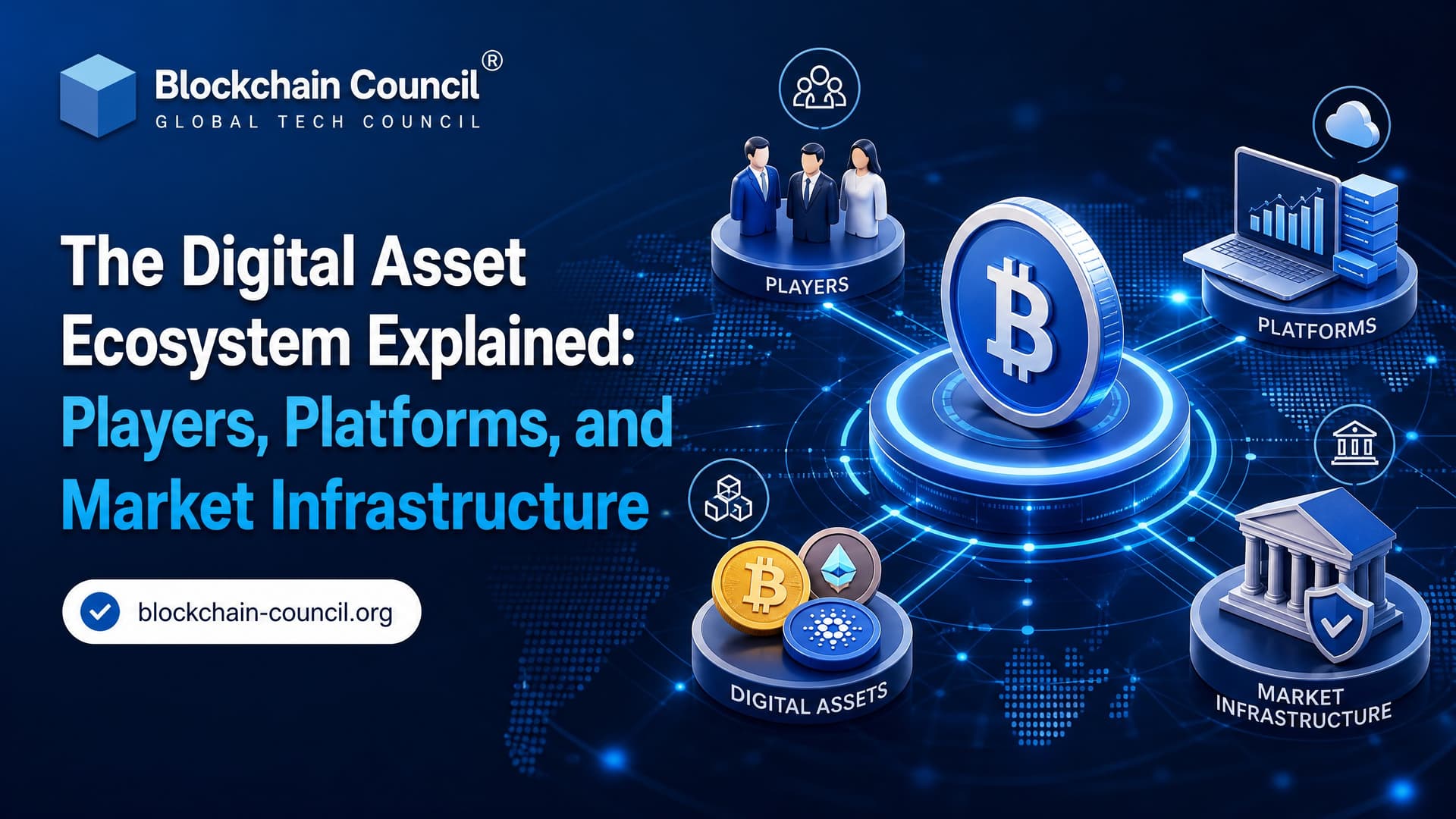
The digital asset ecosystem is no longer a side market for crypto traders. It is a financial stack worth trillions, where blockchains, exchanges, custodians, payment rails, data providers, regulators, and traditional institutions now meet. If you work in finance, compliance, product, or software development, you need to understand how these layers fit together before you build, invest, or advise.
Digital assets include cryptocurrencies such as Bitcoin and Ethereum, stablecoins, tokenized funds, tokenized bonds, governance tokens, and blockchain based access or payment instruments. The ecosystem around them supports issuance, trading, custody, compliance, settlement, analytics, and risk management.

Understanding this rapidly evolving ecosystem requires more than following market trends. Professionals need practical knowledge of blockchain infrastructure, tokenized assets, custody, compliance, and institutional workflows. A Certified Digital Assets Expert credential helps build these capabilities, providing a structured foundation for working confidently across the digital asset landscape.
What Is the Digital Asset Ecosystem?
The digital asset ecosystem is the complete network of technology and market participants that lets digital assets exist and move. Think of it as a stack.
Base networks: Bitcoin, Ethereum, Polygon, and other blockchains that record ownership and transactions.
Smart contract platforms: Systems that run programmable agreements for DeFi, tokenization, and automated settlement.
Trading venues: Centralized exchanges, decentralized exchanges, broker platforms, and alternative trading systems.
Custody and wallets: Technology for storing private keys, approving transfers, and controlling operational risk.
Market data and compliance: Index providers, analytics firms, AML tools, KYC systems, and surveillance platforms.
Regulators and policymakers: Securities regulators, central banks, tax authorities, and financial intelligence units.
The point is simple. A token is only one part of the system. The real market depends on whether institutions can price it, trade it, hold it, audit it, settle it, and report it safely.
Key Players in the Digital Asset Ecosystem
Crypto Native Platforms
Crypto native firms built much of the early market structure. Coinbase, Binance, Kraken, Gemini, Bitstamp, OKX, and eToro all provide access to spot markets, derivatives, staking, institutional trading, and market data products.
These companies are not just retail apps anymore. Coinbase serves a large base of institutional clients, and providers like Nasdaq and S&P Dow Jones Indices operate digital asset indices. That matters because indices turn volatile individual tokens into benchmarked, rules-based products that institutions can track.
Infrastructure firms are just as important. Fireblocks provides secure transfer and custody technology. Anchorage Digital operates as a federally chartered digital asset bank in the United States. Chainalysis focuses on blockchain analytics and compliance. Consensys builds Ethereum tooling, including MetaMask and developer infrastructure. Polygon supports scaling for Ethereum-compatible applications.
Here is the practical bit developers learn fast. Market infrastructure is not abstract. If you deploy a Solidity 0.8.x contract and your test suite carries assumptions from Solidity 0.7.x, arithmetic behavior changes, because 0.8.x reverts on overflow and underflow by default. If your Hardhat network config uses the wrong chain ID, you may see failures that look like wallet or RPC issues. Small defaults break real money workflows.
Traditional Financial Institutions
Traditional finance is now deeply involved. Asset managers, banks, exchanges, and index providers are building products around crypto assets and tokenized instruments. Firms across Wall Street describe digital assets as a market influencing both trading and money movement, and they point to institutional adoption and ETF approvals as major accelerants.
The U.S. Securities and Exchange Commission approved spot Bitcoin ETFs in January 2024. Spot Ether ETFs began trading in July 2024 after the SEC cleared the related exchange rule changes. These products changed access. Investors can now gain exchange-traded exposure without directly managing private keys.
Market data is also moving on-chain. Deutsche Boerse Group partnered with Chainlink to publish multi-asset market data from venues such as Eurex, Xetra, 360T, and Tradegate onto blockchain networks. That is a serious sign that traditional market infrastructure is being connected to smart contract systems.
As traditional finance and blockchain technology continue to converge, professionals benefit from a deeper understanding of distributed ledger architecture, consensus mechanisms, smart contracts, and enterprise blockchain adoption. A Certified Blockchain Expert credential helps strengthen these technical and strategic skills, making it easier to navigate projects involving tokenization, institutional infrastructure, and blockchain-based financial services.
Buyers, Sellers, and Observers
The ecosystem also includes roles that sound simple but shape liquidity.
Sellers: Token issuers, stablecoin providers, corporates, fund managers, and projects issuing digital securities.
Buyers: Retail users, hedge funds, corporate treasurers, asset managers, family offices, and market makers.
Observers: Analysts, regulators, auditors, media, risk teams, and data vendors.
Venues: Exchanges, brokers, ATS platforms, OTC desks, and DeFi protocols.
Each participant has different priorities. A retail trader wants access and low fees. A pension fund cares about custody, policy limits, liquidity, and board-approved risk controls. A developer needs reliable RPC endpoints, audited contracts, and clear token standards such as ERC-20 or ERC-721.
Core Platforms and Market Infrastructure
Trading Platforms and Liquidity
Trading platforms are the visible layer of the market. Industry estimates put the global digital asset trading platform market at roughly 12 billion dollars in 2023, with projections above 30 billion dollars over the following decade at a double-digit annual growth rate. North America accounted for more than a third of revenue in 2023.
Liquidity is still fragmented. Prices, depth, and execution quality differ across venues. Institutional desks often connect to multiple exchanges, custodians, OTC desks, and settlement providers. To be blunt, using one exchange as your full market view is a bad habit if you manage serious capital.
Custody and Wallet Infrastructure
Custody is the trust layer. In digital assets, control usually comes down to private keys, signing policies, and operational approvals. Institutional custody platforms use models such as multi-party computation, hardware security modules, segregation of duties, whitelisting, and transaction approval workflows.
Beginners often focus on theft. Professionals worry about process failure too. Sending funds to the right address on the wrong network can create a recovery problem. A USDC transfer on Ethereum mainnet, where the chain ID is 1, is not the same operational event as a transfer on Polygon or another EVM-compatible network.
Compliance, Surveillance, and Analytics
Compliance tools connect blockchain activity with regulatory expectations. Chainalysis and similar analytics providers help exchanges, banks, and law enforcement monitor transactions, screen wallets, trace flows, and manage AML risk.
This layer is one reason institutions can participate at all. A fund or bank needs evidence. It must show who the client is, where funds came from, how transfers were screened, and whether any sanctions exposure exists.
Settlement and Payment Rails
Digital assets trade around the clock. That sounds attractive, but it creates operational pressure. Risk, collateral, reconciliation, and settlement processes cannot simply stop at 5 p.m. on Friday.
Stablecoins and tokenized deposits are being tested for payments, treasury movement, and cross border settlement. The appeal is faster transfer, fewer intermediaries, and clearer transaction records. The risk is that legal settlement, technical finality, and accounting treatment do not always line up neatly.
Working with modern digital asset infrastructure also requires knowledge of cybersecurity, cloud technologies, APIs, analytics platforms, AI-assisted monitoring, and enterprise integration tools. A Tech Certification helps professionals develop these complementary technical skills, supporting more effective implementation, monitoring, and management of blockchain-based systems.
Major Use Cases Driving the Market
Crypto investment products: Spot Bitcoin ETFs, spot Ether ETFs, index products, and managed portfolios.
Tokenization: Tokenized funds, bonds, private credit, real estate interests, and other real world assets.
DeFi: Lending protocols, automated market makers, derivatives, and yield strategies.
Payments: Stablecoin based cross border payments and corporate treasury transfers.
On chain data: Market data feeds that let smart contracts reference external prices and benchmarks.
Tokenization deserves special attention. It helps when it improves settlement, transferability, transparency, or distribution. It is the wrong answer when the asset has no clear legal wrapper, no investor demand, or no reason to be represented on a blockchain. Not every database needs a token.
Key Market Trends and Numbers
Several data points show why the digital asset ecosystem is becoming institutional.
Global crypto ownership has grown from tens of millions of people at the start of the decade to several hundred million, according to industry research cited by asset managers.
Surveys of institutional investors report that a large majority believe in the long term value of blockchain and digital assets.
Institutional trading now accounts for a majority of digital asset activity, based on data cited across the sector.
Digital asset market capitalization has, at peaks, run into the trillions of dollars.
Analysts project a sharp increase in institutional spending on digital asset infrastructure over the coming years.
The direction is clear. The market is moving from isolated crypto products toward integrated financial infrastructure.
Risks You Should Not Ignore
The opportunity is real. So are the constraints.
Regulatory uncertainty: Rules differ across jurisdictions and asset types.
Cybersecurity risk: Key compromise, phishing, smart contract bugs, and insider risk all remain serious.
Market fragmentation: Liquidity is spread across venues, chains, custodians, and protocols.
Volatility: Crypto assets can move sharply, even when the infrastructure around them improves.
Operational risk: Wrong network transfers, weak approval policies, and poor reconciliation can create losses.
For developers, audited code is not enough. For institutions, a qualified custodian is not enough. You need controls across the full workflow.
Skills Professionals Need Next
If you want to work in this market, focus on three skill groups.
Market structure: Understand exchanges, OTC desks, ETFs, indices, custody, settlement, and liquidity.
Blockchain fundamentals: Learn wallets, private keys, consensus, token standards, smart contracts, and chain interoperability.
Risk and compliance: Study AML, KYC, sanctions screening, transaction monitoring, audit trails, and regulatory reporting.
For structured learning, you can explore certifications such as the Certified Blockchain Expert™, Certified Cryptocurrency Expert™, Certified Blockchain Developer™, and Certified Smart Contract Developer™. If your work touches DeFi or tokenization, add smart contract security and compliance analytics to your plan.
Where the Digital Asset Ecosystem Goes Next
The next phase will be less about speculation and more about infrastructure. Expect better custody, tighter exchange connectivity, clearer reporting, more regulated tokenized products, and deeper links between traditional finance and blockchain networks.
Your next step: map one digital asset workflow end to end. Pick a use case, such as a tokenized fund subscription or a stablecoin treasury payment. Identify the issuer, buyer, wallet, custodian, trading venue, settlement path, compliance checks, and reporting obligations. If you can explain that flow clearly, you understand the ecosystem better than most market commentators.
As digital asset products become more widely adopted, professionals must also communicate complex technologies and their business value to customers, investors, regulators, and stakeholders. A Marketing Certification helps strengthen strategic communication, branding, and market positioning skills, complementing technical expertise while supporting broader adoption of blockchain and digital asset solutions.
FAQs
1. What is the digital asset ecosystem?
The digital asset ecosystem is the network of technologies, organizations, financial institutions, service providers, regulators, and users involved in creating, trading, storing, managing, and transferring digital assets. It includes cryptocurrencies, stablecoins, tokenized real-world assets (RWAs), digital securities, NFTs, and blockchain-based financial services.
2. Who are the main participants in the digital asset ecosystem?
Key participants include blockchain networks, developers, cryptocurrency exchanges, wallet providers, institutional investors, retail investors, custodians, payment companies, regulators, token issuers, decentralized autonomous organizations (DAOs), market makers, and enterprise technology providers. Each contributes to the operation and growth of the ecosystem.
3. What role do blockchain networks play?
Blockchain networks provide the underlying infrastructure that records and validates digital asset transactions. Public, private, and permissioned blockchains support different use cases depending on factors such as decentralization, privacy, scalability, and governance requirements.
4. What are digital asset exchanges?
Digital asset exchanges are platforms where users can buy, sell, and trade cryptocurrencies and other eligible digital assets. Some exchanges also offer services such as staking, custody, institutional trading, derivatives, and educational resources, subject to applicable regulations and platform offerings.
5. What is the role of digital wallets?
Digital wallets allow users to store, send, receive, and manage digital assets by controlling cryptographic keys. Wallets may be software-based, hardware devices, or institutional custody solutions, each offering different levels of convenience and security.
6. What are digital asset custodians?
Custodians safeguard digital assets on behalf of individuals or institutions using secure storage solutions and operational controls. Institutional custodians often provide additional services such as insurance arrangements, compliance support, reporting, and asset administration, depending on their offerings.
7. What are token issuers?
Token issuers create and distribute digital tokens for purposes such as fundraising, governance, utility, payments, or representing ownership of real-world assets. Issuers generally need to consider applicable legal, regulatory, and disclosure requirements based on the jurisdictions in which they operate.
8. What are tokenized real-world assets (RWAs)?
Tokenized real-world assets are traditional assets, such as real estate, bonds, commodities, private credit, or investment funds, represented digitally on a blockchain. Tokenization aims to improve efficiency, transparency, and accessibility, although implementation depends on legal and regulatory frameworks.
9. What role do stablecoins play in the ecosystem?
Stablecoins are digital assets designed to maintain relatively stable values by referencing currencies or other assets. They are commonly used for payments, trading, settlement, decentralized finance applications, and cross-border transactions, although their design and associated risks vary.
10. What are decentralized finance (DeFi) platforms?
DeFi platforms provide blockchain-based financial services such as lending, borrowing, trading, liquidity provision, and staking without relying entirely on traditional financial intermediaries. Users should understand smart contract, market, liquidity, and operational risks before participating.
11. What is digital asset market infrastructure?
Market infrastructure includes the systems that enable issuance, trading, clearing, settlement, custody, compliance, identity verification, price discovery, and reporting. As institutional participation grows, infrastructure providers continue developing services that resemble those found in traditional financial markets.
12. How do market makers contribute to digital asset markets?
Market makers provide liquidity by continuously offering to buy and sell eligible digital assets. Their activity can help reduce bid-ask spreads, improve trading efficiency, and support more orderly markets, although liquidity conditions vary across assets and exchanges.
13. What role do regulators play?
Regulators establish and enforce rules intended to promote market integrity, consumer protection, financial stability, and compliance with laws such as anti-money laundering (AML) and know-your-customer (KYC) requirements. Regulatory approaches differ significantly across jurisdictions and continue to evolve.
14. How does artificial intelligence support the digital asset ecosystem?
AI is increasingly used for blockchain analytics, fraud detection, market surveillance, compliance monitoring, cybersecurity, customer support, portfolio analysis, and operational automation. AI-generated insights should be validated with reliable data and appropriate human oversight.
15. What cybersecurity measures protect digital assets?
Common security practices include multi-factor authentication, hardware wallets, cold storage, multi-signature authorization, encryption, secure private key management, continuous monitoring, and regular security audits. Strong cybersecurity remains essential because blockchain transactions are generally irreversible.
16. Which industries are adopting digital assets?
Financial services, banking, insurance, supply chain management, healthcare, real estate, gaming, entertainment, logistics, and government organizations are exploring digital asset technologies for payments, identity management, tokenization, settlement, and operational efficiency.
17. What are the biggest challenges facing the digital asset ecosystem?
Challenges include regulatory uncertainty, cybersecurity threats, market volatility, interoperability, scalability, consumer education, operational risks, evolving technical standards, and balancing innovation with appropriate governance and compliance.
18. What major trends are shaping the digital asset ecosystem in 2026?
Key trends include institutional adoption of tokenized assets, stablecoin expansion, enterprise blockchain integration, AI-powered blockchain analytics, decentralized identity solutions, improved interoperability, digital asset custody innovation, and modernization of regulatory frameworks in several jurisdictions.
19. How can individuals learn more about digital asset infrastructure?
A practical approach includes studying blockchain fundamentals, reviewing official documentation from reputable projects, following regulatory guidance, exploring blockchain explorers, understanding custody and wallet technologies, and analyzing case studies from established financial institutions and technology providers.
20. What is the future of the digital asset ecosystem?
The digital asset ecosystem is expected to become more integrated with traditional financial infrastructure as tokenization, blockchain-based settlement, and regulated digital asset services continue to mature. Organizations that prioritize security, compliance, interoperability, and responsible innovation may be better positioned to benefit from this evolution, while participants should remain aware of technological, operational, and market risks. The ecosystem grows more sophisticated every year, yet remembering where you stored your wallet backup remains one of the industry's most timeless survival skills.
Related Articles
View All
Digital Assets
How Asset Tokenization Creates Verifiable Digital Ownership
Asset tokenization turns rights to real world and financial assets into blockchain tokens, giving authorized parties a verifiable record of ownership, provenance, and compliance.

Digital Assets
What Assets Can Be Tokenized? Real-World Asset Categories Explained
Learn what assets can be tokenized, from Treasuries and stablecoins to real estate, commodities, IP, carbon credits, and private credit.

Digital Assets
CBDC and Real-World Asset Tokenization: Enabling Digital Securities and RWAs
CBDCs and real-world asset tokenization are converging to support digital securities, tokenized bonds, treasuries, and regulated on-chain settlement.
Trending Articles
AWS Career Roadmap
A step-by-step guide to building a successful career in Amazon Web Services cloud computing.

Top 5 DeFi Platforms
Explore the leading decentralized finance platforms and what makes each one unique in the evolving DeFi landscape.
Claude AI Tools for Productivity
Discover Claude AI tools for productivity to streamline tasks, manage workflows, and improve efficiency.