

CBDC and Real-World Asset Tokenization: Enabling Digital Securities and RWAs
 Suyash Raizada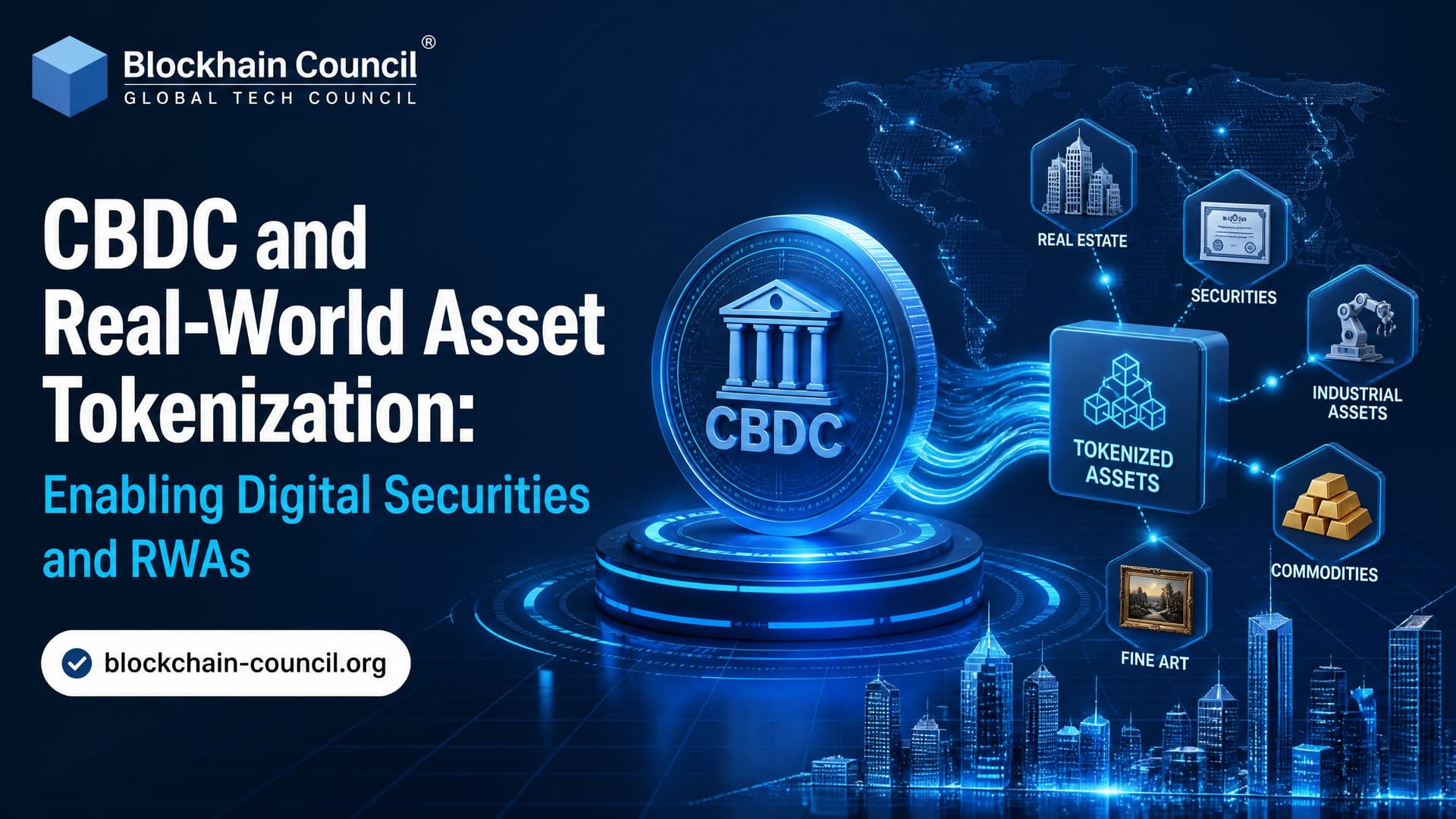
CBDC and real-world asset tokenization are starting to meet where financial markets actually care: settlement, legal finality, and regulated ownership records. The main idea is simple. Tokenized assets can move on a distributed ledger, but the cash leg needs trusted money. Wholesale CBDCs may become that cash leg for digital securities, tokenized bonds, tokenized treasuries, and other institutional RWAs.
This is not just a lab story anymore. The Swiss National Bank, SIX Digital Exchange, and the BIS Innovation Hub have already shown how wholesale central bank money can settle tokenized bonds in Project Helvetia. At the same time, on-chain RWA markets excluding stablecoins have moved from a few billion dollars in 2022 to roughly 24 billion dollars by mid 2025, based on industry market trackers. Definitions vary, but the direction is hard to miss. Professionals trying to get ahead of this shift often start with a structured Certified Central Bank Digital Currency (CBDC) Expert foundation before layering tokenization knowledge on top.

What CBDCs Add to RWA Tokenization
Tokenization converts rights in an asset into digital tokens recorded on a ledger. The asset may be a bond, fund share, property interest, commodity claim, invoice, or treasury bill. A CBDC is digital central bank money. Put them together and you get a cleaner way to settle tokenized asset transfers with money that carries central bank credit risk rather than commercial bank risk. Since so much of this rests on core ledger concepts, it is also worth having a solid Certified Blockchain Expert grounding before going deep into either side of the equation.
The strongest fit is wholesale CBDC, not retail CBDC. Wholesale CBDCs are built for banks, financial market infrastructure, and high-value settlement. They suit capital markets use cases such as tokenized government bonds, repo, interbank payments, and delivery-versus-payment.
Why delivery-versus-payment matters
Delivery-versus-payment, often called DvP, means the asset and payment settle together. Either both legs complete, or neither does. In a tokenized market, this can be coded into a smart contract or coordinated through a regulated platform.
That matters because traditional securities settlement still carries timing gaps, reconciliation work, and counterparty exposure. Atomic settlement can reduce those risks. It also cuts the boring work nobody advertises: breaks, failed instructions, unmatched settlement records, and manual exception handling.
A practical note from implementation work: most prototype DvP failures are not dramatic hacks. They are ordinary integration mistakes. I have seen test settlements fail because the cash token used 6 decimals while the security token assumed 18, or because the transfer reverted with ERC20: insufficient allowance after the buyer forgot to approve the cash leg. In regulated markets, that kind of small mismatch becomes an operational risk, not a developer inconvenience.
Market Size: Big Growth, Messy Definitions
RWA tokenization market numbers differ because analysts count different things. Some include stablecoins. Some count tokenized funds. Some focus only on assets issued on public blockchains. Others include private distributed ledger platforms used by institutions.
Still, several useful signals stand out:
Non-stablecoin tokenized RWAs grew from roughly 5 billion dollars in 2022 to about 24 billion dollars by mid 2025.
On-chain tokenized RWAs crossed about 15 billion dollars globally in 2024, according to institutional market recaps.
Including stablecoins, the broader tokenized asset market was estimated above 200 billion dollars by late 2024.
Some broader market studies value global tokenized RWAs near 297.71 billion dollars in 2024, with projections above 600 billion dollars in 2025. Treat these wider estimates carefully, because scope matters.
Platform-focused forecasts point to sustained growth, with some estimates suggesting compound annual growth above 20 percent through the early 2030s.
The most active asset classes are not exotic. They are private credit, short-dated fixed income, tokenized US Treasuries, real estate funds, commodities, and tokenized bonds. That makes sense. These markets have settlement friction, limited secondary liquidity, or high administrative costs. Tokenization can help there.
CBDC-Backed Settlement for Digital Securities
Digital securities are tokens that represent regulated financial instruments. A tokenized bond, for example, is still a bond. A tokenized fund share is still a fund share. The ledger changes the recordkeeping and transfer mechanism, not the legal substance.
CBDCs can support digital securities by serving as the settlement asset. In the Swiss example, wholesale Swiss franc CBDC has been used on SIX Digital Exchange to settle transactions involving tokenized bonds. The point is not speculation. The point is regulated settlement using central bank money inside a digital securities platform.
That is a major design difference from many crypto-native markets, where settlement often relies on stablecoins. Stablecoins are useful, especially where banks and central banks do not provide direct access to tokenized money. But for systemically important securities settlement, central bank money has a stronger legal and credit-risk profile.
Where CBDC is the right tool
Tokenized government bonds: High-value, regulated issuance with clear settlement requirements.
Repo and collateral mobility: Faster movement of securities and cash can improve intraday liquidity.
Interbank settlement: Wholesale CBDC can support programmable high-value payments.
Regulated digital exchanges: Platforms like SDX show how tokenized securities and digital cash can sit inside supervised infrastructure.
Where CBDC may be the wrong tool
To be blunt, CBDC is overbuilt for many retail RWA marketplaces. If the investors are retail users buying small fractions of property or collectibles, they may not have direct CBDC access. In those cases, tokenized deposits, regulated stablecoins, or traditional payment rails may be more realistic. CBDC is not magic dust. It solves settlement trust and finality problems best in wholesale markets.
Regulation: The Deciding Factor
RWA tokenization only scales when legal rights are clear. A token must map to an enforceable claim. Who owns the asset? Who holds custody? What happens if the issuer fails? Can the token be transferred to anyone, or only to verified investors? These questions matter more than the chain selection.
In the United States, security tokens remain subject to existing securities law when they represent investment contracts, equity-like rights, debt claims, or fund interests. Issuers may need registration under the Securities Act of 1933 or an exemption such as Regulation D Rule 506(b) or Regulation A. Proposed and debated digital asset bills, including Lummis-Gillibrand style frameworks and commodity market structure proposals, seek to clarify the line between SEC and CFTC oversight, but securities analysis remains case-specific.
Other jurisdictions are moving through licensing regimes for digital asset service providers, custodians, broker-dealers, and tokenization platforms. The best regimes focus on client asset segregation, disclosure, custody standards, operational resilience, and smart contract governance. That is the right direction.
Technical Architecture for Tokenized RWAs
A production RWA system usually needs more than a token contract. You need identity, compliance controls, custody workflows, asset servicing, reporting, and integrations with payment systems.
Common building blocks include:
Permissioned transfer rules: Only eligible wallets can receive regulated securities.
Identity and KYC links: Wallets are tied to verified entities, often through off-chain compliance providers.
Custody and key management: Institutions require governed signing policies, not a browser wallet and hope.
Asset servicing: Coupons, dividends, redemptions, corporate actions, and tax reporting must be handled correctly.
Cash leg integration: CBDC, tokenized deposits, or regulated stablecoins must connect to the asset transfer flow.
Public standards such as ERC-20 and ERC-721 are well known, but regulated securities often need stronger transfer restrictions than a basic token allows. Some teams use permissioned ERC-20 patterns. Others look at security token standards and private ledgers. My view: do not start with the standard. Start with the legal transfer rule, then choose the token design that enforces it cleanly. Engineers building toward this kind of role often round out their prototyping skills with a broader Tech Certification, since regulated token architecture leans as much on general secure-systems practice as it does on blockchain-specific tooling.
How CBDC, Tokenized Deposits, and Stablecoins Will Coexist
The future will not have one settlement asset. CBDCs, tokenized deposits, and stablecoins will likely coexist.
Wholesale CBDCs fit central bank money settlement between regulated institutions. Tokenized deposits fit commercial bank money use cases, especially where banks want programmable payments without giving every participant central bank access. Stablecoins will stay useful in public blockchain markets, cross-border flows, and non-bank ecosystems, provided reserves, redemption rights, and supervision are credible.
For digital securities, the choice depends on risk tolerance and market structure. A tokenized treasury fund offered to qualified investors may work with tokenized bank deposits. A systemically important bond settlement platform may prefer wholesale CBDC. A public DeFi-linked RWA product might use a regulated stablecoin, but that comes with different legal and counterparty risks.
Skills Professionals Need for CBDC and RWA Tokenization
If you work in finance, compliance, technology, or product strategy, the learning path should cover both market structure and implementation. You need to understand why tokenized settlement is useful, but also where smart contracts, custody, and regulation can fail.
Useful areas to build next include:
Digital asset regulation and security token classification
CBDC design, especially wholesale CBDC and settlement finality
Smart contract development in Solidity 0.8.x
Token standards, permissioned transfers, and compliance logic
Custody, wallet governance, and institutional key management
Fixed income basics, including coupons, maturity, and repo mechanics
For structured learning, Blockchain Council readers can explore certification paths such as Certified Blockchain Expert™, Certified Blockchain Developer™, Certified Smart Contract Developer™, and Certified CBDC Expert™. If your goal is product or strategy, start with CBDC and blockchain fundamentals. If your goal is engineering, build a simple DvP prototype with a restricted token and a mock cash token, then test every failure path.
What Comes Next
The near-term winners in CBDC and real-world asset tokenization will be institutional products with obvious settlement or liquidity benefits: tokenized treasuries, private credit, real estate funds, tokenized bonds, and repo. Public equities are less urgent because existing markets already work well for many investors.
Expect more pilots to become production systems, but not all at once. Legal finality, interoperability, privacy, and access rules still need work. The most credible projects will look less like crypto launches and more like regulated market infrastructure with better settlement technology underneath.
If you want to prepare for this shift, pick one asset class and study it deeply. Then map its issuance, transfer, custody, and settlement process. After that, learn the token and CBDC layer. That order matters. The asset comes first. The token is only useful when it improves the market it represents. And if part of your role involves pitching these products to institutional clients or investment committees, a Marketing Certification can help you translate the settlement and legal detail into a case that lands with a non-technical audience.
FAQs
1. What is the relationship between CBDCs and real-world asset tokenization?
Central Bank Digital Currencies (CBDCs) and real-world asset tokenization can work together by combining digital central bank money with digitally represented financial or physical assets. Tokenized real-world assets, often called RWAs, may include bonds, securities, funds, real estate interests, commodities, or other assets represented on digital infrastructure. A CBDC can potentially provide a trusted settlement asset for these transactions, reducing reliance on separate payment rails and helping create more integrated digital financial markets.
2. What is real-world asset tokenization?
Real-world asset tokenization is the process of representing ownership rights or economic interests in physical or traditional financial assets using digital tokens. These tokens can be recorded on blockchain or other distributed ledger systems and may represent assets such as bonds, shares, real estate, commodities, invoices, or fund units. Tokenization can improve transferability, automation, recordkeeping, and settlement efficiency, but the legal rights attached to the token remain just as important as the technology representing them.
3. How can CBDCs support tokenized securities?
CBDCs can support tokenized securities by providing digital central bank money that can be used to settle transactions involving tokenized bonds, equities, or other regulated financial instruments. If both the asset and payment exist on compatible digital infrastructure, settlement can potentially occur more efficiently. This can reduce reconciliation requirements and settlement risk. Wholesale CBDCs are particularly relevant because they are designed primarily for financial institutions and market infrastructure rather than everyday consumer payments.
4. What is a wholesale CBDC in tokenized asset markets?
A wholesale CBDC is a digital form of central bank money intended mainly for use by banks, financial institutions, and market infrastructure participants. In tokenized markets, wholesale CBDCs can potentially serve as settlement assets for digital securities, tokenized deposits, and other institutional transactions. Their use may support faster settlement, delivery-versus-payment, and improved interoperability between tokenized financial systems. This makes wholesale CBDCs an important area of experimentation in modern financial-market infrastructure.
5. How can CBDCs enable delivery-versus-payment for digital securities?
Delivery-versus-payment, or DvP, links the transfer of a security with the corresponding payment so that both occur together or under tightly coordinated conditions. If a tokenized security and CBDC are processed on compatible infrastructure, smart contracts or other mechanisms may enable near-simultaneous settlement. This can reduce principal risk and failed settlements. Naturally, coordinating money and securities in one digital workflow is more elegant than making several systems spend two days politely reconciling what already happened.
6. What is atomic settlement in CBDC and RWA markets?
Atomic settlement means that all parts of a transaction either complete together or do not complete at all. For example, the transfer of a tokenized bond and the corresponding CBDC payment could be executed as one coordinated transaction. This can reduce counterparty and settlement risk because one party should not deliver an asset without receiving payment. However, atomic settlement may also affect liquidity management and market structure, so its operational and financial implications require careful evaluation.
7. Can CBDCs be used to settle tokenized bonds?
Yes, wholesale CBDCs could potentially be used to settle tokenized bonds if the legal, technical, and operational infrastructure supports it. A tokenized bond can represent ownership or claims on digitally recorded debt securities, while CBDC can provide the cash leg of the transaction. This can simplify settlement and improve transparency. Several central banks and financial institutions have explored tokenized securities settlement in pilots, although actual implementation depends on jurisdiction-specific regulation and market infrastructure.
8. How can CBDCs improve settlement efficiency for RWAs?
CBDCs can improve settlement efficiency by reducing the need for multiple intermediaries and disconnected payment systems. When tokenized assets and digital money operate on interoperable infrastructure, transactions can potentially settle faster and with fewer reconciliation steps. This may lower operational costs, reduce settlement failures, and improve visibility into transaction status. The benefits are particularly relevant for complex financial markets where traditional settlement can involve multiple institutions, custodians, clearing systems, and payment networks.
9. What role does blockchain play in CBDC and RWA tokenization?
Blockchain or Distributed Ledger Technology can provide a shared digital infrastructure for issuing, transferring, and settling tokenized assets. CBDCs may also use DLT in some implementations, particularly for wholesale applications. Blockchain can support synchronized records, programmable transactions, and tokenized ownership. However, neither CBDCs nor RWAs inherently require blockchain. Centralized or hybrid systems may also be suitable. The architecture should be chosen according to legal, operational, scalability, privacy, and governance requirements.
10. Can smart contracts automate CBDC and tokenized asset transactions?
Smart contracts can potentially automate actions such as payment, settlement, coupon distribution, redemption, collateral management, and compliance checks when predefined conditions are satisfied. When combined with CBDCs and tokenized assets, they could reduce manual processing and improve transaction speed. However, smart contracts require careful testing because coding errors or poorly defined business logic can create financial risk. Legal enforceability, governance, upgrade mechanisms, and operational controls also remain important.
11. What types of real-world assets can be tokenized for CBDC settlement?
Potential tokenized assets include government bonds, corporate debt, equities, investment funds, real estate interests, commodities, trade-finance instruments, invoices, carbon credits, and other assets with clearly defined legal rights. CBDC settlement may be most immediately relevant to regulated financial instruments such as bonds and securities. Tokenization does not automatically make every physical asset suitable for digital trading. Ownership rights, custody, valuation, legal enforceability, and regulatory treatment still need to be resolved.
12. How can CBDCs support tokenized real estate?
CBDCs could potentially provide a digital settlement mechanism for regulated tokenized real-estate transactions or investment products. Real estate can be represented digitally through tokens linked to ownership interests, fund units, or other legally recognized structures. CBDC payments could streamline transaction settlement and improve transparency. However, property law, title registration, taxation, investor protection, custody, and securities regulation remain major considerations. Tokenizing a building does not make property law vanish into a smart contract, despite the industry's recurring optimism.
13. How can CBDCs support fractional ownership of RWAs?
Tokenization can divide an asset or investment vehicle into smaller digital units, potentially enabling fractional ownership. CBDCs could provide a standardized settlement asset for buying or selling those fractions. This may improve accessibility and liquidity for certain investments. However, fractional ownership can introduce regulatory, governance, custody, valuation, and investor-protection requirements. The economic rights represented by each token must be legally clear, particularly when assets involve income distributions, voting rights, or claims during liquidation.
14. How can CBDCs improve liquidity in tokenized asset markets?
CBDCs may improve liquidity by simplifying settlement and reducing operational friction between buyers and sellers. Faster settlement can potentially reduce counterparty exposure and make capital available sooner for reuse. Interoperable CBDC infrastructure may also support broader participation across regulated digital markets. However, liquidity ultimately depends on demand, market makers, asset quality, trading venues, regulation, and investor confidence. Better settlement technology helps, but it cannot manufacture market interest out of architectural diagrams.
15. What are the regulatory challenges of CBDC and RWA tokenization?
Key regulatory challenges include securities classification, investor protection, AML and KYC requirements, custody, taxation, legal ownership, settlement finality, data privacy, and cross-border rules. Regulators must determine how existing financial laws apply when assets and money move through tokenized infrastructure. Different jurisdictions may also classify identical tokens differently. Successful implementation therefore requires coordination among central banks, securities regulators, financial institutions, technology providers, and legal authorities.
16. What are the cybersecurity risks of CBDC-based tokenized markets?
Cybersecurity risks include wallet compromise, stolen credentials, smart-contract vulnerabilities, API attacks, private-key theft, insider threats, and infrastructure disruption. Because tokenized markets could combine valuable assets with central bank money, they may become particularly attractive targets. Security controls must cover not only the ledger but also wallets, identity systems, exchanges, custodians, nodes, APIs, and administrative systems. Strong authentication, encryption, monitoring, key management, and incident-response processes are therefore essential.
17. How can CBDCs and tokenized assets improve cross-border investment?
CBDCs and tokenized assets could potentially simplify cross-border investment by reducing settlement friction and connecting digital financial infrastructures across jurisdictions. Investors might settle tokenized securities using compatible digital currencies, reducing some intermediary steps. However, cross-border tokenized markets must still address foreign-exchange rules, securities laws, sanctions, taxation, custody, identity verification, and capital controls. Technology can make transactions faster, but regulators remain stubbornly resistant to being replaced by APIs.
18. How can interoperability improve CBDC and RWA ecosystems?
Interoperability allows CBDC platforms, tokenized asset networks, financial institutions, exchanges, and custody systems to communicate and transfer value efficiently. Common standards, APIs, messaging formats, and technical protocols can reduce fragmentation and improve settlement across platforms. Without interoperability, tokenized finance could create isolated digital markets rather than a more connected financial system. Legal and regulatory interoperability are equally important because technical compatibility alone does not guarantee that transactions are recognized across jurisdictions.
19. What are the biggest risks of combining CBDCs with real-world asset tokenization?
Major risks include technology failures, cybersecurity attacks, unclear legal ownership, smart-contract errors, regulatory uncertainty, fragmented standards, liquidity problems, and operational concentration. Tokenized markets may also introduce dependencies on digital identity, custody, oracles, and network infrastructure. Central banks and financial institutions therefore need strong governance, testing, resilience, and contingency planning. The objective should be improving market infrastructure rather than recreating every traditional financial risk in a newer and more impressively distributed format.
20. What is the future of CBDCs and real-world asset tokenization?
The future is likely to involve growing experimentation with wholesale CBDCs, tokenized deposits, digital securities, and interoperable settlement platforms. Tokenized government bonds and institutional financial assets may develop faster than more complex physical-asset use cases because their legal and market structures are already relatively mature. Over time, CBDCs could become one settlement option within broader tokenized financial ecosystems. Their success will depend on interoperability, legal certainty, cybersecurity, institutional adoption, and whether tokenization delivers measurable improvements over existing financial infrastructure.
Related Articles
View All
Digital Assets
RWA Tokenization and Digital Securities: Similarities, Differences, and Regulations
RWA tokenization and digital securities overlap, but differ in asset scope, regulation, trading venues, liquidity, and DeFi integration.

Digital Assets
The Role of Smart Contracts in Real-World Asset Tokenization
Smart contracts enforce issuance, compliance, settlement, and investor rights in real-world asset tokenization, making RWAs operational and auditable.

Digital Assets
How Asset Tokenization Creates Verifiable Digital Ownership
Asset tokenization turns rights to real world and financial assets into blockchain tokens, giving authorized parties a verifiable record of ownership, provenance, and compliance.
Trending Articles
The Role of Blockchain in Ethical AI Development
How blockchain technology is being used to promote transparency and accountability in artificial intelligence systems.
What is AWS? A Beginner's Guide to Cloud Computing
Everything you need to know about Amazon Web Services, cloud computing fundamentals, and career opportunities.
Claude AI Tools for Productivity
Discover Claude AI tools for productivity to streamline tasks, manage workflows, and improve efficiency.