

Tokenized Asset Custody: How Wallets, Trustees, and Institutional Custodians Work
 Suyash Raizada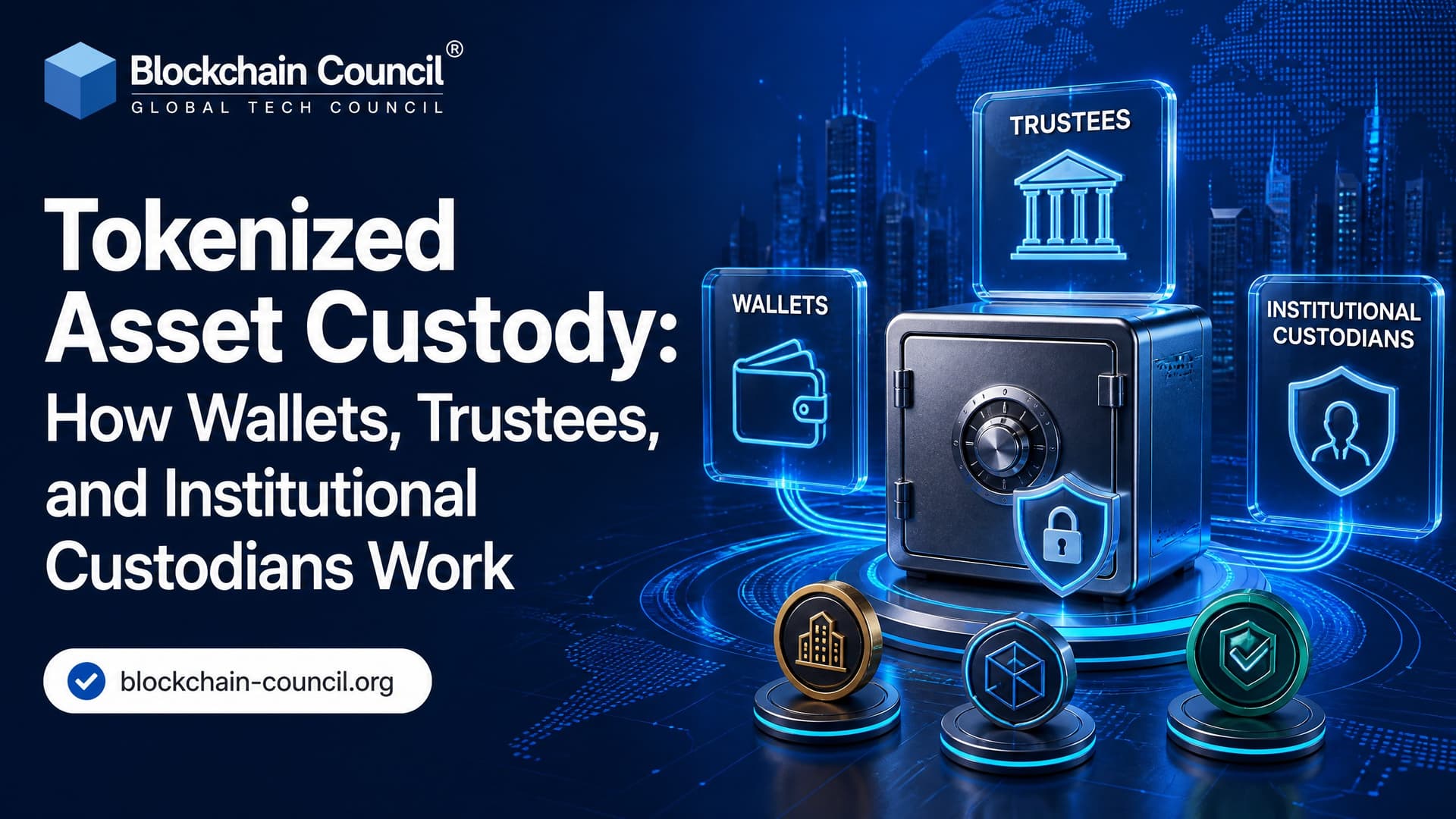
Tokenized asset custody is the system that keeps blockchain-based claims to bonds, funds, equities, treasuries, commodities, and other real-world assets safe while matching them to legal ownership records. The hard part is not just storing a private key. You also need transfer controls, fiduciary duties, investor reporting, sanctions checks, redemption rules, and a clear answer to one simple question: who has the legal right to move the asset? Professionals developing expertise in this area can benefit from structured learning such as the Certified RWA Tokenization Expert program, which aligns closely with the growing need for specialized knowledge in RWA tokenization.
That is why custody is moving toward a hybrid model. Wallet technology handles cryptographic control. Trustees and trust companies handle fiduciary obligations. Institutional custodians connect both sides to auditors, fund administrators, and regulators.

What Does Custody Mean for Tokenized Assets?
Tokenized assets are blockchain representations of off-chain instruments or rights. Common examples include tokenized money market funds, tokenized treasury bills, tokenized bonds, private credit tokens, and tokenized physical assets such as gold or collectibles.
Custody means safekeeping the token and maintaining the controls that make it legally and operationally usable. In institutional settings, a custodian often does four jobs at once:
Controls private keys through hardware security modules, multi-party computation, multi-signature wallets, or cold storage.
Executes transfers only when the transaction meets issuer rules, address whitelist rules, and internal approval policies.
Maintains records for fund administrators, auditors, advisers, and investors.
Supports legal custody where regulations require client assets to be held by a qualified custodian, trust company, or regulated bank.
If you are studying tokenization architecture, this is where smart contract control and off-chain legal settlement start to pull in different directions. Blockchain Council programs such as the Certified Digital Assets Expert can also help professionals understand how digital assets, tokenized instruments, and their supporting infrastructure fit together.
Wallet Models Used in Tokenized Asset Custody
Self-custody wallets
Self-custody means you control the private keys. This can be a browser wallet, a mobile wallet, or a hardware wallet such as a Ledger device. For some retail-accessible tokenized assets, the issuer may allow self-custody after you complete KYC and whitelist your wallet address.
The benefit is control. The downside is unforgiving. Lose the seed phrase and recovery may be impossible. Send from an address that is not whitelisted and the transaction may fail or be blocked before execution. I have watched teams spend hours debugging a token transfer that looked fine in MetaMask, only to find the issuer's transfer agent had whitelisted the investor's Ethereum mainnet address while the custodian test was pointed at Sepolia, chain ID 11155111, instead of mainnet chain ID 1. The contract was not the problem. The operational setup was.
Self-custody is a poor fit for registered investment advisers, funds, and corporate treasuries that must prove segregation, approval workflows, and auditability. It is fine for learning and smaller holdings. It is wrong for regulated institutional portfolios.
Single-party custodial wallets
In a simple custodial model, one company holds the keys and moves assets for the client. This is easy to operate, but it creates concentration risk. If one administrator can move all assets, governance is weak.
This model may work for small platforms or early pilots. For large tokenized funds, sovereign debt, or tokenized private credit, it is rarely enough. Institutions want segregation, insurance, dual controls, SOC reports, and policies that stop one employee from authorizing a sensitive transfer alone.
Multi-signature wallets
Multi-signature wallets require more than one signer before assets can move. A tokenized physical asset structure, for example, may require signatures from the issuer, a trustee, and an independent auditor. This mirrors traditional controls, but puts part of the approval process on-chain.
Multi-sig is transparent and relatively easy to understand. The trade-off is operational friction. If a signer is unavailable, a redemption or transfer can stall. You also need careful signer rotation procedures when employees leave or trustees change.
MPC and institutional wallet infrastructure
Many institutional custodians now use multi-party computation, often combined with hardware security modules and policy engines. MPC splits signing authority into distributed key shares, so no single system holds the full private key.
Providers such as Fireblocks, Anchorage Digital, BitGo, Coinbase Custody, Komainu, Zodia Custody, Cobo, and BNY use different mixes of cold storage, HSMs, MPC, and workflow controls. The common pattern is clear. Custody is no longer just a vault. It is a transaction control layer.
Typical policy rules include:
Only send to approved wallet addresses.
Require two or more approvers for redemptions above a threshold.
Block transfers involving sanctioned addresses.
Separate hot, warm, and cold wallet permissions.
Log every approval for audit review.
Why Trustees Matter
A wallet controls a token. A trustee helps define who has a legally protected interest in the asset. That distinction matters.
Trustees and trust companies sit between the blockchain record and the legal structure. In the United States, regulated trust companies such as Anchorage Digital Bank, BitGo Trust, and Coinbase Custody Trust hold digital assets under trust-law frameworks. Banks acting in a fiduciary capacity must follow existing fiduciary rules, including trust department standards and applicable state law.
For tokenized assets, trustees can perform several functions:
Hold assets for the benefit of investors in segregated accounts.
Act as an independent signer in a multi-sig wallet.
Confirm that minting and redemption match the underlying asset records.
Support investor protection if the issuer or platform fails.
This is where tokenization becomes less glamorous, but more serious. A token that points to a bond is only useful if the legal documents, trustee arrangements, and custody records all say the same thing.
Institutional Custody and Regulation
Institutional tokenized asset custody is shaped by existing securities and banking rules. It is not a legal blank slate.
In the United States, Rule 206(4)-2 under the Investment Advisers Act, known as the SEC Custody Rule, requires registered investment advisers to keep client assets with a qualified custodian. If a tokenized fund token is treated as a security, advisers generally cannot rely on a personal wallet or an informal storage process.
This matters for tokenized fund products such as BUIDL, OUSG, BENJI, and USYC, which are tied to money market funds, treasury exposure, or similar short-duration instruments. Institutional investors usually need qualified custody, formal reporting, and reconciliation with off-chain books.
The same pattern shows up globally. Traditional securities-services firms are adapting custody models for tokenized bonds and equities. The core functions stay familiar: safekeeping, settlement, asset servicing, reporting, and corporate actions. The rails have changed. The obligations have not disappeared.
Live Examples: Funds, Sovereign Debt, and RWAs
Tokenized funds
Tokenized money market and liquidity fund products are among the most mature tokenization use cases. Fidelity International, Chainlink, and Sygnum worked together to bring net asset value data on-chain for Fidelity International's Institutional Liquidity Fund, with tokenization activity on zkSync.
That kind of structure needs more than a smart contract. The custodian must reconcile on-chain balances with fund accounting, NAV data, subscriptions, redemptions, and investor records.
Tokenized sovereign debt
Anchorage Digital announced custody support for CETES, a tokenized version of Mexican federal treasury certificates issued on Stellar. It shows how sovereign instruments can use blockchain settlement while still depending on regulated custody infrastructure for institutional holders.
Tokenized physical assets
For commodities, real estate interests, or luxury assets, custody has two layers. The physical item sits with a warehouse, vault, logistics provider, or trustee. The token sits in a wallet controlled by a custodian or an approved governance group. If those two records drift apart, investor confidence breaks fast.
How to Evaluate a Tokenized Asset Custodian
If you are building or selecting custody for tokenized assets, ask practical questions. Do not stop at the phrase institutional-grade.
Regulatory status: Is the provider a qualified custodian, trust company, bank, or licensed digital asset custodian in the relevant jurisdiction?
Key management: Does it use MPC, HSMs, multi-sig, cold storage, or a mix?
Segregation: Are client assets legally and operationally separated?
Insurance: What is covered, what is excluded, and who underwrites it? BitGo, for example, has reported aggregate institutional insurance coverage up to $250 million for custody clients.
Compliance controls: Can the wallet enforce whitelists, KYC status, sanctions screening, and transfer limits?
Chain support: Does it support the public or permissioned chain where the token is issued?
Reporting: Can it produce statements, NAV reconciliation files, and audit-ready records?
Recovery procedures: What happens if an approver leaves, a device fails, or a policy update is misconfigured?
For technical teams, the Certified Smart Contract Developer™ path is a strong next step. For compliance, operations, and product leaders, pair tokenization study with the Certified Blockchain Expert™ so you can judge both smart contract design and custody governance. Professionals seeking broader technical development across emerging technologies may also consider a Tech Certification relevant to their role.
Global Technology Competition
Students today can benefit from opportunities that allow them to measure their skills beyond their regular classroom environment. A global Tech Olympiad can provide students with an opportunity to participate in technology-focused challenges, develop their skills, and gain recognition for their performance.
The Direction of Tokenized Asset Custody
Custody is becoming the control plane for real-world asset tokenization. Expect more qualified custodians, deeper integration with compliance tools, and wallet systems that double as investor registers.
The winners will not be the providers with the flashiest dashboard. They will be the ones that can align private keys, trustee duties, investor records, and regulatory requirements without slowing every transaction to a crawl.
If you work in asset management, fintech, banking, or Web3 infrastructure, start by mapping one asset from issuance to redemption. Identify who signs, who owns the legal claim, who holds the key, who approves the transfer, and who reports the balance. That single exercise will tell you whether your custody model is ready for production or still just a pilot. For professionals working on the market-facing side of tokenized asset products, a Marketing Certification can complement technical and operational knowledge by strengthening broader marketing capabilities.
FAQs
1. What is tokenized asset custody?
Tokenized asset custody refers to the secure storage, control, and administration of blockchain-based tokens representing real-world assets. Custody can involve wallets, custodians, trustees, or other entities responsible for protecting digital assets and managing associated rights.
2. Why is custody important for RWA tokenization?
Custody helps protect tokenized assets from unauthorized access, theft, loss of private keys, and operational failures. It can also establish clear responsibilities for managing both the blockchain token and, where applicable, the underlying real-world asset.
3. What is a wallet in tokenized asset custody?
A blockchain wallet is a system used to store or control the cryptographic keys required to access and transact with tokens. A wallet does not necessarily hold the physical asset represented by the token.
4. What is the difference between custodial and non-custodial wallets?
With a custodial wallet, a third-party provider controls or manages the private keys on behalf of the user. With a non-custodial wallet, the user generally maintains control of the keys. Each model involves different security, operational, and recovery considerations.
5. What is institutional custody for tokenized assets?
Institutional custody involves professional custody providers managing tokenized assets using enterprise-grade security, governance, access controls, compliance procedures, and operational safeguards designed for institutions.
6. What role does a trustee play in tokenized assets?
A trustee may hold or oversee assets for the benefit of investors or beneficiaries according to a legal trust arrangement. In RWA structures, a trustee can help connect legal ownership of the underlying asset with the rights represented by tokens.
7. Does a wallet legally own the underlying real-world asset?
Not necessarily. A wallet generally controls blockchain tokens, while legal ownership of the underlying asset depends on the token structure, contracts, registries, custodial arrangements, and applicable law.
8. How do institutional custodians protect tokenized assets?
Custodians can use measures such as cold storage, multi-signature controls, hardware security modules, access restrictions, transaction approvals, monitoring, and disaster-recovery procedures to protect digital assets.
9. What is multi-signature custody?
Multi-signature, or multisig, custody requires multiple authorized keys or approvals before certain blockchain transactions can be executed. This can reduce the risk associated with a single compromised key or unauthorized transaction.
10. What is cold storage for tokenized assets?
Cold storage keeps private keys in an environment that is not continuously connected to the internet. It can provide an additional security layer for long-term holdings, although institutions still need effective operational and recovery procedures.
11. How are physical assets connected to token custody?
The blockchain token can be connected to the underlying asset through legal agreements, custodial arrangements, special-purpose entities, registries, and documented ownership structures. Strong documentation is essential for establishing what the token actually represents.
12. Can institutional custodians manage both tokens and physical assets?
Potentially, but the responsibilities may be divided among specialized providers. For example, one entity may custody the blockchain tokens while another manages real estate, commodities, securities, or other physical or financial assets.
13. How does custody support RWA compliance?
Custody systems can implement KYC/AML controls, transaction authorization, investor restrictions, audit trails, asset segregation, reporting, and access management. Requirements vary depending on the asset and jurisdiction.
14. What is asset segregation in tokenized asset custody?
Asset segregation means keeping client assets separate from the custodian's own assets and records, where required by applicable rules and agreements. This can help protect investors if the custodian experiences financial or operational problems.
15. What happens if a private key is lost?
The outcome depends on the custody architecture. Institutional systems may use backup keys, recovery procedures, multisig arrangements, or controlled key-management systems. Poorly designed self-custody can make lost keys difficult or impossible to recover.
16. What are the main risks of tokenized asset custody?
Key risks include private-key theft, hacking, insider threats, operational errors, smart-contract vulnerabilities, custodian insolvency, inadequate recovery procedures, fraud, and unclear legal ownership.
17. How does custody affect investor protection?
Strong custody arrangements can reduce the risk of asset loss, unauthorized transactions, commingling, and operational failures. Clear legal agreements and transparent custody responsibilities can also help investors understand their rights.
18. What should businesses consider when choosing an institutional custodian?
Businesses should evaluate the provider's security architecture, regulatory status, insurance arrangements where applicable, asset segregation, key-management processes, audit controls, recovery procedures, supported blockchains, and experience with institutional clients.
19. How will tokenized asset custody evolve?
Custody is likely to become increasingly integrated with programmable compliance, digital identity, automated transaction controls, institutional wallet infrastructure, and real-world asset management systems. Interoperability between traditional custodians and blockchain networks will also become increasingly important.
20. What is the future of wallets, trustees, and custodians in RWA tokenization?
As tokenized asset markets mature, custody will likely involve a combination of secure wallets, regulated institutional custodians, trustees, legal entities, and automated blockchain controls. The objective is to provide secure digital asset management while maintaining clear legal ownership, investor protection, compliance, and reliable access to the underlying real-world assets.
Related Articles
View All
Digital Assets
RWA Tokenization in Institutional Finance: Use Cases for Banks and Asset Managers
RWA tokenization is moving into production across tokenized funds, collateral networks, deposits, bonds, private credit, and trade finance.

Digital Assets
How Smart Contracts Manage Tokenized Asset Ownership and Payments
Smart contracts manage tokenized ownership, transfers, compliance, and payouts for real estate, funds, securities, RWAs, and stablecoin payment flows.

Digital Assets
What Assets Can Be Tokenized? Real-World Asset Categories Explained
Learn what assets can be tokenized, from Treasuries and stablecoins to real estate, commodities, IP, carbon credits, and private credit.
Trending Articles
AWS Career Roadmap
A step-by-step guide to building a successful career in Amazon Web Services cloud computing.

Top 5 DeFi Platforms
Explore the leading decentralized finance platforms and what makes each one unique in the evolving DeFi landscape.
How Blockchain Secures AI Data
Understand how blockchain technology is being applied to protect the integrity and security of AI training data.