

Best RWA Tokenization Platforms: Features, Use Cases, and Selection Criteria
 Suyash Raizada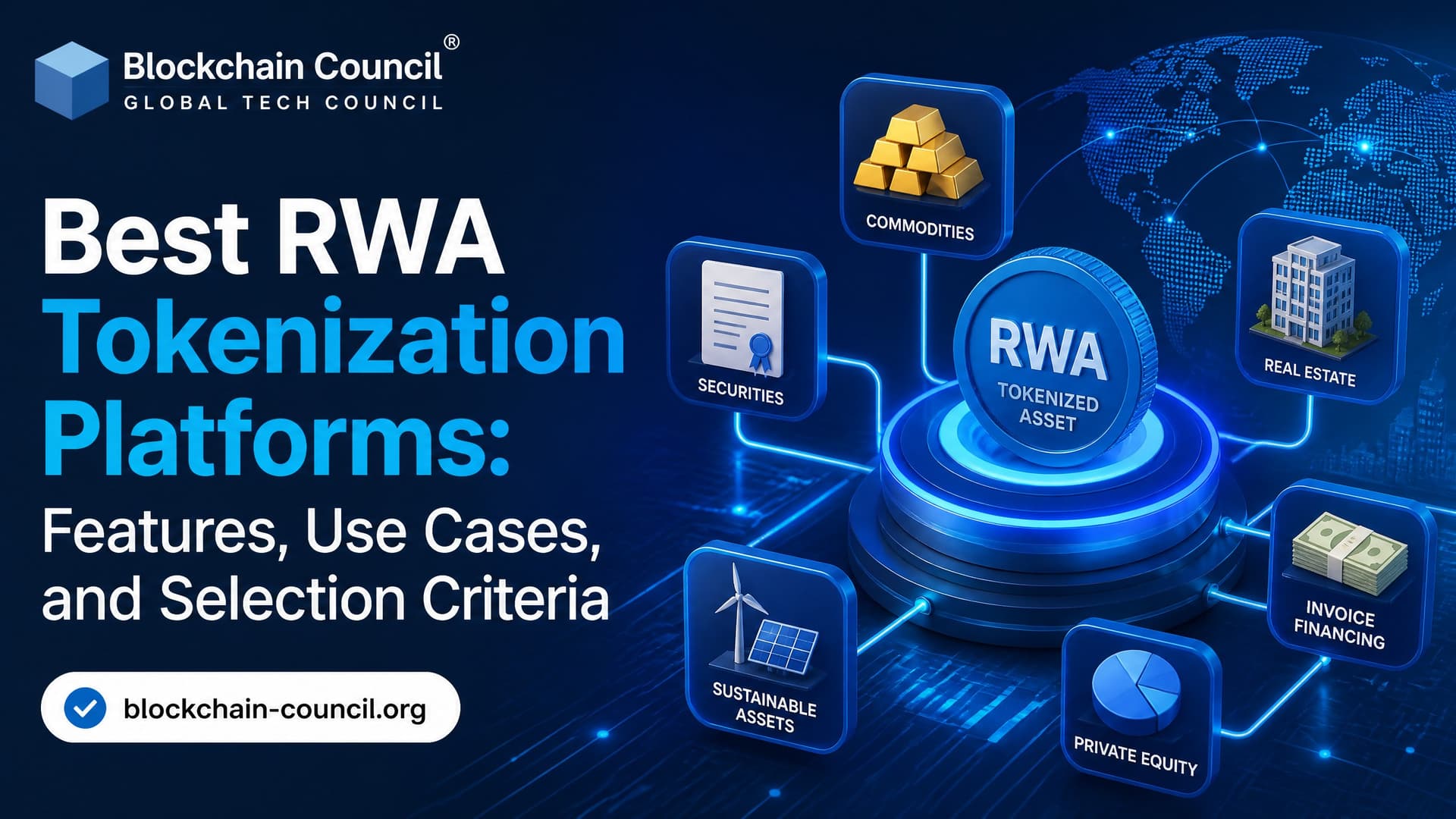
RWA tokenization platforms have moved from conference demos to production finance. The strongest platforms now support tokenized US Treasuries, money market funds, private credit, equities, real estate, commodities, and stablecoin reserves. The right choice is not the platform with the loudest brand. It is the one that fits your asset, jurisdiction, investors, liquidity needs, and compliance model. Professionals looking to build specialized expertise in this evolving space can explore the Certified RWA Tokenization Expert program to develop a deeper understanding of RWA tokenization and its practical applications.
Market estimates vary widely. McKinsey expects about USD 2 trillion in tokenized financial assets by 2030 in its base case, while BCG and ADDX have published much higher scenarios for illiquid assets. Treat those numbers as direction, not certainty. Adoption is real, but it is uneven. Treasuries and money market funds are ahead. Real estate and private assets are harder.

What Makes a Good RWA Tokenization Platform?
A good platform does more than mint tokens. For regulated assets, the token is only the visible layer. The platform also needs investor onboarding, transfer controls, custody, reporting, redemption workflows, and legal documentation that ties the token to the offchain asset.
This is where many first-time teams get caught. A tokenized security is not a plain ERC-20 meme token with a PDF attached. If the smart contract checks an allowlist, a normal transfer to an unapproved wallet can revert with an error such as Transfer not allowed. That is expected behavior, not a bug. If you plan to integrate with wallets, DEXs, or custody systems, test these restrictions early on Ethereum mainnet chain ID 1, Polygon chain ID 137, or whichever network you use.
Understanding these requirements also benefits professionals working across the broader digital asset ecosystem. A Certified Digital Assets Expert credential can complement RWA-focused knowledge by helping professionals build a broader understanding of digital assets, blockchain infrastructure, and the considerations involved in tokenized financial products.
Best RWA Tokenization Platforms to Watch
Securitize
Securitize is one of the most established institutional RWA tokenization platforms. It handles issuance, investor onboarding, compliance, transfer agency services, and lifecycle management for tokenized securities. It operates as an SEC-registered transfer agent and is widely associated with large institutional tokenization programs.
Its most visible role is powering BlackRock's BUIDL tokenized money market fund, including token issuance and investor transfers across supported chains. Securitize also supports tokenized public equities through regulated infrastructure. If you are dealing with securities in the United States, Securitize belongs near the top of your shortlist.
Best fit: Regulated securities, funds, treasuries, private credit, institutional issuers.
Key strengths: Compliance stack, transfer agent status, institutional adoption.
Watch out for: Access requirements and onboarding complexity for smaller issuers.
Ondo Finance
Ondo Finance sits closer to DeFi than traditional transfer agency platforms, but it has built a serious institutional profile. Its products include OUSG for tokenized US Treasury exposure, USDY as a yield-bearing stablecoin alternative for eligible non-US users, and Ondo Global Markets for tokenized stocks and ETFs.
Ondo has integrated across Ethereum, Solana, Cosmos-based infrastructure, and its own Ondo Chain. MetaMask has also partnered with Ondo Global Markets to make tokenized RWAs available to eligible users in supported regions. That matters. Distribution is often the missing piece in tokenization.
Best fit: Tokenized treasuries, tokenized equities, DeFi-connected RWA products.
Key strengths: Product breadth, wallet integrations, DeFi composability.
Watch out for: Jurisdiction limits, especially for US users.
Franklin Templeton Benji Platform
Franklin Templeton's Franklin OnChain US Government Money Fund, represented by BENJI tokens, was the first US-registered money market fund to use a public blockchain as its system of record. The Benji Technology Platform is also offered to banks and asset managers that want tokenized fund infrastructure.
This is not a startup experiment. Franklin Templeton brings traditional asset management discipline, regulated fund operations, and public-chain experience. BENJI has become one of the largest tokenized money market fund products by assets under management.
Best fit: Tokenized money market funds, institutional liquidity products, white-label fund infrastructure.
Key strengths: Regulated fund experience, asset manager credibility, public blockchain recordkeeping.
Watch out for: Less suitable if you need a broad marketplace for many asset classes.
BlackRock BUIDL
BlackRock's USD Institutional Digital Liquidity Fund, known as BUIDL, is issued through Securitize. It invests in cash, US Treasury bills, and repurchase agreements, with tokens targeting a stable USD 1 value. Yield accrues daily and is paid through additional tokens.
BUIDL launched on Ethereum in March 2024 and later expanded to networks including Aptos, Arbitrum, Avalanche, Optimism, and Polygon. It is a strong example of how tokenized treasuries can become collateral and liquidity instruments for institutional onchain finance.
Best fit: Qualified purchasers seeking tokenized Treasury exposure.
Key strengths: BlackRock backing, multi-chain availability, daily liquidity design.
Watch out for: High minimum subscription requirements and restricted access.
Centrifuge
Centrifuge is a long-running RWA protocol focused on private credit, real estate, and cash-flowing assets. It connects offchain asset pools to onchain capital markets. The platform has been active in institutional RWA work on Avalanche, including credit strategies connected to Grove Finance and Janus Henderson-related funds.
Best fit: Private credit, structured credit, real estate-backed pools.
Key strengths: DeFi credit design, asset pool transparency, RWA-native history.
Watch out for: Credit risk is still credit risk, even when reporting is onchain.
Maple Finance
Maple Finance runs an onchain institutional credit marketplace. It supports structured lending, corporate credit, and tokenized yield products. Maple is often grouped with Centrifuge and TrueFi as part of the private credit side of RWA tokenization.
Best fit: Institutional lending, corporate debt, credit pools.
Key strengths: Credit marketplace experience, borrower-lender workflows, institutional focus.
Watch out for: You need strong underwriting. Tokenization does not remove default risk.
Paxos and Tether
Paxos is known for regulated digital asset infrastructure and commodity-backed tokens, including gold-backed products. Tether, best known for USDT, has expanded into RWA-backed products and tokenized asset exposure. These platforms matter because stablecoins and commodity tokens are often the first RWA products users actually touch.
Best fit: Stablecoin reserves, commodity-backed tokens, payment-linked RWA use cases.
Key strengths: Distribution, liquidity, operational experience.
Watch out for: Reserve transparency, jurisdictional scrutiny, counterparty exposure.
Tokeny
Tokeny provides compliance-first infrastructure for issuing and managing tokenized assets. It focuses on permissioned transfers, identity, investor eligibility, and asset lifecycle management. Its work with Hedera and ecosystem mapping makes it useful for issuers that want control rather than a ready-made retail marketplace.
Best fit: Enterprises, banks, asset managers, compliance-heavy issuers.
Key strengths: Transfer controls, issuer tooling, regulated asset workflows.
Watch out for: You may still need separate distribution, custody, and liquidity partners.
Network Infrastructure: Ethereum, Polygon, Avalanche, and Chainlink
Most RWA activity still connects back to Ethereum in some form, but the market is no longer Ethereum-only. Polygon has become a major RWA hub, with tokenized funds and securities from names such as Securitize, Franklin Templeton, and Libre Capital. Avalanche has built a broad institutional RWA ecosystem covering funds, credit, insurance products, and even state-backed stablecoin pilots.
Chainlink matters here too. RWA platforms need verified market data, price feeds, proof of reserves, and cross-chain messaging. Chainlink CCIP is used by several institutional projects for cross-chain connectivity. If your tokenized asset will exist across multiple networks, interoperability is not a nice add-on. It is a design requirement.
Common RWA Tokenization Use Cases
Tokenized treasuries and money market funds: BlackRock BUIDL and Franklin Templeton BENJI are the clearest examples.
Tokenized equities and ETFs: Securitize and Ondo Global Markets support tokenized versions of listed securities for eligible users.
Private credit and loans: Centrifuge, Maple Finance, and TrueFi support credit exposure through onchain structures.
Real estate: Platforms focused on property tokenization support fractional ownership, marketplace access, and digital collateral models.
Commodities: Paxos and similar issuers support gold-backed and reserve-backed token models.
Stablecoin reserves: Tokenized treasuries and money market funds are becoming relevant for regulated stablecoin reserve management.
How to Choose an RWA Tokenization Platform
1. Start with regulation
If the asset is a security, choose a platform that understands securities law in your target jurisdiction. Look for transfer agent registration, broker-dealer relationships, KYC and AML processes, sanctions screening, investor accreditation checks, and legally enforceable token rights.
2. Match the platform to the asset
Do not use a treasury platform for real estate just because it has better branding. Treasuries need fund administration and redemption workflows. Real estate needs property title, valuation, local law, rent distribution, and dispute handling. Private credit needs underwriting and loan servicing.
3. Check chain support and wallet compatibility
Ask which networks are supported: Ethereum, Polygon, Avalanche, Solana, Hedera, Arbitrum, Optimism, or others. Then test the boring parts. Can Fireblocks, MetaMask Institutional, Anchorage, or your custodian handle the token standard and transfer restrictions? Can your reporting system read events correctly?
4. Review liquidity and redemption mechanics
Liquidity claims deserve skepticism. Ask where secondary trading happens, who can participate, what the redemption window is, and whether redemptions settle in cash, stablecoins, or another asset. A token that trades 24/7 but redeems only during business hours has a different risk profile than a native crypto asset.
5. Assess transparency and counterparty risk
Onchain balances are useful, but they do not prove the offchain asset is safe. Review audits, custodians, trustees, administrators, legal opinions, and reporting cadence. For credit pools, study defaults and recoveries. For funds, read the prospectus. Boring documents matter.
Skills Professionals Need for RWA Tokenization
If you work in product, compliance, development, or asset management, RWA tokenization demands mixed skills. You need blockchain architecture, securities workflows, smart contract basics, custody models, and DeFi risk awareness. For structured learning, consider Blockchain Council's Certified Blockchain Expert™, Certified Smart Contract Developer™, or Certified DeFi Expert™ as learning paths. Developers building tokenized asset workflows should also study ERC-20, ERC-721, ERC-1400, ERC-3643, Solidity 0.8.x, Hardhat, Foundry, and wallet integration patterns.
Professionals seeking to expand their technical capabilities across emerging technologies can also explore a Tech Certification aligned with their career interests. This can complement blockchain-specific learning, particularly for professionals working across technology, product, development, and digital transformation.
Technology Skills & Education
Schools and parents are increasingly looking for ways to introduce children to technology in a structured and meaningful way. The Tech Olympiad provides an opportunity for students to explore AI, coding, robotics, cybersecurity, and computational thinking while building confidence and problem-solving skills.
Future Outlook for RWA Tokenization Platforms
The next phase will not be about tokenizing everything. It will be about tokenizing assets where blockchain actually improves settlement, collateral mobility, investor access, reporting, or operational cost. Treasuries and money market funds will likely stay in front because they are familiar, liquid, and useful as collateral. Real estate may grow larger by market size, but it will move more slowly because property law is local and messy.
Here is the practical next step: define your asset class, jurisdiction, investor type, and redemption model before you speak to vendors. Then compare Securitize, Ondo Finance, Franklin Templeton, Centrifuge, Maple Finance, Paxos, Tether, Tokeny, and network partners such as Polygon, Avalanche, and Chainlink against that checklist. If you are building the technical side, start with a small permissioned token prototype and test transfer restrictions before designing the full platform. For professionals who also work on the market-facing side of emerging technology products, a Marketing Certification can complement technical and RWA expertise by strengthening broader marketing capabilities.
FAQs
1. What is an RWA tokenization platform?
An RWA tokenization platform is technology infrastructure that helps businesses convert real-world assets or financial interests into blockchain-based tokens. Depending on the provider, it may support issuance, investor onboarding, KYC/AML, custody, transfers, payments, and post-issuance asset servicing.
2. What are the best RWA tokenization platforms?
There is no single best platform for every project. Frequently evaluated providers include Securitize, Tokeny, Polymesh, Taurus, Brickken, Zoniqx, Centrifuge, Maple, and DigiShares. Their capabilities differ significantly by asset class, jurisdiction, compliance model, and whether they provide infrastructure or their own investment products.
3. What features should an RWA tokenization platform provide?
Important features include token issuance, KYC/AML integration, investor management, transfer restrictions, wallet management, compliance controls, custody integration, payment and settlement, reporting, distributions, and redemption workflows. Not every platform provides all of these capabilities.
4. Which RWA platforms are suitable for institutional investors?
Institutions generally look for platforms offering regulatory infrastructure, institutional custody, secure wallet controls, investor onboarding, auditability, and integration with existing financial systems. Securitize, Tokeny, Taurus, and Polymesh are examples of infrastructure providers commonly evaluated for institutional use cases.
5. Which platforms are suitable for tokenized securities?
Platforms such as Securitize, Tokeny, Polymesh, and ADDX are commonly associated with regulated securities and institutional issuance. The appropriate choice depends on the security, jurisdiction, investor type, and regulatory permissions involved.
6. Which RWA platforms support real estate tokenization?
Real estate tokenization platforms can provide SPV structures, investor records, fractional ownership, compliance controls, distributions, and secondary-transfer functionality. Providers such as DigiShares, Brickken, Securitize, and Tokeny are among those evaluated for real-estate use cases.
7. Which platforms are focused on private credit?
Private-credit tokenization requires capabilities for borrower onboarding, credit underwriting, loan servicing, repayments, investor reporting, and collateral management. Centrifuge, Maple, Figure, and Provenance are examples of platforms or infrastructure associated with tokenized credit markets.
8. How important is regulatory compliance when choosing an RWA platform?
Compliance is one of the most important selection criteria. Businesses should evaluate KYC/AML capabilities, investor eligibility, transfer restrictions, jurisdictional coverage, licensing arrangements, disclosures, and regulatory reporting before selecting a platform.
9. What role does blockchain choice play in RWA tokenization?
The underlying blockchain affects transaction costs, scalability, interoperability, security, smart-contract functionality, privacy, and compliance capabilities. Some platforms support multiple networks, while others are built around a specific blockchain or tokenization architecture.
10. Why are token standards important for RWA platforms?
Token standards determine how assets can be issued, transferred, restricted, and managed. Standards such as ERC-3643 and ERC-1400 can provide features useful for regulated assets, including identity-based transfer controls and compliance rules. Polymesh, for example, provides protocol-level token and compliance functionality.
11. What is the role of KYC/AML in an RWA tokenization platform?
KYC/AML systems verify investors and help platforms comply with financial-crime requirements. Features can include identity verification, beneficial-owner checks, sanctions screening, wallet whitelisting, transaction monitoring, and investor eligibility controls.
12. How important is custody when selecting an RWA platform?
Custody is critical because tokenized assets require secure management of private keys and blockchain wallets. Institutions should examine custody integrations, multisignature controls, asset segregation, recovery procedures, security certifications, and the regulatory status of custody providers.
13. Should businesses choose a white-label RWA tokenization platform?
A white-label platform can be useful when a business wants to operate tokenization infrastructure under its own brand and customer experience. It can provide greater customization, but businesses should also evaluate compliance responsibilities, integrations, scalability, and ongoing platform costs.
14. How do APIs and integrations affect RWA platform selection?
Strong APIs and integrations can connect tokenization infrastructure with custodians, banks, payment systems, CRMs, identity providers, accounting systems, and investor-management platforms. This can be especially important for institutions integrating tokenization into existing operations.
15. What should businesses consider about platform scalability?
Businesses should evaluate whether the platform can support increasing numbers of assets, investors, transactions, wallets, jurisdictions, and blockchain networks. Scalability should cover both technical capacity and operational compliance processes.
16. How important is secondary-market support?
Secondary-market functionality can be valuable for investors seeking liquidity after issuance. Businesses should determine whether the platform provides or integrates with regulated marketplaces, transfer facilities, broker-dealers, or other compliant secondary-trading infrastructure. Tokenization alone does not guarantee liquidity.
17. What are the costs of using an RWA tokenization platform?
Costs can include setup fees, token issuance fees, platform subscriptions, transaction fees, custody charges, compliance services, legal expenses, integration costs, and ongoing asset-servicing fees. Pricing models vary significantly between providers.
18. What are the main risks when choosing an RWA tokenization platform?
Key risks include regulatory limitations, platform dependency, cybersecurity vulnerabilities, smart-contract failures, inadequate custody, poor interoperability, limited liquidity, unclear pricing, and insufficient support for the underlying asset class.
19. How should businesses compare RWA tokenization platforms?
A practical evaluation should compare asset-class support, regulatory coverage, KYC/AML, token standards, custody, blockchain compatibility, APIs, investor management, secondary-market capabilities, scalability, security, pricing, and vendor track record. The best platform is the one that matches the project's specific legal and operational requirements.
20. What is the future of RWA tokenization platforms?
RWA platforms are likely to evolve from simple token-issuance tools into full asset-lifecycle infrastructure covering issuance, compliance, custody, settlement, investor management, distributions, and secondary transfers. The market is increasingly separating specialized roles such as issuance, custody, marketplaces, and credit infrastructure, so businesses should evaluate the complete technology and regulatory stack rather than choosing a platform based on popularity alone.
Related Articles
View All
Digital Assets
RWA Tokenization in Institutional Finance: Use Cases for Banks and Asset Managers
RWA tokenization is moving into production across tokenized funds, collateral networks, deposits, bonds, private credit, and trade finance.
Digital Assets
What Is an RWA Token? Meaning, Features, and Use Cases
An RWA token represents real-world assets such as Treasuries, gold, credit, or property on-chain. Learn its features, use cases, and risks.

Digital Assets
How Institutions Use RWA Tokenization to Modernize Capital Markets
Institutions use RWA tokenization to issue bonds, funds, deposits, and real estate on blockchain rails while keeping legal and regulatory controls intact.
Trending Articles
The Role of Blockchain in Ethical AI Development
How blockchain technology is being used to promote transparency and accountability in artificial intelligence systems.

Top 5 DeFi Platforms
Explore the leading decentralized finance platforms and what makes each one unique in the evolving DeFi landscape.
How Blockchain Secures AI Data
Understand how blockchain technology is being applied to protect the integrity and security of AI training data.