

How Asset Tokenization Creates Verifiable Digital Ownership
 Suyash Raizada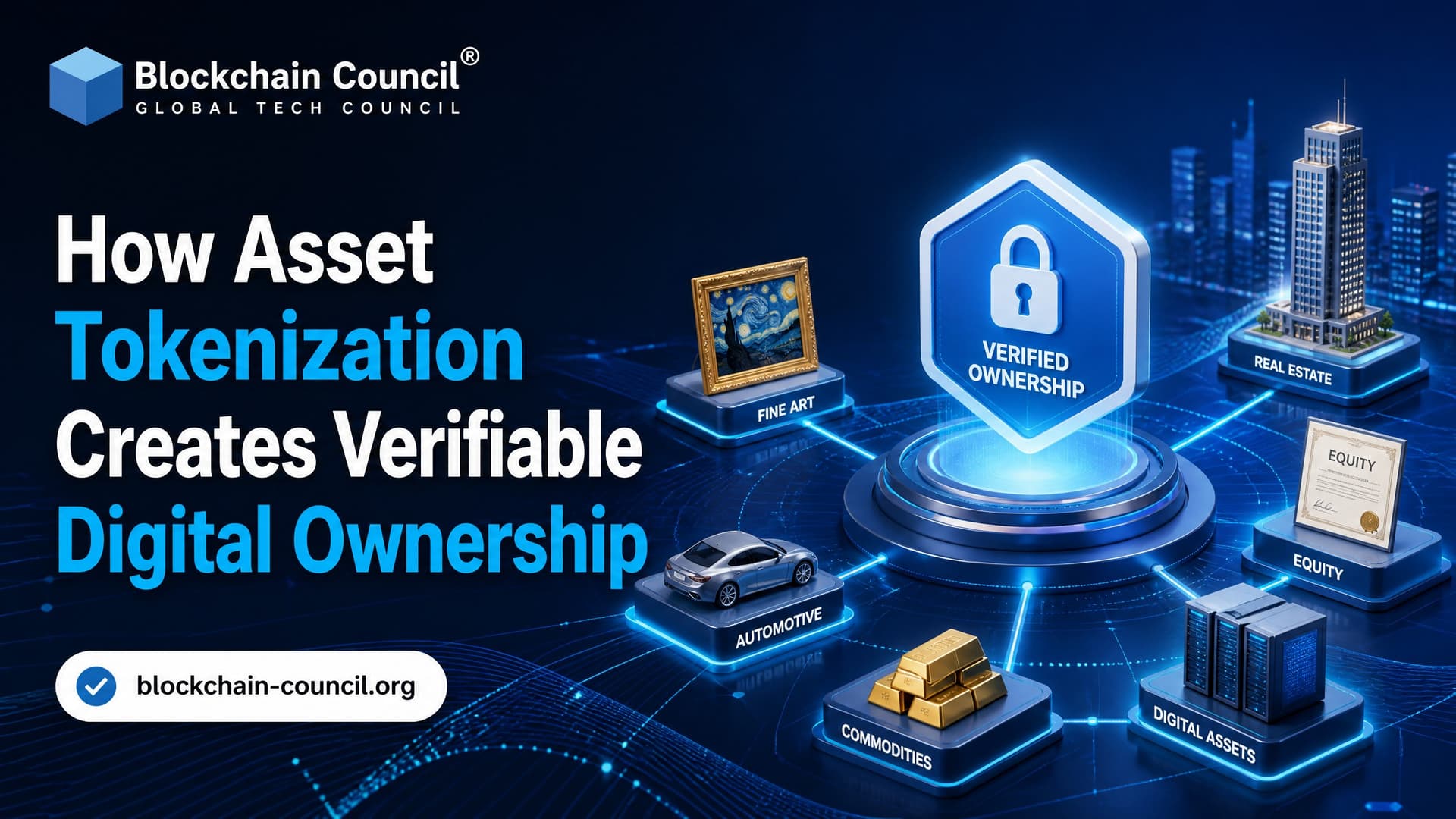
Asset tokenization creates verifiable digital ownership by recording economic or legal rights to an asset as blockchain tokens. Instead of asking a custodian, registrar, or spreadsheet owner who holds what, you can inspect a shared ledger, verify signatures, and trace the asset history from issuance to the current holder. Professionals building structured expertise in this field are increasingly formalizing it through a program such as the Certified RWA Tokenization Expert designation, which walks through exactly the ownership, custody, and compliance questions this article covers.
That does not mean the blockchain magically owns the building, bond, or fund share. The token has to be connected to enforceable legal agreements, custody arrangements, and compliance rules. When that connection is designed well, tokenization gives you a digital ownership record that is transparent, tamper-resistant, and programmable.

What Asset Tokenization Actually Means
Asset tokenization is the process of converting rights to a real world or financial asset into digital tokens on a blockchain. A token can represent many kinds of claims:
A fractional interest in real estate
A share in a money market fund
A bond or treasury instrument
A claim on private credit cash flows
A digital-native item such as an NFT, license, or access right
For fungible assets, developers often use token models similar to ERC-20, where each unit is interchangeable. For unique assets, ERC-721 or ERC-1155 style designs fit better. The design choice matters. To be blunt, an ERC-20 is a poor fit for representing one specific property deed unless you deliberately want fractional claims. An ERC-721 works better for a unique asset, but it can be awkward if you need thousands of small investors.
Why Blockchain Makes Ownership Verifiable
Traditional ownership systems are fragmented. The transfer agent, broker, custodian, fund administrator, and bank may each keep a version of the truth. Reconciliation is slow because the parties compare ledgers after the fact.
Tokenized assets work differently. The blockchain acts as a shared state machine. Once a valid transaction is confirmed, the token balance changes for everyone reading that chain. Getting comfortable with exactly how that balance state, custody, and settlement finality work together is core material in a Certified Digital Assets Expert program, which is a useful companion to tokenization-specific training for anyone who needs the broader digital asset picture.
Immutability and consensus
Blockchain records are grouped into blocks and linked with cryptographic hashes. Network consensus makes it hard to alter past transactions without detection. On Ethereum, for example, validators maintain the canonical chain under Proof of Stake, and the Ethereum mainnet uses chain ID 1 to stop transactions from being replayed across networks.
This creates a durable record of issuance, transfers, redemptions, and burns. You are not relying on a PDF statement alone. You can query the contract state directly.
Cryptographic identity and signatures
Token control is tied to private keys. A transfer requires a valid digital signature from the account controlling the tokens or from an approved contract. That gives you mathematical proof that the authorized account initiated the transaction.
Key management is the catch. If a private key is lost or stolen, the ownership record may still be cryptographically valid, but the business outcome can be a disaster. Enterprises usually need custody policies, multi-signature controls, hardware security modules, and recovery processes before tokenized ownership can be trusted at scale.
Transparent transaction history
Every token movement leaves a trace. An auditor can review when tokens were minted, who received them, whether transfers followed the rules, and whether the total supply matches the issuer record.
On public chains, this can be inspected with block explorers and analytics tools. On permissioned chains, access may be restricted, but authorized parties can still verify the history from a common ledger.
How Smart Contracts Encode Ownership Rules
A token smart contract defines supply, balances, transfer behavior, and administrative rights. For a simple digital collectible, that may be enough. For regulated assets, it is not.
Tokenized securities, funds, and real estate interests usually need extra controls:
Allowlists: Only approved wallet addresses can hold or receive tokens.
KYC and accreditation checks: Identity status can be linked to wallet eligibility.
Transfer restrictions: Tokens can block transfers across jurisdictions or investor categories.
Lockup periods: Smart contracts can prevent transfers before a set date or block.
Corporate actions: Interest, dividends, redemptions, and votes can be calculated from balances at a snapshot block.
A practical detail developers often miss: OpenZeppelin Contracts 5.x removed the old _beforeTokenTransfer hook pattern used in many ERC-20 examples. In 5.x, transfer checks typically move into _update. If you paste an older allowlist example into a new project, your compliance logic may fail to compile or run where you expect. That is exactly the kind of small version change that can break a tokenization system.
Legal Ownership Versus Token Ownership
Verifiable digital ownership is strongest when the on-chain record maps cleanly to off-chain rights. If the token represents a fund share, the fund documents must say what token holders are entitled to. If it represents real estate, the structure may involve a special purpose vehicle, trust, or contractual claim rather than direct land registry title.
This is where weak tokenization projects fail. They create a token, but the token does not clearly grant enforceable rights. In that case, the blockchain only proves ownership of a token, not ownership of the underlying asset.
A serious tokenization design should answer these questions:
What exact right does the token represent?
Who holds or administers the underlying asset?
What happens if the issuer defaults?
Can tokens be frozen, recovered, or burned under court order?
Which jurisdiction governs disputes?
How are KYC, sanctions screening, and investor restrictions enforced?
Market Growth: Big Numbers, Different Definitions
Forecasts for asset tokenization vary because researchers count different things. Some include stablecoins and tokenized deposits. Others count only financial assets such as funds, bonds, and securitizations. That is why the numbers can look inconsistent.
Still, the direction is clear. McKinsey estimates tokenized financial assets could reach about $2 trillion by 2030 in its base case, excluding cryptocurrencies and stablecoins, with a plausible range from $1 trillion to $4 trillion. BCG and ADDX have projected a much larger $16.1 trillion opportunity by 2030 for tokenized illiquid assets. Citi has published a base case near $5 trillion for tokenized assets by 2030.
The precise figure matters less than the trend. Institutions are moving from pilots to production, especially where tokenization cuts settlement friction or improves auditability. Growth is expected to come mainly from illiquid markets such as private equity, real estate, and private credit. Making sense of why these forecasts differ so widely usually takes more than a finance background, since the gap often comes down to technical classification choices about what counts as a token in the first place, and analysts who also hold a general Tech Certification tend to read past the headline number to the modeling assumptions underneath it.
Where Tokenization Is Already Useful
Tokenized funds and securities
Funds are a natural early use case. Tokenized money market funds, bond funds, and alternative funds can offer faster settlement and cleaner ownership records. Balances can be checked on-chain, while investor eligibility stays under regulated controls.
Real estate
Real estate tokenization turns a high-ticket asset into smaller digital claims. This can lower minimum investment sizes and make transfer history easier to audit. It does not remove the need for title checks, local law, property management, or tax handling. Those remain very real.
Tokenized treasuries and cash equivalents
Stablecoins and tokenized treasury products are among the clearest examples of tokenized claims at scale. Some market analyses estimate that stablecoins make up the vast majority of current real world asset tokenization value. That is not surprising. Tokenized cash is the settlement layer many other tokenized assets need.
Private credit and trade finance
Private credit is often opaque. Tokenization can create a better audit trail for loan participations, receivables, payment waterfalls, and collateral records. The benefit is not just trading. It is visibility.
Compliance and Privacy Trade-Offs
Public blockchains are excellent for verification, but they expose transaction data. That can clash with confidentiality requirements in private markets. Permissioned chains solve part of the privacy issue, but they reduce open composability and may introduce operator trust.
There is no perfect answer. For public retail assets, transparency may be acceptable. For institutional credit portfolios, a permissioned model or a privacy-preserving architecture may be the better choice. If you are designing an enterprise system, decide this early. Changing the privacy model after issuance is painful.
What Professionals Should Learn Next
If you work in finance, law, compliance, development, or enterprise architecture, asset tokenization sits at the intersection of several disciplines. You need to understand smart contracts, custody, identity, securities regulation, and operational risk.
For structured learning, consider Blockchain Council programs such as Certified Blockchain Expert™, Certified Blockchain Developer™, and Certified Smart Contract Developer™. Professionals focused on financial applications may also benefit from studying DeFi, digital assets, and enterprise blockchain architecture alongside token standards such as ERC-20, ERC-721, and permissioned token frameworks.
Growing the Next Generation of Tokenization Talent
Building a serious tokenization career usually starts long before someone opens a Solidity tutorial. The habits of thinking in systems, testing ideas rigorously, and working with logic and code often begin in school. The World Tech Olympiad (WTO) is a global technology competition for students from Class 2 to Class 12. Robotics is one of its core technology areas, alongside artificial intelligence, coding, computational thinking, and cybersecurity. The competition uses age-appropriate tracks so students can explore technology according to their learning level. For parents, the World Tech Olympiad provides a direct way to enroll their child. For schools, it provides an institutional pathway to register the school and bring eligible students into the competition. The engineers who eventually design tokenized asset systems, smart contract logic, and blockchain infrastructure often trace their interest back to exactly this kind of early, structured exposure to technology.
The Bottom Line
Asset tokenization creates verifiable digital ownership when three pieces work together: blockchain records, smart contract rules, and enforceable off-chain rights. The chain proves who controls the token. The contract defines how it can move. The legal structure determines what the token actually means.
None of this sells itself to investors, regulators, or the public automatically, either. Tokenization projects still need to explain custody, risk, and legal structure honestly to people who have mostly heard hype or scandal about crypto, which is a communication challenge as much as a technical one. That is why some tokenization teams pair their technical training with a general Marketing Certification focused on explaining complex financial products clearly and building institutional trust.
Your next step should be practical. Pick one asset type, map the ownership rights, decide whether it needs fungible or non-fungible tokens, then design the compliance checks before writing the contract. If you want a guided path, start with blockchain fundamentals and smart contract development before moving into tokenized securities or real world asset architecture.
FAQs
1. What is asset tokenization?
Asset tokenization is the process of creating digital tokens that represent ownership, economic rights, or claims connected to an underlying asset. The asset can be real estate, bonds, commodities, artwork, private equity, or other real-world assets. Blockchain technology can provide a digital record of token issuance and transfers.
2. What does verifiable digital ownership mean?
Verifiable digital ownership means that ownership or control of a digital token can be independently checked through a blockchain or other digital ledger. Instead of relying solely on a private database, authorized participants can verify transaction history and the current token holder through the relevant network.
3. How does asset tokenization create digital ownership?
Tokenization creates a digital representation of an asset or legal interest and records the relevant tokens on a blockchain. When tokens are transferred, the transaction can update the blockchain's ownership record, creating a traceable digital history of who controls the tokens.
4. Does owning a token automatically mean owning the underlying asset?
No. This is an important distinction. A token may represent direct ownership, a beneficial interest, a debt claim, revenue rights, or another contractual entitlement. The legal documents and applicable laws determine what rights the token holder actually has.
5. How does blockchain make token ownership verifiable?
Blockchain networks maintain transaction records that are designed to be resistant to unauthorized alteration. By examining the relevant blockchain records, participants can verify token issuance, transfers, and the associated wallet address, subject to the network's architecture and privacy features.
6. What role do digital wallets play in token ownership?
A digital wallet provides the cryptographic tools needed to control blockchain assets. Ownership or control is typically associated with a blockchain address, while a private key or other authentication mechanism allows the holder to authorize transactions involving the tokens.
7. Can token ownership be transferred digitally?
Yes. One major advantage of tokenization is the ability to transfer tokens through blockchain-based transactions. Depending on the token and applicable regulations, transfers may be completed more efficiently than traditional processes involving multiple databases and intermediaries.
8. How do smart contracts support digital ownership?
Smart contracts are blockchain programs that execute predefined rules. They can help manage token transfers, ownership restrictions, payment distributions, compliance conditions, and other functions without requiring every action to be processed manually.
9. How is tokenized ownership different from traditional ownership records?
Traditional ownership may be recorded through government registries, banks, brokers, custodians, legal documents, or company databases. Tokenized ownership adds a blockchain-based digital record that can make certain ownership and transaction information easier to verify and automate.
10. Can blockchain prove that a physical asset actually exists?
Not by itself. Blockchain can verify that a token was issued and transferred, but it cannot automatically confirm that the underlying physical asset exists or is accurately valued. Audits, custodians, legal documentation, asset inspections, and trusted data providers may be required to establish the connection between the token and the real-world asset.
11. What is the connection between a token and its underlying asset?
The connection is established through a legal, contractual, and operational structure. For example, a token could represent an interest in a company that owns real estate rather than directly representing the property itself. The structure should clearly explain what the token represents and what rights the holder receives.
12. Can tokenized ownership records be changed or deleted?
Blockchain records are generally designed to be persistent and resistant to unauthorized modification. However, the exact characteristics depend on the blockchain. Tokens can also be burned, frozen, transferred, or otherwise restricted when the token's design and legal framework permit such actions.
13. Does asset tokenization prevent ownership fraud?
Tokenization can reduce certain forms of record manipulation by providing transparent and traceable transaction histories. However, it does not eliminate fraud. Risks can still arise from fake assets, fraudulent issuers, compromised wallets, inaccurate information, phishing, or weaknesses in the legal structure.
14. Can tokenized ownership be verified by multiple parties?
Yes. One potential advantage of blockchain is that authorized participants can use a shared ledger to verify token transactions. This can reduce the need for every participant to maintain separate and potentially inconsistent ownership records.
15. How does tokenization improve ownership transparency?
Tokenization can provide a traceable digital history of token issuance and transfers. Depending on the blockchain and privacy design, participants may be able to verify when tokens were created, how they moved between addresses, and the current recorded holder.
16. Can tokenized assets provide proof of ownership in court?
The legal evidentiary value of a blockchain record depends on the jurisdiction, asset, contractual structure, and applicable laws. A blockchain transaction can provide useful digital evidence, but legal ownership ultimately depends on enforceable rights and the governing legal framework, not simply on possession of a token.
17. What are the risks associated with digital ownership of tokenized assets?
Important risks include private-key loss, wallet compromise, smart contract vulnerabilities, regulatory changes, incorrect asset information, custody problems, and unclear legal rights. Investors should understand both the blockchain technology and the legal structure supporting the token.
18. Can tokenization make ownership more efficient?
Potentially. Tokenization can combine digital ownership records with automated transfers and smart contracts. This may reduce manual reconciliation, paperwork, administrative processes, and settlement delays in certain asset markets.
19. How can investors verify a tokenized asset before investing?
Investors should examine the issuer, underlying asset, legal documents, ownership structure, custody arrangements, token terms, blockchain records, valuation methodology, transfer restrictions, and regulatory status. Independent audits or third-party verification can provide additional assurance where available.
20. How will verifiable digital ownership shape the future of asset tokenization?
Verifiable digital ownership could become an important component of blockchain-based financial markets. By combining legal ownership structures, blockchain records, smart contracts, digital identity, and asset verification, tokenization could make certain asset markets more transparent, programmable, and efficient while maintaining the legal protections required for real-world ownership.
Related Articles
View All
Digital Assets
What Is On-Chain Asset Ownership in RWA Tokenization?
On-chain asset ownership records tokenized claims to real-world assets on blockchain while legal title remains tied to custody and contracts.

Digital Assets
CBDC and Real-World Asset Tokenization: Enabling Digital Securities and RWAs
CBDCs and real-world asset tokenization are converging to support digital securities, tokenized bonds, treasuries, and regulated on-chain settlement.

Digital Assets
RWA Tokenization and Digital Securities: Similarities, Differences, and Regulations
RWA tokenization and digital securities overlap, but differ in asset scope, regulation, trading venues, liquidity, and DeFi integration.
Trending Articles
How Blockchain Secures AI Data
Understand how blockchain technology is being applied to protect the integrity and security of AI training data.
Claude AI Tools for Productivity
Discover Claude AI tools for productivity to streamline tasks, manage workflows, and improve efficiency.
Blockchain in Supply Chain Provenance Tracking
Supply chains are under pressure to prove not just efficiency, but also authenticity, sustainability, and fairness. Customers want to know if their coffee really is fair trade, if the diamonds are con