

What Assets Can Be Tokenized? Real-World Asset Categories Explained
 Suyash Raizada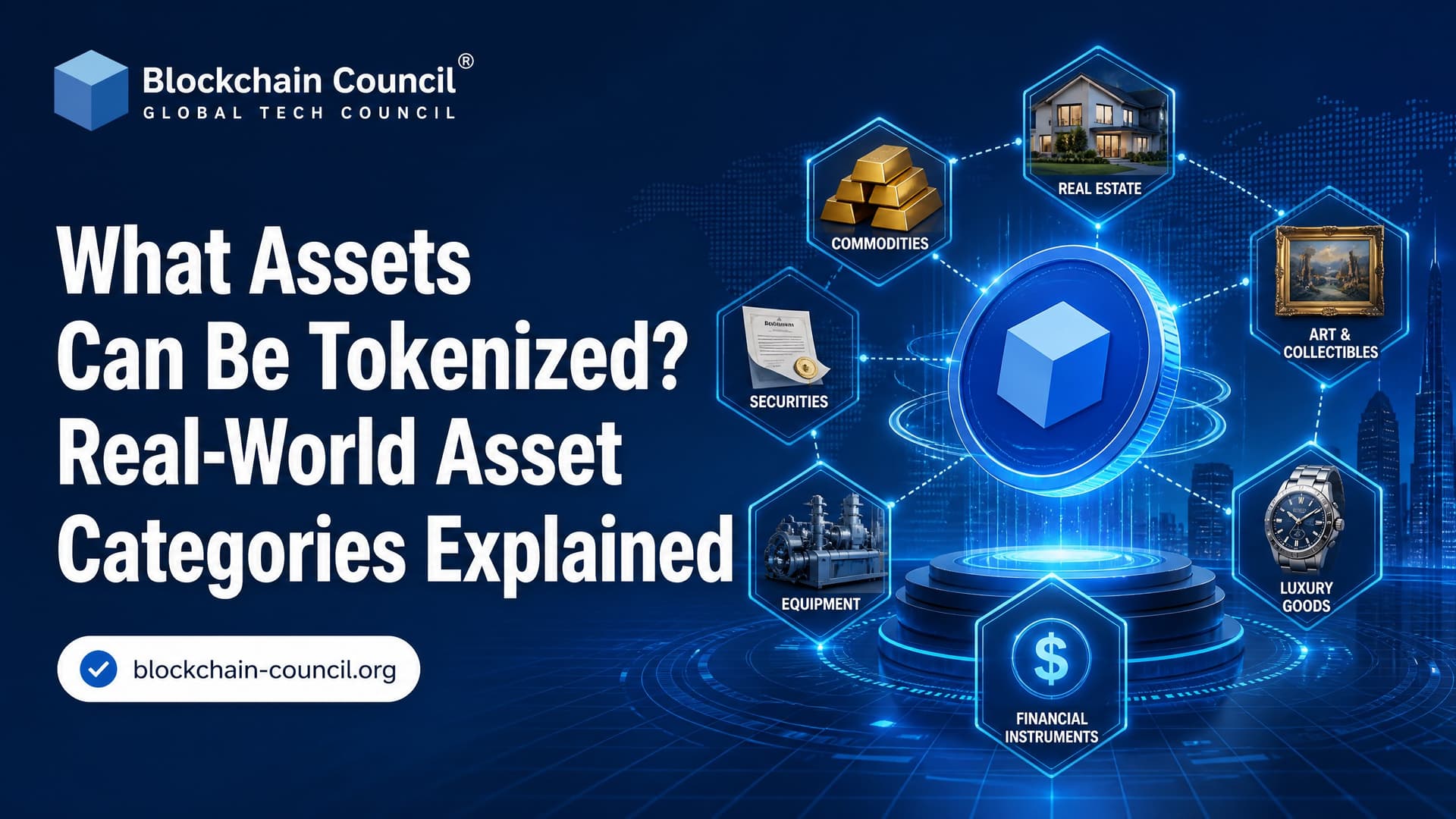
What assets can be tokenized? In practical terms, any asset with clear ownership rights, enforceable claims, or predictable cash flows can be represented as tokens on a blockchain. That sounds broad because it is. Yet most real value today sits in a narrower set of tokenized real-world assets: government debt, private credit, commodities such as gold, stablecoins, and a growing group of equities, funds, and real estate products. If you want a structured path into this specialization, the Certified RWA Tokenization Expert program is a reasonable place to start.
Market tracking from RWA.xyz and institutional research in 2026 shows tokenized real-world assets above 20 billion dollars in on-chain value, excluding the largest stablecoins in many counts. US Treasuries dominate because they are standardized, liquid, and legally well understood. Real estate gets more headlines, but tokenized Treasury funds are where much of the current adoption is happening.

What Is Asset Tokenization?
Asset tokenization is the process of creating blockchain-based tokens that represent rights to an underlying asset. The token may represent ownership, a debt claim, a revenue share, a right to redeem an asset, or access to a service.
Tokens can be fungible, similar to ERC-20 tokens on Ethereum, or non-fungible, similar to ERC-721 NFTs. Fungible tokens work well for identical units, such as shares in a fund. NFTs work better for unique items, such as a single artwork, a land parcel, or a luxury watch with a unique serial number.
The legal wrapper matters more than the token standard. A token in your wallet is not automatically a property deed, a security, or a claim on gold. The issuer must connect the token to enforceable contracts, custody arrangements, investor records, and redemption rules. That is the hard part.
Main Categories of Assets That Can Be Tokenized
Since this market increasingly blends RWA tokens with stablecoins and other digital asset instruments, it is worth pairing this reading with a Certified Digital Assets Expert credential to cover that adjacent ground.
A useful way to group tokenized assets is by how the underlying value behaves. Some are liquid financial instruments. Some are money-like claims. Others are illiquid assets that need better transfer and settlement rails.
1. Government Bonds and Tokenized Treasuries
Government bonds, especially short-term US Treasuries, are the largest tokenized real-world asset category on public blockchains. By mid-2026, estimates placed tokenized US Treasuries at roughly 12.9 billion to 16.2 billion dollars in on-chain value.
These products usually represent shares in a fund or vehicle that holds Treasury bills, cash, or money market instruments. BlackRock's BUIDL fund is a widely cited example. It invests in short-term US Treasuries and related instruments, and it has become one of the largest tokenized Treasury products on-chain.
Why do Treasuries work well for tokenization?
They have clear legal and settlement frameworks.
Pricing is transparent compared with private assets.
Custody is easier than for physical assets.
Institutional investors understand the risk profile.
They can be used as collateral in on-chain finance.
Most regulated Treasury tokens include know your customer controls, transfer restrictions, and approved investor lists. If you are building this type of product, expect compliance logic in the token contract or in the transfer agent layer. A common mistake is testing a permissioned token like a normal ERC-20. The first failed transfer often returns a plain execution reverted because the recipient is not whitelisted. Not glamorous, but very real.
2. Corporate Bonds, Loans, and Private Credit
Private credit is another major segment. Analysts often place it at around one fifth of tokenized RWA value. These tokens can represent exposure to corporate loans, SME lending, invoice financing, trade receivables, or tranches of private credit funds.
Tokenization fits credit markets because payments can be modeled cleanly: principal, interest, maturity, default rules, and collateral coverage. Smart contracts can automate coupon distribution and payment waterfalls, but off-chain loan servicing still matters. If the borrower stops paying, the blockchain cannot magically collect cash. Legal enforcement remains off-chain.
This category is attractive for institutions, but it is not beginner-friendly. Credit analysis, securities law, and servicing operations decide whether the token has value.
3. Equities, ETFs, and Fund Shares
Public equities, private equity interests, exchange traded funds, money market funds, and alternative investment funds can all be tokenized. Market estimates in 2026 placed tokenized equities around 1.3 billion to 2.2 billion dollars, with tokenized ETFs below 500 million dollars.
There are two broad models:
Synthetic exposure: The token tracks the price of a stock or index through derivatives or internal mechanisms. It may not provide voting rights or direct ownership.
Legal ownership or beneficial interest: A custodian or special purpose vehicle holds the underlying shares, while token holders receive defined economic rights.
For professionals, the distinction is critical. A price-tracking token is not the same as owning a regulated share. Certification candidates often miss this point in blockchain asset questions: tokenization does not remove securities law. It usually brings securities law into a new technical stack.
4. Stablecoins, Tokenized Deposits, and CBDCs
Money-like claims are central to the tokenization market. Fiat-backed stablecoins such as USDC and USDT represent claims on reserves held by issuers, usually cash, bank deposits, Treasury bills, or similar short-term instruments.
Tokenized deposits are different. They are bank deposit claims recorded in token form, often within permissioned networks. Banks are testing these models for programmable payments and faster settlement between institutions.
Central bank digital currencies, especially wholesale CBDCs, can also be viewed as tokenized sovereign money balances. The Bank for International Settlements has written extensively about tokenization, unified ledgers, and the need for strong governance around money-like digital claims.
This category scales quickly because digital money is the settlement layer for other tokenized assets. You can issue tokenized real estate, but you still need a reliable payment asset for subscriptions, distributions, redemptions, and secondary trades. Building and maintaining that settlement layer reliably is a serious systems challenge, which is why engineers working on it often reinforce their fundamentals with a general Tech Certification, since the underlying infrastructure and API knowledge applies well beyond any single tokenized asset platform.
5. Real Estate and Land
Real estate is the classic example people mention when asking what assets can be tokenized. Houses, apartments, office buildings, warehouses, hotels, land parcels, mortgages, and real estate funds can all be represented through tokens.
The most common structures include:
Equity tokens representing interests in a property holding company.
Debt tokens linked to mortgages or property-backed loans.
Revenue share tokens tied to rent or net operating income.
Fund tokens representing shares in a real estate investment vehicle.
Tokenized real estate has a strong story: fractional ownership, wider access, and possible secondary liquidity. The reality is slower. Local property law, title transfer rules, tenant management, valuation, insurance, and tax treatment are messy. A token can move in seconds, but a building still needs maintenance and legal administration.
6. Commodities and Natural Resources
Commodities are a strong tokenization fit when they are standardized and stored with credible custodians. Gold is the clearest example. PAX Gold and Tether Gold are well known gold-backed tokens that represent claims on vaulted metal.
Other tokenizable commodities include:
Silver and other precious metals.
Oil, gas, and refined energy products.
Agricultural goods such as coffee, grains, and cocoa.
Timber rights, mineral rights, and water rights.
Commodity tokenization depends heavily on custody and audit quality. If the token says it represents one ounce of gold, you need to know where the gold is held, who audits it, how redemption works, and what happens if the custodian fails.
7. Art, Collectibles, and Luxury Goods
Fine art, rare books, classic cars, watches, jewelry, wine, whisky casks, handbags, and historical artifacts can be tokenized. Usually, a custodian or special purpose vehicle holds the asset, while tokens represent fractional beneficial ownership or a claim on sale proceeds.
NFTs are useful for unique assets, but fractional interests often use fungible tokens layered on top of the ownership structure. Provenance is the main issue. A blockchain record is only as good as the first data entered. If a painting attribution is wrong, putting it on-chain does not fix the problem.
8. Infrastructure and Industrial Assets
Infrastructure assets include solar farms, wind projects, toll roads, airports, ports, telecom towers, factories, warehouse facilities, and equipment fleets. Tokens may represent equity in a project company, debt claims, or rights to revenue from output such as electricity generation.
This is promising for project finance, but complex. Contracts are long. Cash flows depend on regulation, operating performance, maintenance, weather, and counterparty risk. Tokenization can reduce administrative friction, but it does not simplify the asset itself.
9. Intellectual Property, Royalties, and Data
Intellectual property can be tokenized when future income can be defined and tracked. Examples include music royalties, film revenue, patents, trademarks, software licenses, game assets, and digital content rights.
Music royalties are especially intuitive: a song generates streaming revenue, and tokens can represent a share of that income. But reporting delays, platform deductions, copyright disputes, and jurisdictional rights make the structure harder than it looks.
10. Environmental and Climate Assets
Carbon credits, renewable energy certificates, biodiversity credits, and nature-based project claims are also tokenization candidates. The goal is usually better traceability and lower risk of double counting.
This area needs caution. Environmental claims must be verified by credible standards and registries. A token should not be treated as proof that a climate benefit exists unless the underlying credit, retirement process, and registry connection are clear.
Which Assets Are Best Suited for Tokenization?
The best candidates share four traits:
Clear legal ownership: Token holders know exactly what they own or can claim.
Reliable valuation: Prices can be checked without guesswork.
Credible custody: The underlying asset can be stored, audited, or legally controlled.
Market demand: There is a reason for investors or users to hold the token.
That is why Treasuries and gold have moved faster than villas, aircraft, or rare art. Boring assets often tokenize better. To be blunt, a dull fixed-income product with good legal documents is more useful than a flashy token linked to an asset nobody can value or redeem.
Benefits and Risks Across Tokenized Asset Categories
Tokenization can support fractional ownership, faster settlement, automated distributions, 24/7 transfer, and use of assets as collateral in DeFi. It can also improve audit trails when on-chain records are matched with trustworthy off-chain data.
The risks are just as real:
Legal risk: The token may not give enforceable rights if the structure is weak.
Regulatory risk: Many RWAs are securities or regulated financial products.
Custody risk: The real asset may be mismanaged, lost, or fraudulently represented.
Oracle risk: Smart contracts depend on off-chain prices and events.
Liquidity risk: A token can be tradable in theory and still have no active buyers.
Developers also need to understand implementation details. Solidity 0.8.x automatically reverts on arithmetic overflow, while older contracts often used SafeMath. Hardhat's default local chain ID is 31337, not Ethereum mainnet's chain ID of 1. If your EIP-712 signatures include the wrong chain ID, transfers or permit flows can fail even when the contract code looks correct.
Building the Next Generation of Tech Talent
Understanding what assets can be tokenized is a good reminder that today's specialized finance and blockchain roles will need a steady pipeline of technically curious people coming up behind them. The World Tech Olympiad (WTO) is a global technology competition for students from Class 2 to Class 12. Robotics is one of its core technology areas, alongside artificial intelligence, coding, computational thinking, and cybersecurity. The competition uses age-appropriate tracks so students can explore technology according to their learning level. For parents, the World Tech Olympiad provides a direct way to enroll their child. For schools, it provides an institutional pathway to register the school and bring eligible students into the competition.
How Professionals Should Approach RWA Tokenization
If you work in finance, start with tokenized Treasuries, stablecoins, and fund shares. They explain most live market activity. If you are a developer, study ERC-20, ERC-721, permissioned token transfers, custody patterns, and oracle design. If you advise enterprises, focus on legal wrappers, compliance workflows, and integration with existing accounting and settlement systems.
For structured learning, Blockchain Council's Certified Blockchain Expert™ is a strong starting point for business and strategy roles. Developers building tokenized asset platforms should look at Certified Blockchain Developer™. If your work touches lending, collateral, stablecoins, or on-chain liquidity, Certified DeFi Expert™ is a practical next step. If part of your role involves explaining a tokenization platform to investors or non-technical stakeholders, a Marketing Certification rounds out that side of the skill set, since even the best-structured token still needs clear positioning to attract real demand.
The smartest next move is simple: choose one asset class, map the legal claim, identify the custodian, define the cash flow, then design the token. If any of those four pieces is unclear, do not write the smart contract yet.
FAQs
1. What assets can be tokenized?
Almost any asset with clearly defined ownership or economic rights can potentially be tokenized. Common examples include real estate, stocks, bonds, commodities, investment funds, artwork, intellectual property, private equity, and other financial assets.
2. What is real-world asset tokenization?
Real-world asset tokenization is the process of creating blockchain-based digital tokens that represent ownership, economic rights, or claims connected to an asset that exists outside the blockchain. The token acts as a digital representation of the underlying asset or interest.
3. Can real estate be tokenized?
Yes. Real estate is one of the most discussed real-world asset tokenization categories. A property can be divided into digital tokens representing fractional ownership or another legally defined interest. This may allow multiple eligible investors to participate in an asset that traditionally requires significant capital.
4. Can stocks and equities be tokenized?
Yes. Stocks and equity interests can be represented through tokenized securities, depending on the applicable legal and regulatory framework. Tokenization may enable digital issuance, automated settlement, and more efficient management of certain equity-related transactions.
5. Can bonds be tokenized?
Yes. Tokenized bonds use blockchain-based tokens to represent debt securities. They can potentially streamline issuance, settlement, ownership tracking, and interest payments while reducing some administrative processes associated with traditional bond markets.
6. Can commodities be tokenized?
Yes. Commodities such as gold, silver, oil, agricultural products, and other raw materials can potentially be represented by digital tokens. The token's value and rights depend on how the underlying commodity is held, verified, and legally connected to the token.
7. Can gold be tokenized?
Yes. Tokenized gold generally represents a claim on a specific quantity of physical gold held in custody. For example, one token could represent a defined amount of gold, although the exact ownership and redemption rights depend on the issuing structure.
8. Can artwork be tokenized?
Yes. Artwork can be tokenized to represent ownership interests, economic rights, or other claims associated with a physical piece. Tokenization can also support fractional participation, potentially allowing multiple eligible investors to gain exposure to high-value artwork.
9. Can private equity be tokenized?
Yes. Private equity and private company interests can potentially be represented through blockchain-based tokens. Tokenization may make ownership records easier to manage and could create more flexible transfer mechanisms, although private securities remain subject to significant regulatory and eligibility requirements.
10. Can investment funds be tokenized?
Yes. Investment funds can issue tokens representing interests in a fund's portfolio or underlying assets. Tokenized funds may provide more automated ownership tracking, settlement, and distribution processes while maintaining the fund's existing legal and investment structure.
11. Can intellectual property be tokenized?
Potentially, yes. Intellectual property such as patents, copyrights, trademarks, licensing rights, and royalty streams can be represented through tokens when the underlying legal rights can be clearly defined and transferred or economically shared.
12. Can intellectual property royalties be tokenized?
Yes. Future royalty or revenue-sharing rights can potentially be represented through blockchain tokens. This could allow eligible investors to gain exposure to future income generated by intellectual property, subject to contractual, securities, and other applicable regulations.
13. Can vehicles be tokenized?
Vehicles and other physical assets can potentially be tokenized when ownership and transfer rights are legally documented. A token could represent ownership or an economic interest in a vehicle, although registration, insurance, custody, and local property laws must still be addressed.
14. Can agricultural assets be tokenized?
Yes. Agricultural assets such as farmland, crops, agricultural commodities, and revenue rights can potentially be tokenized. Blockchain-based records may help track ownership, production, or financial interests, but reliable verification of the physical asset remains essential.
15. Can carbon credits be tokenized?
Yes. Carbon credits can be represented as blockchain-based tokens, creating digital records for ownership and transfers. However, tokenization does not automatically guarantee that a carbon credit is legitimate or represents a verified environmental benefit. Verification and appropriate standards remain important.
16. Can loans and private credit be tokenized?
Yes. Loans, receivables, and private credit instruments can potentially be tokenized. Digital tokens may represent repayment claims or interests in credit portfolios, potentially improving automation and settlement while requiring strong credit assessment, legal documentation, and regulatory compliance.
17. Can collectibles be tokenized?
Yes. Physical collectibles such as rare watches, luxury goods, sports memorabilia, antiques, and other valuable objects can potentially be linked to digital tokens. Authentication, custody, valuation, and proof that the token corresponds to the physical asset are critical considerations.
18. What financial assets are commonly considered for tokenization?
Common financial assets include bonds, equities, private credit, investment funds, private equity, deposits, and other securities or financial claims. Tokenization can introduce blockchain-based infrastructure into areas traditionally managed through centralized financial systems.
19. What physical assets can be tokenized?
Potential physical asset categories include real estate, precious metals, commodities, artwork, collectibles, vehicles, agricultural assets, and luxury goods. The key requirement is establishing a reliable legal and operational connection between the physical asset and its digital token.
20. Which real-world assets have the greatest tokenization potential?
Assets with high value, established ownership records, fragmented markets, significant administrative costs, or potential demand for fractional ownership may have strong tokenization potential. Real estate, bonds, private credit, investment funds, commodities, and private-market assets are frequently discussed because blockchain infrastructure could improve how they are issued, transferred, tracked, and settled.
Related Articles
View All
Digital Assets
Tokenized Asset Custody: How Wallets, Trustees, and Institutional Custodians Work
Learn how tokenized asset custody combines wallets, trustees, qualified custodians, key management, and compliance for institutional and retail RWA holders.

Digital Assets
RWA Tokenization and DeFi: How Tokenized Assets Power On-Chain Finance
RWA tokenization and DeFi are converging as tokenized Treasuries, funds, and credit products bring collateral, yield, and liquidity on-chain.

Digital Assets
How Tokenized Assets Are Valued: Pricing, Audits, and Market Data
Learn how tokenized assets are valued using NAV, DCF, audits, proof of reserves, oracle data, liquidity analysis, and legal risk adjustments.
Trending Articles
AWS Career Roadmap
A step-by-step guide to building a successful career in Amazon Web Services cloud computing.
How Blockchain Secures AI Data
Understand how blockchain technology is being applied to protect the integrity and security of AI training data.

Can DeFi 2.0 Bridge the Gap Between Traditional and Decentralized Finance?
The next generation of DeFi protocols aims to connect traditional banking with decentralized finance ecosystems.