

RWA Tokenization: Market Outlook and Emerging Opportunities
 Suyash Raizada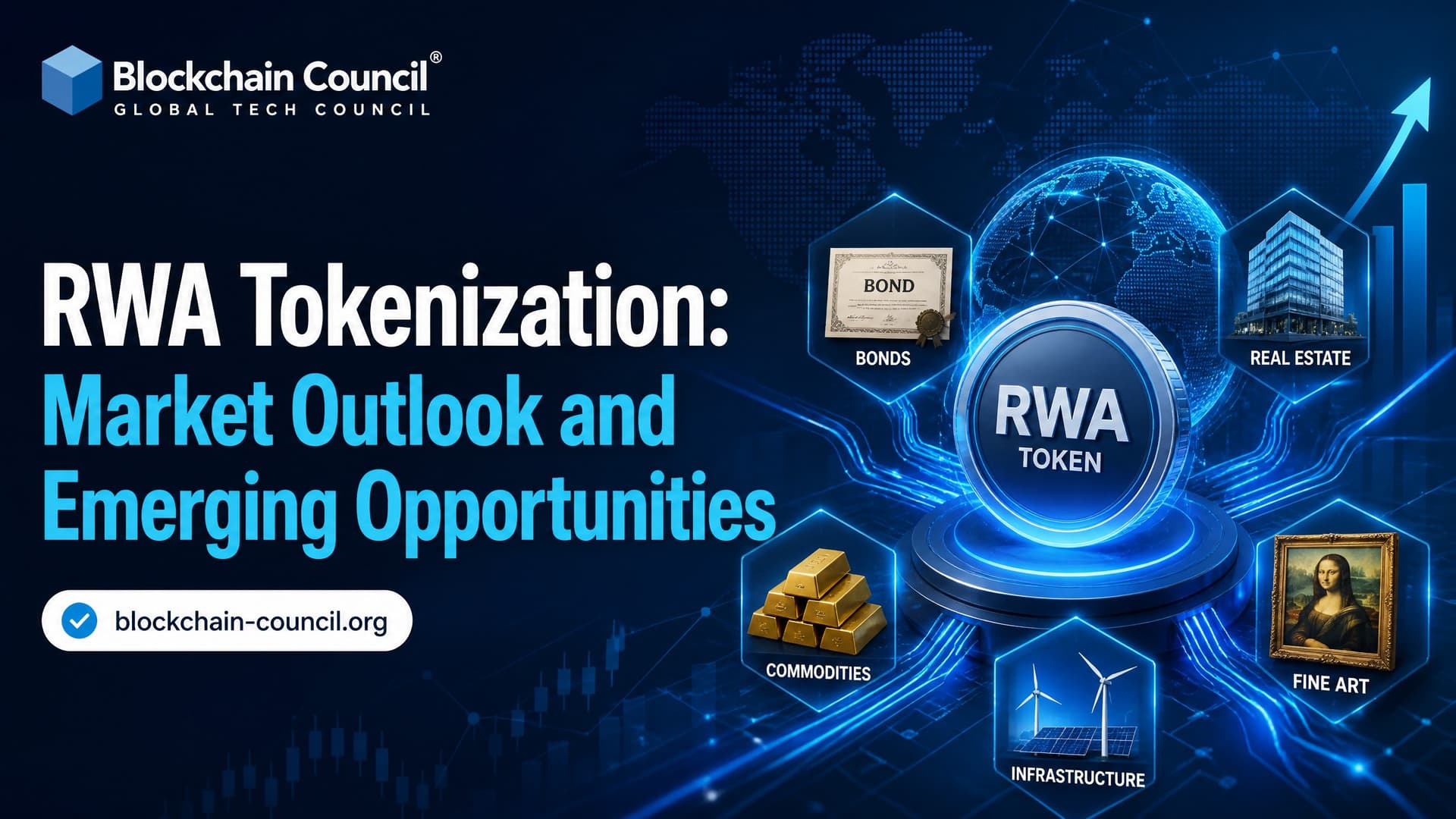
RWA tokenization is no longer a theory slide in a bank innovation lab. It is moving into institutional deployment, with tokenized Treasuries, money market funds, private credit, and fund shares already sitting on-chain. The market is still small beside global capital markets, but the growth curve is hard to ignore. As professionals explore opportunities in this evolving field, specialized learning such as the Certified RWA Tokenization Expert can help build a stronger understanding of tokenized assets, their structures, and practical applications.
Depending on what you count, mid 2026 estimates range from roughly 23 billion dollars to 60 billion dollars in non-stablecoin tokenized real-world assets. That spread matters. Some datasets count only freely tradable on-chain assets. Others include tokenized funds, centralized wrappers, or assets committed to tokenization but not yet trading. If you work in this space, definitions are not academic. They change the size of the market by tens of billions.

What RWA Tokenization Means in Practice
RWA tokenization is the process of representing claims on off-chain assets as blockchain-based tokens. Those assets can include Treasury bills, fund shares, loans, real estate, invoices, commodities, intellectual property, or art. The token is not the asset itself. It is a digital representation of legal and economic rights linked to that asset.
That distinction is where many projects fail. A token without enforceable rights, qualified custody, clear transfer rules, and reliable asset servicing is just a database entry with a nicer interface. Real RWA tokenization needs three layers working together:
Legal layer: asset ownership, investor rights, transfer restrictions, disclosures, and jurisdictional rules.
Technical layer: smart contracts, wallets, identity checks, oracle data, and settlement rails.
Operational layer: custody, fund administration, redemption, audits, tax reporting, and investor support.
For developers, the compliance layer changes the architecture. You are rarely building a free-transfer ERC-20 token. You are usually building permissioned transfers, role-based controls, allowlists, transfer agents, or ERC-3643-style identity-aware flows. A common beginner mistake is treating RWA tokens like memecoins. Wrong model.
Current RWA Tokenization Market Outlook
CoinGecko estimated that tokenized RWA market capitalization, excluding stablecoins, rose from 5.42 billion dollars at the start of 2025 to 19.32 billion dollars by 31 March 2026. That is 256.7 percent growth in fifteen months. RWA.xyz data cited in market updates placed freely tradable on-chain RWA value at about 33.5 billion dollars in early July 2026, close to triple the level from a year earlier.
Other market trackers report different totals. DeFiLlama data cited by Bitmarkets put the market near 23.6 billion dollars by mid 2026. Thirdweb, drawing on BeInCrypto Research and RWA.xyz, estimated about 60 billion dollars in May 2026 when additional categories were included. The gap is not necessarily a contradiction. It reflects methodology.
There is also a pipeline story. Some market reports place represented or committed RWA value near 345 billion dollars. These are assets intended for tokenization but not always freely tradable on-chain. That pipeline will not convert overnight. Still, it shows where institutions are pointing their infrastructure budgets.
Tokenized Treasuries and Funds Lead the Market
The most mature RWA tokenization use cases are boring on purpose: tokenized United States Treasuries, money market funds, and credit funds. Boring is good here. Short-duration government debt has clear pricing, established custody workflows, and strong institutional demand.
BlackRock's BUIDL fund is a flagship example, with reported assets around 2.5 to 2.9 billion dollars in 2026. Secondary trading through UniswapX also showed how traditional fund structures can connect with decentralized liquidity venues. That does not mean every fund should trade on a decentralized exchange. It does mean the boundary between asset management and on-chain settlement is getting thinner.
Tokenized funds are now one of the largest segments. DeFiLlama data cited by Bitmarkets suggests tokenized funds account for about 44.5 percent of the RWA market, or roughly 10.5 billion dollars in mid 2026. These include money market funds, bond funds, and diversified vehicles.
Why Institutions Are Paying Attention
The institutional case for RWA tokenization is not only fractional ownership. That phrase gets overused. The bigger drivers are settlement speed, distribution, collateral mobility, transparency, and operational cost reduction.
The Depository Trust & Clearing Corporation, which provides core clearing and settlement infrastructure for United States securities markets and custodies more than 114 trillion dollars in securities, has been reported as piloting tokenized securities trading with more than 50 major firms, including BlackRock, Goldman Sachs, JPMorgan, and Ripple Prime. A commercial launch has been discussed for 2026. If even a narrow version of that goes live, it would move tokenization from pilot theater into real market plumbing.
DeFi is also pulling RWAs in. RWA deposits in DeFi protocols reportedly grew from 2.33 billion dollars in Q2 2025 to 7.44 billion dollars in Q2 2026. That is still early, but it tells you something important: tokenized off-chain collateral is becoming part of on-chain lending and yield design.
For professionals seeking to understand the wider digital asset ecosystem surrounding these developments, the Certified Digital Assets Expert can provide a complementary learning path covering broader digital asset concepts and applications.
Emerging Opportunities in RWA Tokenization
1. On-Chain Treasury Management
Enterprises with digital asset operations need places to park funds without sitting entirely in volatile crypto assets. Tokenized money market funds and government debt can support payment automation, collateral management, and treasury workflows. The opportunity is strongest where the firm already operates on-chain, such as exchanges, stablecoin issuers, Web3 companies, and payment platforms.
2. RWA-Backed Lending and Private Credit
Credit is the next serious frontier. Tokenized receivables, invoice financing, trade finance, and private credit funds can connect borrowers with wider pools of capital. But this is not a place to cut corners. You need underwriting, servicing, default handling, and legal recourse. Smart contracts do not collect late invoices by themselves.
3. Compliance and Identity Infrastructure
Permissioning will be a major category. RWA tokens often need investor eligibility checks, jurisdictional restrictions, sanctions screening, holding limits, and transfer locks. This creates demand for on-chain identity tools, compliance APIs, permissioned liquidity pools, and audit-friendly reporting systems.
A practical note from smart contract work: if you are using OpenZeppelin Contracts 5.x and inherit Ownable, the constructor now expects an initialOwner argument. Many developers migrating from older examples hit the Solidity error, No arguments passed to the base constructor. Specify the arguments or mark the contract as abstract. Small version changes like that can break deployment scripts. In regulated token projects, that kind of mistake is more than annoying. It can delay audits and launch windows.
4. Data, Risk, and Valuation Tools
As RWA tokenization scales, investors will need better analytics. Who is the issuer? What assets back the token? Is liquidity real or just quoted? What happens on redemption day? Risk tools for duration, credit quality, legal enforceability, oracle reliability, and liquidity depth will become essential.
5. Real Estate and Alternative Assets
Real estate, art, intellectual property, and agricultural assets make good headlines, but they are harder to scale than Treasuries. Valuation is subjective. Transfers can trigger local legal requirements. Liquidity is uncertain. My view: alternatives will grow, but they are a later-stage opportunity. If you are building now, money markets and credit are the cleaner entry points.
Technology & Problem Solving
Technology education is not only about learning tools or programming languages. It also involves understanding problems, analysing information, identifying patterns, and developing logical solutions. A Tech Olympiad gives students an opportunity to develop these problem-solving abilities while exploring different areas of technology.
Risks That Could Slow the Market
RWA tokenization has real momentum, but the risks are not minor.
Legal enforceability: Investors must know whether the token gives them a valid claim under securities, property, or contract law.
Custody risk: The off-chain asset must be held, audited, and protected by credible institutions.
Oracle risk: On-chain systems need reliable price, collateral, and asset status data.
Liquidity risk: Tokenization does not create buyers. A token can be technically transferable and still barely trade.
Concentration risk: Current activity is heavily concentrated in Treasuries and a small group of funds.
Interoperability risk: Assets spread across public chains, permissioned ledgers, and custodial systems can fragment liquidity.
Regulation is the deciding variable. Jurisdictions that give clear treatment to tokenized securities, fund shares, and digital custody will attract issuance. Others will watch activity move offshore or into permissioned institutional systems.
Forecasts for 2030 and Beyond
Long-term forecasts vary, but they point in the same direction. McKinsey has projected roughly 2 to 4 trillion dollars in tokenized RWAs by 2030. BCG and Ripple estimates have been cited around 9.4 trillion dollars by 2030 and about 18 to 19 trillion dollars by 2033. Standard Chartered has been reported forecasting about 30 trillion dollars by 2034.
Those numbers should not be read as guarantees. A 30 trillion dollar outcome requires major re-platforming of securities, funds, and lending markets. That is possible, but not automatic. The more realistic path is phased adoption:
Money markets: Treasuries, cash equivalents, and regulated liquidity funds.
Credit: private credit, trade finance, receivables, and structured lending.
Alternatives: real estate, private equity, art, IP, and other illiquid assets.
This sequence matches what we see in the data. Capital is moving first into assets with clear pricing, clear custody, and clear redemption mechanics. Good. That is how serious financial infrastructure usually starts.
What Professionals and Developers Should Learn Now
If you want to work in RWA tokenization, do not study blockchain in isolation. You need the overlap between smart contracts, financial markets, compliance, and risk. Developers should understand ERC-20, ERC-721 where relevant, role-based access controls, upgrade patterns, oracle design, and chain-specific deployment issues. Business and compliance teams should understand custody models, securities regulation, KYC, AML, investor accreditation, and fund operations.
For structured learning, Blockchain Council readers can explore learning paths such as Certified Blockchain Expert™, Certified Blockchain Developer™, Certified Smart Contract Developer™, and Certified DeFi Expert™. If your work touches digital assets more broadly, Certified Cryptocurrency Expert™ is also a useful foundation.
Professionals who want to expand their technical capabilities across emerging technologies can also explore a Tech Certification aligned with their career interests. This can complement blockchain-specific learning, particularly for professionals working across technology, product development, and digital transformation.
Build one small project next: a permissioned ERC-20-style token with allowlisted transfers, a mock net asset value oracle, and a simple redemption workflow on a testnet. Then write down the legal assumptions your contract cannot enforce. That exercise will teach you the main truth about RWA tokenization: the future belongs to teams that can connect code with real-world rights.
For professionals working on the commercial side of emerging technology, developing complementary market-facing skills can also be valuable. A Marketing Certification can complement technical and RWA expertise by strengthening broader marketing knowledge and helping professionals communicate technology products effectively.
FAQs
1. What is the market outlook for RWA tokenization?
The outlook for RWA tokenization is increasingly positive as financial institutions explore blockchain for asset issuance, settlement, custody, investment, and asset servicing. Tokenized RWAs reached about $19.3 billion by the end of Q1 2026, more than triple the level at the start of 2025.
2. Why is RWA tokenization expected to grow?
Growth is being driven by institutional adoption, improving regulatory clarity, blockchain infrastructure, demand for faster settlement, fractional ownership, and new digital investment products. A 2026 institutional survey found that 63% of respondents were very interested in investing in tokenized assets.
3. Which RWA categories have the strongest growth potential?
Major opportunities include Treasury securities, bonds, private credit, real estate, commodities, investment funds, equities, and infrastructure assets. Tokenized Treasuries currently remain the largest RWA category, while commodities and tokenized stocks are also expanding.
4. What is the opportunity in tokenized Treasury products?
Tokenized Treasury products provide blockchain-based access to government debt and yield-bearing instruments. They can support 24/7 transferability, programmable transactions, and integration with digital financial applications.
5. How could tokenized funds reshape asset management?
Tokenization can enable digital fund distribution, fractional participation, automated administration, and potentially broader investor access. PwC projects tokenized fund assets under management could reach $715 billion globally by 2030, representing a projected 41% CAGR.
6. What opportunities exist in tokenized private credit?
Private credit is a significant opportunity because tokenization can provide digital ownership records, automated repayments, improved reporting, and potentially broader distribution. Institutions are increasingly exploring asset-backed credit and specialty-finance products on blockchain networks.
7. Can real estate become a major RWA tokenization market?
Yes. Real estate can potentially benefit from fractional ownership, digital investor onboarding, automated distributions, and easier transfer of eligible interests. However, property rights, local regulations, valuation, and secondary-market liquidity remain important considerations.
8. What is driving growth in tokenized commodities?
Tokenized commodities, particularly gold-backed assets, have experienced strong growth. CoinGecko reported tokenized commodities increasing from $1.4 billion to $5.5 billion through Q1 2026, with gold-backed tokens accounting for much of the increase.
9. What opportunities are emerging for tokenized equities?
Tokenized equities could provide digital access to equity exposure, programmable transfers, extended trading possibilities, and integration with blockchain-based financial applications. Tokenized stocks reached approximately $0.5 billion by Q1 2026, according to CoinGecko.
10. How can RWA tokenization create new investment opportunities?
Tokenization can make certain assets available through smaller investment denominations, digital distribution channels, programmable ownership structures, and potentially broader market access. It may also enable new combinations of traditional assets with blockchain-based financial services.
11. How are institutions approaching RWA tokenization?
Institutions are increasingly moving from experimentation toward implementation. In a 2026 survey, 67% of firms identified asset tokenization as a capability they plan to prioritize over the following two years.
12. Can tokenization reduce capital-market costs?
Potentially. Blockchain-based infrastructure can automate settlement, reconciliation, recordkeeping, compliance, and asset servicing, potentially reducing some administrative costs and intermediary dependencies.
13. Will RWA tokenization improve liquidity?
Tokenization can improve transferability and accessibility, but it does not automatically create liquidity. Sufficient buyers, sellers, market infrastructure, regulatory access, and reliable pricing are still necessary. Research in 2026 also highlights that tokenization and actual secondary-market liquidity should be treated as distinct outcomes.
14. What role will stablecoins play in the RWA market?
Stablecoins can provide digital payment and settlement infrastructure for tokenized assets. Institutional investors are already exploring stablecoins for cash management, money movement, and near-real-time settlement, creating potential synergies with tokenized securities.
15. How could AI create new opportunities in RWA tokenization?
AI can support asset valuation, risk analysis, compliance monitoring, fraud detection, portfolio management, and predictive analytics. Combining AI with tokenized assets could make asset management and monitoring more automated.
16. What role will regulation play in the RWA market outlook?
Regulatory clarity will be a major driver of adoption. Institutions increasingly view regulation as both an accelerator and a barrier, with regulatory uncertainty remaining one of the most significant obstacles to investing in tokenized assets.
17. What are the biggest challenges to RWA tokenization growth?
Key challenges include regulatory uncertainty, interoperability, insufficient secondary-market liquidity, custody, cybersecurity, valuation, legal ownership structures, and integration with existing financial infrastructure.
18. Will traditional and tokenized financial markets coexist?
Yes. The likely direction is a hybrid financial market where traditional and blockchain-based infrastructure operate alongside one another. Broadridge's 2026 survey found that 92% of respondents expect digital and traditional assets to coexist for the foreseeable future.
19. What emerging RWA opportunities should businesses watch?
Businesses should watch tokenized funds, private credit, Treasury products, commodities, tokenized equities, collateral management, digital settlement, programmable payments, and institutional asset servicing. These areas combine clear financial utility with growing institutional interest.
20. What is the long-term future of RWA tokenization?
RWA tokenization could become an important part of global financial-market infrastructure, connecting traditional assets with blockchain-based settlement, payments, custody, and investment systems. The strongest opportunities are likely to emerge where tokenization solves practical problems such as settlement efficiency, distribution, automation, and access rather than simply putting existing assets on-chain.
Related Articles
View All
Digital Assets
RWA Tokenization and Lending: Collateral, Credit, and Yield Opportunities
RWA tokenization and lending is reshaping collateral, credit, and yield markets through tokenized Treasuries, private credit, and receivables-backed assets.

Digital Assets
RWA Tokenization Risks: Legal, Technical, Market, and Custody Challenges
RWA tokenization brings real assets on-chain, but legal, technical, liquidity, and custody risks can break investor rights and market trust.

Digital Assets
Is an RWA Tokenization Certification Worth It? Benefits, Careers, and ROI
Is an RWA tokenization certification worth it? Learn the benefits, career paths, market growth, and ROI factors for blockchain and finance professionals.
Trending Articles
The Role of Blockchain in Ethical AI Development
How blockchain technology is being used to promote transparency and accountability in artificial intelligence systems.

Top 5 DeFi Platforms
Explore the leading decentralized finance platforms and what makes each one unique in the evolving DeFi landscape.
What is AWS? A Beginner's Guide to Cloud Computing
Everything you need to know about Amazon Web Services, cloud computing fundamentals, and career opportunities.