

What is Dash?
 Toshendra Kumar Sharma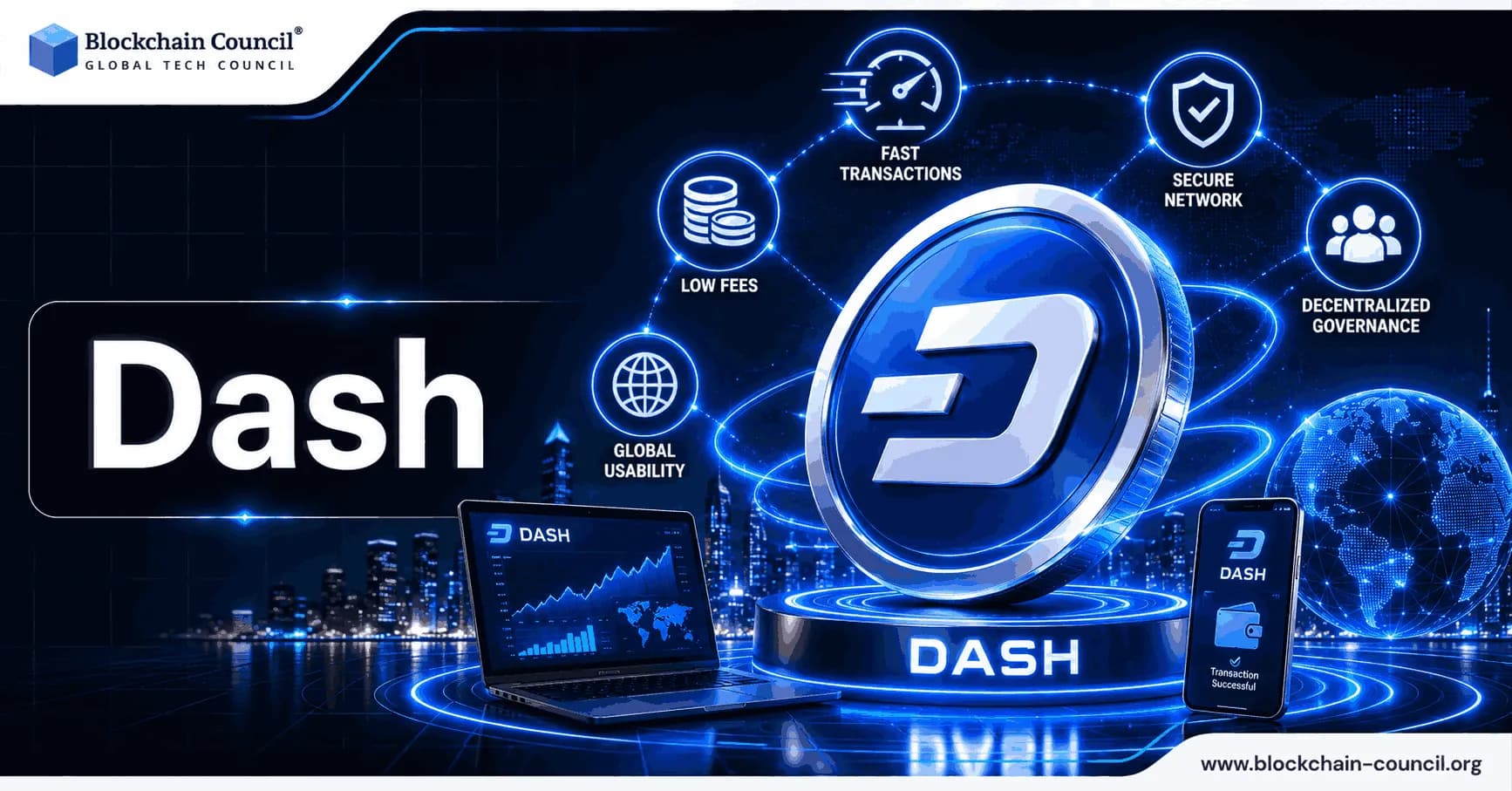
As of the time of writing, the market cap of Dash is approximately $350-400 million.
Welcome to the world of cryptocurrency and for once, this isn't going to be another article about Bitcoin. Dash is one of the earliest altcoins built specifically for fast, private, everyday payments, and it's still an active project in 2026, even though its market position looks very different today than it did during crypto's early hype years. This guide breaks down what Dash actually is, how it works, and where it realistically stands in the current market. For anyone building a genuine understanding of how privacy-focused altcoins like Dash fit into the wider crypto landscape, a Certified Cryptocurrency Expert credential is a solid way to learn the fundamentals without relying on outdated hype.

What Is Dash?
Dash is a cryptocurrency forked from Bitcoin's codebase, originally launched in January 2014 under the name "Darkcoin" before rebranding to Dash later that year. Its core mission was and still is to solve two problems that plagued early Bitcoin: slow transaction confirmation times and limited payment privacy. Dash inherits its basic transaction structure from Bitcoin, which is why understanding Bitcoin's fundamentals first makes Dash's design choices much easier to follow. A Certified Bitcoin Expert credential is a genuinely useful prerequisite here, since most of what makes Dash distinctive only makes sense in contrast to how Bitcoin itself handles confirmation times and transaction visibility.
The Problems Dash Was Built to Solve
Bitcoin's original design requires merchants and users to wait for network confirmation before treating a transaction as final often several minutes, and sometimes much longer during network congestion. That confirmation delay put Bitcoin at a real disadvantage compared to physical cash or card payments for everyday retail use. Dash was built around three specific goals: faster transaction confirmation, stronger optional payment privacy, and a more reliable path to near-instant, low-risk transactions for merchants the kind of "zero-confirmation" experience that Bitcoin could only offer through trusted third-party payment processors.
How Dash's Two-Tier Network Works
What actually sets Dash apart technically is its two-tier network structure. The first tier works much like Bitcoin's miners, securing the network and processing blocks. The second tier is Dash's distinctive masternode network nodes that must lock up a defined amount of DASH as collateral in order to operate, and in exchange provide two specialized services:
InstantSend- Enables transactions to be locked and confirmed by the masternode network in just a few seconds, rather than waiting for standard block confirmations.
PrivateSend- An opt-in privacy feature that mixes transactions to obscure their origin, giving users a level of financial privacy closer to physical cash than Bitcoin's fully transparent public ledger.
This masternode layer also powers Dash's self-governing treasury system, where masternode operators vote on proposals anyone can submit one competing for a share of the network's block rewards to fund development, marketing, or ecosystem initiatives. Understanding exactly how this dual-layer consensus and governance model functions at a protocol level is where a proper Tech Certification in blockchain architecture becomes genuinely useful, since Dash's masternode incentive structure is meaningfully different from both Bitcoin's proof-of-work model and newer proof-of-stake networks.
Key Features of Dash
Privacy- PrivateSend gives users optional control over how visible their transaction history is, unlike Bitcoin's fully public ledger.
Speed- InstantSend transactions typically settle within a few seconds rather than the minutes-to-hours confirmation window common on Bitcoin.
Low fees- Like most cryptocurrencies, Dash transaction fees remain low compared to traditional remittance services or card payment processors.
Global reach- Dash can be sent and received internationally for the same low fee, regardless of destination.
Where Dash Actually Stands in 2026
This is where it's worth being direct: Dash is not, and has not been for years, among the top cryptocurrencies by market capitalization a claim that circulated widely (and inaccurately) during the 2017-2018 crypto boom. As of 2026, Dash typically trades in a market capitalization range of roughly $400-450 million, placing it outside the top 50 cryptocurrencies and closer to the 100th spot depending on the day and data source, with its price sitting more than 97% below its December 2017 all-time high near $1,642. Dash retains an active developer community and a loyal user base, but it now competes in a much more crowded privacy-and-payments niche alongside coins like Zcash, Horizen, and Decred, rather than contending near the top of the market.
Regulatory pressure has also become a real factor for privacy-focused coins like Dash. In mid-2026, the Philippine central bank (Bangko Sentral ng Pilipinas) issued new guidelines barring licensed virtual asset service providers from listing or supporting anonymity-enhancing cryptocurrencies, including Dash even as the Dash team was simultaneously exploring entry into the Philippine payments market. This kind of regulatory friction has become a recurring theme for privacy coins generally, and it's a meaningful factor to weigh alongside Dash's technical strengths.
Future-Ready Skills
As technology becomes increasingly important across industries, students need opportunities to develop future-ready skills early in their education. A World Tech Olympiad can introduce students to areas such as artificial intelligence, coding, cybersecurity, robotics, and computational thinking while encouraging curiosity and continuous learning.
Should You Pay Attention to Dash?
Dash remains a legitimate, functioning payments-focused cryptocurrency with real technical differentiators its InstantSend and PrivateSend features still work as designed, and its masternode governance system remains one of the more mature self-funding models in the industry. But its market relevance has shrunk considerably since its early hype years, and increasing regulatory scrutiny of privacy coins adds a layer of uncertainty that wasn't as prominent when Dash first launched. As with any altcoin, separating genuine technical merit from outdated market-position claims matters and that skill extends beyond investors. Crypto exchanges, educators, and fintech platforms increasingly need people who can explain a coin's real current standing accurately rather than repeating stale hype, which is exactly where pairing technical crypto knowledge with a Marketing Certification becomes genuinely valuable for anyone communicating about crypto assets professionally.
Frequently Asked Questions
1. What is Dash?
Dash is an open-source, peer-to-peer cryptocurrency launched in 2014 as a fork of Bitcoin. Originally known as XCoin and later Darkcoin, it was rebranded as Dash, short for "Digital Cash." Dash is designed to provide fast, low-cost, and user-friendly digital payments for individuals and businesses worldwide.
2. Why is Dash important?
Dash was one of the first cryptocurrencies to introduce features such as InstantSend, ChainLocks, and a decentralized governance and treasury system. These innovations aimed to improve transaction speed, network security, and community-driven project funding.
3. How does Dash work?
Dash operates on a decentralized blockchain where transactions are verified by miners using the Proof of Work (PoW) consensus mechanism. In addition to miners, Dash uses a second layer of specialized servers called Masternodes, which provide advanced network services and governance.
4. What is the Dash (DASH) cryptocurrency?
DASH is the native cryptocurrency of the Dash network. It is used for sending and receiving payments, paying transaction fees, rewarding miners and Masternodes, and participating in the network's decentralized governance system.
5. What are Masternodes in Dash?
Masternodes are specialized servers that perform advanced network functions such as InstantSend, ChainLocks, PrivateSend coordination, and governance voting. Operating a Masternode requires locking a specified amount of DASH as collateral, helping align operators with the network's long-term health.
6. What is InstantSend?
InstantSend is a Dash feature that allows eligible transactions to be confirmed within seconds by leveraging the Masternode network. This makes Dash suitable for point-of-sale payments and other situations where fast transaction confirmation is important.
7. What is PrivateSend?
PrivateSend is an optional privacy-enhancing feature that mixes transactions through a series of standardized denominations using the Masternode network. It is designed to make transaction histories more difficult to trace, though it does not provide complete anonymity.
8. What is ChainLocks?
ChainLocks is a Dash security feature that uses Masternodes to quickly confirm newly mined blocks, helping protect the blockchain from certain attacks, including some forms of chain reorganizations and 51% attacks.
9. How does Dash's governance system work?
Dash uses a decentralized governance model where Masternode operators vote on proposals related to development, marketing, partnerships, and ecosystem improvements. Approved proposals may receive funding from the network's treasury.
10. What is the Dash Treasury?
The Dash Treasury is a decentralized funding system that allocates a portion of newly created DASH to community-approved projects. This enables ongoing development and ecosystem growth without relying solely on donations or external funding.
11. What are the main features of Dash?
Key features include fast payments through InstantSend, enhanced security with ChainLocks, optional transaction privacy via PrivateSend, decentralized governance, treasury funding, low transaction fees, global accessibility, and open-source development.
12. What are the advantages of Dash?
Dash offers quick transaction settlement, relatively low fees, decentralized governance, self-funded ecosystem development, broad wallet support, and usability for everyday digital payments in regions where cryptocurrency adoption is growing.
13. What are the limitations of Dash?
Like many cryptocurrencies, Dash faces challenges including competition from newer blockchain networks, changing regulations, market volatility, adoption levels, and the need for continued ecosystem development. Privacy-related features may also face additional scrutiny in some jurisdictions.
14. Which industries and use cases support Dash?
Dash can be used for peer-to-peer payments, online shopping, remittances, merchant payments, charitable donations, cross-border transfers, and other digital payment applications where supported by wallets, exchanges, and merchants.
15. How does Dash compare with Bitcoin?
Both Dash and Bitcoin are decentralized cryptocurrencies, but Dash emphasizes faster transaction confirmations, lower fees, governance through Masternodes, and additional payment-focused features. Bitcoin is generally viewed as a store of value, while Dash has focused more heavily on everyday digital payments.
16. What common mistakes should beginners avoid?
Common mistakes include confusing InstantSend with final settlement, neglecting wallet security, sharing recovery phrases, investing based solely on price speculation, ignoring transaction fees on exchanges, and failing to research the project's technology and risks.
17. What are best practices for using Dash?
Best practices include using trusted wallets and exchanges, enabling two-factor authentication (2FA), securely storing recovery phrases offline, verifying recipient addresses before sending funds, staying informed about network updates, and understanding local tax and regulatory requirements.
18. How does Dash fit into the cryptocurrency ecosystem?
Dash is part of the broader cryptocurrency ecosystem as a payment-focused blockchain emphasizing speed, usability, governance, and decentralized funding. It continues to serve as an example of how blockchain networks can evolve beyond basic peer-to-peer payments through additional infrastructure and community governance.
19. What trends are shaping Dash in 2025-2026?
Key trends include growing demand for efficient digital payments, broader merchant adoption, blockchain interoperability, improved wallet experiences, decentralized governance innovation, privacy discussions, integration with digital asset payment platforms, and increased regulatory attention toward cryptocurrencies.
20. What is the future of Dash?
Dash's future will depend on continued technological development, merchant adoption, regulatory clarity, ecosystem participation, and its ability to compete with both traditional payment systems and newer blockchain networks. As demand for fast and affordable digital payments continues to grow, Dash may remain relevant in payment-focused use cases if it continues delivering practical value and maintaining an active community. In cryptocurrency, being fast is helpful, being inexpensive is attractive, but remaining useful after years of relentless competition is the challenge that separates lasting projects from forgotten ones.
Related Articles
View All
Blockchain
Beyond Cryptocurrency: How Blockchain Is Transforming Real-World Industries
Explore how blockchain works beyond cryptocurrency in banking, supply chains, healthcare, tokenisation, CBDCs, and government, plus key challenges and career paths.

Blockchain
Smart Contracts & dApps: How Blockchain Becomes Programmable
Learn how smart contracts and dApps make blockchain programmable, from Ethereum and tokens to DeFi, NFTs, real use cases, benefits, and key risks.

Blockchain
Public, Private & Consortium Blockchains: Which Network Fits the Use Case?
Compare public, private, and consortium blockchains by security, speed, privacy, and control, with real examples and a simple guide to choosing the right network.
Trending Articles
AWS Career Roadmap
A step-by-step guide to building a successful career in Amazon Web Services cloud computing.
How Blockchain Secures AI Data
Understand how blockchain technology is being applied to protect the integrity and security of AI training data.
Claude AI Tools for Productivity
Discover Claude AI tools for productivity to streamline tasks, manage workflows, and improve efficiency.