

What are the alternative strategies for Proof-Of-Work?
 Toshendra Kumar Sharma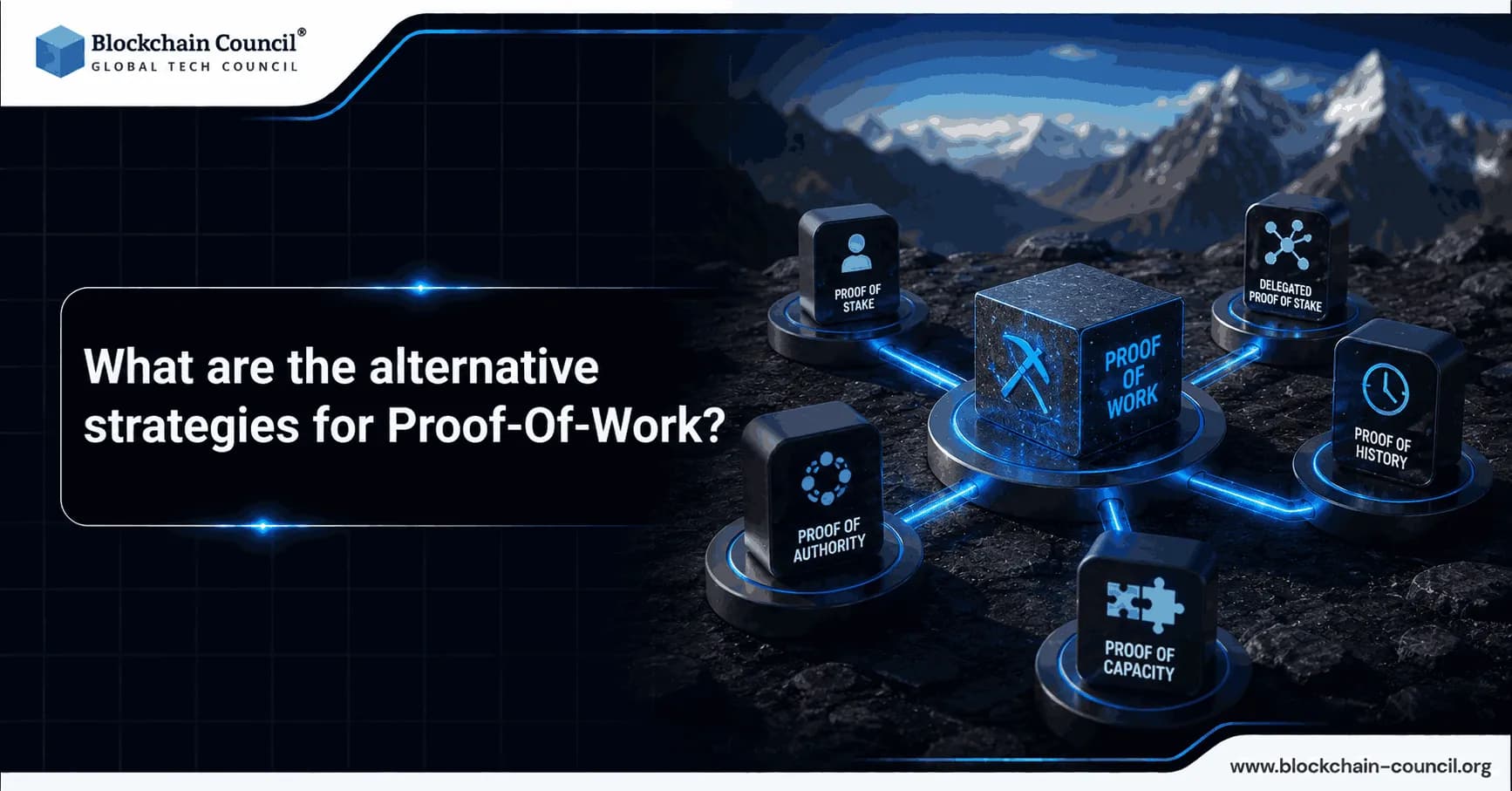
Cryptocurrencies run on a global, decentralized network, which means every new transaction needs a way to be verified without relying on a central authority. That's the job of a consensus algorithm the mechanism that confirms new blocks are legitimate and keeps the entire network in sync. Bitcoin popularized this idea through Proof-of-Work (PoW), but as the crypto industry has grown, so has interest in more efficient alternatives. Understanding these mechanisms has become a genuine career skill, which is why so many people entering the space start with a Certified Cryptocurrency Expert credential to build a solid foundation before going deeper into how different blockchains actually reach consensus.
In this article, we'll break down what a consensus algorithm is, why Proof-of-Work has real limitations, and walk through the major alternatives reshaping how blockchains validate transactions today.

What Is a Consensus Algorithm, and Why Look Beyond Proof-of-Work?
A consensus algorithm is the set of rules a blockchain network uses to agree that a new block of transactions is valid before it gets added to the chain. It serves two core purposes: verifying that new data is legitimate, and keeping the entire distributed network operating smoothly without needing a central referee.
Proof-of-Work, the mechanism behind Bitcoin, achieves this by having miners compete to solve a complex cryptographic puzzle. Whoever solves it first earns the right to add the next block and collects a reward in Bitcoin's case, newly minted coins plus a share of transaction fees. It's a proven system, but it comes with real trade-offs: solving these puzzles demands enormous computational power and electricity, and confirming a single transaction can take anywhere from several minutes to nearly an hour. As a result, large-scale mining operations tend to cluster in regions with the cheapest electricity rather than being distributed evenly.
These limitations are exactly why the industry has spent years developing alternative consensus models that aim to be faster and more energy-efficient without sacrificing security. For anyone building a career around evaluating or implementing these systems, pairing foundational crypto knowledge with a Certified Blockchain Expert credential provides a broader, technology-first understanding of how these different consensus models fit into blockchain architecture as a whole.
Quick Answer (for readers in a hurry)
The main alternatives to Proof-of-Work are Proof-of-Burn, Proof-of-Stake, Proof-of-Capacity, and Proof-of-Elapsed Time. Each replaces PoW's energy-intensive mining competition with a different mechanism burning coins, staking coins, allocating hard drive space, or using trusted hardware to determine who gets to validate the next block, generally at a lower energy cost and with faster confirmation times.
Major Alternatives to Proof-of-Work
1. Proof-of-Burn (PoB)
Proof-of-Burn takes a different approach to earning mining rights. Instead of dedicating computing power to solve puzzles, participants "burn" a portion of their coins by sending them to a verifiably unusable wallet address one with no known private key, making the coins permanently unspendable. In return, the network grants that participant the ability to mine new blocks, with selection happening on a randomized basis.
Miners can burn either the blockchain's own native coin or, in some implementations, a different cryptocurrency such as Bitcoin. The core principle is straightforward: the more coins a participant burns, the higher their odds of being selected to validate the next block.
While Proof-of-Burn reduces the ongoing energy demands of traditional mining, it still involves a real economic sacrifice, since burned coins are gone permanently. It also has limited adoption, currently used mainly by networks like Slimcoin and Peercoin, and in practice often functions as a hybrid of Proof-of-Work and Proof-of-Stake rather than a fully independent model.
2. Proof-of-Stake (PoS)
Proof-of-Stake is currently the most widely adopted alternative to Proof-of-Work. Rather than burning coins or solving computational puzzles, validators lock up ("stake") a portion of their existing coins as collateral to become eligible for selection.
Unlike Proof-of-Work, Proof-of-Stake doesn't involve creating new coins as a mining reward. Instead, all coins already exist within the system, and validators are compensated through transaction fees. The likelihood of being chosen to validate the next block is directly tied to how many coins a participant has staked someone staking 200 coins has better odds of selection than someone staking 100.
Building expertise in exactly these kinds of technical trade-offs comparing staking mechanics, validator selection, and network security models is where formal technical training becomes valuable. Many developers and analysts working directly with these protocols pursue a structured Tech Certification to strengthen their hands-on understanding of how staking-based systems are implemented and secured at the code level, beyond just the conceptual overview.
Proof-of-Stake currently powers networks such as Peercoin and Nxt, and it's the model Ethereum transitioned to as part of its long-planned shift away from Proof-of-Work.
3. Proof-of-Capacity (PoC)
Proof-of-Capacity, sometimes called Proof-of-Space, shifts the resource requirement from computing power or staked coins to hard drive storage. Participants dedicate unused hard drive space to the network, and the more space they contribute, the greater their chances of being selected to mine the next block a dynamic conceptually similar to how larger stakes improve odds under Proof-of-Stake.
The process works by having the algorithm generate large datasets, known as "plots," which are stored on a participant's hard drive. The more plots a miner stores, the better their odds of finding the next valid block. This means qualifying for mining rewards under Proof-of-Capacity requires investing in storage hardware rather than processing power or staked capital.
At present, Proof-of-Capacity is primarily associated with Burstcoin, making it one of the more niche alternatives compared to the broader adoption seen with Proof-of-Stake.
4. Proof-of-Elapsed Time (PoET)
Proof-of-Elapsed Time was developed by Intel and offers a fundamentally different approach that still mirrors some of Proof-of-Work's core logic, minus the heavy energy consumption. Instead of competing to solve a cryptographic puzzle, participants rely on a Trusted Execution Environment (TEE) to generate a random, fair waiting period for each participant, and whoever's wait time elapses first earns the right to create the next block.
The clear advantage here is dramatically lower energy usage compared to traditional mining. The trade-off, however, is a dependency on Intel's specific hardware and trusted execution technology which introduces a reliance on a third party. That's a notable tension for a technology built around removing the need for trusted intermediaries in the first place.
Comparing the Alternatives at a Glance
Proof-of-Burn: Requires permanently destroying coins to earn mining eligibility; energy-efficient but economically costly and limited to a few coins.
Proof-of-Stake: Requires staking coins as collateral; widely adopted, energy-efficient, and used by major networks including Ethereum.
Proof-of-Capacity: Requires dedicating hard drive storage space; lower energy use but niche adoption, mainly Burstcoin.
Proof-of-Elapsed Time: Requires trusted hardware to generate fair wait times; highly energy-efficient but dependent on Intel's technology.
Final Thoughts
Proof-of-Work laid the foundation for how decentralized networks reach consensus, but its heavy energy demands and slower confirmation times have pushed the industry to explore faster, more sustainable alternatives. Proof-of-Burn, Proof-of-Stake, Proof-of-Capacity, and Proof-of-Elapsed Time each solve the same core problem verifying transactions without a central authority through very different mechanisms, each with its own trade-offs around energy use, security, and adoption.
As these consensus models continue to evolve, the people explaining them matter just as much as the engineers building them. Projects and platforms working in this space often need clear, accessible communication to help users and investors understand these technical shifts, which is why marketing and communications professionals in the crypto industry are increasingly pairing their skill set with a Marketing Certification to translate complex consensus mechanisms into messaging that a broader, non-technical audience can actually understand.
Choosing the "best" consensus algorithm ultimately depends on what a network prioritizes speed, energy efficiency, decentralization, or security and that ongoing trade-off is exactly why the search for better alternatives to Proof-of-Work is far from over.
FAQs
1. What are the alternatives to Proof-of-Work (PoW)?
Proof-of-Work alternatives are consensus mechanisms that allow blockchain networks to validate transactions and secure the network without relying on energy-intensive mining. Popular alternatives include Proof of Stake (PoS), Delegated Proof of Stake (DPoS), Proof of Authority (PoA), Proof of History (PoH), Proof of Space (PoSpace), Proof of Burn (PoB), Proof of Elapsed Time (PoET), Proof of Activity (PoAct), and Byzantine Fault Tolerant (BFT) consensus mechanisms.
2. Why do blockchains use alternatives to Proof-of-Work?
Alternative consensus mechanisms are designed to improve energy efficiency, increase transaction throughput, reduce hardware requirements, lower operational costs, and provide faster transaction finality while maintaining network security and decentralization.
3. What is Proof of Stake (PoS)?
Proof of Stake (PoS) is a consensus mechanism where validators secure the blockchain by staking cryptocurrency instead of performing computational mining. Validators are selected according to protocol rules, often based partly on the amount of cryptocurrency they have staked, and they receive rewards for honestly validating transactions.
4. How does Proof of Stake differ from Proof of Work?
Proof of Work relies on miners solving computational puzzles using specialized hardware, while Proof of Stake selects validators based on staking mechanisms rather than computing power. As a result, PoS generally consumes significantly less energy than PoW.
5. What is Delegated Proof of Stake (DPoS)?
Delegated Proof of Stake allows token holders to vote for a limited number of delegates or witnesses who validate transactions and maintain the blockchain. This approach increases transaction speed but involves a smaller set of active validators compared to many PoS networks.
6. What is Proof of Authority (PoA)?
Proof of Authority is a consensus mechanism where pre-approved validators with verified identities produce new blocks. PoA is commonly used in enterprise and private blockchain networks where participants are known and trusted.
7. What is Proof of History (PoH)?
Proof of History is a cryptographic timekeeping mechanism introduced by Solana that helps establish the order of events before consensus. It works alongside a separate consensus protocol rather than replacing one, enabling high transaction throughput.
8. What is Proof of Space (PoSpace)?
Proof of Space, also known as Proof of Capacity, secures a blockchain by requiring participants to dedicate unused storage space instead of computational power. Networks such as Chia use storage capacity as part of their consensus process.
9. What is Proof of Burn (PoB)?
Proof of Burn requires participants to permanently remove, or "burn," cryptocurrency from circulation to demonstrate commitment to the network. In return, they may receive the opportunity to validate transactions or earn rewards, depending on the protocol.
10. What is Proof of Elapsed Time (PoET)?
Proof of Elapsed Time is a consensus mechanism that randomly assigns waiting times to participants. The participant whose waiting period expires first is selected to create the next block. It is primarily used in permissioned blockchain environments and relies on trusted execution technologies.
11. What is Practical Byzantine Fault Tolerance (PBFT)?
Practical Byzantine Fault Tolerance (PBFT) is a consensus algorithm that enables distributed systems to continue operating correctly even if some participants behave maliciously or fail. PBFT is widely used in enterprise and permissioned blockchain platforms where validator identities are known.
12. Which consensus mechanism is the most energy-efficient?
Proof of Stake and many other modern consensus mechanisms generally consume far less energy than Proof of Work because they eliminate the need for continuous computational mining. Actual efficiency depends on the specific blockchain architecture and validator infrastructure.
13. Which consensus mechanism is best for enterprise blockchains?
Enterprise blockchain networks commonly use Proof of Authority (PoA), PBFT, Raft, IBFT (Istanbul Byzantine Fault Tolerance), Hyperledger Fabric's ordering services, or Corda's consensus model because they prioritize performance, privacy, and known participants over permissionless decentralization.
14. What are the advantages of Proof-of-Work alternatives?
Benefits may include lower energy consumption, faster transaction processing, reduced hardware costs, improved scalability, lower transaction fees, faster settlement, and increased flexibility for enterprise and public blockchain applications.
15. What are the challenges of alternative consensus mechanisms?
Challenges include validator centralization, governance complexity, staking concentration, regulatory considerations, security trade-offs, network coordination, economic incentive design, and maintaining decentralization while improving performance.
16. What common misconceptions exist about consensus mechanisms?
A common misconception is that one consensus mechanism is universally superior. In reality, different mechanisms are optimized for different goals such as decentralization, scalability, energy efficiency, privacy, or enterprise performance. The best choice depends on the blockchain's intended use case.
17. What are best practices when choosing a consensus mechanism?
Developers should evaluate security, scalability, decentralization, energy efficiency, governance, validator incentives, transaction finality, interoperability, regulatory requirements, and long-term ecosystem sustainability before selecting a consensus model.
18. How do consensus mechanisms fit into the blockchain ecosystem?
Consensus mechanisms are the foundation of blockchain networks. They determine how transactions are validated, how participants reach agreement, how new blocks are added, and how the network remains secure without relying on a central authority.
19. What trends are shaping blockchain consensus mechanisms in 2025-2026?
Major trends include modular blockchain architectures, Proof of Stake improvements, zero-knowledge (ZK) technologies, restaking protocols, AI-assisted validator optimization, hybrid consensus models, decentralized physical infrastructure networks (DePIN), sustainable blockchain infrastructure, and greater interoperability between consensus systems.
20. What is the future of blockchain consensus mechanisms?
Blockchain consensus mechanisms will continue evolving to balance security, decentralization, scalability, sustainability, and usability. Future networks are likely to combine multiple technologies, including Layer 2 scaling, zero-knowledge proofs, modular blockchains, and hybrid consensus approaches to meet growing demand across finance, enterprise, gaming, healthcare, and Web3 applications. Proof of Work remains historically significant for demonstrating decentralized security, but the future of blockchain will likely feature a diverse ecosystem of consensus models, each optimized for different real-world needs. After all, asking every blockchain to solve problems the exact same way would be like insisting every vehicle on Earth should be built as a bulldozer.
Related Articles
View All
Blockchain
DeFi Product Management Guide: Strategies for Decentralized Finance Products
A practical DeFi product management guide covering token economics, governance, analytics, security, product process, and career skills for Web3 PMs.

Blockchain
Beyond Cryptocurrency: How Blockchain Is Transforming Real-World Industries
Explore how blockchain works beyond cryptocurrency in banking, supply chains, healthcare, tokenisation, CBDCs, and government, plus key challenges and career paths.

Blockchain
Smart Contracts & dApps: How Blockchain Becomes Programmable
Learn how smart contracts and dApps make blockchain programmable, from Ethereum and tokens to DeFi, NFTs, real use cases, benefits, and key risks.
Trending Articles
How Blockchain Secures AI Data
Understand how blockchain technology is being applied to protect the integrity and security of AI training data.
Claude AI Tools for Productivity
Discover Claude AI tools for productivity to streamline tasks, manage workflows, and improve efficiency.
How to Install Claude Code
Learn how to install Claude Code on macOS, Linux, and Windows using the native installer, plus verification, authentication, and troubleshooting tips.