

What Are Crypto Tokens & How Crypto Tokens Work?
 Toshendra Kumar Sharma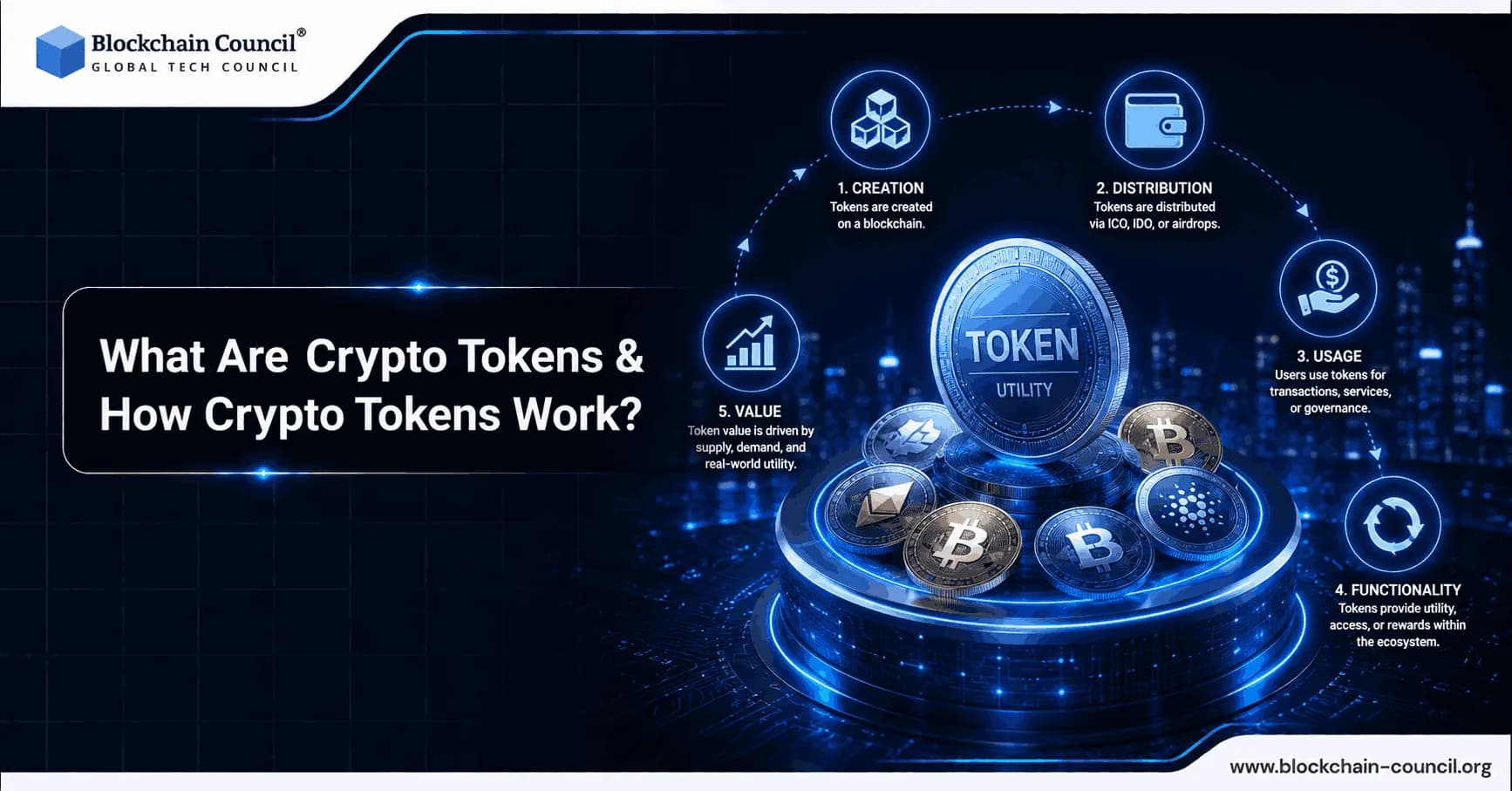
Crypto tokens started as a niche experiment tied to Bitcoin's rise in 2009 and Ethereum's programmable smart contracts in 2015, but by 2026 they've become genuine financial infrastructure. Stablecoins alone are now processing trillions of dollars in monthly transaction volume, tokenized real-world assets like treasuries and equities have crossed tens of billions of dollars in on-chain value, and major institutions including asset managers and global banks are issuing their own on-chain fund products. What began as a way to fund early-stage crypto projects through Initial Coin Offerings has evolved into a full asset class with its own regulatory frameworks, use cases, and career paths including structured learning routes like a Certified Cryptocurrency Expert credential for anyone trying to understand this space with more than surface-level knowledge.
What Exactly Is a Crypto Token?
A crypto token is a digital asset built on top of an existing blockchain through a smart contract, rather than being the native currency of its own chain. That distinction matters: Bitcoin and Ether are coins, native to their respective blockchains, while a token like a stablecoin or a governance token is issued using another network's infrastructure most commonly Ethereum, though newer chains have carved out significant token activity of their own.

Tokens represent a genuine breakthrough in how open networks are designed. They let developers build decentralized systems that combine the openness of public protocols with the incentive structures normally reserved for proprietary platforms, and they give network participants users, developers, investors, and service providers alike a direct financial stake in a system's success rather than a one-way relationship with a platform owner. That's a meaningful shift from the internet's earlier era, where value tended to concentrate around a handful of centralized companies. Understanding how that architecture actually functions is a core part of what a solid Certified Blockchain Expert program covers, since token design sits directly on top of blockchain fundamentals.
The Main Types of Crypto Tokens in 2026
Not all tokens serve the same purpose, and regulators in major markets including the SEC in the U.S., the EU's MiCA framework, and Singapore's Monetary Authority now use fairly consistent categories to decide how a token should be treated legally. The most common types include:
Utility tokens Grant access to a product or service within a specific ecosystem, such as paying network fees, accessing storage, or unlocking platform features. These are judged primarily on usage and demand rather than ownership rights.
Security tokens Represent ownership in a real asset, such as company equity, real estate, or a fund, and are subject to the same securities regulations as traditional financial instruments. Tokenized funds and equities have grown into a multi-billion-dollar category as institutions bring real-world assets on-chain.
Governance tokens Give holders on-chain voting rights over a protocol's future decisions, effectively turning users into stakeholders in how a network evolves.
Stablecoins Pegged to a reserve asset like the U.S. dollar, designed to minimize price volatility, and now processing an enormous share of total on-chain transaction volume, particularly for payments and settlement.
Non-fungible tokens (NFTs) Represent unique, non-interchangeable ownership of a specific digital or digitally-linked asset, ranging from art to in-game items to event tickets.
A single token can sometimes straddle more than one category, which is part of why classification disputes have led to high-profile regulatory enforcement actions in the past getting the legal treatment right from the start is no longer optional for serious projects.
How Crypto Tokens Actually Work
Each token represents a tradable unit of value defined by the smart contract that created it that could be a share of a company, a voting right, an in-game item, or a claim on a real-world asset like a tokenized treasury bond. Projects typically raise funds by selling a portion of their token supply to early backers, and while the Initial Coin Offering model that defined the 2017-2018 boom has largely given way to more structured and regulated fundraising formats, the underlying goal hasn't changed: exchange early capital for a stake in the network's future.
Once a project's initial distribution is complete, tokens are commonly listed on cryptocurrency exchanges, giving holders a liquid market to buy and sell. Smart contracts also give token issuers programmable control that traditional assets don't have including the ability to freeze or restrict transfers in specific circumstances, such as responding to a security exploit or complying with a regulatory order. This capability has become more sophisticated and more tightly regulated since the early days of token design, with modern token standards building compliance logic directly into the smart contract layer rather than bolting it on afterward.
This blend of technical architecture and financial mechanics is exactly why professionals working in fintech, product, or platform engineering increasingly pursue a general Tech Certification token systems now touch smart contract development, security auditing, and compliance simultaneously, and building real fluency across all three has become a genuine hiring differentiator.
Why Tokens Matter Beyond Speculation
The most durable argument for crypto tokens was never about short-term price movement it's about what they enable structurally. By letting networks distribute both governance and financial upside among their actual participants, tokens create an alternative to the internet's default pattern of value concentrating around a small number of centralized platforms. In 2026, that thesis is playing out in concrete ways: tokenized real-world assets are giving smaller investors access to markets that used to require institutional-scale capital, decentralized infrastructure tokens are funding physical networks like storage and compute without a single corporate owner, and settlement that used to take days now happens in near real time.
Conclusion
Crypto tokens have moved a long way past their early reputation as a speculative, loosely regulated fundraising tool. Today they underpin stablecoin payment rails, tokenized institutional assets, decentralized governance systems, and an expanding set of real-world use cases that regulators around the world are actively building rules around rather than ignoring. That maturity cuts both ways the opportunity is larger, but so is the expectation that builders and investors actually understand what they're working with. For teams bringing a token-based product to market, that increasingly means pairing technical and regulatory literacy with real go-to-market skill, which is where a focused Marketing Certification rounds out the picture for anyone trying to turn solid token design into an actual audience.
FAQs
1. What are crypto tokens?
Crypto tokens are digital assets created on an existing blockchain, such as Ethereum, Solana, BNB Chain, or Polygon. Unlike cryptocurrencies that operate on their own blockchain, tokens rely on an existing blockchain network and can represent utility, governance rights, digital ownership, financial assets, or access to decentralized applications (dApps).
2. How do crypto tokens work?
Crypto tokens are created using smart contracts that define their supply, transfer rules, ownership, and functionality. Users can store, transfer, trade, or use tokens within compatible wallets and blockchain applications according to the rules programmed into the smart contract.
3. What is the difference between a coin and a token?
A coin operates on its own blockchain, such as Bitcoin (BTC) or Ether (ETH) on the Ethereum network. A token is built on top of an existing blockchain and depends on that blockchain for transaction validation and security.
4. Why are crypto tokens important?
Tokens enable decentralized applications, digital ownership, fundraising, governance, loyalty programs, gaming economies, asset tokenization, and decentralized finance (DeFi). They have expanded blockchain use cases far beyond digital payments.
5. What are the main types of crypto tokens?
The most common types include:
Utility tokens
Governance tokens
Security tokens
Stablecoins
Non-Fungible Tokens (NFTs)
Asset-backed tokens
Payment tokens
Reward and loyalty tokens
Each type serves different purposes within blockchain ecosystems.
6. What are utility tokens?
Utility tokens provide access to products, services, or features within a blockchain platform. They are commonly used to pay network fees, access decentralized applications, or unlock specific platform functionality.
7. What are governance tokens?
Governance tokens allow holders to participate in decentralized decision-making by voting on protocol upgrades, treasury spending, network parameters, or other community proposals within decentralized autonomous organizations (DAOs).
8. What are stablecoins?
Stablecoins are crypto tokens designed to maintain relatively stable value by being linked to assets such as fiat currencies or other reserves. Popular examples include USDT, USDC, DAI, and FDUSD.
9. What are security tokens?
Security tokens represent investment interests or financial rights and are generally subject to securities laws in many jurisdictions. They may represent equity, debt, revenue-sharing arrangements, or ownership in tokenized assets.
10. What are Non-Fungible Tokens (NFTs)?
NFTs are unique blockchain tokens representing ownership of individual digital or physical assets, including artwork, collectibles, music, gaming items, event tickets, memberships, and tokenized real-world assets.
11. Which blockchain standards are commonly used for tokens?
Popular token standards include Ethereum's ERC-20, ERC-721, and ERC-1155, Solana's Token Program, BNB Chain's BEP-20, Polygon token standards, and similar standards on other blockchain networks.
12. How are crypto tokens created?
Developers create tokens by deploying smart contracts that define token supply, transfer rules, ownership, minting, burning, and other programmable features. Many modern blockchain platforms provide standardized frameworks that simplify token creation.
13. Where can crypto tokens be stored?
Tokens can be stored in compatible cryptocurrency wallets, including software wallets, hardware wallets, custodial wallets, and non-custodial wallets. The wallet must support both the blockchain network and the specific token standard.
14. How are crypto tokens used?
Crypto tokens are used for payments, decentralized finance (DeFi), governance voting, staking, gaming, NFTs, digital identity, creator economies, loyalty programs, crowdfunding, decentralized autonomous organizations (DAOs), and tokenization of real-world assets.
15. What risks should investors consider?
Investors should consider market volatility, smart contract vulnerabilities, phishing attacks, scams, rug pulls, regulatory changes, liquidity risks, wallet security, private key management, and the possibility of losing part or all of their investment.
16. What common mistakes should beginners avoid?
Common mistakes include confusing coins with tokens, sending tokens to incompatible blockchain networks, failing to verify smart contract addresses, storing recovery phrases insecurely, investing based on hype, and overlooking token utility and project fundamentals.
17. What are best practices for using crypto tokens?
Best practices include researching projects thoroughly, verifying official token contract addresses, using trusted wallets and exchanges, enabling two-factor authentication (2FA), protecting private keys, diversifying investments, monitoring regulatory developments, and understanding the token's purpose before investing.
18. How do crypto tokens fit into the Web3 ecosystem?
Crypto tokens are a core component of Web3. They enable decentralized ownership, governance, creator monetization, decentralized finance, gaming economies, identity management, cross-border payments, and participation in blockchain-based applications and communities.
19. What trends are shaping crypto tokens in 2025-2026?
Major trends include tokenization of real-world assets (RWAs), AI-powered blockchain applications, stablecoin adoption, decentralized identity (DID), cross-chain interoperability, Layer 2 scaling, decentralized physical infrastructure networks (DePIN), SocialFi, GameFi, and increasing institutional participation in tokenized assets.
20. What is the future of crypto tokens?
Crypto tokens are expected to play an increasingly important role in the digital economy by representing value, ownership, access rights, and financial assets across blockchain ecosystems. As regulations mature and enterprise adoption expands, tokenization is likely to extend beyond cryptocurrencies into areas such as real estate, securities, intellectual property, supply chains, digital identity, and financial infrastructure. The most valuable tokens will probably not be those with the loudest marketing campaigns, but those that continue solving real problems long after the market has moved on to its next fashionable acronym.
Related Articles
View All
Blockchain
Crypto Wallet Product Management: Building Secure, User-Friendly Wallet Experiences
A practical guide to crypto wallet product management, covering custody models, secure UX, threat modeling, metrics, compliance, and wallet roadmap decisions.

Blockchain
Crypto Wallet Product Management: Features, Security, and UX Priorities
Crypto wallet product management requires secure key design, clear UX, MPC workflows, AI risk controls, and recovery-first product strategy.

Blockchain
Blockchain vs IoT: How Decentralized Networks and Connected Devices Work Together
Blockchain vs IoT explained: how connected devices, smart contracts, device identity, and decentralized ledgers work together in real systems.
Trending Articles

Top 5 DeFi Platforms
Explore the leading decentralized finance platforms and what makes each one unique in the evolving DeFi landscape.
What is AWS? A Beginner's Guide to Cloud Computing
Everything you need to know about Amazon Web Services, cloud computing fundamentals, and career opportunities.
Claude AI Tools for Productivity
Discover Claude AI tools for productivity to streamline tasks, manage workflows, and improve efficiency.