

The Impact of Blockchain Goes Beyond Financial Services
 Toshendra Kumar Sharma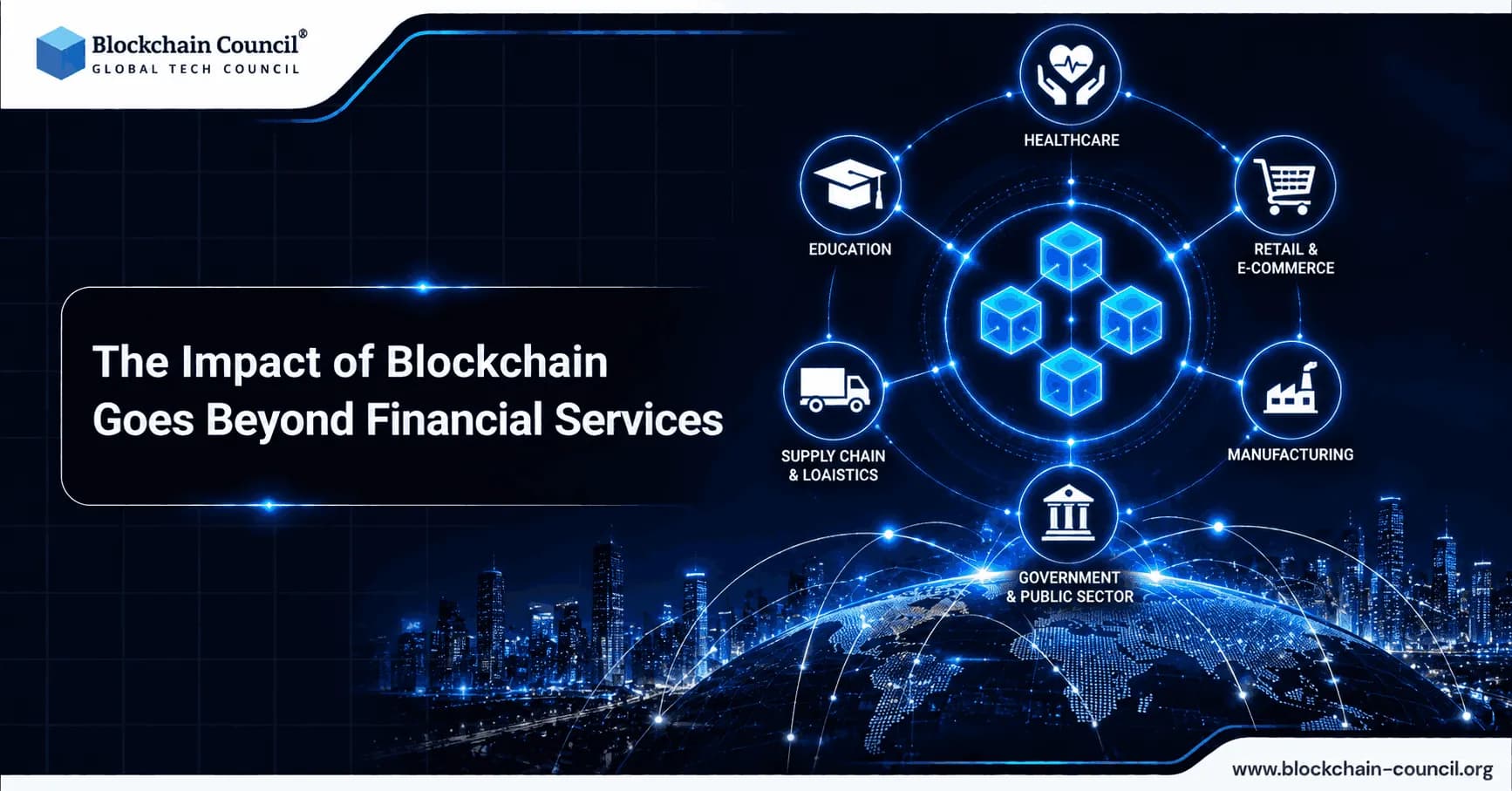
Mention blockchain to most people, and the conversation still defaults to Bitcoin, trading, and crypto wallets. That association made sense a decade ago but it's increasingly out of date. By 2026, the business value blockchain adds to the global economy has climbed past $360 billion, and nearly 90% of businesses worldwide are actively exploring or already using the technology across industries that have nothing to do with currency at all. Healthcare, logistics, energy, government services, gaming, and real estate are all quietly running production-scale blockchain systems today, not pilot programs. Finance may have been blockchain's proving ground, but it was never meant to be its ceiling.
For anyone still picturing blockchain purely as a financial tool, closing that knowledge gap starts with the fundamentals. A recognized Certified Blockchain Expert credential gives professionals across any industry a working foundation in how the technology actually functions, independent of any single use case.

Why Finance Became Blockchain's Starting Point, Not Its Ceiling
It's not hard to understand why financial services led blockchain adoption. Banks and fintechs were dealing with exactly the kind of problems blockchain solves well slow cross-border payments, expensive intermediaries, and a genuine need for tamper-proof transaction records. Financial services still accounts for the largest single share of the blockchain market today, and confidence in the sector's blockchain-driven future runs high, with the vast majority of financial institutions expecting the technology to reach even stronger mainstream acceptance in the years ahead.
But that early lead reflects timing and obvious fit, not a ceiling on where blockchain's value stops. The same core properties that made it useful for payments immutability, decentralization, and verifiable audit trails apply just as directly to a hospital record, a shipping container, or a land title.
Because finance still leads adoption and shapes much of blockchain's regulatory and technical maturity, professionals working across industries benefit from understanding that foundation directly. A Certified Blockchain & Finance Professional credential gives non-finance professionals real insight into how blockchain-based financial infrastructure works, which is often the model other industries are now adapting for their own use cases.
Healthcare: Protecting and Sharing Sensitive Data Securely
Healthcare systems worldwide struggle with fragmented patient records scattered across incompatible systems, making it hard for providers to get a complete picture of a patient's history and even harder to guarantee that shared records haven't been tampered with. Blockchain-based health records give patients a secure, portable, and verifiable medical history that can be shared across providers without relying on a single hospital's database, while still meeting strict data protection requirements. Enterprises are increasingly relying on distributed ledgers specifically to protect medical data as this shift moves from pilot programs into standard practice.
Supply Chain and Logistics: Proving What Actually Happened
Supply chain applications represent one of blockchain's fastest-growing non-financial use cases, with market projections estimating this segment alone could surpass $15 billion in value. The logic is straightforward: goods pass through many hands before reaching a consumer, and each handoff is a potential point of fraud, error, or delay. A widely cited real-world example is Walmart's requirement that suppliers use IBM Food Trust for tracking leafy greens, which reduced food safety investigation time from weeks down to mere seconds when contamination issues arise. Similar systems are now standard in seafood, luxury goods, and pharmaceutical supply chains, where verifying authenticity and origin genuinely matters.
Government and Public Services: Building Trust Into Records
Governments are using blockchain to strengthen the integrity of some of their most sensitive functions:
Digital identity systems that give citizens secure, verifiable identification without relying on a single centralized database vulnerable to breaches.
Land and property registries that eliminate the fraud risk associated with falsified or duplicated paper titles.
Election transparency pilots exploring how blockchain could make voting more auditable and tamper-resistant, with numerous initiatives now underway globally.
Public procurement systems designed to reduce corruption by making government spending and contract awards fully traceable.
Energy, IoT, and Manufacturing in the Middle of Blockchain's Expansion
Energy markets Blockchain enables peer-to-peer energy trading, where households generating their own solar power can sell excess energy directly to neighbors through smart contracts, without needing a traditional utility company as an intermediary for every transaction.
Internet of Things (IoT) As connected devices multiply across smart cities, healthcare, and manufacturing, blockchain provides a way to secure device authentication and prevent data manipulation across these networks. The blockchain IoT market is projected to reach nearly $33 billion, driven by the need for secure, automated machine-to-machine interactions that don't rely on a single trusted authority.
Process manufacturing Manufacturing has steadily integrated blockchain into production workflows, using it to verify component authenticity, track quality control data, and maintain compliance records across complex, multi-vendor production lines.
Insurance Smart contracts are automating insurance claims processing, triggering payouts automatically once verifiable conditions like a confirmed flight delay or weather event are met, cutting out lengthy manual claims review for straightforward cases.
Building systems robust enough to handle sensitive healthcare data, national identity infrastructure, or industrial IoT networks requires serious technical depth, not just familiarity with blockchain's benefits. A structured Tech Certification in blockchain development gives engineering and IT teams outside the financial sector the practical skills to design and implement systems that can actually handle these higher-stakes, non-financial use cases securely.
Gaming, Entertainment, and Digital Ownership
Blockchain has reshaped digital ownership in gaming and entertainment, enabling true player-owned in-game assets, decentralized marketplaces, and play-to-earn economies where in-game achievements carry verifiable, tradeable value outside the game itself. NFTs have extended this further into music, art, and collectibles, giving creators direct, verifiable ownership and royalty mechanisms that traditional platforms never offered.
What's Driving This Broader Shift in 2026
A few forces are accelerating blockchain's move beyond finance across every one of these industries:
Regulatory clarity has improved significantly, with frameworks like the EU's MiCA regulation and maturing digital asset guidance in the U.S. giving enterprises confidence to build production systems rather than isolated pilots.
Technical maturity has caught up with ambition. Modern consensus algorithms, layer-2 scaling solutions, and zero-knowledge proofs now let blockchain systems handle high transaction volumes without the performance issues that limited earlier deployments.
Consortium and permissioned models are solving the trust-versus-control trade-off, letting businesses and governments share infrastructure while still meeting compliance and governance requirements specific to their industry.
CIOs increasingly see blockchain as core infrastructure, not an experiment a majority of senior technology executives across industries now consider it essential to their digital strategy going forward.
Final Thoughts
Blockchain's reputation as "the technology behind Bitcoin" undersells what it's actually become. Its real strength was never about currency specifically it was always about creating trust and transparency in systems that previously relied on manual verification and blind faith in a single record-keeper. Whether that record is a patient's medical history, a shipment's origin, a land title, or a vote, blockchain applies the same fundamental value: a shared, tamper-proof source of truth that everyone involved can rely on.
For organizations rolling out blockchain-based systems in these newer, non-financial contexts, the technology alone isn't enough to drive adoption people still need to understand and trust what's changing. That's where a well-rounded Marketing Certification becomes genuinely valuable, helping teams across healthcare, government, energy, and beyond translate blockchain's real, practical benefits into messaging that stakeholders outside the tech world can actually understand and get behind.
FAQs
1. How does blockchain impact industries beyond financial services?
Blockchain is transforming industries beyond finance by improving transparency, security, traceability, automation, and data sharing. It is being applied in healthcare, supply chain management, education, real estate, government, manufacturing, energy, media, retail, agriculture, and many other sectors.
2. Why is blockchain important outside the financial industry?
Many industries rely on secure record-keeping, trusted transactions, and collaboration among multiple organizations. Blockchain provides a tamper-evident, shared ledger that can improve accountability, reduce fraud, and streamline business processes without relying entirely on a single centralized authority.
3. How does blockchain work in non-financial industries?
Blockchain records verified transactions and events on a distributed ledger shared among authorized participants. Smart contracts can automate workflows, while cryptography protects data integrity and enables transparent auditing.
4. How is blockchain used in healthcare?
Healthcare organizations can use blockchain to manage patient records, verify medical credentials, secure clinical trial data, improve pharmaceutical traceability, and streamline insurance claims while protecting sensitive information through appropriate privacy controls.
5. How does blockchain improve supply chain management?
Blockchain enables businesses to track products from raw materials to end consumers, helping reduce counterfeiting, improve inventory visibility, verify product authenticity, support sustainability initiatives, and simplify product recalls.
6. Can blockchain improve education?
Yes. Educational institutions can issue tamper-resistant digital certificates, manage academic records, verify qualifications, and support lifelong learning credentials through blockchain-based verification systems.
7. How is blockchain used in real estate?
Blockchain can streamline property ownership records, automate transactions through smart contracts, simplify title verification, support tokenized real estate assets, and reduce paperwork in property transfers.
8. Can blockchain improve government services?
Yes. Governments are exploring blockchain for digital identity, land registries, public procurement, taxation, voting research, licensing, and document verification to improve transparency and administrative efficiency.
9. How does blockchain benefit manufacturing?
Manufacturers can use blockchain to verify supplier information, track components, monitor production, manage warranties, improve quality control, and enhance product lifecycle management.
10. How is blockchain used in agriculture?
Blockchain supports farm-to-table traceability, food safety, sustainability verification, supply chain transparency, crop certification, and agricultural data management, helping producers and consumers verify product origins.
11. Can blockchain improve the energy sector?
Yes. Blockchain can support peer-to-peer energy trading, renewable energy certificate tracking, carbon credit management, smart grids, EV charging payments, and decentralized energy marketplaces.
12. Which industries are adopting blockchain?
Industries adopting blockchain include:
Banking and FinTech
Healthcare
Supply chain and logistics
Retail and e-commerce
Manufacturing
Real estate
Government
Education
Insurance
Agriculture
Energy
Media and entertainment
Telecommunications
Automotive
Travel and hospitality
13. What are the advantages of blockchain beyond finance?
Benefits include enhanced transparency, stronger security, immutable records, automated workflows, improved traceability, reduced fraud, greater operational efficiency, simplified compliance, better collaboration, and increased customer trust.
14. What challenges exist when implementing blockchain?
Challenges include integration with legacy systems, implementation costs, scalability, interoperability, regulatory compliance, governance, cybersecurity, privacy requirements, user adoption, and ensuring accurate data entry.
15. Can blockchain replace existing business systems?
No. Blockchain is generally designed to complement existing enterprise systems such as ERP, CRM, cloud platforms, and databases. It adds value where shared trust, transparency, and verification are important rather than replacing all existing technologies.
16. What common mistakes should businesses avoid?
Common mistakes include implementing blockchain without solving a real business problem, storing sensitive information directly on public blockchains, neglecting cybersecurity, skipping smart contract audits, ignoring regulatory requirements, and underestimating change management and user training.
17. What are best practices for implementing blockchain?
Best practices include identifying clear business objectives, choosing the right blockchain platform, conducting pilot projects, storing confidential data off-chain where appropriate, auditing smart contracts, integrating with existing enterprise systems, ensuring regulatory compliance, and measuring business outcomes.
18. How does blockchain fit into digital transformation?
Blockchain complements artificial intelligence (AI), cloud computing, Internet of Things (IoT), robotic process automation (RPA), big data analytics, cybersecurity, digital identity, and API-driven enterprise platforms to support modern digital transformation strategies.
19. What trends are shaping enterprise blockchain in 2025-2026?
Major trends include tokenization of real-world assets (RWAs), decentralized identity (DID), AI-powered business automation, zero-knowledge proofs (ZKPs), Blockchain-as-a-Service (BaaS), Central Bank Digital Currency (CBDC) integration, supply chain digitization, cross-chain interoperability, decentralized physical infrastructure networks (DePIN), and enterprise smart contract adoption.
20. What is the future of blockchain beyond financial services?
Blockchain is expected to become a foundational technology across numerous industries by improving trust, transparency, automation, and secure data sharing. Rather than replacing existing software, blockchain will increasingly integrate with AI, IoT, cloud computing, and enterprise applications to solve complex multi-party business challenges. As organizations continue digitizing operations, blockchain's greatest impact may come not from creating entirely new industries but from making existing systems more efficient, transparent, and reliable. After all, technology earns its place not by being fashionable, but by quietly eliminating problems that businesses have tolerated for decades.
Related Articles
View All
Blockchain
Top Blockchain Use Cases in Banks and Financial Services
Explore the top blockchain use cases in banks, from payments and trade finance to tokenization, settlement, lending, KYC, and digital asset services.

Blockchain
Blockchain in Financial Services: Payments, Lending, Compliance, and Tokenization
Explore how blockchain in financial services is changing payments, lending, compliance, custody, and tokenization with real use cases and trade-offs.

Blockchain
Beyond Cryptocurrency: How Blockchain Is Transforming Real-World Industries
Explore how blockchain works beyond cryptocurrency in banking, supply chains, healthcare, tokenisation, CBDCs, and government, plus key challenges and career paths.
Trending Articles
AWS Career Roadmap
A step-by-step guide to building a successful career in Amazon Web Services cloud computing.
What is AWS? A Beginner's Guide to Cloud Computing
Everything you need to know about Amazon Web Services, cloud computing fundamentals, and career opportunities.
Claude AI Tools for Productivity
Discover Claude AI tools for productivity to streamline tasks, manage workflows, and improve efficiency.