

Role Of Blockchain In The Manufacturing Industry
 Toshendra Kumar Sharma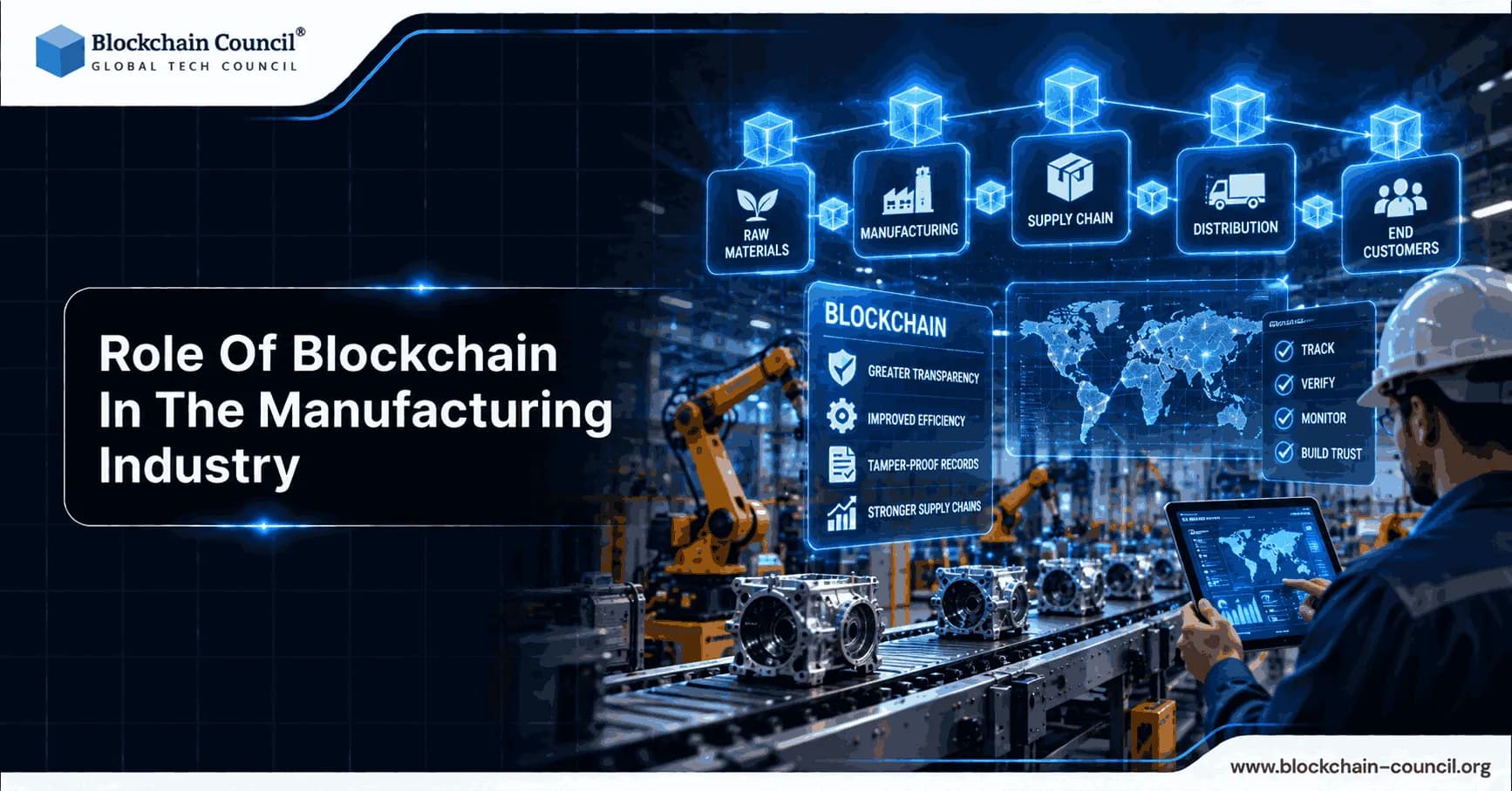
Manufacturing runs on trust between dozens of parties at once, raw material suppliers, component manufacturers, logistics providers, quality inspectors, and end customers, all relying on records that are often scattered across incompatible systems. Blockchain is increasingly stepping into this gap, giving manufacturers a shared, tamper-resistant way to track parts, verify quality, and settle payments without waiting on slow manual reconciliation between every party involved. Professionals building expertise in this intersection of manufacturing and distributed ledger technology are increasingly formalizing that knowledge through a Certified Blockchain Expert credential, which covers the foundational concepts behind exactly these kinds of industrial trust systems.
This article looks at where blockchain is already reshaping manufacturing operations, from supply chain traceability to the connected factory floor, and what manufacturers should understand before investing in it.

Why Manufacturing Needs Blockchain Right Now
Fragmented Supply Chains
A single finished product can involve dozens of suppliers spread across multiple countries, each keeping their own separate records of what was shipped, when, and in what condition. When something goes wrong, whether it is a defective component or a counterfeit part entering the chain, tracing the problem back to its source often takes days of manual investigation across systems that were never designed to talk to each other.
Rising Pressure for Transparency and Compliance
Customers, regulators, and business partners are all asking manufacturers to prove more about their products than ever before, from ethical sourcing of raw materials to carbon footprint data to genuine quality certifications. Meeting these demands with spreadsheets and paper certificates is slow, easy to falsify, and increasingly unacceptable to buyers who expect verifiable proof rather than a company's word alone.
How Blockchain Is Being Applied Across Manufacturing
Blockchain addresses these gaps by creating a shared record that every party in a supply chain can verify independently, without needing to trust a single company's internal database. Building and managing these systems well requires understanding both blockchain technology and how physical supply chains actually operate, which is exactly the combination covered in the Certified Blockchain & Supply Chain Professional program, designed specifically for professionals working at this intersection.
Supply Chain Traceability and Provenance
Recording each step a component takes, from raw material extraction to final assembly, on a blockchain makes it possible to trace a finished product back to its exact origin within minutes rather than days. This matters enormously during a recall, when manufacturers need to identify precisely which batches or shipments were affected without pulling every product off the shelf out of caution.
Counterfeit Prevention and Quality Assurance
Counterfeit parts entering a supply chain can cause serious safety failures, particularly in industries like aerospace, automotive, and electronics. Blockchain-based part authentication lets manufacturers verify that a component genuinely came from an approved supplier, cutting down on the counterfeit parts that slip through traditional paper-based verification processes.
Smart Contracts for Supplier and Vendor Payments
Manufacturing payment terms often depend on verifying that goods arrived, passed inspection, or met agreed specifications before payment releases. A smart contract can automatically trigger payment once verified delivery and inspection data confirms the conditions were met, removing much of the manual invoice matching and dispute resolution that currently slows down supplier relationships.
Blockchain, IoT, and the Connected Factory Floor
Predictive Maintenance Data Sharing
Modern factory equipment generates constant streams of sensor data on temperature, vibration, and performance. Sharing this data across a blockchain-based system allows equipment manufacturers, maintenance teams, and factory operators to all trust the same verified data when predicting failures, rather than each party working from a different, potentially incomplete version of the equipment's history. Building and securing this kind of connected sensor and data pipeline is genuine software engineering work, and manufacturing technology teams often round out their skills with a general Tech Certification covering broader systems integration and industrial cybersecurity alongside blockchain-specific knowledge.
Inventory and Asset Tracking
Blockchain-based inventory systems give manufacturers real-time, verifiable visibility into stock levels and equipment location across multiple facilities. This reduces the overstocking, stockouts, and lost asset problems that come from relying on manually updated spreadsheets that are often out of date by the time anyone actually checks them.
Future-Ready Skills
As technology becomes increasingly important across industries, students need opportunities to develop future-ready skills early in their education. A World Tech Olympiad can introduce students to areas such as artificial intelligence, coding, cybersecurity, robotics, and computational thinking while encouraging curiosity and continuous learning. The engineers who will eventually design tomorrow's connected, blockchain-enabled factories often build their first comfort with technology through exactly this kind of early, structured exposure.
What This Means for Manufacturers Going Forward
Blockchain will not fix every inefficiency in a manufacturing operation overnight, but it is already proving useful wherever multiple parties need to agree on a shared, verifiable version of the truth, from supplier verification to quality records to payment settlement. Manufacturers considering this shift need to think beyond the technology itself, since a tamper-resistant supply chain record only creates real value if suppliers, customers, and regulators actually understand and trust the system behind it. That is why some manufacturers are pairing their technical blockchain rollout with a general Marketing Certification focused on communicating new technology clearly to partners and customers who may be unfamiliar with how blockchain actually works.
Manufacturers that start building this infrastructure now, with a clear focus on solving real traceability and trust problems rather than adopting blockchain for its own sake, will be better positioned as supply chain transparency becomes an expectation rather than a competitive advantage.
FAQs
1. What is the role of blockchain in the manufacturing industry?
Blockchain can help manufacturers create trusted, traceable, and tamper-evident records across production and supply-chain processes. It can support areas such as product provenance, supplier management, inventory tracking, quality assurance, payments, and compliance.
2. How can blockchain improve manufacturing supply chains?
Blockchain can provide authorized participants with a shared record of products, materials, transactions, and supply-chain events. This can improve visibility between manufacturers, suppliers, logistics providers, distributors, and other business partners.
3. Can blockchain improve product traceability in manufacturing?
Yes. Blockchain can record information about a product's origin, components, processing stages, ownership changes, and distribution. This can help manufacturers trace products backward to their source and forward through the supply chain.
4. How does blockchain help manufacturers prevent counterfeit products?
Blockchain can create verifiable records associated with products, components, or materials. When combined with QR codes, RFID, IoT devices, or digital product identities, manufacturers can make it easier to verify provenance and identify suspicious products.
5. Can blockchain improve quality control in manufacturing?
Blockchain can create an auditable record of inspections, certifications, test results, and production events. This can help manufacturers and authorized partners verify that required quality-control processes were completed.
6. How can smart contracts be used in manufacturing?
Smart contracts can automate business processes when predefined conditions are met. For example, a smart contract could trigger a payment after a shipment is delivered and verified, reducing manual processing and administrative delays.
7. Can blockchain improve inventory management?
Blockchain can provide a shared record of inventory movements between manufacturers, warehouses, suppliers, and distributors. This can improve visibility into the movement and status of materials and finished products.
8. How can blockchain and IoT work together in manufacturing?
IoT devices can collect real-time information about machines, products, environmental conditions, and shipments, while blockchain can record selected data or events in a tamper-evident ledger. This combination can strengthen traceability and trust in industrial data.
9. Can blockchain improve manufacturing data security?
Blockchain can strengthen data integrity by using cryptographic techniques and distributed records. However, it does not automatically secure every component of a manufacturing network, so access controls, device security, encryption, and cybersecurity practices remain essential.
10. How does blockchain improve transparency between manufacturers and suppliers?
A permissioned blockchain can give authorized participants access to consistent records of relevant transactions and supply-chain events. This can reduce discrepancies between separate databases and improve coordination between business partners.
11. Can blockchain help manufacturers reduce supply-chain fraud?
Blockchain can make recorded transactions and product histories more difficult to manipulate retrospectively. This may help identify inconsistencies involving shipments, materials, certifications, or ownership, although blockchain cannot prevent inaccurate information from being entered initially.
12. How can blockchain support manufacturing compliance?
Manufacturers can use blockchain to maintain verifiable records of certifications, inspections, production processes, and supply-chain activities. These records can provide an auditable history that may simplify compliance reporting and verification.
13. Can blockchain improve payments in manufacturing?
Blockchain and smart contracts can automate certain payments between manufacturers, suppliers, logistics providers, and other participants. Payments could potentially be triggered by predefined conditions such as delivery confirmation or quality verification.
14. What are the benefits of blockchain in manufacturing?
Potential benefits include improved traceability, supply-chain transparency, data integrity, fraud detection, automated transactions, compliance support, and better coordination between organizations. The greatest value is typically found in processes involving multiple parties that need to share trusted information.
15. Can blockchain support sustainable manufacturing?
Yes. Blockchain can help record information related to material origins, environmental certifications, carbon-related data, recycling processes, and product lifecycles. This can improve the traceability of sustainability claims when reliable data collection and verification mechanisms are also in place.
16. Can blockchain improve manufacturing maintenance?
Blockchain can provide a trusted record of equipment maintenance, inspections, replacement parts, and service history. When combined with IoT and predictive-maintenance systems, this information can help organizations establish a more reliable history of industrial assets.
17. What are the challenges of implementing blockchain in manufacturing?
Major challenges include integration with legacy systems, scalability, interoperability, implementation costs, data quality, privacy, governance, and employee training. Manufacturers also need participation from suppliers and other partners for blockchain-based networks to deliver their full value.
18. Is blockchain suitable for every manufacturing company?
No. Blockchain is most useful when several independent organizations need to share and verify information without relying entirely on one organization's database. A conventional database may be simpler and more efficient for processes that take place within a single organization.
19. Is blockchain currently widely used in manufacturing?
Blockchain adoption in manufacturing is growing through research, pilots, and selected production applications, particularly around supply-chain traceability and provenance. However, it has not replaced conventional enterprise databases or manufacturing execution systems across the industry.
20. What is the future of blockchain in the manufacturing industry?
The future could involve blockchain integrated with IoT, AI, digital twins, smart contracts, and digital product passports. These technologies could create more connected manufacturing ecosystems in which product information, materials, machine events, and transactions can be verified across organizational boundaries.
Related Articles
View All
Blockchain
Blockchain Product Manager Interview Tips to Land Your Next Web3 Role
Practical blockchain product manager interview tips for Web3 roles, covering technical literacy, security, community, metrics, and PM tradeoffs.

Blockchain
Blockchain Product Manager vs Web3 Product Manager: Which Role Is Right for You?
Compare blockchain product manager vs Web3 product manager roles, responsibilities, skills, salaries, and career paths to choose the right fit.

Blockchain
The Role of a Blockchain Product Manager in DeFi Product Development
A practical guide to the blockchain product manager role in DeFi, covering roadmap ownership, tokenomics, compliance, UX, data, and career skills.
Trending Articles
How Blockchain Secures AI Data
Understand how blockchain technology is being applied to protect the integrity and security of AI training data.
What is AWS? A Beginner's Guide to Cloud Computing
Everything you need to know about Amazon Web Services, cloud computing fundamentals, and career opportunities.

Can DeFi 2.0 Bridge the Gap Between Traditional and Decentralized Finance?
The next generation of DeFi protocols aims to connect traditional banking with decentralized finance ecosystems.