

PM Narendra Modi: Blockchain and AI to Increase Employment
 Toshendra Kumar Sharma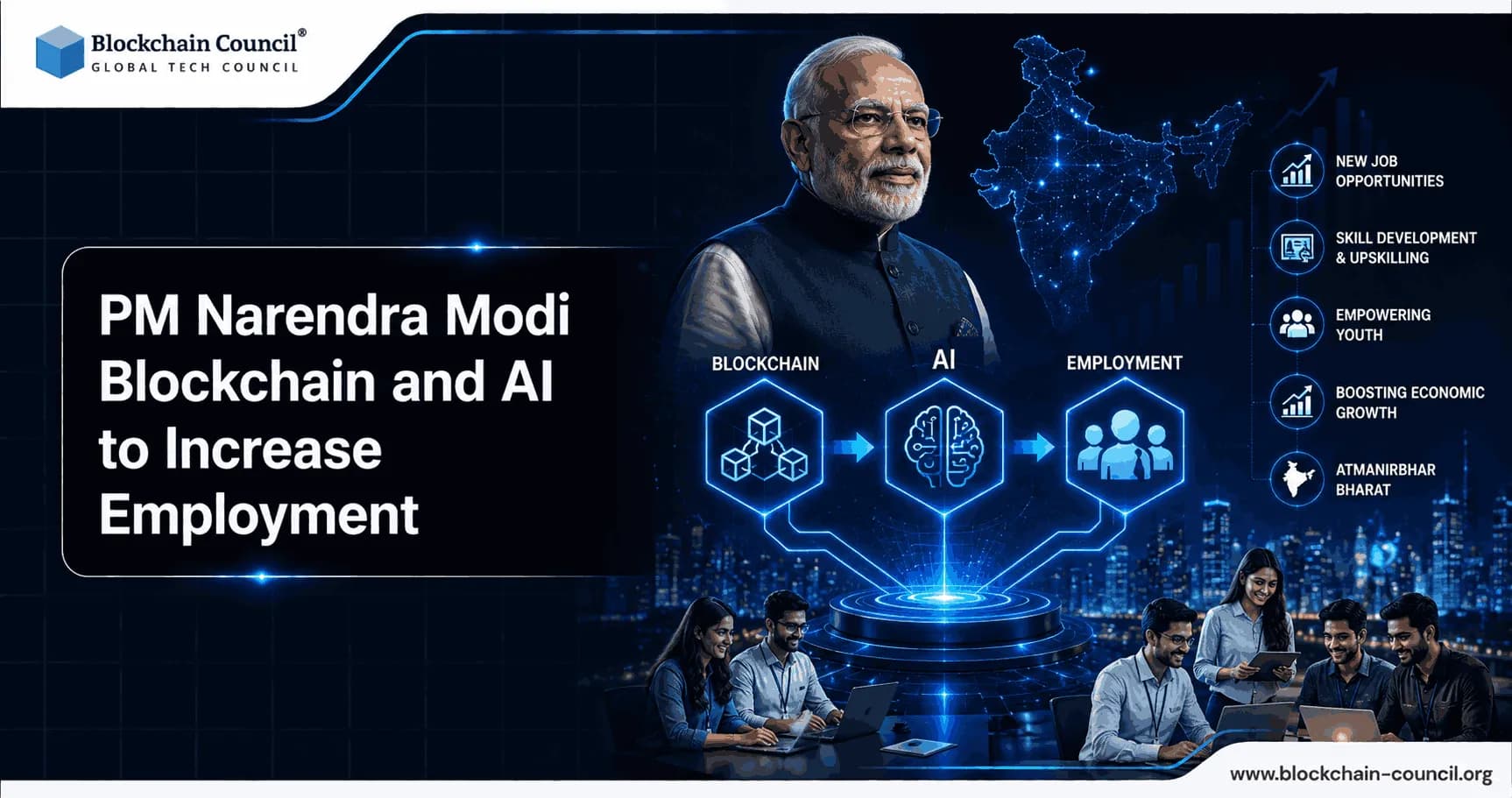
India's approach to emerging technology has consistently framed innovation as a job creation engine rather than a threat to the workforce, and blockchain and artificial intelligence have become central to that framing under the current government's digital economy push. Rather than treating automation as something to fear, India's policy direction has positioned blockchain and AI as tools that can generate entirely new categories of employment while modernizing existing sectors like finance, agriculture, and governance. Professionals looking to participate in this growth often start with a Certified Blockchain Expert credential, which builds the foundational knowledge needed to understand exactly where these employment opportunities are emerging within India's expanding digital infrastructure.
This is not a small or symbolic policy direction. India has one of the largest working-age populations in the world, and the government's broader Digital India initiative has consistently emphasized that technology adoption must translate into real jobs, not just efficiency gains for large corporations. Blockchain and AI sit at the center of that ambition, touching sectors as varied as banking, supply chain logistics, healthcare, and public administration.

Why India Sees Blockchain and AI as Employment Engines Rather Than Job Threats
The common global narrative around AI and automation often centers on job displacement, and that concern is not unfounded in certain sectors. India's policy approach, however, has consistently emphasized a different framing: that these technologies create new categories of skilled work even as they automate certain repetitive tasks. This is not simply optimistic messaging. It reflects a genuine structural reality in a country where digital infrastructure is still being built out at scale, meaning the demand for people who can design, implement, and maintain these systems continues to outpace the supply of qualified professionals.
Government-backed digital initiatives, including national blockchain strategy documents released by India's Ministry of Electronics and Information Technology, have explicitly framed blockchain adoption in areas like land records, supply chain traceability, and digital identity as opportunities to build a domestic workforce of blockchain developers, auditors, and implementation specialists rather than simply importing foreign technology and expertise. Similarly, India's national AI strategy has emphasized building domestic AI talent capable of developing solutions tailored to Indian languages, use cases, and infrastructure constraints, rather than relying entirely on technology developed elsewhere. This dual emphasis on blockchain and artificial intelligence reflects a recognition that the two technologies increasingly work together, and professionals building expertise in both areas often pursue a Certified Artificial Intelligence (AI) Expert credential alongside blockchain training, since many of the most promising government and enterprise applications combine AI-driven analysis with blockchain-based verification and record-keeping.
Government Initiatives Driving Blockchain and AI Adoption Across Sectors
India has rolled out several concrete initiatives that translate this employment-focused vision into practical infrastructure. State governments, including Telangana and Maharashtra, have piloted blockchain-based land record systems designed to reduce fraud and disputes, projects that require sustained technical teams to build, maintain, and expand rather than one-time deployments that run themselves afterward.
On the artificial intelligence side, the government's IndiaAI Mission has committed significant funding toward building AI infrastructure, including compute capacity and datasets specific to Indian contexts, explicitly framed around building domestic capability rather than dependency on foreign AI platforms. This mission includes components focused on skilling and workforce development, recognizing that infrastructure investment alone does not create jobs without a trained workforce ready to use it.
Financial services represent another sector where this employment impact is already visible. Indian banks and fintech companies have increasingly explored blockchain for trade finance, cross-border payments, and fraud detection, while simultaneously deploying AI for credit assessment, customer service automation, and risk management. Both trends have created demand for hybrid roles that require understanding of financial systems, regulatory compliance, and the underlying technology, a combination that traditional finance or computer science degrees alone often do not fully prepare candidates for.
Building the Skilled Workforce These Technologies Require
The employment opportunity that blockchain and AI represent for India depends entirely on whether the workforce has the skills to fill these emerging roles. This is where the gap between policy ambition and practical readiness becomes most visible, since India's traditional education system has been slower to update curricula than the pace at which these technologies have evolved commercially.
Private certification programs, coding bootcamps, and university partnerships with technology companies have stepped in to help close this gap, offering structured pathways for both fresh graduates and mid-career professionals looking to transition into blockchain or AI-focused roles. This matters particularly for India's large population of engineering graduates who may have strong theoretical computer science foundations but limited practical exposure to blockchain architecture or applied machine learning during their formal education.
Beyond blockchain and AI specific skills, professionals entering this workforce increasingly need broader technical fluency to work effectively across the full technology stack that supports these applications. A general Tech Certification helps round out that wider technical grounding across cloud infrastructure, cybersecurity, and conventional software engineering, since most real-world blockchain and AI deployments in India involve significant integration work with existing enterprise and government systems rather than standalone applications built in isolation.
Where Future-Ready Thinking Begins Long Before a Career
India's ability to sustain this employment growth over the long term depends on students developing comfort with computational thinking, coding, and systems reasoning well before they enter college or begin specializing in blockchain or AI specifically.
Future-Ready Skills
As technology becomes increasingly important across industries, students need opportunities to develop future-ready skills early in their education. A World Tech Olympiad can introduce students to areas such as artificial intelligence, coding, cybersecurity, robotics, and computational thinking while encouraging curiosity and continuous learning.
New Job Categories Emerging Across India's Digital Economy
The employment impact of blockchain and AI in India extends well beyond pure technical development roles. Compliance and regulatory specialists who understand both the technology and India's evolving data protection and digital asset regulations have become increasingly valuable, particularly as the Reserve Bank of India and other regulatory bodies continue refining their approach to blockchain-based financial products.
Implementation and consulting roles have also grown substantially, as government agencies and enterprises seeking to adopt blockchain or AI often lack in-house expertise and turn to specialized consulting firms and system integrators for guidance. These roles blend technical understanding with project management and stakeholder communication skills, creating opportunities for professionals who may not come from a purely engineering background but bring valuable domain expertise in sectors like agriculture, healthcare, or public administration where these technologies are being applied.
Data annotation, AI training, and quality assurance roles represent another growing category, particularly given India's need for AI systems trained on data reflecting its linguistic and cultural diversity. These roles, while sometimes viewed as less prestigious than core development positions, provide meaningful entry points into the broader AI workforce for candidates without advanced technical degrees.
Communicating This Employment Story to Build Public and Investor Confidence
Government initiatives and private sector innovation alone do not automatically translate into public confidence that these technologies will genuinely benefit the broader workforce rather than a small technical elite. Communicating this employment story effectively, to job seekers deciding which skills to invest in, to investors evaluating India's technology sector, and to international partners considering collaboration, requires deliberate effort beyond the technology itself. Organizations and government bodies responsible for this communication increasingly rely on structured approaches, and a Marketing Certification can help translate genuine policy achievements and job creation data into messaging that builds real public understanding and confidence rather than leaving the narrative to skepticism or misinformation.
Turning Technology Investment Into Sustained Employment Growth
India's positioning of blockchain and artificial intelligence as employment engines reflects a genuine structural opportunity given the scale of digital infrastructure still being built across the country. Realizing that opportunity fully depends on whether workforce training keeps pace with technology deployment, whether new job categories get communicated clearly enough that job seekers actually pursue the right skills, and whether policy initiatives translate into sustained private sector investment rather than one-time pilot projects. The technology itself is only half the story. The other half depends on building a workforce ready to fill the roles these technologies create, and an economy prepared to sustain that growth well beyond the initial policy announcement.
FAQs
1. How can blockchain and AI increase employment in India?
Blockchain and AI can create employment by generating demand for developers, data specialists, cybersecurity professionals, AI engineers, blockchain architects, analysts, and other technology professionals. PM Narendra Modi has highlighted that emerging technologies such as AI and blockchain have the potential to create millions of new employment opportunities.
2. What has PM Narendra Modi said about AI and employment?
PM Modi has emphasized that AI should be viewed as an opportunity rather than only a threat to jobs. At the India AI Impact Summit 2026, he said AI could create higher-value, creative, and meaningful roles while stressing the importance of skilling, reskilling, and lifelong learning.
3. How can artificial intelligence create new job opportunities?
AI can create jobs in areas such as machine learning, data science, AI engineering, AI product development, automation, robotics, AI governance, and AI safety. It can also create opportunities in industries that adopt AI to develop new products and services.
4. How can blockchain technology create employment opportunities?
Blockchain can generate employment in software development, smart-contract development, decentralized applications, cybersecurity, blockchain architecture, digital assets, financial technology, supply-chain management, and Web3 services. Government-supported skilling initiatives in India also identify blockchain as an emerging technology relevant to future employment.
5. Can AI and blockchain create jobs beyond the technology sector?
Yes. Their applications extend into finance, healthcare, education, agriculture, logistics, manufacturing, government services, retail, and other industries. As organizations adopt these technologies, they can create technology-enabled roles for professionals who combine domain knowledge with digital skills.
6. Will AI take away more jobs than it creates?
AI may automate or significantly change some existing tasks and occupations, but it can also create new roles and industries. PM Modi has argued that technological progress historically changes the nature of work while creating new opportunities, and he has emphasized preparing workers through skilling and reskilling.
7. Why is skill development important for AI and blockchain jobs?
Technology changes rapidly, so workers need continuously updated skills. India's Skill India ecosystem includes emerging-technology training in areas such as AI, machine learning, data science, cybersecurity, cloud computing, IoT, and blockchain to help build a future-ready workforce.
8. What is India's approach to preparing youth for AI jobs?
India is expanding AI education and workforce training through initiatives such as the Skill India Digital Hub and the Skilling for AI Readiness (SOAR) programme. As of August 2026, more than 5.17 lakh learners had enrolled in SOAR courses and more than 1 lakh had been certified.
9. How can blockchain help India's digital economy?
Blockchain can support applications requiring trusted records, transparency, digital identity, secure transactions, and traceability. Its use across finance, supply chains, public services, and other sectors can create demand for specialized professionals and blockchain-enabled businesses.
10. What blockchain skills can help people find jobs?
Useful skills include blockchain fundamentals, distributed systems, cryptography, smart contracts, Solidity or other blockchain programming languages, decentralized applications, Web3 architecture, cybersecurity, and blockchain analytics. Combining technical knowledge with business or industry expertise can further improve employability.
11. What AI skills will be valuable for future employment?
Important AI skills include machine learning, data analysis, prompt engineering, generative AI, AI-assisted software development, model evaluation, automation, AI governance, and responsible AI. Strong foundational programming and problem-solving skills remain valuable as AI tools evolve.
12. How can AI support entrepreneurship and job creation?
AI can reduce barriers to launching products and services by helping entrepreneurs analyze markets, automate operations, create content, develop software, and serve customers. PM Modi has described AI as an opportunity for innovation, entrepreneurship, and the creation of new industries.
13. Can blockchain support entrepreneurship in India?
Yes. Entrepreneurs can build blockchain-based products and services in areas such as fintech, payments, supply-chain tracking, digital identity, tokenization, gaming, and decentralized applications. Government skilling initiatives also recognize blockchain as one of the emerging technologies relevant to India's future workforce.
14. What role can startups play in creating AI and blockchain jobs?
Startups can transform emerging technologies into commercial products and services, creating demand for developers, designers, marketers, researchers, sales professionals, and other workers. India's AI policy also includes startup financing as one of the pillars of the IndiaAI Mission.
15. How can AI and blockchain improve employment opportunities for young people?
Young people can benefit by developing practical skills in emerging technologies and combining them with communication, business, and problem-solving abilities. Training, apprenticeships, internships, open-source projects, and startup opportunities can help turn these skills into employment.
16. What government initiatives support emerging technology skills in India?
Initiatives include the Skill India Programme, PMKVY 4.0, the Skill India Digital Hub, SOAR, FutureSkills PRIME, and apprenticeship programmes. These initiatives cover emerging areas including AI, machine learning, data science, cybersecurity, cloud computing, and blockchain.
17. How is FutureSkills PRIME helping create technology talent?
FutureSkills PRIME focuses on reskilling and upskilling India's workforce in emerging technologies, including AI, big data analytics, cybersecurity, IoT, blockchain, and AR/VR. By March 2026, more than 27.53 lakh candidates had registered on the platform, according to the Government of India.
18. Can blockchain and AI work together to create new employment opportunities?
Yes. Combining AI with blockchain can create opportunities in areas such as trusted AI data, decentralized AI applications, automated smart contracts, AI-powered financial services, data provenance, digital identity, and decentralized computing. This convergence can create new technical and business roles as these applications mature.
19. What is PM Modi's vision for AI and India's future workforce?
PM Modi has described a future in which humans and intelligent systems work together, with AI improving productivity and enabling higher-value work. He has also called for widespread skilling, reskilling, and lifelong learning so that India's workforce can participate in the opportunities created by AI.
20. How can students prepare for blockchain and AI jobs?
Students can start by learning programming, data fundamentals, AI or blockchain concepts, and cybersecurity basics. Building practical projects, earning relevant certifications, participating in open-source communities, completing internships, and continuously updating their skills can help them prepare for emerging technology careers.
Related Articles
View All
Blockchain
Beyond Cryptocurrency: How Blockchain Is Transforming Real-World Industries
Explore how blockchain works beyond cryptocurrency in banking, supply chains, healthcare, tokenisation, CBDCs, and government, plus key challenges and career paths.

Blockchain
Smart Contracts & dApps: How Blockchain Becomes Programmable
Learn how smart contracts and dApps make blockchain programmable, from Ethereum and tokens to DeFi, NFTs, real use cases, benefits, and key risks.

Blockchain
Behind the Blocks: How Blockchain Transactions Actually Work
Go behind the blocks to see how a blockchain transaction really works: wallets and keys, digital signatures, verification, hashing, blocks, consensus, proof of work vs proof of stake, and how miners and validators secure the network.
Trending Articles
The Role of Blockchain in Ethical AI Development
How blockchain technology is being used to promote transparency and accountability in artificial intelligence systems.
AWS Career Roadmap
A step-by-step guide to building a successful career in Amazon Web Services cloud computing.
How to Install Claude Code
Learn how to install Claude Code on macOS, Linux, and Windows using the native installer, plus verification, authentication, and troubleshooting tips.