

Blockchain To Address Food Security In India
 Toshendra Kumar Sharma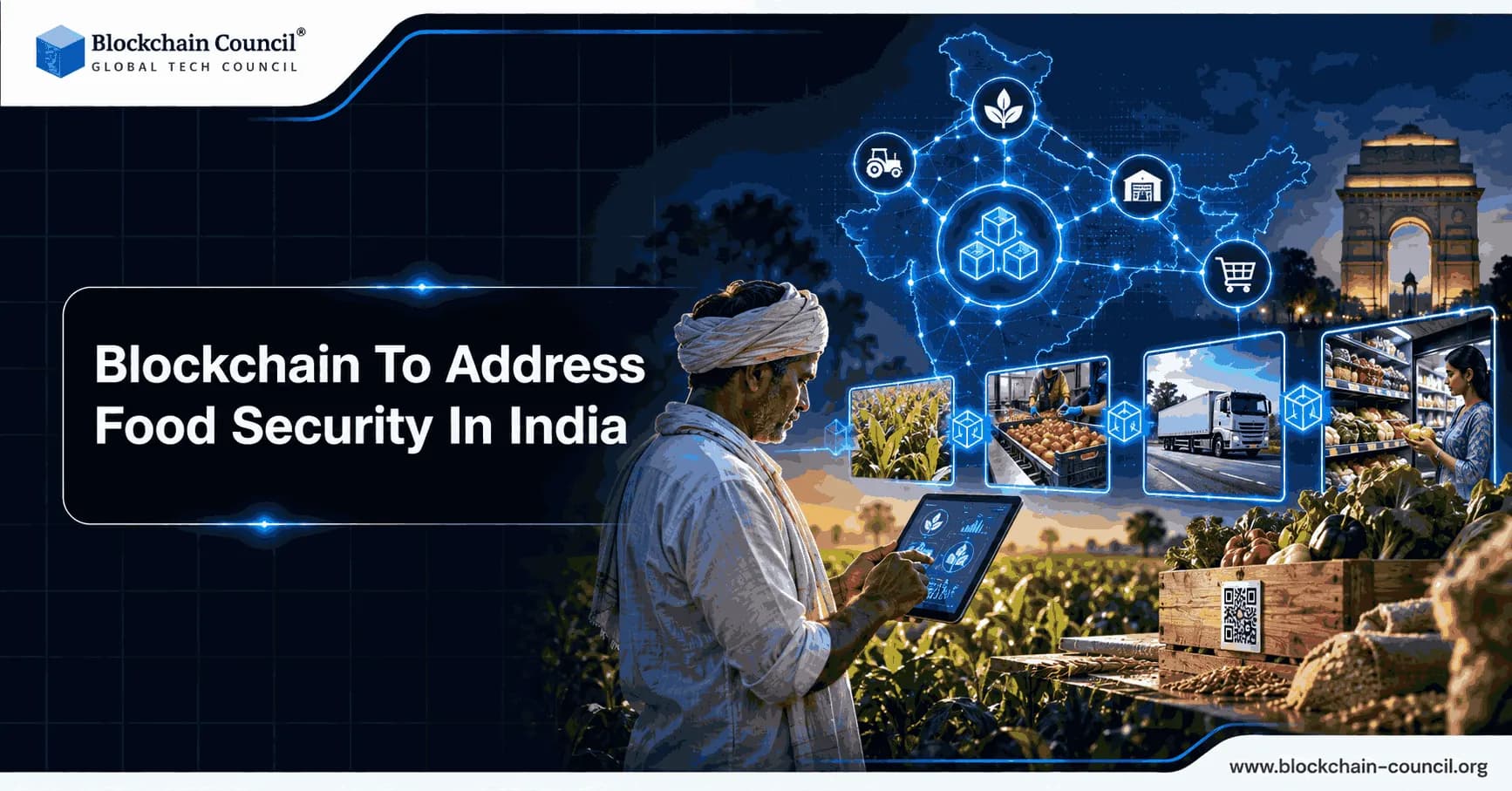
Introduction: Tackling Leakages in India's Food Distribution System
India runs one of the largest food distribution networks in the world, feeding hundreds of millions of citizens through its public distribution system. Yet the system has long struggled with leakages, diversion of grain, and delays that prevent food from reaching the people who need it most. Blockchain technology is now being positioned as a practical solution to these persistent problems, offering a way to track food from farm to ration shop with a level of transparency traditional systems have never achieved. Professionals who want to understand the technical mechanics behind these systems often begin with a Certified Blockchain Expert credential, which builds the foundational knowledge needed to evaluate how distributed ledgers can strengthen something as critical as national food security.
Food security in India is not simply a question of production. The country grows enough food to feed its population, but inefficiencies in storage, transportation, and distribution mean that grain is often lost, diverted, or delayed before it reaches vulnerable households. Blockchain's ability to create tamper-proof, real-time records addresses exactly these weak points in the supply chain.

How Blockchain Is Strengthening India's Public Distribution System
The Indian government has taken concrete steps toward integrating blockchain into its foodgrain distribution infrastructure. The recently introduced SARTHAK-PDS initiative builds on earlier digitization efforts, including end-to-end computerization of the targeted public distribution system and Aadhaar-seeded ration card verification, by incorporating blockchain alongside artificial intelligence and machine learning. This unified approach aims to create a citizen-centric, interoperable distribution architecture covering more than eighty crore people under the National Food Security Act, with the explicit goals of improving transparency, reducing leakages, and strengthening real-time monitoring across the entire supply chain.
By recording every transaction, from grain allocation at the warehouse level to final distribution at ration shops, blockchain creates an auditable trail that makes diversion and fraud significantly harder to conceal. This level of accountability has been difficult to achieve with earlier digitization efforts alone, since centralized databases remain vulnerable to manipulation at various points along the chain. Professionals working specifically on these kinds of large-scale distribution networks often pursue a Certified Blockchain & Supply Chain Professional credential to understand how blockchain-based traceability systems are designed and implemented across complex logistics networks.
Bringing Transparency to Agricultural Supply Chains
Beyond public distribution, blockchain is also reshaping how agricultural produce moves from farms to markets. India's primary production stage, covering sowing, cultivation, harvesting, and aggregation, has traditionally been the weakest link in the country's agri-food value chain, with government estimates of harvests often taking months to reach planning authorities. The nationwide rollout of a digital agriculture mission aims to address this gap by building infrastructure that integrates satellite imagery, sensors, and blockchain to create verifiable farm-to-fork traceability.
This kind of visibility allows regulators, buyers, and even consumers to verify exactly where their food came from, how it was handled, and whether it meets safety and quality standards. Several Indian states have already begun piloting blockchain-based crop tracking programs, involving more than a million farmers across the country in efforts to formalize and secure agricultural data that was previously scattered across informal or paper-based records.
Reducing Food Waste Through Better Supply Chain Visibility
Food loss remains a significant challenge in India, with substantial quantities of harvested grain and produce spoiling before ever reaching consumers due to poor storage conditions and inefficient logistics coordination. Blockchain-enabled supply chain systems can help address this by giving stakeholders real-time visibility into inventory levels, storage conditions, and transportation timelines, allowing quicker intervention when spoilage risks arise.
Smart contracts add a further layer of efficiency by automating payments to farmers once produce is verified as delivered and meeting quality standards, reducing the payment delays that often discourage smallholder farmers from participating in formal supply chains. Global market research indicates that blockchain adoption in agriculture and food supply chains is accelerating rapidly, with the sector's underlying technology market expected to grow substantially over the coming years as more governments and enterprises move from pilot programs into full deployment.
Implementing these systems at national scale requires a workforce equipped with broad technical capabilities beyond blockchain alone. A well-rounded Tech Certification helps professionals build that wider foundation, covering IoT integration, data analytics, and system architecture skills that are essential for designing food security platforms capable of operating across India's vast and varied logistics landscape.
Future-Ready Skills
As technology becomes increasingly important across industries, students need opportunities to develop future-ready skills early in their education. A World Tech Olympiad can introduce students to areas such as artificial intelligence, coding, cybersecurity, robotics, and computational thinking while encouraging curiosity and continuous learning. Building this kind of technical curiosity early can help cultivate a future generation of engineers capable of scaling food security solutions across India's evolving digital infrastructure.
Challenges to Nationwide Blockchain Adoption
Despite the clear potential, scaling blockchain across India's food security infrastructure is not without obstacles. Many rural areas still face limited digital connectivity, making real-time data recording difficult at the last mile where ration shops and small farmers operate. Integrating blockchain systems with existing government databases, many of which were built on legacy technology, also requires significant technical coordination between multiple state and central agencies.
Building trust among farmers and ration shop operators unfamiliar with blockchain technology presents an additional hurdle, since successful adoption depends on more than just technical deployment. Training programs and clear communication about how these systems benefit everyday users will play a central role in determining how smoothly these initiatives scale nationwide.
Building Public Trust and Awareness
Technology alone cannot guarantee the success of food security reforms. For blockchain-based systems to gain acceptance among farmers, ration shop dealers, and beneficiaries, the public needs to understand how these changes directly improve their access to food and reduce corruption in the system. Many citizens interacting with the public distribution system have limited familiarity with concepts like distributed ledgers or smart contracts, which can create resistance even when the underlying technology offers genuine benefits.
Government agencies and technology partners rolling out these systems need clear, accessible communication strategies to build that trust. A Marketing Certification equips professionals with the skills needed to translate complex blockchain initiatives into messaging that resonates with a diverse population, helping ensure that food security reforms achieve the widespread public support needed for long-term success.
India's move toward blockchain-enabled food distribution reflects a broader recognition that technology can meaningfully address one of the country's most persistent development challenges. As initiatives like SARTHAK-PDS expand and agricultural traceability programs mature, blockchain is steadily positioning itself as a foundational layer for ensuring that food reaches those who need it most, with fewer leakages and greater accountability across the entire supply chain.
FAQs
1. How can blockchain help address food security in India?
Blockchain can improve food security by making agricultural and food supply chains more transparent, traceable, and accountable. It can create shared records of food movement from production and procurement to storage and distribution, helping stakeholders identify inefficiencies, fraud, and supply disruptions.
2. How can blockchain improve food supply chain traceability in India?
Blockchain can record important information at different stages of the food supply chain, including production, transportation, storage, processing, and distribution. This creates a traceable digital history that can help stakeholders identify where problems occurred and improve food safety.
3. Can blockchain reduce food wastage in India?
Blockchain can potentially help reduce food wastage by improving visibility into inventory, transportation, storage, and delivery processes. Better information sharing can help stakeholders identify delays, inefficient handling, and supply chain bottlenecks earlier.
4. Can blockchain improve India's Public Distribution System?
Yes. Blockchain has been proposed as a way to improve India's Public Distribution System by recording the movement of food grains from procurement through warehouses and Fair Price Shops to beneficiaries. India's Centre of Excellence in Blockchain Technology specifically identifies the PDS as a potential blockchain use case for improving accountability across the supply chain.
5. How can blockchain prevent leakage of food grains?
A blockchain-based PDS could create shared records for procurement, transportation, storage, and distribution. Because transactions are recorded on a tamper-resistant ledger, unauthorized diversions or discrepancies could become easier to detect and investigate.
6. Can blockchain help farmers in India?
Blockchain can help farmers by improving access to supply chain information, product traceability, certification records, and potentially financial services. Transparent records may also help farmers demonstrate the origin and quality of their agricultural products to buyers.
7. How can blockchain improve food safety in India?
Blockchain can create a traceable record of food products from farm to consumer. If contamination or a quality problem is discovered, stakeholders may be able to identify the affected batch and trace its movement more efficiently, supporting targeted recalls and accountability.
8. What role does blockchain play in farm-to-fork traceability?
Blockchain can connect records from farmers, processors, logistics providers, warehouses, retailers, and other participants into a shared traceability system. This can provide greater visibility into a product's origin, movement, and handling throughout the food chain.
9. Can blockchain improve transparency in agricultural supply chains?
Yes. Blockchain can provide a shared ledger where authorized participants can access consistent records of transactions and product movements. Research on Indian agriculture identifies traceability, auditability, immutability, and provenance as important drivers for blockchain adoption.
10. How can smart contracts support food security in India?
Smart contracts can automatically execute predefined actions when specified conditions are met. In agricultural supply chains, they could potentially support automated payments, compliance checks, delivery confirmations, and other transactions, reducing manual processing and delays.
11. Can blockchain improve payments to farmers?
Blockchain-based systems could support more transparent transaction records and automate certain payment processes through smart contracts. This may help reduce administrative delays and provide clearer records of transactions between farmers and other supply chain participants.
12. How can blockchain help detect food fraud?
Blockchain can provide a traceable record of product origin, certifications, transactions, and movement. This can make it harder to alter historical records and can help stakeholders identify inconsistencies in claims about a product's origin or supply chain history.
13. Can blockchain support agricultural certification in India?
Yes. Blockchain can be used to maintain digital records associated with certifications, production practices, and product provenance. FAO research highlights blockchain's potential for agricultural certification and traceability, including organic food and seed certification.
14. How can blockchain improve food distribution during supply disruptions?
A shared and up-to-date supply chain record can help authorized stakeholders understand where food stocks are located and where transportation or distribution problems are occurring. This information could support faster coordination during disruptions, although blockchain itself does not solve physical transportation or storage constraints.
15. What are the benefits of blockchain for India's food security system?
Potential benefits include improved traceability, transparency, auditability, food safety, provenance tracking, and supply chain coordination. Indian research identifies traceability and real-time information availability among the most significant drivers for blockchain adoption in food security applications.
16. What are the challenges of using blockchain for food security in India?
Major challenges include implementation costs, digital infrastructure gaps, limited technical literacy, interoperability, data quality, governance, and adoption among smaller agricultural stakeholders. Blockchain adoption in India's agricultural supply chain is still developing, so practical implementation requires appropriate infrastructure and institutional support.
17. Can blockchain completely solve India's food security challenges?
No. Blockchain is a technology tool rather than a complete solution to food insecurity. It can improve information, traceability, and accountability, but food security also depends on agricultural productivity, climate resilience, storage infrastructure, transportation, affordability, distribution systems, and effective public policy.
18. How can IoT and blockchain work together in agriculture?
IoT devices can collect information such as temperature, humidity, location, and environmental conditions, while blockchain can provide a shared record for relevant data and transactions. Combining these technologies could improve monitoring across agricultural and food supply chains.
19. Is blockchain currently widely used for food security in India?
Blockchain has been researched and proposed for Indian agricultural supply chains and the Public Distribution System, but widespread deployment across the entire food security ecosystem remains a challenge. Current evidence suggests that blockchain has significant potential, while adoption still requires infrastructure, governance, technical capacity, and stakeholder participation.
20. What is the future of blockchain for food security in India?
The future could involve blockchain-enabled traceability across agricultural production, procurement, storage, logistics, food safety, certification, and public distribution. Its strongest value is likely to come from integration with IoT, digital identity, AI, smart contracts, and existing government and supply chain systems rather than blockchain operating independently.
Related Articles
View All
Blockchain
Blockchain Wallet Security: Private Keys, Seed Phrases, and Common Threats
Learn how to secure your blockchain wallet with safer private key storage, seed phrase backups, hardware wallets, stronger authentication, and threat awareness.

Blockchain
Blockchain Wallets Explained: How They Work, Types, and Security Best Practices
Blockchain wallets manage keys, sign transactions, and secure digital assets. Learn wallet types, risks, best practices, and how to choose the right setup.

Blockchain
Why Blockchain Is the Future of Digital Trust, Finance, and Data Security
Blockchain is becoming core infrastructure for digital trust, finance, and data security through shared ledgers, stablecoins, smart contracts, and verifiable records.
Trending Articles
The Role of Blockchain in Ethical AI Development
How blockchain technology is being used to promote transparency and accountability in artificial intelligence systems.

Can DeFi 2.0 Bridge the Gap Between Traditional and Decentralized Finance?
The next generation of DeFi protocols aims to connect traditional banking with decentralized finance ecosystems.
How to Install Claude Code
Learn how to install Claude Code on macOS, Linux, and Windows using the native installer, plus verification, authentication, and troubleshooting tips.