

How Blockchain Will Put Pressure on Broker’s Commission in the Upcoming Years?
 Toshendra Kumar Sharma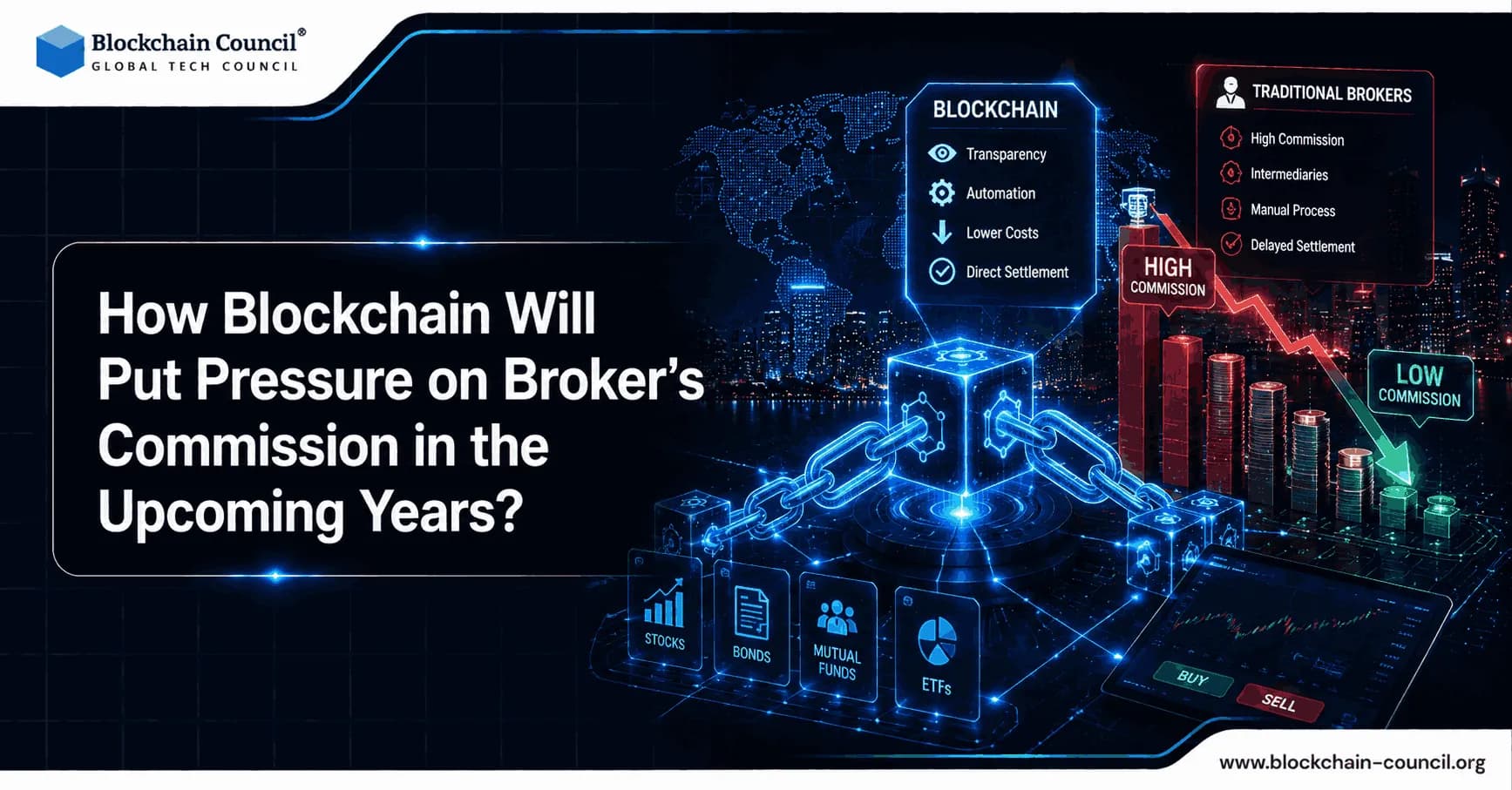
Real-world asset tokenization crossed 26 billion dollars in total value by March 2026, a fourfold increase from just 6.5 billion dollars in early 2025, driven not by retail speculation but by institutional players moving Treasuries, private credit, and trade finance instruments directly on-chain. Major financial institutions including BlackRock, Franklin Templeton, and JPMorgan have already launched tokenized funds, and analysts at McKinsey project the broader tokenization market could reach 2 trillion dollars by 2030. Every one of these shifts touches the same underlying mechanic: smart contracts automating settlement, transfer, and compliance processes that human brokers and intermediaries have traditionally handled manually, for a fee. That mechanic is exactly why broker commissions across real estate, securities trading, and insurance are facing genuine, structural pressure over the next several years.
Understanding precisely how blockchain reshapes these fee structures, and where brokers genuinely remain essential despite the pressure, starts with real technical grounding. Blockchain Council's Certified Blockchain Expert credential gives finance and real estate professionals the foundation needed to evaluate this shift on genuine mechanics rather than speculative headlines.

How Smart Contracts Actually Compress Commission Structures
Automated Settlement Removes Manual Processing Fees
A meaningful share of a traditional broker's commission compensates for manual work, verifying documentation, coordinating between multiple parties, and processing settlement steps that historically required human oversight at every stage. Smart contracts can automate direct settlement once agreed conditions are met, and this automation directly eliminates many of the fees tied to traditional intermediary services, since the coordination work a commission used to compensate for increasingly happens automatically and verifiably on-chain instead.
Fractional Ownership Changes The Economics Of A Transaction
Tokenization allows real estate, equities, bonds, and even less liquid assets to be divided into fractional, tradeable units, letting a much broader pool of investors participate with lower minimum investment requirements than traditional transactions typically demand. This shift changes broker economics meaningfully, since a fund manager can raise capital from a global pool of investors directly through a tokenized offering, reducing dependence on the traditional broker network that previously served as the primary gateway to that same capital.
Transparency Reduces The Value Of Information Asymmetry
Commercial real estate and securities transactions have historically involved many parties holding fragmented, often obscured pieces of information, and a broker's expertise in navigating that fragmented data has traditionally justified part of their fee. Blockchain-based systems create a single, tamper-resistant source of transaction data accessible to all parties simultaneously, meaningfully reducing the information asymmetry that brokers have traditionally been compensated for managing.
Where This Pressure Is Showing Up First
Real Estate Brokerage
Real estate tokenization is expected to reduce the need for traditional intermediaries specifically in standardized investment offerings, where automated, smart-contract-driven settlement can replace manual transaction coordination almost entirely. Academic research examining this shift directly has found a more nuanced pattern than outright broker elimination, however, describing what researchers call reintermediation, where new categories of specialized intermediaries take over specific functions previously handled by traditional agents, while traditional brokers retain other functions that still genuinely require human judgment and local market expertise.
Securities And Stock Trading
With tokenized Treasuries alone now representing roughly 8.7 billion dollars, about 45 percent of the total tokenized real-world asset market, and major asset managers actively expanding tokenized fund offerings, the traditional brokerage model built around manual trade execution and settlement faces genuine structural pressure. Standard Chartered's Chief Executive has publicly suggested the majority of financial transactions could eventually move on-chain, a shift that would fundamentally compress the fee structures built around traditional trade execution and settlement services.
Insurance And Forex Brokerage
Smart-contract-based insurance products can automate claims verification and payout once predefined, verifiable conditions are met, removing much of the manual claims processing that traditional insurance brokers and adjusters have historically been compensated to manage. Similarly, blockchain-based foreign exchange settlement, already being piloted by major financial institutions, reduces dependence on the layered intermediary chains that have traditionally justified forex broker spreads and commissions.
Advising clients and institutions through a shift this structurally significant requires genuine fluency in both blockchain mechanics and traditional financial services. Blockchain Council's Certified Blockchain & Finance Professional credential is built specifically for this intersection, giving professionals the combined expertise needed to guide brokers, institutions, and clients through commission structures genuinely being reshaped by tokenization and smart contract automation.
Why Brokers Are Unlikely To Disappear Entirely
Despite genuine, measurable pressure on commission structures, industry analysts do not expect tokenization to eliminate the role of brokers and agencies outright. Complex, non-standardized transactions, ones involving unique properties, nuanced negotiation, or highly personalized advisory needs, still benefit meaningfully from human expertise that automated systems cannot fully replicate. Regulatory frameworks are also reinforcing rather than removing broker roles in important ways. The Clarity Act, moving through the US Congress and expected to take effect in 2026, specifically codifies registration requirements for brokers and dealers operating with digital assets, formalizing rather than eliminating their regulatory function within this new tokenized landscape.
The more accurate picture emerging from current research is reintermediation rather than pure disintermediation, brokers who adapt by developing new capabilities around token structuring, digital asset advisory, and compliance consulting are positioned to remain genuinely relevant, while brokers who rely purely on manual transaction processing and information gatekeeping face the most direct commission pressure.
Building the technical capability needed to actually implement tokenized transaction infrastructure, whether for real estate platforms, securities trading systems, or insurance claims automation, requires serious, sustained engineering skill. A Tech Certification in blockchain development gives technical teams the practical grounding needed to build systems capable of handling this shift reliably and securely at genuine transactional scale.
Roles, Skills, And Careers Emerging From This Shift
Tokenization Structuring Specialists
As more asset classes move on-chain, demand is growing for professionals who understand how to structure a tokenized offering correctly, balancing regulatory compliance, investor protections, and smart contract design in ways that traditional securities structuring never required.
Digital Asset Compliance Advisors
With frameworks like the Clarity Act formalizing broker and dealer registration requirements specifically for digital assets, compliance professionals who understand both traditional securities law and blockchain-specific regulatory requirements are becoming genuinely difficult to find and correspondingly well compensated.
Hybrid Broker-Technologists
Brokers who successfully adapt to this shift increasingly position themselves as advisors on tokenized products and blockchain-based transaction structures, rather than purely as transaction facilitators, creating a genuinely new hybrid role that blends traditional brokerage relationships with technical, blockchain-specific advisory value.
Smart Contract Auditors For Financial Products
As settlement, escrow, and compliance logic increasingly moves into smart contracts governing real financial transactions, auditors capable of verifying that this code behaves correctly and securely have become an essential, high-stakes specialization within the broader tokenization ecosystem.
Building Future-Ready Skills
As technology becomes increasingly important across industries, students need opportunities to develop future-ready skills early in their education. A World Tech Olympiad can introduce students to areas such as artificial intelligence, coding, cybersecurity, robotics, and computational thinking while encouraging curiosity and continuous learning. Early, structured exposure to this kind of technical and financial thinking is exactly what tends to produce the professionals capable of navigating an industry where traditional broker roles and blockchain-based automation increasingly intersect.
Communicating This Shift To Clients And Stakeholders
Brokers and financial institutions navigating this transition face a genuine communication challenge, explaining to clients why fee structures are changing, and why a hybrid, technology-enhanced advisory relationship still carries real value even as automated settlement handles more of the transactional work. A Marketing Certification rounds out that capability well, helping brokers and financial professionals translate a genuinely complex structural shift into messaging that clients can actually understand, rather than experiencing the change as an unexplained erosion of the service they are paying for.
Final Thoughts
Blockchain's pressure on broker commissions over the coming years is real, structural, and already measurable in tokenized asset volumes crossing tens of billions of dollars and growing at triple-digit percentage rates. Automated settlement, fractional ownership, and transparent, shared transaction data all directly compress the fees traditionally justified by manual coordination and information gatekeeping. But the emerging evidence points toward reintermediation rather than outright elimination, brokers who adapt by building genuine expertise in tokenized products, compliance, and technology-enhanced advisory work are likely to remain essential, even as the commission structures built around purely manual transaction processing continue eroding steadily in the years ahead.
FAQs
1. How can blockchain put pressure on brokers’ commissions?
Blockchain can put pressure on brokers' commissions by reducing intermediaries, automating transaction processes, improving settlement efficiency, and enabling direct peer-to-peer transactions. Smart contracts can automate activities that traditionally require manual brokerage or administrative intervention, potentially lowering the cost of transactions.
2. Can blockchain eliminate brokers completely?
Not necessarily. Blockchain can reduce the need for brokers in certain transactions, but brokers may continue to provide market expertise, negotiation, compliance support, due diligence, advisory services, and customer relationships.
The likely impact is more nuanced: blockchain may change what brokers charge for and how their services are delivered.
3. Why could blockchain reduce brokerage fees?
Traditional transactions can involve several intermediaries, each adding costs. Blockchain can create a shared digital record and automate parts of the transaction lifecycle.
Potential cost reductions can come from:
Automated settlement
Smart contracts
Shared transaction records
Reduced reconciliation
Faster verification
Tokenized assets
Automated compliance workflows
These efficiencies could put competitive pressure on commissions.
4. What role do smart contracts play in reducing broker commissions?
Smart contracts are programs that automatically execute predefined rules on a blockchain. They can automate processes such as escrow, settlement, ownership transfers, payments, and certain compliance checks.
When repetitive intermediary functions become automated, brokers may have less opportunity to charge fees for those specific activities.
5. Can blockchain reduce real estate broker commissions?
Potentially. Tokenization could allow ownership interests in certain real-world assets to be represented digitally and transferred using blockchain infrastructure.
However, real estate transactions still involve legal documentation, property inspections, valuation, financing, regulation, and negotiation, so blockchain is unlikely to eliminate every role performed by real estate brokers.
6. Can blockchain reduce stockbroker commissions?
Blockchain could potentially reduce some costs associated with trading, clearing, settlement, recordkeeping, and asset transfer.
However, stockbrokers and investment firms provide services beyond settlement, including research, advisory services, market access, execution, and regulatory functions. Therefore, blockchain's impact may be stronger on transaction infrastructure than on every brokerage service.
7. How does tokenization affect brokers?
Asset tokenization converts rights or interests in an asset into digital tokens that can be recorded and transferred using blockchain infrastructure.
If tokenized assets can be traded and settled more efficiently, certain traditional intermediary functions may become less expensive. This could encourage brokers to compete based on value-added services rather than transaction commissions alone.
8. What is disintermediation in blockchain?
Disintermediation means reducing or removing intermediaries from a transaction.
Blockchain can support disintermediation by allowing participants to interact through shared infrastructure and programmable rules. Smart contracts can perform certain functions that previously required centralized intermediaries.
9. Will blockchain make financial transactions cheaper?
It can potentially reduce some operational costs, but lower blockchain costs are not guaranteed. Network fees, compliance requirements, custody, cybersecurity, integration, and regulatory obligations can still create expenses.
The overall cost depends on the blockchain infrastructure and the specific transaction.
10. Can decentralized finance reduce the role of traditional brokers?
Yes, in certain financial activities. DeFi enables users to access services such as lending, borrowing, trading, and liquidity provision through blockchain-based protocols.
Instead of relying on a traditional intermediary for every transaction, users can interact directly with smart contracts. However, DeFi introduces its own risks, including smart-contract vulnerabilities, liquidity risks, and regulatory uncertainty.
11. How can blockchain change the brokerage business model?
Blockchain could encourage brokers to move from transaction-based commissions toward value-added services.
Potential revenue sources could include:
Advisory services
Research
Custody
Compliance
Asset management
Tokenization services
Institutional infrastructure
Risk management
Technology services
This could make brokerage businesses more service-oriented.
12. Can blockchain enable peer-to-peer transactions?
Yes. Blockchain networks can allow participants to transact directly without requiring a centralized database to record every transaction.
Smart contracts can also enforce predefined conditions. This creates opportunities for peer-to-peer payments, digital-asset trading, tokenized assets, and decentralized financial applications.
13. Will blockchain reduce commissions for tokenized assets?
It could. Tokenized assets can potentially streamline issuance, ownership records, transfers, settlement, and compliance processes.
If these processes become more efficient, intermediaries may face pressure to reduce transaction charges. However, regulated tokenized securities can still require brokers, exchanges, custodians, transfer agents, legal professionals, and other service providers.
14. Can blockchain reduce settlement costs?
Yes, blockchain-based settlement can potentially reduce costs associated with reconciliation, recordkeeping, and coordination between multiple databases.
A shared ledger can provide participants with a common transaction record, potentially reducing some back-office processes.
15. Will brokers lose their jobs because of blockchain?
Blockchain is more likely to change brokerage roles than eliminate the entire profession.
Routine transaction processing and administrative tasks may become increasingly automated, while human expertise can remain valuable for investment advice, complex negotiations, institutional relationships, compliance, research, and risk management.
16. How will blockchain affect brokerage competition?
Blockchain could increase competition by lowering technological barriers and enabling new types of financial platforms.
Traditional brokers may face competition from:
Digital-asset platforms
DeFi protocols
Tokenization platforms
Digital exchanges
Fintech companies
Blockchain-based marketplaces
This competition could encourage brokers to improve pricing, technology, transparency, and customer services.
17. Can blockchain increase transparency in brokerage?
Yes. Blockchain can provide a shared, tamper-resistant record of transactions, depending on the network and system design.
Greater transparency could make it easier for participants to verify transaction histories and ownership records. However, blockchain transparency does not automatically mean that every participant's identity or transaction information will be publicly visible.
18. What are the limitations of blockchain replacing brokers?
Important limitations include:
Regulatory requirements
Legal ownership issues
Smart-contract vulnerabilities
Cybersecurity risks
User-experience challenges
Liquidity limitations
Privacy concerns
Integration costs
Need for professional advice
Asset-specific legal requirements
For these reasons, blockchain is unlikely to remove every intermediary from every market.
19. When could blockchain significantly pressure brokers’ commissions?
The pressure could become stronger as tokenization, blockchain settlement, digital assets, institutional blockchain infrastructure, and smart-contract automation become more mature.
The effect will likely differ by market. Highly standardized transactions may be easier to automate than transactions requiring significant negotiation, due diligence, or professional judgment.
20. What is the future of brokers in a blockchain-based financial market?
The future may involve brokers becoming technology-enabled financial service providers rather than simply transaction intermediaries.
As blockchain automates settlement, recordkeeping, and other repetitive processes, brokers may increasingly compete through expertise, advisory services, compliance, custody, research, risk management, and access to specialized markets.
In short, blockchain may not make brokers disappear, but it could put sustained pressure on commissions by making certain intermediary functions faster, cheaper, and more automated.
Related Articles
View All
Blockchain
Beyond Cryptocurrency: How Blockchain Is Transforming Real-World Industries
Explore how blockchain works beyond cryptocurrency in banking, supply chains, healthcare, tokenisation, CBDCs, and government, plus key challenges and career paths.
Blockchain
Smart Contracts & dApps: How Blockchain Becomes Programmable
Learn how smart contracts and dApps make blockchain programmable, from Ethereum and tokens to DeFi, NFTs, real use cases, benefits, and key risks.

Blockchain
Behind the Blocks: How Blockchain Transactions Actually Work
Go behind the blocks to see how a blockchain transaction really works: wallets and keys, digital signatures, verification, hashing, blocks, consensus, proof of work vs proof of stake, and how miners and validators secure the network.
Trending Articles
The Role of Blockchain in Ethical AI Development
How blockchain technology is being used to promote transparency and accountability in artificial intelligence systems.
What is AWS? A Beginner's Guide to Cloud Computing
Everything you need to know about Amazon Web Services, cloud computing fundamentals, and career opportunities.
Can DeFi 2.0 Bridge the Gap Between Traditional and Decentralized Finance?
The next generation of DeFi protocols aims to connect traditional banking with decentralized finance ecosystems.