

Famous Personalities who are Lured into Blockchain Technology
 Toshendra Kumar Sharma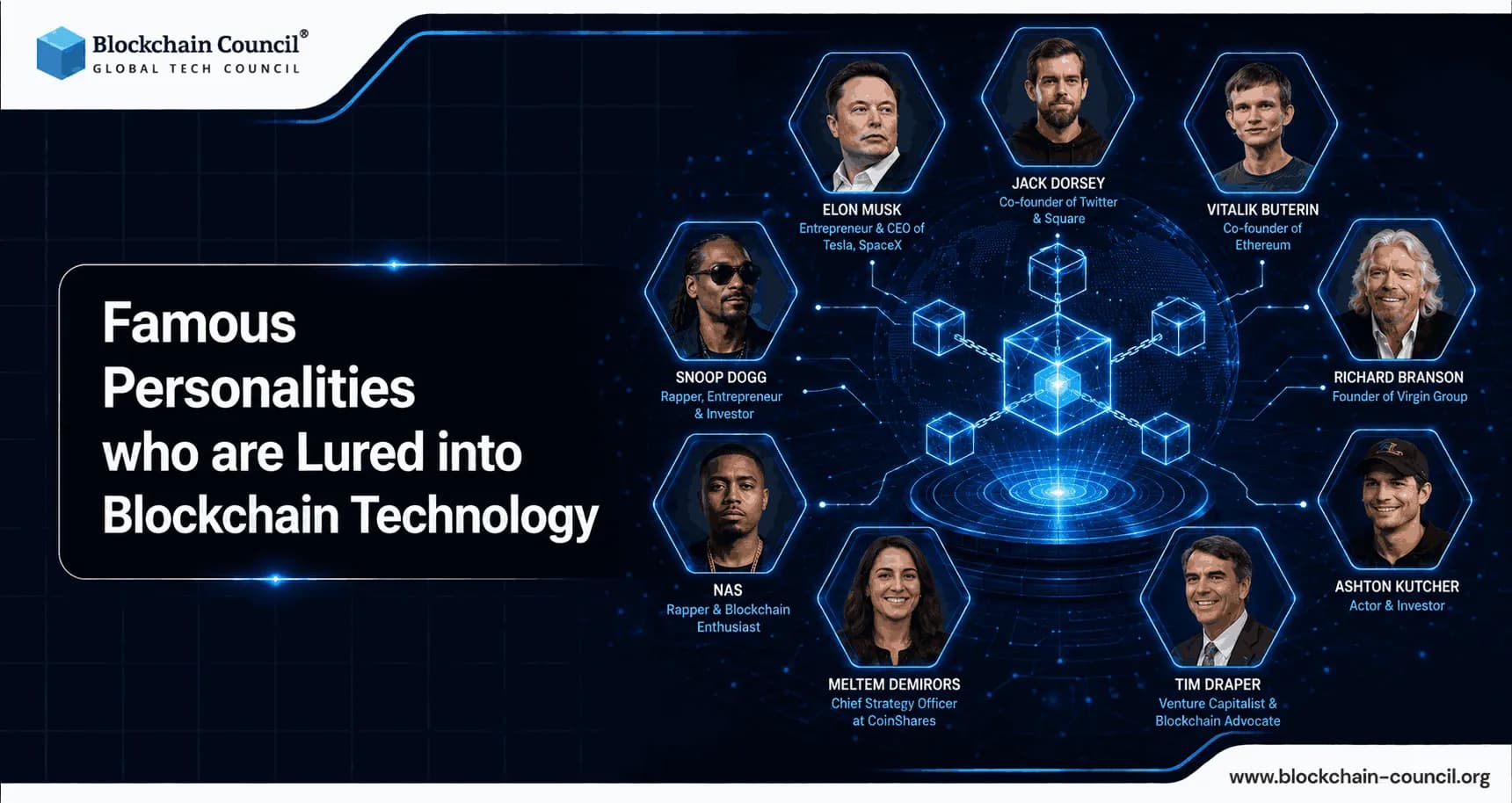
Introduction: When Fame Meets Distributed Ledgers
Blockchain technology has attracted an unusual mix of believers over the years, and not all of them come from the world of finance or engineering. Actors, athletes, musicians, and business magnates have all found their way into cryptocurrency and blockchain ventures, drawn by the promise of early investment gains and the appeal of backing something disruptive. For anyone curious about what actually makes these ventures work beneath the celebrity headlines, a Certified Blockchain Expert credential offers the technical grounding needed to separate genuine innovation from hype-driven trends.
Celebrity involvement has done more than generate headlines. It has introduced blockchain and cryptocurrency to millions of fans who might never have encountered the technology otherwise, accelerating mainstream awareness even when the motivations behind these endorsements vary widely.

Business Magnates Who Bet Early on Blockchain
Some of the most notable names in the blockchain space are not entertainers but entrepreneurs who recognized the technology's potential long before it reached the mainstream. The Winklevoss twins, who first gained public attention for their legal dispute with Facebook, became one of the earliest large-scale Bitcoin investors when they poured millions into the cryptocurrency years before it became a household topic. Their early conviction turned into a significant stake in the total Bitcoin supply, positioning them as influential figures in the space long after their Facebook lawsuit faded from headlines.
Mark Cuban, the billionaire investor known for his role on Shark Tank, took a different approach by launching an initial coin offering for his eSports betting platform. The token sale raised tens of millions of dollars and attracted backing from established blockchain investment firms, showing how traditional business figures could successfully bridge into decentralized finance. For entrepreneurs who want to build similar ventures with a stronger technical foundation, working toward a Certified Blockchain Developer credential provides the hands-on skills needed to actually design and launch blockchain-based products rather than simply investing in them.
Athletes Entering the Crypto Arena
Professional sports have produced their own share of blockchain enthusiasts. Tom Brady co-founded a blockchain platform focused on digital collectibles, extending his brand into the world of Web3 long after his playing career made him a household name. Serena Williams has backed multiple blockchain startups as well, using her public platform to speak about the technology's potential to reshape traditional industries. Their involvement reflects a broader pattern among athletes looking to diversify their income streams beyond endorsements and prize money.
Middle of the Pack: Entertainers Who Embraced the Trend
Hollywood and the music industry have contributed some of the most visible names in celebrity crypto adoption. Actor Jamie Foxx promoted a token sale for a cryptocurrency exchange, drawing both attention and criticism from industry veterans who cautioned that celebrity endorsements should never replace genuine research before investing. Lindsay Lohan took a more hands-on approach, releasing multiple non-fungible token collections and becoming one of the earlier entertainment figures to experiment directly with digital collectibles rather than simply promoting existing platforms.
Musician Akon went a step further than most celebrities by launching his own cryptocurrency aimed at supporting business development across Africa, demonstrating how a public figure's involvement can move beyond investment and into infrastructure building. Antivirus software pioneer John McAfee also became one of the most talked-about figures in the space, known for bold public predictions about cryptocurrency prices that generated significant media attention regardless of their accuracy.
These varied levels of involvement, from simple endorsements to founding entire projects, show that celebrity interest in blockchain spans a wide spectrum of commitment and technical understanding.
Future-Ready Skills
As technology becomes increasingly important across industries, students need opportunities to develop future-ready skills early in their education. A World Tech Olympiad can introduce students to areas such as artificial intelligence, coding, cybersecurity, robotics, and computational thinking while encouraging curiosity and continuous learning. Building this kind of technical curiosity early can help the next generation approach blockchain with genuine understanding rather than relying solely on celebrity influence to guide their decisions.
The Risk Behind Celebrity Endorsements
Not every celebrity venture into blockchain has ended well. Several high-profile endorsements have drawn regulatory scrutiny after the projects behind them failed to deliver on their promises, leaving fans and followers with financial losses. Industry experts have repeatedly warned that a celebrity's public support should never be the sole basis for an investment decision, since fame does not necessarily translate into technical expertise or business viability.
This is precisely why understanding the broader technology landscape matters more than following a famous face into a new project. A well-rounded Tech Certification helps individuals evaluate blockchain ventures on their technical merit, covering the wider set of skills needed to assess whether a project's underlying architecture and business model can actually succeed.
What Celebrity Involvement Means for the Industry
Despite the risks, celebrity participation has undeniably accelerated public awareness of blockchain technology. Millions of fans who follow these public figures on social media have been introduced to concepts like tokens, wallets, and decentralized platforms simply because someone they admire mentioned it. This kind of organic exposure has done more for mainstream adoption than most traditional advertising campaigns could achieve on their own.
Companies looking to replicate this kind of reach without relying purely on celebrity partnerships need strong marketing strategies of their own. A Marketing Certification equips professionals with the tools to build genuine brand trust and communicate complex blockchain concepts to audiences who may only be familiar with the technology through a celebrity headline. As the industry matures, the projects that combine credible technical foundations with thoughtful marketing will likely outlast those built on fame alone.
The fascination famous personalities have shown toward blockchain technology is unlikely to fade soon. As new use cases emerge across finance, entertainment, and digital ownership, more public figures will probably continue to explore the space, for better or worse, keeping blockchain firmly in the cultural spotlight for years to come.
FAQs
1. Which Famous Personalities Have Shown Interest in Blockchain Technology?
Many well-known entrepreneurs, investors, technologists, athletes, musicians, and entertainers have explored blockchain technology, cryptocurrencies, NFTs, Web3, and tokenized digital assets. Frequently discussed names include Elon Musk, Mark Cuban, Jack Dorsey, Vitalik Buterin, Serena Williams, Lionel Messi, Snoop Dogg, Paris Hilton, Ashton Kutcher, and others.
Their involvement varies considerably. Some have invested in blockchain businesses, some have promoted digital collectibles, and others have supported companies developing decentralized financial or Web3 infrastructure. Celebrity involvement should therefore be evaluated individually rather than treated as universal endorsement of blockchain.
2. Why Are Famous Personalities Attracted to Blockchain Technology?
Blockchain offers several characteristics that attract entrepreneurs and public figures, including digital ownership, programmable assets, decentralized networks, global payments, tokenization, and new creator-economy models.
For celebrities and creators, blockchain can provide alternative methods for distributing digital content and interacting with audiences. For entrepreneurs and investors, the attraction may instead involve financial infrastructure, decentralized applications, or new technology businesses.
3. How Has Elon Musk Influenced Interest in Blockchain and Cryptocurrency?
Elon Musk has been highly influential in public discussions surrounding cryptocurrencies, particularly Bitcoin and Dogecoin. His comments have repeatedly drawn mainstream attention to digital assets.
However, cryptocurrency advocacy and blockchain development are different activities. Musk is better described as a prominent participant in cryptocurrency discussions than as a core Ethereum or blockchain protocol developer.
4. What Is Mark Cuban's Connection With Blockchain Technology?
Entrepreneur and investor Mark Cuban has publicly discussed Ethereum, smart contracts, cryptocurrencies, NFTs, and decentralized finance and has invested in various technology ventures connected with the broader crypto ecosystem.
His interest illustrates how blockchain can attract conventional technology investors because smart contracts enable applications beyond simple cryptocurrency payments, including decentralized exchanges, lending platforms, collectibles, and tokenized assets.
5. How Is Jack Dorsey Connected With Blockchain Technology?
Twitter co-founder Jack Dorsey has become particularly associated with Bitcoin and decentralized financial technology. His companies and initiatives have explored Bitcoin payments, mining, wallets, and open financial infrastructure.
His approach is more Bitcoin-centered than broadly Ethereum-focused. This distinction matters because public discussions often place Bitcoin, Ethereum, blockchain, Web3, and cryptocurrency into one enormous conceptual bucket and then wonder why everyone gets confused.
6. Is Vitalik Buterin a Famous Personality in Blockchain Technology?
Yes. Vitalik Buterin is one of the most influential figures in blockchain because he co-founded Ethereum, a programmable blockchain platform designed to support smart contracts and decentralized applications.
Ethereum helped expand blockchain's perceived purpose beyond cryptocurrency transfers. Its programmable infrastructure has supported areas such as DeFi, NFTs, DAOs, stablecoins, tokenization, Layer 2 networks, and decentralized applications.
7. Which Famous Investors Have Entered the Blockchain and Crypto Industry?
A number of prominent investors and business personalities have participated in blockchain and cryptocurrency markets through venture investments, funds, startups, or direct digital-asset exposure.
Examples often discussed include Mark Cuban, Tim Draper, Michael Novogratz, Cameron Winklevoss, Tyler Winklevoss, and other technology investors. Their strategies differ significantly, so their participation should not be interpreted as evidence that a particular cryptocurrency or blockchain investment is suitable for everyone.
8. Which Famous Athletes Have Explored Blockchain and Web3?
Professional athletes have participated in blockchain through NFT collections, sponsorship agreements, digital collectibles, fan-engagement platforms, cryptocurrency partnerships, and investments.
Prominent athletes associated at various times with crypto or Web3 initiatives include Lionel Messi, Serena Williams, Stephen Curry, and others. Some celebrity partnerships have subsequently changed or ended, which is worth remembering when reading older promotional material.
9. How Has Lionel Messi Been Connected With Blockchain and Web3?
Lionel Messi has participated in digital-asset initiatives, including NFT-related projects and cryptocurrency-industry partnerships. His involvement helped expose blockchain-based digital collectibles and fan experiences to a large international audience.
Such partnerships primarily demonstrate blockchain's potential role in sports marketing and digital engagement. They do not necessarily indicate technical involvement in blockchain development or endorsement of every cryptocurrency product.
10. How Has Serena Williams Been Involved in Blockchain?
Serena Williams has been associated with technology investing, including exposure to companies operating in cryptocurrency and digital-asset infrastructure through investment activities.
Her involvement is an example of how prominent athletes can participate in blockchain not simply through endorsements but also through venture investment. Nevertheless, individual investments can succeed or fail, and celebrity participation does not eliminate commercial risk.
11. Which Musicians Have Been Interested in Blockchain Technology?
Musicians have been among the most visible celebrity participants in NFTs and Web3 because blockchain can support digital collectibles, token-gated communities, direct distribution, royalties, and experimental ownership models.
Snoop Dogg is one prominent example associated with NFTs and Web3 initiatives. Other musicians have experimented with tokenized releases and blockchain-based fan experiences as the technology has evolved.
12. Why Has Snoop Dogg Become Associated With NFTs and Web3?
Snoop Dogg has participated in NFT and metaverse-related projects and has been one of the entertainment industry's more visible figures experimenting with Web3.
For musicians, the broader attraction is understandable: blockchain can create programmable digital assets that potentially connect music, collectibles, communities, memberships, merchandise, and virtual experiences.
Whether individual projects maintain long-term value is an entirely separate question, because celebrity visibility and sustainable economics are not synonyms.
13. How Is Paris Hilton Connected With Blockchain and NFTs?
Paris Hilton became an early high-profile celebrity participant in the NFT ecosystem and has publicly discussed cryptocurrency and digital collectibles.
Her involvement helped bring NFT terminology to audiences outside traditional technology communities. Celebrity participation was particularly significant during the rapid expansion of NFT markets, although subsequent market volatility demonstrated that visibility does not guarantee durable value.
14. Has Ashton Kutcher Invested in Blockchain Companies?
Ashton Kutcher is known not only as an actor but also as a technology investor. Through his venture-investment activities, he has been associated with companies operating in cryptocurrency and blockchain-related markets.
His involvement reflects a broader pattern in which celebrities with established venture portfolios approach blockchain as a technology and startup investment category, rather than merely promoting individual tokens.
15. Why Are Celebrities Interested in NFTs?
NFTs gave celebrities a relatively accessible way to experiment with blockchain-based digital ownership.
Potential applications include digital artwork, collectibles, music releases, membership passes, event access, gaming items, sports memorabilia, and fan experiences. Smart contracts can also provide programmable functionality around these assets.
However, NFT prices can be highly volatile, intellectual-property rights can be misunderstood, and purchasing an NFT does not automatically transfer copyright or broader ownership rights.
16. How Can Blockchain Change the Creator Economy for Famous Personalities?
Blockchain can potentially allow creators to issue digital assets and interact with audiences through programmable platforms.
A possible model is:
Creator → Digital Content → Blockchain Token/NFT → Fan → Secondary Market or Community Access
Smart contracts may support royalties, memberships, token-gated access, or automated distributions. The practical value depends on platform design, legal rights, user demand, transaction costs, and whether blockchain genuinely improves the experience over conventional technology.
17. Are Celebrities Using Blockchain for the Metaverse and Gaming?
Some celebrities and entertainment brands have experimented with blockchain-enabled virtual worlds, gaming assets, avatars, digital land, collectibles, and interactive fan experiences.
Blockchain can allow certain virtual assets to be represented as transferable tokens. However, interoperability between different metaverse or gaming platforms remains technically and commercially challenging, so owning an asset on one platform does not mean it will function everywhere.
18. What Are the Risks of Celebrity Involvement in Blockchain Projects?
Celebrity participation can generate attention extremely quickly, but it also creates significant risks for consumers.
Important concerns include speculative hype, undisclosed compensation, misleading promotions, token volatility, scams, project failure, cybersecurity risks, and regulatory violations. Regulators in multiple jurisdictions have warned investors against making financial decisions solely because celebrities promote digital assets.
People should evaluate the technology, issuer, legal rights, token economics, security, liquidity, and regulatory status independently.
19. Should Investors Buy Cryptocurrency Because a Famous Personality Supports It?
No. A celebrity endorsement should never substitute for independent research and appropriate financial judgment.
Before considering a crypto or blockchain-related asset, people should examine what the token does, who controls the project, supply mechanics, smart-contract risks, custody arrangements, liquidity, legal status, fees, and potential for total loss.
Celebrity involvement is primarily a marketing or reputational signal. It does not establish intrinsic value, regulatory approval, security, or future returns.
20. What Is the Future of Famous Personalities in Blockchain and Web3?
Celebrity involvement in blockchain will probably evolve away from purely speculative token promotion toward more practical applications involving digital identity, tokenized memberships, gaming, ticketing, intellectual property, loyalty programs, creator communities, digital collectibles, and real-world asset experiences.
At the same time, stronger consumer-protection rules and advertising standards may make transparent disclosures increasingly important. Public personalities and companies operating across jurisdictions will need to consider securities, financial-promotion, intellectual-property, privacy, and consumer-protection requirements where applicable.
The most durable celebrity blockchain projects are likely to be those where the technology provides an actual function rather than existing solely because a famous name can attract buyers. Blockchain may give celebrities programmable digital ownership, but it has yet to invent the smart contract that guarantees good celebrity judgment.
Related Articles
View All
Blockchain
Blockchain Explained: The Technology Changing How We Trust & Transact
Blockchain explained from the ground up: what it is, why it was created, centralised vs decentralised systems, how blocks, nodes, and ledgers work, how data is stored, security, real-world examples, and how blockchain compares with traditional databases.

Blockchain
Blockchain Train Technology: Rail Use Cases, Benefits, and Limits
Blockchain train technology is moving from pilots to practical rail use cases in freight, ticketing, asset records, IoT security, and audit trails.

Blockchain
Beyond Cryptocurrency: How Blockchain Is Transforming Real-World Industries
Explore how blockchain works beyond cryptocurrency in banking, supply chains, healthcare, tokenisation, CBDCs, and government, plus key challenges and career paths.
Trending Articles

Top 5 DeFi Platforms
Explore the leading decentralized finance platforms and what makes each one unique in the evolving DeFi landscape.
What is AWS? A Beginner's Guide to Cloud Computing
Everything you need to know about Amazon Web Services, cloud computing fundamentals, and career opportunities.
Claude AI Tools for Productivity
Discover Claude AI tools for productivity to streamline tasks, manage workflows, and improve efficiency.