

Blockchain Use Cases for Retail Industry
 Toshendra Kumar Sharma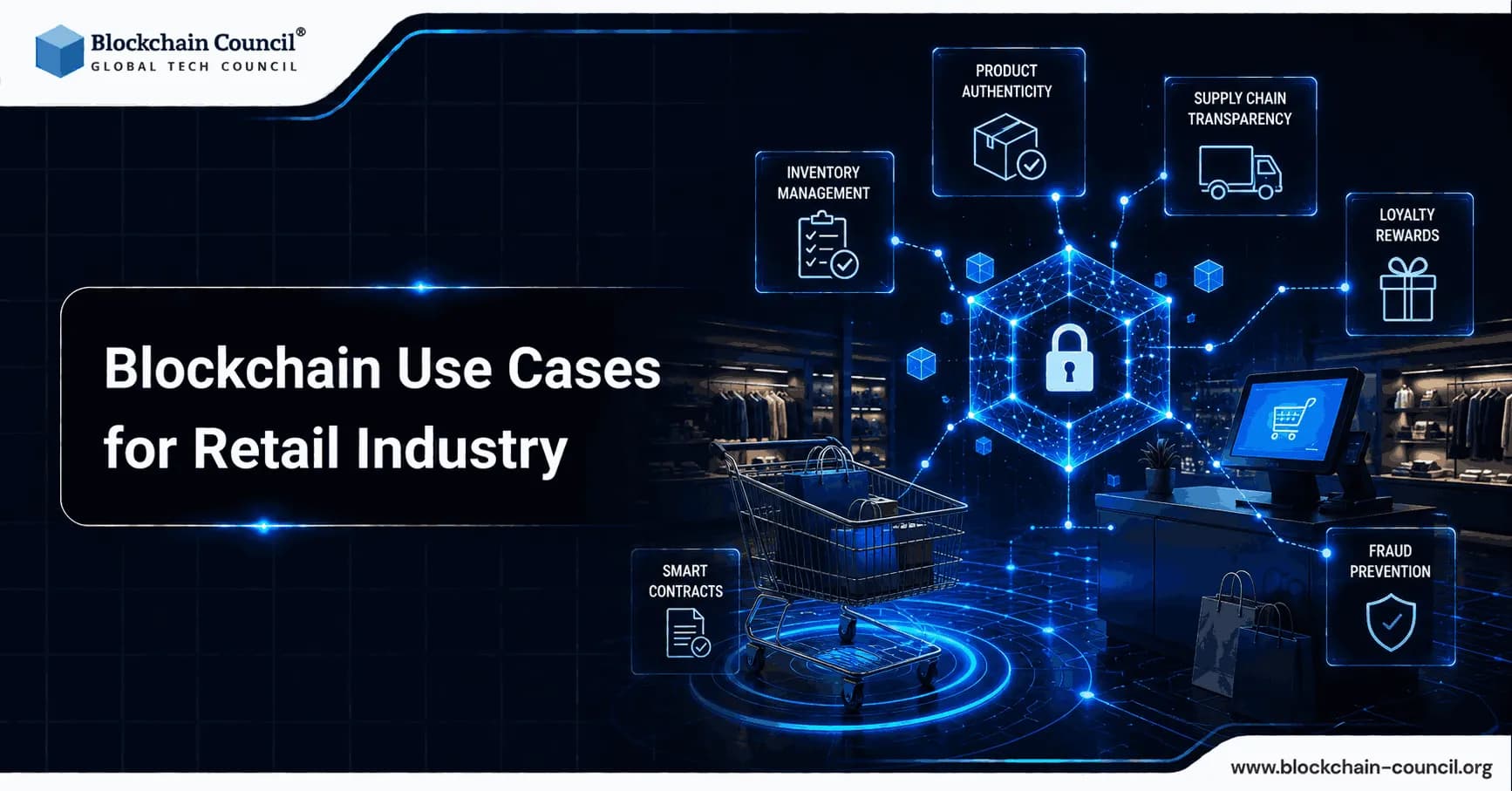
Retailers deal with a constant stream of trust problems: verifying that products are authentic, proving where items actually came from, managing loyalty programs across multiple systems, and reconciling payments between suppliers, distributors, and stores. Blockchain technology is being applied across all of these areas, giving retailers and their partners a shared, tamper-proof record instead of fragmented, disconnected systems. As retail companies explore what this actually looks like in practice, more professionals are pursuing a Certified Blockchain Expert credential to understand how the technology applies specifically to retail operations.
In this article, we'll walk through the main blockchain use cases already emerging in retail, how each one works, and the challenges retailers still need to work through before wider adoption.

Why Retail Is a Strong Fit for Blockchain
Retail supply chains typically involve manufacturers, distributors, logistics providers, and multiple store locations, each maintaining separate records that need to be reconciled constantly. This creates real friction: counterfeit goods slipping into legitimate supply chains, slow dispute resolution when inventory records don't match, and limited visibility for consumers who increasingly want to know where their products actually come from.
Blockchain addresses this by giving every party in a retail supply chain access to the same verified data, recorded in a way that can't be secretly altered after the fact. Because this touches directly on how goods move from supplier to shelf, retail operations and procurement professionals are increasingly pursuing a Certified Blockchain & Supply Chain Professional credential, building the specific expertise needed to apply blockchain to sourcing, inventory, and vendor management within a retail context.
Quick Answer (for readers in a hurry)
Blockchain use cases in retail include verifying product authenticity, tracing goods across the supply chain, managing loyalty and rewards programs, streamlining supplier payments through smart contracts, and improving inventory accuracy across multiple locations. Together, these applications reduce fraud, speed up reconciliation, and give retailers and consumers more transparent, verifiable information about the products they buy and sell.
Key Blockchain Use Cases in Retail
1. Product Authenticity and Anti Counterfeiting
Retailers, especially in luxury goods, electronics, and apparel, use blockchain to record a product's origin and journey on an immutable ledger. Consumers or store staff can scan a product code to instantly verify its authenticity, making it significantly harder for counterfeit goods to pass through legitimate retail channels undetected.
2. Supply Chain Traceability
By recording every step a product takes, from manufacturer to distributor to store shelf, blockchain gives retailers full visibility into their supply chain. This is particularly valuable for food retailers needing to trace contamination sources quickly, and for brands wanting to prove ethical or sustainable sourcing claims with verifiable evidence rather than marketing language alone.
3. Loyalty and Rewards Programs
Traditional loyalty programs often trap value within a single retailer's system, frustrating customers who accumulate points they rarely redeem. Blockchain based loyalty programs allow points to function more like a portable digital asset, potentially usable or exchangeable across multiple retail partners, with transaction history recorded transparently on the ledger.
Building the systems that actually power blockchain based authenticity checks, supply chain tracking, and loyalty programs requires genuine technical depth, from integrating point of sale systems to designing secure smart contracts. This is why development teams working on retail blockchain platforms often pursue a formal Tech Certification to validate their engineering skills before deploying systems that handle real transactions and customer data at scale.
4. Automated Supplier Payments
Smart contracts can automatically release payment to suppliers once agreed conditions are met, such as confirmed delivery or quality inspection, reducing the manual invoice processing and payment disputes that commonly slow down retailer supplier relationships.
5. Inventory Management Across Locations
Retailers with multiple stores or warehouses can use blockchain to maintain a single, synchronized inventory record accessible across every location, reducing the discrepancies that occur when separate systems fall out of sync, and making it easier to track stock movement between locations in real time.
6. Secure Customer Data and Identity
Blockchain can give customers more control over their own data, allowing them to selectively share information with retailers for personalized offers or faster checkout, without retailers needing to store large centralized databases of sensitive customer information that become attractive targets for breaches.
Key Benefits of Blockchain in Retail
Reduced counterfeiting: Verifiable product histories make it harder for fake goods to reach consumers.
Faster dispute resolution: Shared, synchronized records reduce disagreements between retailers and suppliers.
Improved customer trust: Transparent sourcing data supports genuine sustainability and authenticity claims.
Lower administrative costs: Automated payments and reconciliation reduce manual back office work.
Portable loyalty value: Blockchain based rewards programs can offer customers more flexibility than traditional points systems.
Real World Examples
Major retailers have piloted blockchain for food traceability, cutting the time needed to trace contaminated products from days down to seconds during safety investigations. Luxury goods companies have used blockchain to certify authenticity for high value items like watches and handbags, addressing counterfeiting concerns that have long affected the secondary resale market. Some retailers have also tested blockchain based loyalty programs that let customers earn and redeem rewards across a network of partner brands rather than being locked into a single company's system.
Challenges to Consider
Blockchain adoption in retail still faces real hurdles. Integrating blockchain with existing point of sale and inventory management systems requires meaningful investment. Smaller suppliers may lack the technical resources to join a retailer's blockchain network. Blockchain can guarantee that recorded data hasn't been altered, but it cannot verify that the information was accurate at the moment it was entered. And achieving industry wide standards across competing retailers and suppliers remains a genuine coordination challenge.
Technology & Problem Solving
Technology education is not only about learning tools or programming languages. It also involves understanding problems, analysing information, identifying patterns, and developing logical solutions. A World Tech Olympiad gives students an opportunity to develop these problem-solving abilities while exploring different areas of technology.
Final Thoughts
Blockchain is steadily addressing several of retail's most persistent challenges, from counterfeit products and opaque supply chains to rigid loyalty programs and slow supplier reconciliation. By giving every party access to the same verified, tamper proof data, retailers can build more trust with both suppliers and customers while reducing the administrative friction that has long weighed down retail operations.
As adoption grows, retailers need more than reliable technology. They need to clearly explain these changes to customers and partners who may not understand how blockchain based authenticity checks or loyalty programs actually work. That's why teams working on blockchain retail initiatives are increasingly pairing their technical expertise with a Marketing Certification to communicate these innovations clearly and build genuine trust with the shoppers and partners these systems are designed to serve.
Blockchain in retail is still an evolving space, but the direction is clear: more verifiable products, more transparent supply chains, and a more trustworthy shopping experience for everyone involved.
FAQs
1. How is blockchain used in the retail industry?
Blockchain can be used in retail to improve product traceability, supply chain transparency, anti-counterfeiting, loyalty programs, payments, digital identity, warranties, returns, and sustainability reporting.
It creates a shared, tamper-evident record that retailers, suppliers, manufacturers, logistics providers, and consumers can use to verify important information about products and transactions.
2. Why is blockchain important for retailers?
Modern retailers operate across complicated networks of manufacturers, distributors, warehouses, logistics companies, marketplaces, and stores. Information is often fragmented across different systems.
Blockchain can provide authorized participants with a common source of verified information, reducing reconciliation problems and improving visibility across the retail ecosystem.
3. How can blockchain improve retail supply chains?
Blockchain can record important events throughout a product's journey, including:
Manufacturing
Packaging
Shipping
Customs clearance
Warehousing
Distribution
Store delivery
Sale to the customer
Combined with IoT devices, RFID tags, QR codes, and enterprise systems, blockchain can provide retailers with better end-to-end supply chain visibility.
4. How does blockchain improve product traceability?
A product or batch can be assigned a unique digital identifier linked to blockchain records.
Retailers can then track information such as its origin, manufacturer, production date, certifications, shipping history, and ownership. This can be particularly valuable for food, pharmaceuticals, luxury goods, electronics, and other products where provenance matters.
5. Can blockchain help retailers fight counterfeit products?
Yes.
Manufacturers can create blockchain-backed digital records for authentic products. Customers or retailers can scan a QR code, NFC tag, RFID tag, or other identifier to check whether a product corresponds with an authorized record.
Blockchain does not physically prevent counterfeiting, however. Secure product identifiers and reliable data entry are still necessary.
6. How can blockchain improve food safety in retail?
Blockchain can help supermarkets and food retailers trace products back through farms, processors, distributors, and logistics providers.
If contamination or another safety problem is discovered, retailers may be able to identify affected batches more quickly instead of recalling unnecessarily large quantities of products.
7. Can blockchain improve inventory management?
Yes, particularly when multiple organizations share inventory information.
Blockchain can provide verified records of products entering and leaving warehouses, distribution centers, and stores. Combined with IoT sensors, RFID, and AI forecasting, it can improve inventory visibility and reduce discrepancies.
8. How can blockchain be used for retail payments?
Blockchain-based payment systems can support:
Cryptocurrency payments
Stablecoin payments
Cross-border settlements
Supplier payments
Automated refunds
Machine-to-machine payments
Programmable payments
Retailers can integrate these payment methods alongside conventional cards, bank transfers, and digital wallets.
9. How can blockchain improve loyalty programs?
Retailers can use blockchain to create interoperable or tokenized loyalty programs.
Customers could earn digital rewards from one transaction and potentially redeem them across participating brands, marketplaces, or partners. Smart contracts can automate reward issuance and redemption.
10. Can blockchain improve product returns and warranties?
Yes.
Purchase dates, product serial numbers, warranty conditions, repairs, and ownership transfers can be linked to tamper-evident digital records.
This can simplify warranty verification and reduce fraudulent returns involving counterfeit products, altered receipts, or products purchased through unauthorized channels.
11. How can blockchain support Digital Product Passports?
A Digital Product Passport (DPP) provides structured information about a product throughout its lifecycle.
Blockchain can help verify information associated with DPPs, including:
Product origin
Materials
Manufacturing history
Sustainability information
Repair records
Ownership history
Recycling instructions
Certifications
DPPs are becoming particularly relevant as sustainability and product transparency requirements expand.
12. How can blockchain improve sustainable retail?
Blockchain can help retailers verify environmental and ethical claims by tracking information about:
Raw materials
Carbon emissions
Ethical sourcing
Recycled content
Renewable energy
Fair-trade certification
Waste management
This can make sustainability reporting more auditable, provided the underlying data is trustworthy.
13. Can blockchain improve customer identity and privacy?
Blockchain-based decentralized identity (DID) and verifiable credentials can allow customers to prove specific information without repeatedly providing complete personal records.
For example, a customer could potentially prove age eligibility without revealing unnecessary identity information.
14. How can smart contracts be used in retail?
Smart contracts can automate business rules involving:
Supplier payments
Purchase orders
Loyalty rewards
Refunds
Insurance claims
Delivery confirmation
Marketplace commissions
Warranty processing
For example, a supplier payment could automatically be released after verified delivery conditions are satisfied.
15. What are the major benefits of blockchain for retailers?
Potential benefits include:
Better supply chain transparency
Improved product traceability
Counterfeit detection
Faster recalls
Automated supplier settlements
More transparent loyalty programs
Better warranty management
Improved sustainability verification
Secure digital identity
Reduced reconciliation costs
The actual benefit depends heavily on whether multiple parties genuinely need a shared, trusted record.
16. What are the challenges of implementing blockchain in retail?
Major challenges include:
Integration with legacy systems
Initial implementation costs
Supplier participation
Data quality
Scalability
Privacy requirements
Regulatory compliance
Blockchain interoperability
Governance
Employee and customer adoption
Blockchain can make recorded information difficult to manipulate, but it cannot magically determine whether someone entered false information in the first place. The ancient computing problem of "garbage in, garbage out" remains stubbornly alive.
17. What mistakes should retailers avoid when adopting blockchain?
Common mistakes include:
Using blockchain without a clear business problem
Putting sensitive customer information directly on a public blockchain
Assuming blockchain automatically verifies real-world data
Ignoring supplier onboarding
Neglecting smart contract security audits
Creating unnecessary cryptocurrencies
Failing to integrate blockchain with ERP, POS, CRM, and supply chain systems
The objective should be measurable business improvement, not merely acquiring a fashionable technology diagram.
18. What are the best practices for implementing blockchain in retail?
Retailers should begin with a clearly defined use case, such as food traceability, luxury authentication, supplier settlement, or Digital Product Passports.
Best practices include using blockchain only for information requiring shared verification, keeping confidential data off-chain, integrating with existing enterprise systems, using secure IoT or product identifiers, auditing smart contracts, establishing clear consortium governance, and measuring return on investment.
19. What blockchain retail trends are important in 2026?
Important trends include:
Digital Product Passports (DPPs)
Tokenization of real-world assets (RWAs)
Stablecoin payments
Blockchain-based loyalty programs
AI and blockchain integration
Decentralized identity (DID)
Verifiable credentials
Luxury product authentication
Circular economy tracking
Supply chain carbon accounting
Zero-knowledge proofs (ZKPs)
Blockchain-enabled product provenance
The strongest implementations increasingly combine blockchain with AI, IoT, cloud computing, and conventional enterprise software rather than treating blockchain as an isolated system.
20. What is the future of blockchain in the retail industry?
Blockchain's future in retail is likely to center on traceability, product authenticity, Digital Product Passports, programmable payments, loyalty, and supply chain transparency.
A future retail transaction could involve a customer scanning a product and instantly verifying where it was manufactured, which materials were used, whether sustainability certifications are genuine, whether the item is authentic, and how it can eventually be repaired or recycled.
Blockchain will not replace retail databases, ERP platforms, payment processors, or supply chain systems. Instead, it can provide a trusted verification layer connecting them.
The most successful blockchain retail applications may therefore be the ones customers barely notice. People generally want authentic products, safer food, faster refunds, and reliable information. They do not particularly care how many distributed ledgers had to suffer behind the scenes to make that happen.
Related Articles
View All
Blockchain
Blockchain in Banks: Use Cases, Benefits, Risks, and the AI Connection
Explore how blockchain in banks is reshaping payments, trade finance, tokenized deposits, KYC, AML, and AI-driven risk workflows.
Blockchain
Top Blockchain Use Cases in Banks and Financial Services
Explore the top blockchain use cases in banks, from payments and trade finance to tokenization, settlement, lending, KYC, and digital asset services.

Blockchain
Blockchain Train Technology: Rail Use Cases, Benefits, and Limits
Blockchain train technology is moving from pilots to practical rail use cases in freight, ticketing, asset records, IoT security, and audit trails.
Trending Articles
The Role of Blockchain in Ethical AI Development
How blockchain technology is being used to promote transparency and accountability in artificial intelligence systems.
What is AWS? A Beginner's Guide to Cloud Computing
Everything you need to know about Amazon Web Services, cloud computing fundamentals, and career opportunities.
How to Install Claude Code
Learn how to install Claude Code on macOS, Linux, and Windows using the native installer, plus verification, authentication, and troubleshooting tips.