

Blockchain Use Case for the Telecom Industry
 Toshendra Kumar Sharma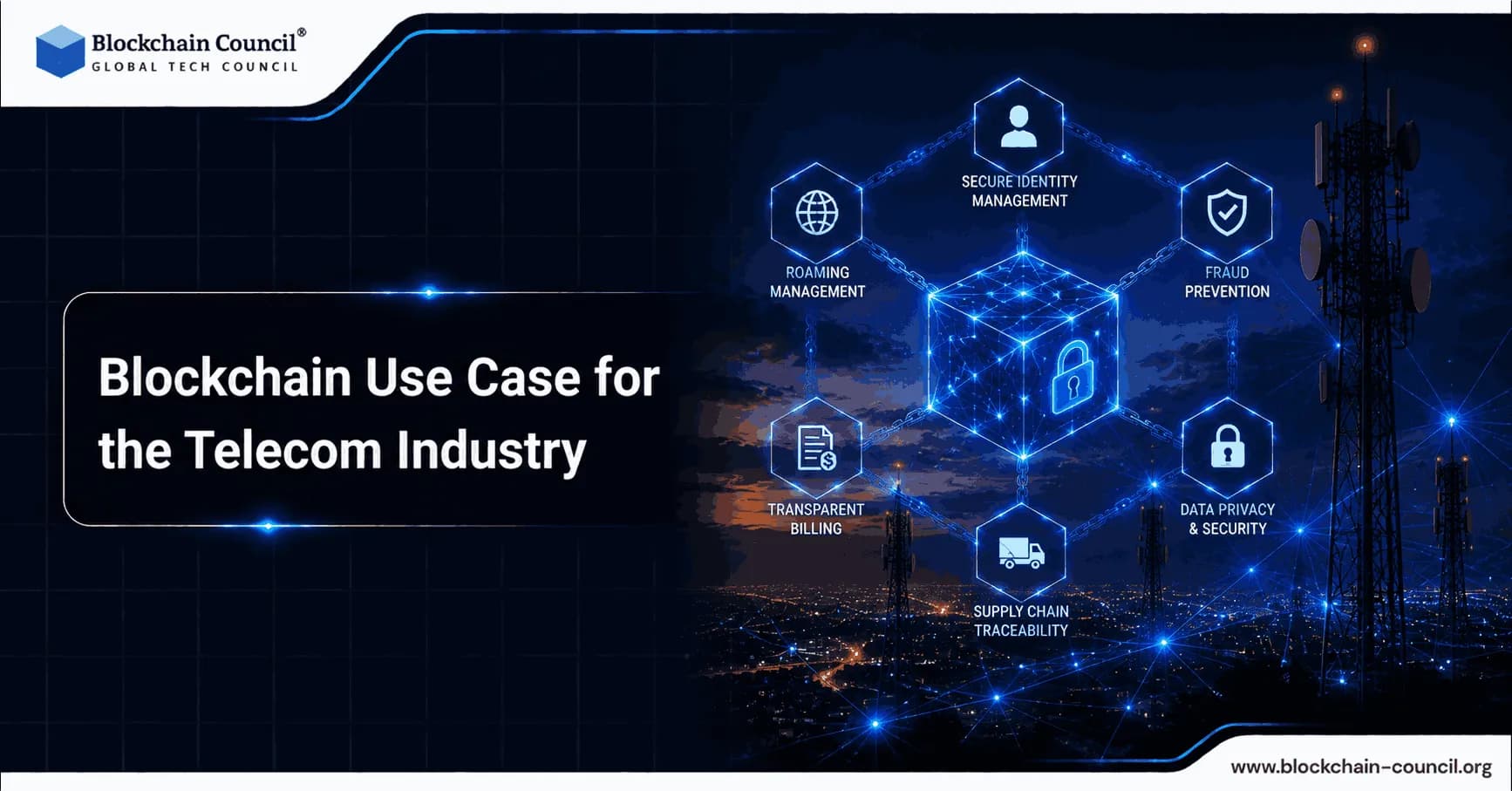
The telecom industry runs on trust between parties that rarely trust each other directly. Carriers settle roaming charges with competitors, verify subscriber identities across networks they do not control, and manage billions of IoT devices that all need secure, tamper proof records. Blockchain is emerging as one of the more practical answers to these problems, and the market reflects that shift: the global blockchain in telecom market grew from roughly $441 million in 2023 to $564 million in 2024, and it is projected to reach $2.47 billion by 2030 at a compound annual growth rate of nearly 28%. Professionals earning a Certified Blockchain Expert credential are increasingly studying telecom as one of the clearest examples of blockchain solving operational problems that have persisted for decades, not just a financial use case.
Why Telecom Needs Blockchain Now
The Industry's Core Problems
Telecom operators face a familiar set of challenges that blockchain is well suited to address. Average revenue per user has been declining across most global markets for years, squeezing margins right as networks need to invest heavily in 5G and IoT infrastructure. Fraud remains a persistent drain on profitability, from SIM cloning to international revenue share fraud that costs carriers billions annually. On top of that, coordinating between competing carriers for roaming, number portability, and interconnection billing requires constant reconciliation of records that each party maintains separately, creating friction, delays, and disputes.

Why Blockchain Fits This Environment
Blockchain addresses these problems directly because it was built for exactly this kind of multi party coordination. A shared, tamper resistant ledger lets competing carriers agree on a single source of truth without needing to trust a central intermediary, which is precisely the structure roaming settlement, billing, and fraud prevention all require. This is also where security expertise becomes essential to get right. Understanding how these systems hold up against real world attack vectors is exactly what a Certified Blockchain Security Professional credential prepares telecom IT teams for, since a poorly secured blockchain deployment can introduce new risks rather than removing old ones.
Key Blockchain Use Cases in Telecom
Roaming and Interconnect Settlement
International roaming has long been one of the most frustrating parts of the telecom experience for both operators and customers. Multiple intermediaries sit between carriers to reconcile usage records and settle payments, which makes the process slow, expensive, and prone to disputes. Blockchain based smart contracts can automate this entire settlement process, letting carriers agree on usage data and trigger payments automatically once predefined conditions are met. Industry initiatives like the GSMA's Blockchain for Wholesale Roaming project and TM Forum Catalyst pilots have already tested Hyperledger based solutions for exactly this purpose, demonstrating that these systems are moving from proof of concept into real infrastructure backed by major carriers and global standards bodies.
Fraud Prevention and Identity Verification
SIM swap fraud, subscription fraud, and international revenue share fraud all exploit weaknesses in how carriers verify identity and authorize transactions. A blockchain based identity layer gives carriers a shared, verifiable record of subscriber credentials that is far harder to forge or manipulate than data siloed within a single company's systems. This also streamlines customer onboarding across carriers, since a verified digital identity can be reused rather than re establishing trust from scratch every time a customer switches providers or crosses borders.
Securing the Internet of Things
The explosion of connected devices is one of the biggest pressures facing telecom networks today, and it is only accelerating. Billions of IoT devices now rely on cellular connectivity, and each one represents a potential entry point for attackers if device identity and data integrity are not properly secured. Blockchain can record a tamper proof ledger of a device's entire history, from provisioning through every subsequent transaction, making it far easier to detect anomalies and verify that data coming from a sensor or device has not been altered in transit. This is central to what the industry calls Blockchain Internet of Things, and it is one of the fastest growing intersections of the two technologies as billions of new devices come online.
Dynamic Spectrum Sharing
Spectrum is a finite, heavily regulated resource, and telecom operators are increasingly exploring blockchain as a way to manage it more efficiently. A blockchain based ledger can support dynamic spectrum allocation, letting operators, government agencies, and enterprises coordinate real time access to radio frequencies without the delays that come from centralized allocation processes. The same underlying approach extends to other emerging communication technologies as well, including RFID tracking, laser communications, and Light Fidelity networks, all of which benefit from a shared, verifiable record of usage and access rights.
Streamlining OSS and BSS Operations
Behind the scenes, telecom operators run enormous operational and business support systems to manage device connectivity provisioning, number portability, and billing. These back office processes are frequently manual, siloed, and slow to reconcile between departments or partner carriers. Blockchain offers a way to automate and unify these workflows, cutting the administrative overhead that currently eats into telecom margins while reducing the errors that come from manually reconciling records across disconnected systems.
Getting the Implementation Right
None of these use cases succeed on architecture alone. Telecom is a deeply regulated, technically complex industry, and rolling out blockchain infrastructure well requires teams who understand networking, compliance, and distributed systems together rather than in isolation. This is exactly the kind of cross disciplinary grounding a broader Tech Certification provides, giving telecom IT and engineering teams the wider technical context needed to evaluate where blockchain genuinely helps and where it adds unnecessary complexity.
Technical readiness is only half the equation, though. Convincing internal stakeholders, regulators, and partner carriers to adopt a new shared infrastructure model takes clear communication and a compelling business case, not just a working prototype. A Marketing Certification rounds out that skill set, helping telecom teams translate the operational and cost saving benefits of blockchain into a pitch that actually secures buy in from the partners and decision makers who need to say yes before any of these use cases can go live.
Blockchain will not solve every challenge the telecom industry faces, but roaming settlement, fraud prevention, IoT security, spectrum management, and back office automation are five areas where it is already moving from pilot projects to real deployment. Carriers that build the right technical and organizational foundation now are the ones most likely to capture the efficiency gains as this technology matures.
FAQs
1. How can blockchain be used in the telecom industry?
Blockchain can improve telecommunications by enabling secure digital identity, fraud prevention, roaming settlement, automated billing, smart contracts, infrastructure sharing, IoT device management, supply chain transparency, and decentralized connectivity services.
2. Why is blockchain important for telecom?
Telecom operators manage millions of customer identities, billing records, roaming agreements, network assets, and connected devices. Blockchain provides a tamper-evident, shared ledger that can improve trust, transparency, and operational efficiency across multiple organizations.
3. How does blockchain work in telecommunications?
Blockchain records transactions and events such as customer identity verification, roaming usage, billing, equipment tracking, service agreements, and network sharing. Smart contracts automate predefined business processes, while cryptography secures transaction records.
4. Can blockchain improve telecom billing?
Yes. Smart contracts can automate billing, payment reconciliation, usage verification, and settlements between operators, reducing manual processing and billing disputes.
5. How does blockchain simplify roaming settlements?
International roaming often involves multiple telecom providers and complex reconciliation processes. Blockchain can create a shared record of roaming usage and automate inter-operator settlements, potentially reducing processing time and administrative costs.
6. Can blockchain reduce telecom fraud?
Yes. Blockchain can help reduce certain forms of fraud by improving identity verification, securing SIM registration records, validating transactions, and creating transparent audit trails. It complements existing fraud detection and cybersecurity systems.
7. How does blockchain improve digital identity?
Blockchain-based decentralized identity (DID) systems enable customers to manage verifiable digital credentials while giving telecom providers stronger identity verification capabilities and reducing duplicate KYC processes.
8. Can blockchain improve IoT connectivity?
Yes. Blockchain can securely manage identities for connected IoT devices, authenticate machine-to-machine communications, automate payments, and record device activity across distributed networks.
9. How do smart contracts benefit telecom operators?
Smart contracts can automate:
Roaming settlements
Wholesale agreements
Infrastructure sharing
Billing
Vendor payments
Service provisioning
SLA enforcement
Subscription management
Automation reduces administrative effort and improves efficiency.
10. Can blockchain improve telecom supply chains?
Yes. Blockchain enables telecom companies to track network equipment, verify suppliers, authenticate hardware, monitor shipments, and improve inventory management throughout the supply chain.
11. Which telecom services benefit from blockchain?
Applications include:
Mobile networks
Internet service providers (ISPs)
Roaming services
5G infrastructure
IoT platforms
Satellite communications
Network infrastructure management
Digital identity
Mobile payments
Customer authentication
12. Which blockchain platforms are suitable for telecom?
Popular enterprise blockchain platforms include:
Hyperledger Fabric
Ethereum
Hedera
Polygon
Quorum
Avalanche
Hyperledger Besu
Corda
Platform selection depends on scalability, privacy, governance, and interoperability requirements.
13. What are the advantages of blockchain in telecom?
Benefits include:
Automated settlements
Improved billing accuracy
Reduced fraud
Secure digital identity
Better IoT management
Enhanced transparency
Faster reconciliation
Improved supply chain visibility
Stronger cybersecurity
Lower operational costs
14. What challenges exist when implementing blockchain?
Challenges include integration with legacy telecom infrastructure, scalability, interoperability, regulatory compliance, privacy protection, governance, cybersecurity, implementation costs, user adoption, and coordination among multiple operators.
15. Can blockchain replace telecom operators?
No. Blockchain enhances telecommunications infrastructure but does not replace mobile networks, fiber infrastructure, spectrum management, customer support, or network engineering. It serves as an enabling technology that improves coordination and automation.
16. What common mistakes should telecom companies avoid?
Common mistakes include storing sensitive customer information directly on public blockchains, assuming blockchain alone prevents fraud, neglecting smart contract security audits, overlooking regulatory requirements, failing to integrate with existing OSS/BSS systems, and adopting blockchain without a clearly defined business objective.
17. What are best practices for implementing blockchain in telecom?
Best practices include integrating blockchain with operational support systems (OSS), business support systems (BSS), customer relationship management (CRM), identity management platforms, and IoT infrastructure; storing confidential customer data off-chain; conducting security audits; implementing decentralized identity (DID); and ensuring compliance with telecommunications and privacy regulations.
18. How does blockchain fit into the future of telecommunications?
Blockchain complements artificial intelligence (AI), 5G, Internet of Things (IoT), edge computing, cloud computing, digital identity, network automation, and advanced analytics to create more secure, intelligent, and efficient telecommunications ecosystems.
19. What trends are shaping blockchain in telecom in 2025-2026?
Major trends include decentralized identity (DID), AI-powered network automation, blockchain-enabled roaming settlements, machine-to-machine (M2M) payments, 5G infrastructure sharing, edge computing integration, enterprise IoT security, decentralized physical infrastructure networks (DePIN), zero-knowledge proofs (ZKPs), and programmable telecom services.
20. What is the future of blockchain in the telecom industry?
Blockchain is expected to become an increasingly valuable technology for automating settlements, strengthening digital identity, improving IoT security, and increasing operational efficiency across the telecommunications sector. Rather than replacing existing telecom infrastructure, blockchain will integrate with AI, 5G, cloud platforms, and enterprise systems to create more resilient and transparent communication networks. As billions of connected devices communicate across increasingly complex ecosystems, trusted digital coordination will become just as important as network speed. After all, the fastest connection in the world is far less useful if nobody can verify who is on the other end.
Related Articles
View All
Blockchain
Public, Private & Consortium Blockchains: Which Network Fits the Use Case?
Compare public, private, and consortium blockchains by security, speed, privacy, and control, with real examples and a simple guide to choosing the right network.

Blockchain
Blockchain in Banks: Use Cases, Benefits, Risks, and the AI Connection
Explore how blockchain in banks is reshaping payments, trade finance, tokenized deposits, KYC, AML, and AI-driven risk workflows.

Blockchain
User Experience in Blockchain Products: How to Make Web3 Apps Easier to Use
Learn how to improve user experience in blockchain products with simpler onboarding, clearer transaction flows, safer wallet UX, and better Web3 metrics.
Trending Articles
The Role of Blockchain in Ethical AI Development
How blockchain technology is being used to promote transparency and accountability in artificial intelligence systems.
What is AWS? A Beginner's Guide to Cloud Computing
Everything you need to know about Amazon Web Services, cloud computing fundamentals, and career opportunities.
Claude AI Tools for Productivity
Discover Claude AI tools for productivity to streamline tasks, manage workflows, and improve efficiency.