

Blockchain Technology to be implemented in Gaming Industry
 Toshendra Kumar Sharma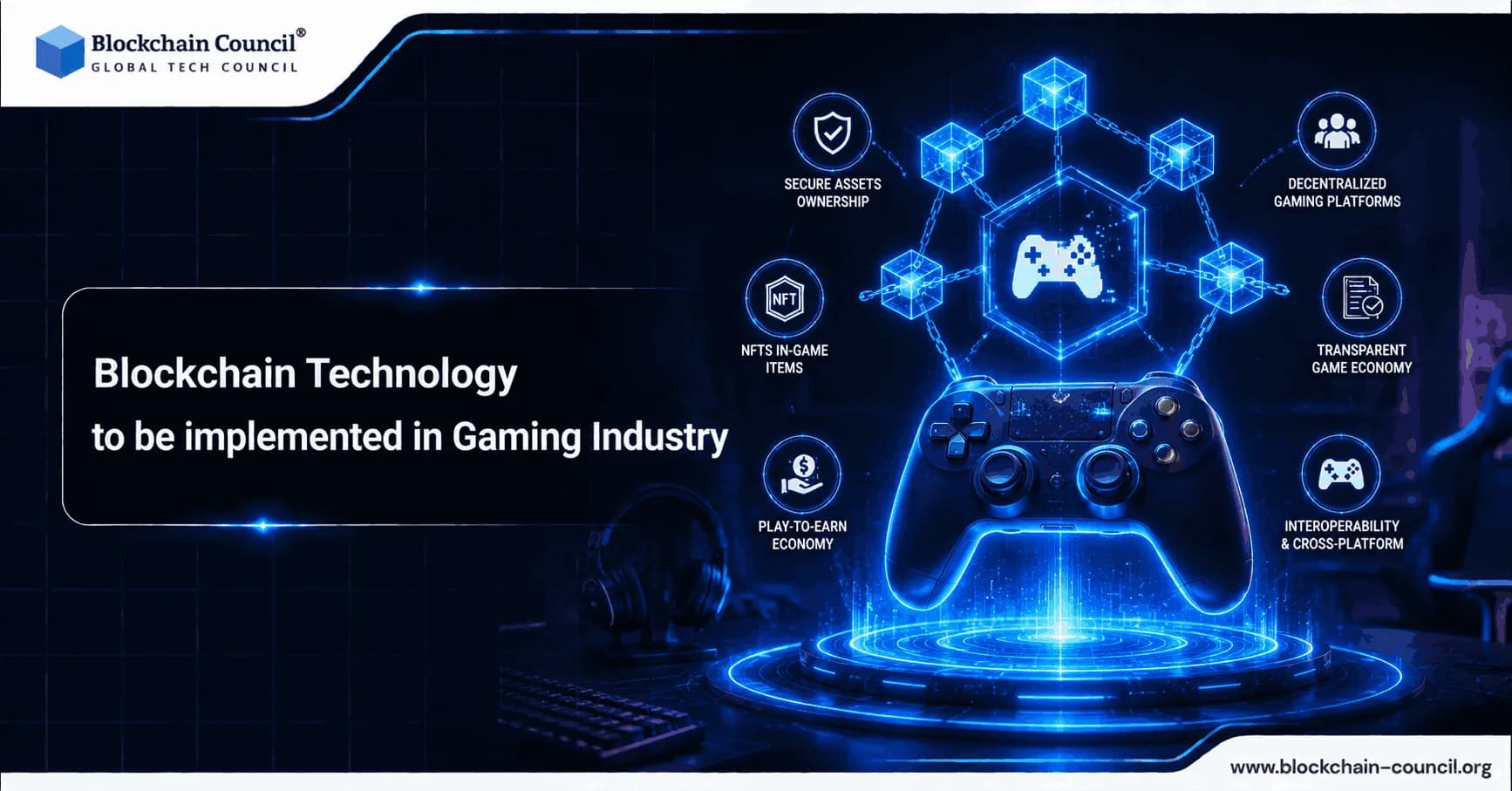
Gamers have spent decades investing real time and real money into virtual items, skins, weapons, characters, that technically belong to the game publisher, not the player, and disappear entirely the moment a server shuts down or an account gets banned. Blockchain technology is being implemented across the gaming industry specifically to change that arrangement, giving players genuine ownership over in game assets that exist independently of any single publisher's servers. As studios and developers explore what this actually looks like in practice, more people are pursuing a Certified Blockchain Expert credential to understand how blockchain is being built into games rather than simply layered on top of them as a marketing gimmick.
In this article, we will look at how blockchain is actually being implemented in gaming, the specific mechanics behind true digital ownership and play to earn models, and the genuine challenges the industry still needs to work through before this becomes standard practice rather than a niche experiment.

Why Gaming Is a Genuine Fit for Blockchain
Traditional gaming operates on a licensing model, players pay for the right to use an item within a specific game's ecosystem, but never actually own that item the way they own a physical possession. If a publisher shuts down a game's servers, changes its terms of service, or bans an account, years of accumulated in game value can simply vanish, with the player having no real recourse or asset to show for the time and money invested.
Blockchain addresses this directly by representing in game items as tokens that exist on a public ledger independent of any single game's servers, giving players verifiable, transferable ownership that persists even if a specific game shuts down. This shift touches both game design and the underlying blockchain infrastructure making true ownership possible, which is why developers building in this space are increasingly pursuing a Certified Web3 Game Developer credential, building the specific expertise needed to actually implement blockchain mechanics within a functioning, enjoyable game rather than bolting token ownership onto a product that was never designed around it.
Quick Answer
Blockchain is being implemented in gaming through verifiable ownership of in game assets as NFTs, play to earn economies where players earn tradable tokens through gameplay, interoperable items that can move between different games, and decentralized game economies governed partly by player communities rather than a single publisher. This shift gives players genuine, persistent ownership over items and progress that traditional gaming has never offered, though the industry is still working through real design and adoption challenges before these mechanics become widespread standard practice.
How Blockchain Is Actually Being Implemented in Games
1. True Digital Ownership Through NFTs
In game items, weapons, skins, land, characters, can be minted as non fungible tokens, giving players verifiable proof of ownership that exists independently of the game's own servers. This means a player's inventory genuinely belongs to them, tradable or sellable on open marketplaces, rather than being permanently locked within a single publisher's closed ecosystem.
2. Play to Earn Game Economies
Some blockchain based games have built economies where players can earn tradable tokens or NFTs through gameplay itself, effectively turning time invested in a game into assets with real world value. This model represents a genuine departure from traditional gaming, where time spent playing produces entertainment value but nothing players can actually take with them or convert into anything outside the game.
3. Interoperable Assets Across Games
A more ambitious blockchain gaming vision involves items that can move between different games entirely, letting a weapon or character earned in one title carry recognizable value or function in another game built on compatible standards. While still an emerging concept rather than widespread reality, this interoperability represents one of blockchain gaming's most genuinely novel possibilities, something traditional, siloed game architecture was never designed to support.
Actually building games capable of supporting real time blockchain transactions, secure asset ownership, and smooth gameplay simultaneously requires serious technical sophistication, balancing blockchain's verification requirements against the performance demands players expect from modern games. This is why development teams working on blockchain based titles increasingly pursue a formal Tech Certification to validate the engineering skills needed to build games where blockchain enhances rather than disrupts the actual playing experience.
4. Decentralized Game Governance
Some blockchain based games are experimenting with community governance, letting token holding players vote on aspects of a game's development, economy, or rules, shifting some decision making power away from a single publisher and toward the community actually playing and investing in the game long term.
5. Transparent, Verifiable Item Rarity and Scarcity
Blockchain allows game developers to create genuinely verifiable scarcity for rare items, since the total supply and ownership history of any given asset is recorded transparently and cannot be secretly altered by the publisher after the fact. This addresses a longstanding trust issue in traditional gaming, where players have no way to independently verify a publisher's claims about how rare a given item actually is.
6. Blockchain Based In Game Marketplaces
Rather than relying on third party, often unofficial marketplaces for trading in game items, many blockchain based games now include native marketplaces where players can buy, sell, and trade assets directly, with the blockchain itself verifying every transaction and ownership transfer transparently.
Genuine Challenges the Industry Still Needs to Solve
Blockchain gaming implementation faces real, practical obstacles. Many blockchain based games have struggled to balance genuine gameplay quality with token economics, sometimes producing games that feel more like financial products than enjoyable experiences worth playing on their own merits. Transaction speeds and fees on some blockchain networks can disrupt fast paced gameplay if not carefully engineered around. Regulatory uncertainty around play to earn economies and in game token value varies significantly by country. And mainstream gamers, accustomed to simply buying and playing without managing digital wallets, still face a genuine learning curve that blockchain games need to design around rather than ignore.
Technology Skills & Education
Schools and parents are increasingly looking for ways to introduce children to technology in a structured and meaningful way. The World Tech Olympiad provides an opportunity for students to explore AI, coding, robotics, cybersecurity, and computational thinking while building confidence and problem-solving skills.
Final Thoughts
Blockchain's implementation in gaming addresses a genuinely long standing frustration, players investing real time and money into virtual items they never actually own. Through NFT based asset ownership, play to earn economies, interoperable items, and community governance, the technology offers gamers something traditional titles structurally cannot, persistent, verifiable ownership that survives beyond any single game or publisher's decisions.
As blockchain gaming continues maturing, studios need to do more than build interesting token mechanics. They need to clearly explain these systems to players who are used to traditional gaming and may be skeptical of anything resembling a financial product layered onto their entertainment. That is why development teams and studios working in this space are increasingly pairing their technical work with a Marketing Certification to communicate these mechanics clearly and build genuine trust with players who want compelling games first and blockchain benefits second.
Blockchain in gaming is still working through real growing pains, but the direction is clear. Games are moving toward a future where what players earn and own genuinely belongs to them, not just to the publisher who built the world they played in.
FAQs
1. How is blockchain technology being implemented in the gaming industry?
Blockchain technology is being implemented in gaming through digital asset ownership, tokenized items, player-driven marketplaces, blockchain-based identity, rewards, and decentralized game economies. Developers can use blockchain to let players hold selected assets in independent wallets rather than keeping everything exclusively inside a publisher-controlled database. The strongest implementations increasingly hide blockchain complexity so players can interact with games normally without needing to understand wallets, gas fees, or network architecture.
2. What is blockchain gaming?
Blockchain gaming refers to video games that use blockchain for one or more features such as digital ownership, item trading, currencies, identity, rewards, or governance. A game does not need to place its gameplay directly on a blockchain to qualify. In many designs, the game itself runs on conventional servers while blockchain manages selected assets or transactions that benefit from independent verification.
3. Why is blockchain technology useful for gaming?
Traditional games generally give publishers complete control over in-game assets. Players may spend substantial amounts of time or money obtaining characters, skins, weapons, or collectibles without actually controlling them outside the game. Blockchain can create verifiable ownership of selected digital assets and allow players to transfer them according to the rules established by the developer and blockchain network.
4. Can blockchain give gamers real ownership of in-game assets?
Blockchain can give players direct control over tokenized game assets through compatible wallets. If a sword, character, skin, land parcel, or collectible is represented by a blockchain token, the player can potentially hold or transfer that token independently of the game's internal database. However, the usefulness of the asset still depends on the game and intellectual-property rights established by its developer.
5. How are NFTs used in blockchain games?
NFTs can represent unique or limited game items such as characters, weapons, skins, virtual land, collectibles, achievements, or memberships. Blockchain provides a verifiable record of each token's identity and ownership history. NFTs do not need to be speculative investments; they can simply function as programmable digital objects. Their success depends on whether they improve the game rather than existing mainly to create something else for players to purchase.
6. Can players sell blockchain gaming assets?
Players can potentially sell or exchange blockchain-based assets through compatible marketplaces if the game and token design permit transfers. This can create player-driven economies in which digital items retain value beyond a single transaction with the publisher. Developers must still address fraud, taxation, market manipulation, intellectual property, age restrictions, and other regulatory considerations when enabling real-money markets.
7. Can blockchain assets work across different games?
Interoperability is technically possible but considerably more complicated than transferring a token between wallets. Two games can recognize the same blockchain asset, but developers must decide what that asset means inside each game. A powerful sword in one fantasy game cannot magically become a useful object in a racing game merely because both developers have discovered ERC standards. Cross-game interoperability therefore requires technical and commercial cooperation.
8. How can blockchain improve gaming marketplaces?
Blockchain can create transparent marketplaces where players trade supported game assets directly between compatible wallets. Smart contracts can automate transactions and distribute marketplace fees or creator royalties according to predefined rules. Blockchain can also provide an auditable history of asset transfers. User-friendly marketplaces still need fraud protection, moderation, search, pricing tools, and account recovery.
9. What are blockchain-based gaming economies?
Blockchain gaming economies use tokenized assets or currencies to support economic activity between players, developers, creators, and marketplaces. Players might earn assets through gameplay, purchase items, trade collectibles, or contribute content. Sustainable economies require careful design because excessive financial incentives can encourage speculation and farming rather than enjoyable gameplay. A functioning economy cannot compensate indefinitely for a game nobody enjoys playing.
10. What happened to the play-to-earn gaming model?
Play-to-earn became highly popular during the earlier blockchain gaming boom because players could receive crypto tokens or NFTs for participating in games. Many models struggled because token rewards depended on continuous demand from new participants. The industry has increasingly shifted toward approaches emphasizing gameplay, ownership, optional trading, and sustainable game economies rather than promising players reliable income simply for playing.
11. How can blockchain help game developers make money?
Developers can generate revenue through primary asset sales, marketplaces, subscriptions, digital memberships, transaction fees, downloadable content, and other blockchain-enabled services. Smart contracts can automate revenue distribution between developers, artists, creators, and other contributors. However, successful monetization should complement the game rather than make every interaction feel like a financial transaction wearing a fantasy costume.
12. Can blockchain reduce fraud in online games?
Blockchain can make ownership records and token transfers tamper-evident, helping prevent certain forms of asset duplication or transaction manipulation. It can also provide verifiable histories for valuable game items. However, blockchain does not eliminate cheating, account theft, bots, phishing, exploits, or fraudulent marketplaces. Conventional cybersecurity and anti-cheat systems remain necessary.
13. How can blockchain improve player identity?
Blockchain-based identity can allow players to maintain portable profiles, credentials, achievements, memberships, or reputation across compatible gaming platforms. Verifiable Credentials could confirm achievements without exposing unnecessary personal information. Players might eventually carry selected aspects of their gaming identity between ecosystems while maintaining greater control over their digital history.
14. How can blockchain improve esports?
Blockchain can support esports through verifiable tournament records, digital tickets, player credentials, prize distribution, collectibles, and fan memberships. Smart contracts could automate selected prize payments after tournament results are officially confirmed. Blockchain can also provide provenance for limited esports memorabilia. Competitive integrity itself still depends on anti-cheat systems, tournament governance, and reliable result verification.
15. How can blockchain improve gaming loyalty programs?
Publishers can issue blockchain-based rewards or credentials linked to achievements, purchases, events, or long-term participation. These rewards can potentially be used across multiple games or services operated by participating companies. Tokenization can make loyalty programs more programmable and portable, although developers need to avoid creating complicated financial systems when ordinary reward points would accomplish the same job with considerably less drama.
16. How can AI and blockchain work together in gaming?
AI can generate characters, dialogue, quests, environments, personalized experiences, and intelligent non-player characters. Blockchain can provide ownership, provenance, identity, and payments around selected AI-generated assets. Players might create content with AI and register or trade approved assets through blockchain marketplaces. Cryptographic provenance may also help distinguish officially authorized game content from unofficial AI-generated material.
17. What role could blockchain play in metaverse games?
Blockchain can provide portable digital assets, identity, currencies, memberships, and ownership records for persistent virtual worlds. Players could potentially hold virtual land, avatars, collectibles, or other assets independently of a single application. Whether a true interoperable metaverse develops depends on cooperation between companies, technical standards, intellectual-property rules, and whether users actually want their virtual belongings to travel between platforms.
18. What are the biggest problems with blockchain gaming?
Major challenges include poor user experience, wallet security, transaction fees, scalability, speculative token economies, regulatory uncertainty, scams, account recovery, and resistance from players who associate blockchain with aggressive monetization. Developers need to demonstrate that blockchain provides a genuine gameplay or ownership benefit. Adding NFTs to an ordinary game without solving a player problem is not innovation; it is database architecture with a marketing department.
19. What are the major blockchain gaming trends in 2026?
Important trends include invisible wallets, account abstraction, gasless transactions, digital asset ownership, player marketplaces, interoperable identity, AI-generated content, gaming-focused blockchain infrastructure, and less emphasis on speculative play-to-earn models. Developers are increasingly attempting to make blockchain operate quietly underneath the game so that mainstream players can participate without managing private keys or purchasing cryptocurrency first.
20. What is the future of blockchain technology in the gaming industry?
The future of blockchain gaming is likely to depend on whether developers can make the technology useful without making it intrusive.
Players already spend enormous amounts of money and time acquiring digital characters, skins, weapons, achievements, and collectibles. Blockchain can provide a new ownership layer for selected assets, allowing them to have verifiable scarcity, transaction histories, and potentially greater portability.
AI could make games more dynamic by generating personalized worlds, characters, and content. Blockchain could provide provenance and ownership for selected AI-generated assets. Digital identity systems could allow achievements and reputation to move between compatible services. Smart contracts could support marketplaces and automatically distribute revenue among developers and creators.
But the game must remain the product.
Players generally do not want to open a wallet, purchase a network token, calculate transaction fees, and approve several cryptographic prompts before acquiring a virtual sword. Successful blockchain games will increasingly hide those processes behind familiar accounts, card payments, and simple interfaces.
The long-term opportunity is therefore not “every game becomes a crypto game.” It is that blockchain becomes one of the technologies developers can use when players genuinely benefit from digital ownership, open marketplaces, provenance, or portable identity.
When gamers can receive those benefits without thinking about the blockchain underneath, the technology will have moved from being the selling point to being infrastructure.
And gaming infrastructure, unlike a badly designed token economy, does not need players to care how it works. It merely needs to work.
Related Articles
View All
Blockchain
Blockchain Explained: The Technology Changing How We Trust & Transact
Blockchain explained from the ground up: what it is, why it was created, centralised vs decentralised systems, how blocks, nodes, and ledgers work, how data is stored, security, real-world examples, and how blockchain compares with traditional databases.

Blockchain
Blockchain Train Technology: Rail Use Cases, Benefits, and Limits
Blockchain train technology is moving from pilots to practical rail use cases in freight, ticketing, asset records, IoT security, and audit trails.

Blockchain
Beyond Cryptocurrency: How Blockchain Is Transforming Real-World Industries
Explore how blockchain works beyond cryptocurrency in banking, supply chains, healthcare, tokenisation, CBDCs, and government, plus key challenges and career paths.
Trending Articles

Top 5 DeFi Platforms
Explore the leading decentralized finance platforms and what makes each one unique in the evolving DeFi landscape.
How Blockchain Secures AI Data
Understand how blockchain technology is being applied to protect the integrity and security of AI training data.

Can DeFi 2.0 Bridge the Gap Between Traditional and Decentralized Finance?
The next generation of DeFi protocols aims to connect traditional banking with decentralized finance ecosystems.