

How Blockchain Can Be Used In Regulatory Reporting & How It Works?
 Toshendra Kumar Sharma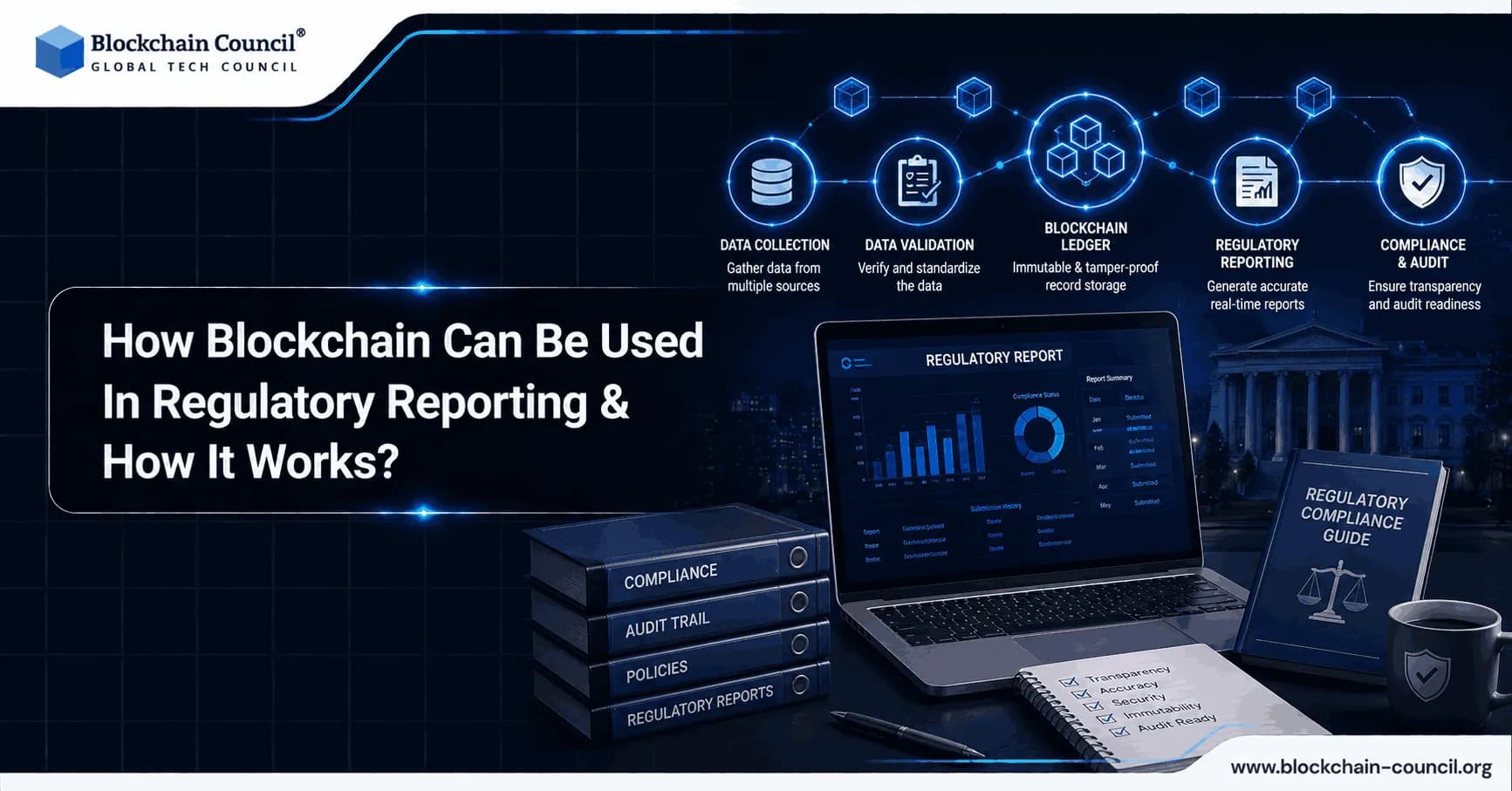
Regulatory reporting has long been one of the most resource-draining functions inside financial institutions teams pulling data from multiple systems, reconciling discrepancies, and compiling reports that are often outdated the moment they're submitted. Blockchain is changing that equation by making the underlying data more transparent, immediate, and secure from the point it's created, rather than reconstructed after the fact. As regulators and financial institutions explore blockchain-based reporting frameworks, more compliance and finance professionals are pursuing a Certified Blockchain Expert credential to understand how this shift could reshape one of the industry's most compliance-heavy functions.
In this article, we'll explain what blockchain in regulatory reporting actually means, how it works step by step, the real-world use cases already emerging, and the challenges that still need to be addressed.

What Is Blockchain in Regulatory Reporting?
Regulatory reporting covers everything financial institutions must document and submit to regulators trade reporting, clearing and settlement records, risk management data, financial accounting, and compliance evidence such as financial crime prevention efforts. Traditionally, this data is captured after transactions happen, pulled from disconnected internal systems, and compiled into reports on a periodic basis, which leaves regulators reviewing information that may already be outdated by the time they see it.
Blockchain changes this model by allowing the same data used to execute a transaction to also serve as the compliance record recorded once, on a shared ledger, and available in near real time to every authorized party. Instead of institutions preparing reports for regulators after the fact, regulators can potentially become active participants in the process itself, viewing verified data as it's created rather than waiting for a scheduled submission.
Because this shift touches directly on how financial institutions meet legal and regulatory obligations, understanding both the technology and its compliance implications has become genuinely valuable. That's why many compliance officers and legal teams are now pursuing a Certified Blockchain & Law Professional qualification, which builds the regulatory and legal context needed to apply blockchain thoughtfully within existing compliance frameworks rather than treating it as a purely technical upgrade.
Quick Answer (for readers in a hurry)
Blockchain improves regulatory reporting by creating an immutable, shared record of transactions that regulators can access in near real time, replacing after-the-fact report compilation with continuous, verifiable data. This reduces reporting errors, cuts compliance costs, and allows regulators to move from reviewing periodic reports to actively monitoring compliance as it happens.
How Blockchain Works in Regulatory Reporting (Step-by-Step)
Here's how blockchain-based regulatory reporting typically functions within a financial institution:
1. Transaction Recording at the Source
When a trade, transfer, or financial transaction occurs, its details are recorded directly onto a blockchain ledger the same record used to execute the transaction becomes the compliance record, eliminating the need to separately compile reporting data afterward.
2. Cryptographic Verification and Immutability
Transactions are grouped into blocks and cryptographically sealed before being added to the chain, making it extremely difficult to alter the data once recorded. This immutability is what makes blockchain particularly valuable from a compliance standpoint, since it becomes very difficult to fraudulently manipulate the historical record.
3. Consensus-Based Validation
Before any data is added to the ledger, network participants must agree based on shared protocols and rules that the transaction is legitimate. This consensus process means no single party can unilaterally alter or insert fraudulent records, adding a layer of trust that traditional centralized databases don't inherently offer.
Implementing this kind of infrastructure at an institutional scale requires real technical capability designing secure ledger architecture, integrating with existing trading and risk systems, and ensuring the platform can handle regulatory-grade data volumes. This is a major reason development teams building these systems pursue a formal Tech Certification to validate their blockchain engineering skills before deploying reporting infrastructure that regulators and institutions will rely on directly.
4. Proof-of-Process for Compliance
Blockchain's immutability also supports what's known as proof-of-process recording each step required by a given regulation directly onto the ledger. This creates a built-in audit trail showing not just the outcome of a transaction, but the compliance steps taken along the way, which regulators can independently verify.
5. Real-Time Regulatory Access
Rather than waiting for scheduled report submissions, regulators can be granted read-only access to a financial institution's private blockchain, allowing them to monitor activity and verify compliance in near real time. This shifts regulators from being passive recipients of reports to active participants with ongoing visibility into the process.
6. Reduced Reconciliation and Rework
Because all parties reference the same shared, verified ledger, the need for manual reconciliation between an institution's internal records and its regulatory submissions drops significantly, reducing both the cost and the error rate traditionally associated with periodic reporting cycles.
Key Benefits of Blockchain in Regulatory Reporting
Near real-time visibility: Regulators can monitor compliance as transactions happen, not weeks later.
Reduced reporting costs: Automating data capture cuts down on the manual effort spent compiling reports.
Stronger audit trails: Immutable, cryptographically verified records simplify regulatory investigations.
Fewer errors: A single shared source of data eliminates discrepancies between internal and reported figures.
Improved trust: Consensus-based validation reduces the risk of fraudulent or manipulated reporting data.
Real-World Use Cases
Blockchain-based reporting concepts are already being tested across several areas, including trade reporting, clearing and settlement, recordkeeping, market surveillance, risk management, and financial crime prevention. One notable example comes from outside pure financial services: Sweden's national land survey (Lantmäteriet) has piloted a blockchain-based system for registering and recording land titles, aiming to digitize property ownership records and reduce the time and paperwork traditionally required for real estate transactions a model that illustrates how the same immutability benefiting financial regulators can apply to broader forms of regulated recordkeeping.
Challenges to Consider
Despite its potential, blockchain adoption in regulatory reporting faces real hurdles: integrating shared ledgers with legacy institutional systems, establishing common standards that regulators and institutions across jurisdictions can agree on, addressing data privacy concerns when regulators are granted deep visibility into institutional activity, and managing the governance question of who controls and maintains a shared regulatory blockchain. These are significant coordination challenges that require buy-in from both regulators and the institutions they oversee.
Building Technology Skills From an Early Age
Developing technology awareness early can help students build a foundation for future careers in artificial intelligence and other emerging fields. Designed to encourage technology learning among school students, the World Tech Olympiad (WTO) brings together participants from Class 2 to Class 12 through different technology-focused challenges. Its areas include robotics, AI, programming, computational thinking, and cybersecurity, with competition levels structured to suit different age groups and abilities.
The Olympiad supports participation through separate routes for families and educational institutions. Parents can enroll their children directly, while schools can register as institutions and facilitate participation for students who meet the eligibility requirements. Early exposure to these areas can help students develop problem-solving, computational thinking, and technology skills that may support more advanced learning and career development in AI and related fields.
Final Thoughts
Blockchain is steadily reshaping regulatory reporting from a periodic, after-the-fact exercise into a continuous, near real-time process built on shared, immutable data. By recording compliance-relevant information at the source and giving regulators direct, verified visibility, financial institutions stand to reduce cost, error, and delay while improving the overall quality and trustworthiness of the reporting process.
As these systems move from pilots to production, institutions will need more than strong technology and legal grounding they'll need to clearly communicate these changes to regulators, boards, and clients alike. That's why teams working on blockchain reporting initiatives are increasingly pairing their technical and compliance expertise with a Marketing Certification to explain these infrastructure shifts clearly and build confidence among stakeholders who aren't deeply technical themselves.
Blockchain in regulatory reporting is still an emerging shift, but the direction is clear: less rework, more transparency, and a compliance process that regulators can participate in rather than simply receive.
FAQs
1. What is blockchain in regulatory reporting?
Blockchain in regulatory reporting refers to the use of distributed ledger technology (DLT) to securely record, verify, and share financial and operational data with regulators. It creates transparent, tamper-resistant records that can improve reporting accuracy, reduce manual reconciliation, and simplify compliance processes.
2. Why is blockchain important for regulatory reporting?
Traditional regulatory reporting often relies on multiple disconnected systems, manual data collection, and repetitive reconciliation. Blockchain provides a shared source of verified information, helping organizations improve data quality, transparency, and reporting efficiency.
3. How does blockchain work in regulatory reporting?
Blockchain records transactions and compliance-related events on a distributed ledger. Authorized participants, including regulated entities and regulators where appropriate, can access verified records while smart contracts automate reporting workflows, validation, and notification processes based on predefined rules.
4. Which industries can use blockchain for regulatory reporting?
Industries including banking, insurance, healthcare, capital markets, pharmaceuticals, energy, telecommunications, logistics, manufacturing, government agencies, and cryptocurrency service providers can benefit from blockchain-enabled reporting solutions.
5. How does blockchain improve data accuracy?
Blockchain creates immutable records that are difficult to alter after validation. Every approved transaction includes timestamps, digital signatures, and cryptographic verification, reducing inconsistencies and making unauthorized modifications easier to detect.
6. Can blockchain automate compliance reporting?
Yes. Smart contracts can automatically collect qualifying transaction data, validate reporting conditions, generate compliance records, and trigger required reporting actions when predefined regulatory rules are satisfied.
7. What are smart contracts in regulatory reporting?
Smart contracts are self-executing blockchain programs that automate compliance tasks such as data validation, report generation, audit logging, deadline monitoring, and workflow approvals according to predefined business and regulatory rules.
8. How does blockchain improve audit trails?
Blockchain records every approved transaction with timestamps, digital signatures, and a complete history of modifications where applicable. These immutable audit trails simplify internal audits, regulatory reviews, and forensic investigations.
9. Can blockchain reduce reporting errors?
Yes. By minimizing manual data entry, reducing duplicate records, and synchronizing information across participants, blockchain can lower the likelihood of reporting errors. However, it cannot prevent inaccurate data from being entered initially without proper validation controls.
10. How does blockchain improve transparency?
Authorized stakeholders can access consistent and synchronized records, reducing discrepancies between institutions and regulators. This shared visibility improves trust while supporting efficient compliance monitoring and reporting.
11. How does blockchain support Know Your Customer (KYC) and Anti-Money Laundering (AML)?
Blockchain can securely store verification records, customer identity references, and compliance logs while enabling authorized institutions to verify information more efficiently. Sensitive personal information is generally stored off-chain, with blockchain maintaining cryptographic proofs or references.
12. Which blockchain platforms are suitable for regulatory reporting?
Enterprise blockchain platforms commonly used include Hyperledger Fabric, Corda, Quorum, Ethereum-based enterprise solutions, Canton Network, Hedera, and other permissioned blockchain frameworks designed for regulated industries.
13. What are the advantages of blockchain for regulatory reporting?
Benefits include improved data integrity, real-time reporting capabilities, automated compliance workflows, enhanced transparency, secure audit trails, lower operational costs, reduced reconciliation efforts, faster reporting cycles, and improved collaboration between regulated organizations and oversight bodies.
14. What challenges exist when implementing blockchain?
Challenges include integration with legacy systems, regulatory differences across jurisdictions, privacy requirements, interoperability between platforms, cybersecurity, implementation costs, governance, scalability, and organizational change management.
15. Can blockchain replace regulators?
No. Blockchain is a technology that supports compliance and reporting processes but does not replace regulators or legal oversight. Regulatory agencies continue to establish rules, conduct supervision, enforce compliance, and interpret applicable laws.
16. What common mistakes should organizations avoid?
Common mistakes include storing confidential information directly on public blockchains, assuming blockchain guarantees data quality without validation, neglecting cybersecurity, failing to audit smart contracts, overlooking interoperability, and implementing blockchain without clearly defined compliance objectives.
17. What are best practices for implementing blockchain in regulatory reporting?
Best practices include using permissioned blockchain networks, encrypting sensitive information, storing confidential documents off-chain, conducting regular smart contract audits, implementing strong identity and access management, integrating with existing compliance systems, ensuring regulatory alignment, and starting with pilot projects before full-scale deployment.
18. How does blockchain fit into RegTech (Regulatory Technology)?
Blockchain is an important component of RegTech because it complements artificial intelligence (AI), cloud computing, robotic process automation (RPA), digital identity, advanced analytics, and API-based reporting systems to modernize compliance operations and regulatory oversight.
19. What trends are shaping blockchain regulatory reporting in 2025-2026?
Major trends include AI-assisted compliance monitoring, real-time regulatory reporting, tokenization of real-world assets (RWAs), decentralized identity (DID), zero-knowledge proofs (ZKPs) for privacy-preserving compliance, Central Bank Digital Currency (CBDC) initiatives, interoperable compliance platforms, automated ESG reporting, and expanding global digital asset regulations.
20. What is the future of blockchain in regulatory reporting?
Blockchain is expected to become an increasingly valuable technology for regulatory reporting by improving transparency, automation, auditability, and operational efficiency. Rather than replacing existing compliance systems, blockchain will likely integrate with enterprise software, AI-driven analytics, and regulatory platforms to create more reliable and timely reporting processes. As reporting obligations continue to grow across industries, organizations that can produce accurate, verifiable information quickly will be better positioned to meet evolving regulatory expectations. After all, regulators tend to appreciate accurate records far more than creative explanations for why those records cannot be found.
Related Articles
View All
Blockchain
Blockchain Fundamentals Explained: A Beginner's Guide to How Blockchain Works
Learn blockchain fundamentals from first principles: blocks, hashes, consensus, smart contracts, use cases, and the best learning path for beginners.

Blockchain
Blockchain Certification Programs You Can Join Online
Discover the best blockchain certification programs you can join online. Learn blockchain fundamentals, smart contracts, enterprise blockchain, and career opportunities with globally recognized certifications.

Blockchain
Agile for Blockchain Teams: Managing Sprints, Smart Contracts, and Decentralized Roadmaps
Learn how agile for blockchain teams works when sprints, smart contracts, audits, governance, and decentralized roadmaps are planned around risk.
Trending Articles
AWS Career Roadmap
A step-by-step guide to building a successful career in Amazon Web Services cloud computing.
How Blockchain Secures AI Data
Understand how blockchain technology is being applied to protect the integrity and security of AI training data.
Claude AI Tools for Productivity
Discover Claude AI tools for productivity to streamline tasks, manage workflows, and improve efficiency.