

NFT Marketplace
 Council
What is an NFT Marketplace?
An NFT marketplace is an online platform where users can discover, buy, sell, and trade Non-Fungible Tokens. These tokens represent ownership of unique digital assets, such as digital art, music, virtual real estate, collectibles, and more. Unlike cryptocurrencies like Bitcoin or Ethereum, which are fungible and can be exchanged on a one-to-one basis, NFTs are one-of-a-kind and cannot be replicated.
NFT marketplaces act as intermediaries that facilitate the interaction between creators and collectors in the NFT space. They provide the following essential functions:

Discoverability: NFT marketplaces serve as curated galleries, making it easy for users to explore a wide range of NFTs. This includes digital artworks, music albums, virtual real estate, and even virtual goods within video games.
Buying and Selling: Users can list their NFTs for sale and make purchases within these marketplaces. Transactions typically involve cryptocurrencies like Ethereum.
Ownership Transfer: NFT marketplaces ensure the secure transfer of ownership from the seller to the buyer. This is done by leveraging Blockchain technology and smart contracts, which record and automate these transactions.
Rarity and Provenance: NFT marketplaces often display information about the rarity and provenance of NFTs, allowing collectors to make informed decisions.
Also Read: How to Mint An NFT?
Centralized vs Decentralized NFT Marketplaces
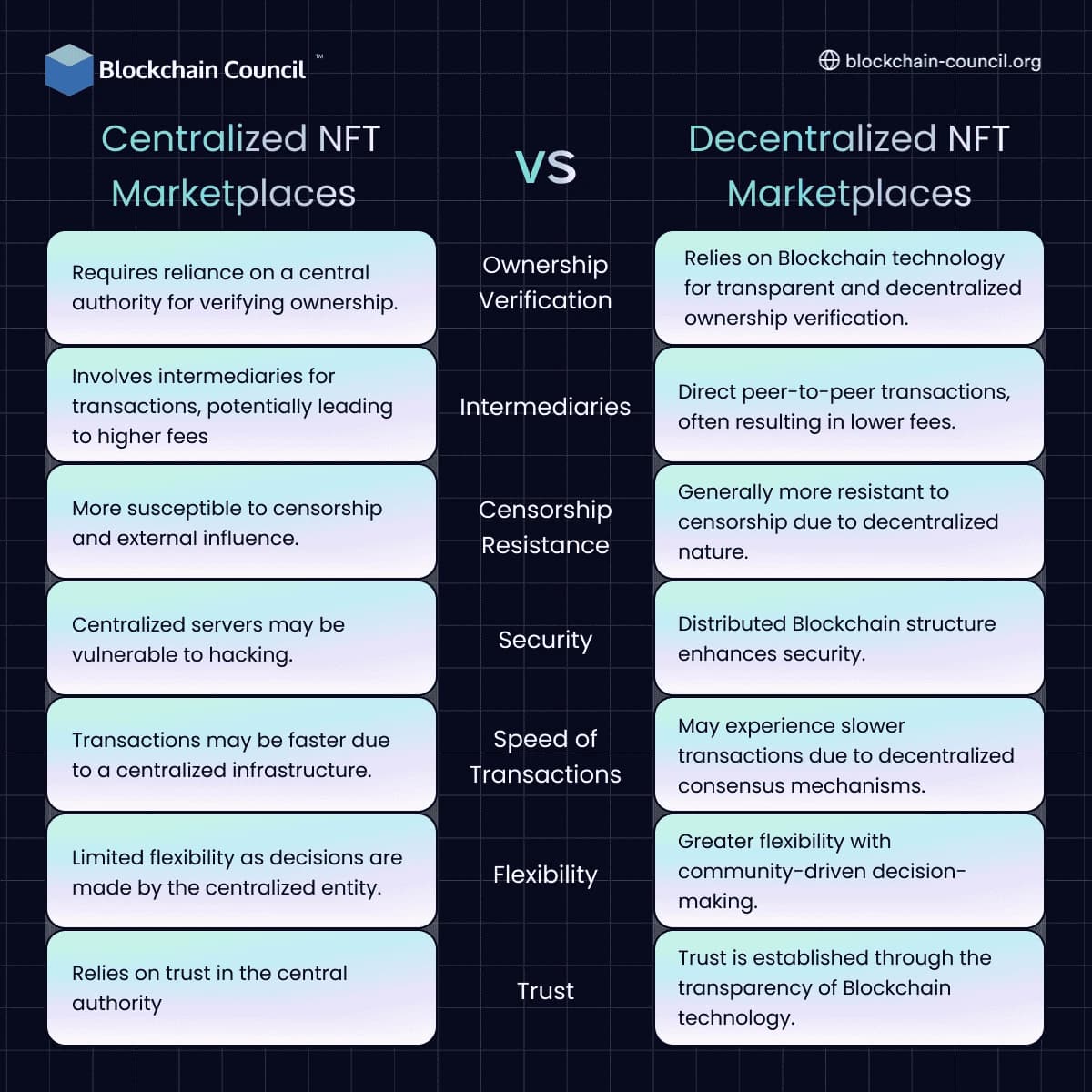
NFT marketplaces can be categorized into two main types: centralized and decentralized. Each type has its own set of characteristics and advantages.
Centralized NFT Marketplaces:
Centralized NFT marketplaces are owned and operated by centralized entities or companies. These platforms provide a more traditional and user-friendly experience, similar to online marketplaces like eBay or Amazon. Key features include:
- User-Friendly Interface: Centralized NFT marketplaces often have intuitive interfaces that make it easy for newcomers to navigate and participate in the NFT ecosystem.
- Curation and Governance: These platforms usually have a level of curation and oversight to maintain quality and authenticity. Governance decisions are made by the platform’s owners or administrators.
- Support and Customer Service: Centralized marketplaces typically offer customer support services, making it easier for users to address issues or inquiries.
- Speed and Scalability: Transactions on centralized marketplaces tend to be faster and more scalable, as they do not rely solely on Blockchain consensus.
Decentralized NFT Marketplaces:
Decentralized NFT marketplaces operate on Blockchain networks and are governed by smart contracts and decentralized autonomous organizations (DAOs). They offer a more decentralized and censorship-resistant approach to NFT trading. Key features include:
- Trustless Transactions: Decentralized marketplaces enable trustless peer-to-peer transactions without the need for intermediaries. Smart contracts facilitate the exchange of NFTs.
- Ownership and Control: Users have complete control over their assets, as they are stored in personal wallets. This eliminates the risk of platform shutdowns or account freezes.
- Openness and Transparency: Decentralized marketplaces are typically open-source and transparent, allowing anyone to review and audit the code.
- Security: Transactions on decentralized marketplaces are secured by the underlying Blockchain, reducing the risk of fraud or hacking.
- Reduced Fees: Decentralized marketplaces often have lower fees compared to centralized counterparts, as they eliminate the need for middlemen.
Conceptualizing NFT marketplace
It is a platform that makes it simple to store and sell NFTs. These tokens are generally available for purchase or auction at a set price. To use an NFT marketplace, you will need a crypto wallet to store and trade your best NFT tokens.
Users have to create an account, upload digital artwork, and sell their work on the marketplace. In general, specialized marketplaces are more popular than conventional ones because they include everything a client would require-specialized marketplaces’ expertise in promoting online artworks and concentrating on specific target audiences.
NFT Marketplace Functionality
Before we understand how to build an NFT marketplace, it is essential to know how an NFT marketplace functions from a client’s perspective. In fact, all NFT platforms follow the same procedure. For instance, NFTically is a Non-Fungible Tokens exchange platform. You may open your store on NFTically in a matter of minutes. NFTically provides options for minting, selling, and buying.
Users must first log in by creating an account on the platform. After creating their account, they can download a digital wallet to store their NFTs.
The users can list their assets by uploading goods to exhibit their effort. Users can also specify which payment tokens they want to receive and set fees if the platform allows it.
The next step is to put the products for sale on the market. Users have the option of bidding on a fixed price or an auction. When a user sells an item, a transaction is produced in the user’s wallet to start a private transaction smart contract.
The platform will need to conciliate the data before adding the NFT to the list.
The NFT marketplace deploys smart contracts, a type of transaction protocol. These protocols control the connections between the supplier and the buyer.
Furthermore, these smart contracts include NFT-specific identifying data. As a result, buying and selling tokens becomes more accessible and convenient.
Types of NFT Marketplaces
General Marketplaces: General marketplaces are the most common type of NFT platforms. They act as extensive hubs offering a diverse range of NFTs, spanning from digital art to virtual real estate. Notable examples include OpenSea and Rarible. These platforms are witnessing a surge in popularity in regions like Asia-Pacific and Europe. This growth often aligns with the flourishing regional digital art movements and vibrant gaming communities.
Art-Centric Marketplaces: Art-centric marketplaces focus specifically on digital art NFTs, catering to artists and art collectors. Platforms like SuperRare and Foundation exemplify this category. These marketplaces wield a substantial influence on the global digital art scene, often setting trends in digital art styles and fostering collaborations among artists.
Gaming and Virtual World Marketplaces: These marketplaces center around NFTs related to gaming, including in-game items, characters, and virtual land. Axie Marketplace (Axie Infinity) and Decentraland are prominent examples. Particularly popular in regions with robust gaming cultures like South Korea and Japan, these platforms are pioneers in integrating NFTs with interactive entertainment.
Music and Entertainment NFT Marketplaces: Dedicated to music and entertainment-related NFTs, these platforms offer exclusive content from artists and virtual event tickets. Catalog and Sound.xyz are key players, gaining traction globally, especially in the U.S. and Europe. Artists are turning to these platforms for new revenue streams and innovative methods of engaging with their fan base.
Sports and Collectibles Marketplaces: Focusing on sports memorabilia and collectibles as NFTs, platforms like NBA Top Shot and Sorare have gained widespread popularity. These marketplaces attract global attention, with particular interest in regions where the respective sports have a strong fan base, such as basketball in the U.S. and soccer in Europe and Latin America.
Utility and Service-Based Marketplaces: These marketplaces offer NFTs with real-world utilities or services, like access to events or memberships. Examples include VeeFriends and Unlock Protocol. Such marketplaces are rising in popularity globally as businesses explore NFTs for customer engagement and loyalty programs.
Exclusive and Curated Marketplaces: Exclusive and curated platforms like Nifty Gateway and KnownOrigin focus on offering high-end, exclusive NFTs with an emphasis on quality over quantity. These platforms set high standards for NFT quality and have a global impact, attracting elite artists and collectors.
Decentralized and Community-Governed Marketplaces: Operated on decentralized networks, these marketplaces often feature community governance models, allowing users to influence the platform’s development. Examples include Zora and Async Art. This model represents a shift towards a more democratized and user-centric approach in the NFT space, resonating with global audiences valuing transparency and community involvement.
Applications for NFT Marketplaces
Apart from dealing with artworks, there are several other fields where using NFT marketplaces can benefit.
Digital Art
Several NFTs are utilizing various forms of digital art to build profit. There’s something for everyone, from digital replicas of authentic images to memes.
For example, on the NFTically platform, you may buy, sell, and send photographs, movies, GIFs, and music. The platform is built on Ethereum and uses the ERC721 and ERC1155 protocols to create NFTs.
Swapping
From swapping virtual worlds (Metaverses), virtual properties (Mintable), collectibles (NBA Top Shot), animated characters (CryptoKitties), investment opportunities, and any other sector whose ownership can be turned into tokens, everywhere is the NFT marketplace.
E-learning services
These marketplaces should provide a wide spectrum of e-learning services. This includes selling complete courses, keeping track of student’s progress, and communicating with professors.
Video games
NFTs, which represent numerous in-game products and characters, are typically sold and purchased in-game or through external internet platforms like Steam, which provide secure transactions. This necessitates a close relationship with the game.
Security
Required tokens can be used as keys for a variety of information, programs, databases, operating systems, and events. To market NFTs, the platform must prioritize security and include Touch ID, Face ID, and Eye ID features.
Real Estate
Origin Story creates marketplaces across industries, including everything from web3 collections to marketplaces for real-life real estate. In partnership with leading real estate investment firm Roofstock, Origin created an NFT marketplace for homebuyers and sellers to cut out redundancies in traditional real estate markets.
Projects for Investment
These NFT trading platforms should act as stock exchanges for asset trading. Along with shares, dividends, and property rights, they must be able to issue legally enforceable assets.
Significant Features to Look for in a Marketplace App for NFT
While looking out for an NFT marketplace app, check out for these significant features:
Shopfront
A shopfront or storefront that functions as a dashboard is expected in a thriving NFT marketplace. It provides the users with ample information they need about an asset like owner, title, price description, archives, payment gateways, and more.
Search with Advanced Options
Consumers should be able to obtain complete information about things they require promptly and without exerting any effort. Therefore, organize every product with some features in your NFT marketplace app (for example, art, images, music, videos, and memes). Client satisfaction rises when searches are completed more quickly.
The use of filters
Filters are really beneficial. Furthermore, it becomes simpler to navigate a website. Add this functionality if you wish to establish a collectibles NFT marketplace platform. Users can choose assets based on their type, payment method, due date, and listing status.
Trading
Customers must be able to buy and sell NFTs recorded on the platform on a marketplace. Therefore, their proposals should also include a bid validity date and information about the status of such proposals.
User Account
Users must register an account in order to sell and buy NFTs on the site. Typically, people register using their email address, phone number, or social network account. Users are obligated to reveal their cryptocurrency accounts in general.
Sign up for Metamask, MyEtherWallet, Coinbase Wallet, or any other cryptocurrency wallet if you haven’t already.
Promotions
This procedure should be straightforward and quick. It should ideally be identical to what you’d find on eBay. Create something like a collection manager for the most remarkable outcomes. It aids in the specification of goods downloads, titles, prices, descriptions, tags, external links, and other characteristics.
NFT Wallet
Users will require a wallet to transfer, receive, and store NFT tokens and cryptocurrencies. Integrating with a popular cryptocurrency wallet is the simplest solution. The wallet, above all, supports the NFT protocol. Metamask, MyEtherWallet, Coinbase, and WalletConnect are just a few of the wallets that come to mind while discussing them.
Ratings and reviews
Indicates whether or not the user thinks highly of the lot/seller. This information will help you figure out how much a package is worth. The scale runs from 1 to 10 in general. Subscribed users can leave reviews, which are similar to comments. After the transaction accomplishes, both parties may leave a cancellation.
Promptness
A push notification system will notify users of new bids, status changes, new posts, lots for sale, or NFT platform upgrades in their favorite category or store.
Support
It is an essential feature of every trading platform. Support services assist users in locating information and resolving difficulties and conflicts. For example, some support services might include a call center or email assistance, an information platform, or even a chatbot.
Building an NFT Marketplace
Consider taking the following steps if you wish to start an NFT marketplace for your company.
Pick a Domain
Before starting your NFT marketplace development project, you first need to be specific about the domain. It will be a good idea to discuss with your developers if you have a particular concept in your mind. A healthy discussion will help strategize and estimate the timeframe required to develop the marketplace. Then, depending on the expert advice, choose between vertical and horizontal markets.
Establish a UI/UX design for your project
When developing a marketplace, UI/UX design is crucial. The user interface (UI) of your application must be simple. A good UI/UX enhances usability, which gives the platform an excellent feel and look. For example, NFTically offers its users an easy-to-use and flexible UI.
Switch to Front-End development
It’s the right opportunity to execute your ideas. Pick a reliable framework and hire a professional NFT developer or an NFT Development Services provider for better credibility and functionality to meet your requirements.
Token Generator for Smart Contracts
Back-end development for an NFT marketplace is not the same as it is for a traditional marketplace. Most of the data require authentication and validation on Blockchain because of the decentralized attribute of the NFT marketplace.
Testing
One of the essential steps for creating an NFT marketplace app is testing. This step helps to detect and resolve issues concerning bugs and other backlogs. In addition, testing ensures the smooth and efficient working of the software.
After initial testing, post-launch assistance is necessary to assure quality performance and resolve on-the-spot issues. Precisely, testing ensures efficient app functionality and integrity.
How Does an NFT Marlletplaces Make Money
NFT marketplaces can generate revenue through fees on sales of NFTs, listing fees for NFT creators, and the sale of advertising or sponsorships. Some marketplaces may also offer premium services or membership packages that provide access to additional features or benefits for a fee. In addition, NFT marketplaces may earn revenue by acting as a facilitator for NFT-based crowdfunding campaigns or by taking a percentage of the proceeds from such campaigns.
Getting Started with NFTically
NFTically is a business-to-business (B2B) software-as-a-service (SaaS) company that enables artists, creators, brands, and businesses in creating and launching their own white-label NFT markets and stores.
NFTically has made the process of creating and controlling your own NFT marketplace quite simple. All you have to do is follow a few simple steps, and you’ll be ready to deposit your freshly minted NFTs in a matter of minutes.
Step 1:
Visit www.nftically.com and select ‘Create Store’ from the first option on the right-hand side.
Step 2:
A pop-up box will appear once you pick the ‘Create Store’ option, prompting you to choose your chosen wallet. (You will get two options to choose from- Ethereum - based wallets with WalletConnect and Metamask wallets. Choose according to your preference).
For instance, you want to get started with the Metamask wallet. In that case, simply link your Metamask wallet to NFTically. You can begin by creating a Metamask account, after which you can easily link it to NFTically.
Step 3:
After selecting your wallet account to be linked, simply click on the ‘Next’ option.
Step 4:
To use WalletConnect, simply scan the QR code from your wallet’s mobile app and then click on ‘Sign’ when required. NFTically will be linked to your wallet automatically.
Step 5:
You’ll be taken to your dashboard after linking your crypto wallet to NFTically, where you’ll need to set up the store.
Step 6:
In the blank space, type the name of your store, and then click the ‘Create Store’ option. After you’ve given your store a name, go to the bottom right corner and click the ‘Create Store’ button to get started.
Step 7:
Then you’ll be taken to the settings page for your store, where you may make any changes you want. Now you are ready to access your store, just dab on the highlighted link.
So, Why Should You Create Your Own NFT Marketplace?
Customization and Brand Identity: Creating your own NFT marketplace allows for complete customization to align with your brand identity. This can include unique features, a distinctive user interface, and specialized services that differentiate your marketplace from existing ones.
Targeted Audience Engagement: A dedicated marketplace can cater specifically to a targeted audience, creating a community around shared interests or specific types of NFTs. This leads to higher engagement and loyalty from users who feel their interests are directly addressed.
Revenue Generation: Owning an NFT marketplace provides a direct revenue stream. This can come from transaction fees, listing fees, or premium services offered to users. The control over the revenue model allows for flexibility and adaptation to market trends.
Control over User Experience: Having your own platform gives you full control over the user experience. This includes ensuring ease of use, implementing robust security measures, and providing effective customer support, all of which contribute to user trust and satisfaction.
Data Insights and Analytics: Operating your marketplace provides valuable data on user behavior, market trends, and preferences. These insights can be leveraged to improve the platform, develop marketing strategies, and identify emerging trends.
Innovation and Flexibility: As the owner of the marketplace, you have the freedom to innovate, experiment with new features, and quickly adapt to changes in the NFT space, keeping your platform at the forefront of the industry.
Estimated expenditure for building an NFT marketplace
The operational cost and time consumption rely upon the presentation of the marketplace. If you want to build a more sophisticated platform, you will need to invest some extra bucks.
However, if you choose to deploy market-available solutions, then there is no guarantee for system reliability, and you will be dependent on the key provided by the platform. Nonetheless, the expense will be lower in this situation.
Apart from this, you might enlist a software development firm to make a custom application for you. Above all, the experts will make a client stream, construct the usefulness, add highlights, and plan the marketplace from scratch. Thus, the cost might build somewhat more.
Most Popular NFT Marketplaces and Their Unique Features
NFTically:
NFTically stands out as the ultimate full-stack NFT marketplace within the metaverse, offering a comprehensive solution for users to effortlessly launch their own NFT collections. Particularly appealing to those lacking deep technical expertise, NFTically is a game-changer in the NFT space. A standout feature is its white label NFT marketplace, providing a ready-to-deploy platform supporting the buying, selling, and bidding of NFTs across diverse forms such as digital collectibles, art, music, and films. Operating on popular Blockchain networks like Ethereum, Binance Smart Chain, Solana, Polygon, and more, NFTically ensures widespread accessibility.
Its key features include white label NFT minting, simplifying digital collectible creation through Blockchain-based smart contracts, and white label NFT staking, allowing users to earn cryptocurrency revenue by staking their NFTs on DeFi systems. Lazy minting reduces barriers for creators by enabling NFT production without upfront costs. NFTically also ensures long-lasting availability and accessibility of NFT data through IPFS-NFT storage and boasts multichain compatibility, allowing users to seamlessly interact across various Blockchain networks, enhancing the platform’s flexibility and reach.
NFT Launchpad:
NFT Launchpad is a recently established marketplace that stands out by supporting multiple Blockchains, such as Binance Smart Chain and Polygon. This flexibility enables creators to reach a broader audience. Artists have the option to set royalties, and the platform facilitates NFT sales through auctions or fixed prices. The marketplace covers a diverse range of NFT types, spanning art, music, video, gaming, and more.
Crypto.com:
Crypto.com not only serves as a cryptocurrency exchange but also boasts an integrated NFT marketplace. Renowned for its collaborations with celebrities and artists, the platform allows users to effortlessly create, showcase, sell, and purchase NFTs. A distinctive feature is its zero NFT transaction fees, making it an attractive choice for both creators and buyers.
Bybit Marketplace:
Bybit Marketplace stands out by offering premium NFT collections, particularly focusing on GameFi and metaverse NFTs. Users can mint NFTs using the Ethereum Blockchain, and the platform ensures a straightforward checkout process. This marketplace caters to those seeking high-quality NFTs within the realms of gaming and virtual environments.
Binance:
Known for its low transaction fees, Binance’s NFT marketplace is built on the Binance Smart Chain. It features an array of digital artworks and collectibles. Binance supports various payment methods, including credit and debit cards, making it accessible to a wide range of users. The platform emphasizes affordability for both creators and collectors.
OpenSea:
OpenSea holds the title of the most popular NFT marketplace, offering a vast array of digital assets. Its unique feature, “lazy minting,” streamlines the NFT creation process. Despite a competitive 2.5% brokerage fee, OpenSea’s popularity stems from its extensive selection and user-friendly interface. Artists and collectors alike are drawn to the platform’s diverse and dynamic NFT ecosystem.
Axie Marketplace:
Axie Marketplace specializes in the trading of Axies from the Axie Infinity game. Beyond being a marketplace, it hosts a thriving ecosystem of third-party games and apps. With a relatively low trade fee of 4.25%, Axie Marketplace has become a hub for enthusiasts of Blockchain-based gaming and virtual assets.
NBA Top Shot:
NBA Top Shot is a unique sports-focused marketplace developed in collaboration with the NBA and WNBA. Utilizing the Flow Blockchain, it stands out by offering accessibility to users without a background in cryptocurrency. The platform’s focus on sports-related NFTs and the partnership with major sports leagues make it a distinctive player in the NFT space.
Larva Labs/CryptoPunks:
Larva Labs/CryptoPunks gained notoriety for the viral CryptoPunks project. Offering 10,000 unique CryptoPunk characters and supporting Ethereum-based transactions, it holds a special place in the NFT world. The scarcity and uniqueness of CryptoPunks make them sought-after collectibles among Blockchain enthusiasts.
Rarible:
Rarible positions itself as a decentralized platform for collectors, presenting itself as a notable competitor to OpenSea. Its user-friendly interface and support for a wide range of collectibles contribute to its popularity among creators and collectors alike.
Mintable:
Mintable, an open marketplace similar to OpenSea, aims to be user-friendly while supporting creators in minting NFTs. However, it distinguishes itself with a higher transaction charge compared to other platforms. Its focus on user experience and creator support sets it apart in the competitive NFT marketplace landscape.
Foundation:
Foundation provides a platform for digital art with a straightforward interface, focusing on auctions. Notable for its royalty system, which offers 10% to original creators on the resale of NFTs, it appeals to artists looking for a fair compensation model for their work.
Nifty Gateway:
Nifty Gateway stands out by hosting exclusive artists and enabling the purchase of NFTs with fiat currency. Known for its art and music-related NFTs, as well as limited availability “drops,” it caters to a broader audience by simplifying the buying process with traditional currency transactions.
SuperRare:
SuperRare distinguishes itself by focusing on unique digital collectibles and offering high royalties for artists. Operating exclusively on Ethereum, it may limit payment methods but ensures a high demand for collectibles due to its emphasis on uniqueness and rarity.
Async Art:
Async Art specializes in dynamic and programmable digital art. Artists can create artworks with layers or “Tokens” that can be owned and customized by collectors. This unique approach offers a different dimension to the NFT experience, allowing for dynamic and interactive digital art ownership.
NFT Marketplaces: Legal and Ethical Consideration to Keep in Mind
Intellectual Property Rights: In the NFT realm, understanding intellectual property (IP) rights is key. There’s a misconception that purchasing an NFT automatically grants all associated IP rights. However, rights like copyright and trademark must be explicitly transferred and aren’t inherently part of the NFT sale. For example, the original copyright holder maintains exclusive rights unless a specific license is granted. This complexity is evident in cases like Quentin Tarantino’s dispute over his “Pulp Fiction” screenplay NFT, highlighting the nuanced nature of digital IP rights.
Legal Compliance and Regulatory Considerations: NFT regulations are evolving, and the U.S. is taking steps to address potential risks and benefits. Initiatives like President Biden’s Executive Order on Digital Assets aim to position the U.S. as a leader in NFT innovation. The classification of NFTs as securities or commodities influences the application of financial regulations, including anti-money laundering (AML) and know-your-customer (KYC) requirements. Transparency and reporting obligations may also be imposed to prevent fraud and money laundering.
Ethical Considerations in NFT Trading and Creation: Ethical concerns in the NFT space focus on consumer protection, the environmental impact of Blockchain technology, and the potential for market manipulation. Issues like counterfeit NFTs and scams, such as rug pulls and wash trading, have misled consumers and damaged market integrity. Additionally, the substantial energy consumption of Blockchain technology raises environmental concerns that creators of NFT marketplaces need to address.
Is the NFT Market Growing?
The demand for NFTs has witnessed substantial growth, evident in the market’s robust volume. In 2022, the NFT market recorded an impressive $24.7 billion in trading volume, although it fell short of the $67.8 billion generated by traditional art sales during the same period. Notably, the Bored Ape Yacht Club NFT project contributed significantly, achieving nearly $1.6 billion in trading volume. Marketplace dynamics have evolved, with OpenSea’s dominance facing a challenge from Blur, especially in daily transactions on the Ethereum blockchain. Blur’s rise is attributed in part to its zero-transaction fee policy, leading to a substantial increase in its trading volume.
Ownership trends reveal a doubling of NFT ownership in the United States, with 4% of the population holding NFTs, while Southeast Asia boasts higher prevalence, with 32% in the Philippines, 26.6% in Thailand, and 23.9% in Malaysia owning NFTs. Despite some NFTs fetching millions, the average selling price is around $150 per NFT, with minting costs ranging from $70 to $150, posing challenges for artists to turn a profit. However, the music NFT market has experienced significant growth, reaching $1.350 billion in 2021 and projected to reach $6.002 billion by 2028, emphasizing the rising popularity and investment potential of music NFTs. The buyer to seller ratio at the end of Q3 2022 stood at approximately 1.3 buyers for every seller, with around 150,000 buyers and 110,000 sellers in the NFT market, further illustrating the sustained demand in this evolving landscape.
Conclusion
The growth of the NFT market is a new trend with a growing market value. Because of its appealing characteristics, the network attracts more and more users as the value of non-fungible tokens rises.
Furthermore, investors are increasingly adopting Blockchain platforms because of their high trend graphs. As a result, the NFT market has a promising future due to its potential. And it’s for this reason you are strongly advised to get your NFT platform up and running so you can make millions and billions of dollars off of other people’s artwork.
NFTically is currently the greatest option for creating your own NFT marketplace. With all of its fantastic features and advantages. Setting up your own marketplace is really effortless. And now your NFT store is ready to greet NFT fanatics, art lovers, and celebrities.
If you are still wondering how to utilize your crypto assets, you can probably indulge in self-study programs by enrolling in some relevant cryptocurrency courses. You can even seek the help of a crypto advisor. To make your search simple, Blockchain council is at your service!!
We have created an Updated Step-by-Step NFT Guide for Beginners to give you a complete understanding of “What is an NFT and how it works.” Also, read about industry insights, Key leaders & professionals, and job opportunities in the NFT Space. Click here to read the complete NFT Guide.
FAQ’s
1. What is an NFT marketplace?
An NFT marketplace is an online platform where users can create, buy, sell, and trade non-fungible tokens (NFTs). These platforms connect creators, collectors, and investors while supporting blockchain-based ownership records and digital asset transactions.
2. How does an NFT marketplace work?
NFT marketplaces allow users to connect a compatible digital wallet, browse collections, purchase NFTs, list assets for sale, or mint new NFTs. Transactions are typically recorded on a blockchain, providing a transparent record of ownership and transfers.
3. What types of NFTs can be traded?
NFT marketplaces support a wide range of digital assets, including artwork, collectibles, music, videos, photography, virtual real estate, gaming items, domain names, membership passes, and tokenized digital experiences. Availability varies by platform and blockchain.
4. Which blockchains support NFT marketplaces?
NFT marketplaces operate on several blockchain networks, including Ethereum, Polygon, Solana, BNB Chain, Avalanche, Base, and other compatible ecosystems. Each blockchain differs in transaction fees, speed, scalability, and ecosystem adoption.
5. What is NFT minting?
Minting is the process of creating a new NFT and recording it on a blockchain. During minting, metadata and ownership information are linked to the token, making it available for ownership, transfer, or sale according to the platform's supported standards.
6. How do I buy an NFT?
To purchase an NFT, users generally create a compatible wallet, fund it with supported cryptocurrency, connect it to an NFT marketplace, and complete the transaction. Buyers should verify collection authenticity, pricing, and transaction fees before confirming a purchase.
7. How do I sell an NFT?
Selling an NFT typically involves connecting your wallet, selecting the asset, setting a fixed price or auction terms, and paying any required network fees. Once listed, the NFT becomes available for potential buyers based on the marketplace's listing rules.
8. What is a digital wallet?
A digital wallet stores the cryptographic keys that allow users to access and manage blockchain-based assets. Software wallets, hardware wallets, and custodial wallets offer different balances of convenience, control, and security.
9. What fees are associated with NFT marketplaces?
Common fees include blockchain network (gas) fees, marketplace service fees, minting costs, and creator royalty mechanisms where supported. Fee structures differ between marketplaces and blockchain networks.
10. What are NFT royalties?
NFT royalties are programmable payments that may allow creators to receive a percentage of eligible secondary sales, depending on the marketplace, blockchain standards, and current platform policies. Royalty implementation varies across ecosystems.
11. How do NFT marketplaces verify ownership?
Ownership is generally verified through blockchain records, where each NFT is linked to a wallet address. Blockchain transparency allows users to view transaction histories and ownership changes using blockchain explorers.
12. Are NFT marketplaces secure?
Many established marketplaces implement security features such as wallet authentication, smart contract reviews, account protection, and fraud detection. However, users should remain cautious of phishing attacks, fake collections, malicious smart contracts, and unauthorized websites.
13. How does AI influence NFT marketplaces?
AI is increasingly used to improve content discovery, recommend collections, detect fraudulent activity, moderate listings, analyze market trends, and enhance customer support. AI-generated insights should be evaluated alongside independent research.
14. What should buyers consider before purchasing NFTs?
Buyers should evaluate the project's purpose, creator reputation, blockchain network, marketplace credibility, community activity, licensing terms, transaction costs, liquidity, and associated risks. Digital assets can experience significant price volatility.
15. How are NFT marketplaces regulated?
Regulatory treatment differs across jurisdictions and continues to evolve. Depending on local laws and the nature of the assets, marketplaces and participants may need to consider consumer protection, tax obligations, anti-money laundering (AML), know-your-customer (KYC), and intellectual property requirements.
16. What industries use NFT marketplaces?
NFT marketplaces are used across art, gaming, entertainment, sports, fashion, music, education, real estate, ticketing, loyalty programs, and brand engagement. Businesses continue exploring NFTs for both consumer and enterprise applications.
17. What are the biggest challenges facing NFT marketplaces?
Challenges include market volatility, intellectual property disputes, cybersecurity risks, changing regulations, scalability, user education, inconsistent royalty models, and maintaining long-term utility beyond speculation.
18. What trends are shaping NFT marketplaces in 2026?
Key trends include tokenized real-world assets, AI-assisted discovery, cross-chain interoperability, enterprise NFT adoption, digital identity integration, gaming expansion, improved wallet experiences, enhanced creator tools, and evolving regulatory frameworks.
19. How can beginners safely get started with NFT marketplaces?
Beginners should use reputable marketplaces, secure their wallets, enable multi-factor authentication where available, verify official project links, understand transaction fees, and research projects thoroughly before making purchases. Investing only what you can afford to lose is a prudent approach in any volatile market.
20. What is the future of NFT marketplaces?
NFT marketplaces are expected to evolve beyond digital collectibles into broader platforms supporting tokenized assets, memberships, intellectual property, gaming, ticketing, and enterprise use cases. As infrastructure, interoperability, and regulatory clarity improve, marketplaces may become more integrated with mainstream digital commerce, though adoption and market conditions will continue to vary. The picture on the screen may grab the attention, but the underlying technology and use case usually determine whether the story lasts.
Related Articles
View All
NFT
Nft marketplace UAE how to start
Learn how to start an NFT marketplace in the UAE, including platform setup, legal considerations, and business strategies.

NFT
IOST Launches Innovative NFT Marketplace with Unique Reward System To Welcome Artists
The official partner of IOST Foundation, the EMOGI Team announced the mega launch of their revolutionary new marketplace named Revival. They have announced the launch of this marketplace in a blog post dated July 20, 2021. The team stated that the Revival Marketplace is geared towards artists to…
NFT
How to create nft and sell on opensea
Learn how to create and sell NFTs on OpenSea with a step-by-step guide for beginners and digital creators.
Trending Articles
The Role of Blockchain in Ethical AI Development
How blockchain technology is being used to promote transparency and accountability in artificial intelligence systems.
AWS Career Roadmap
A step-by-step guide to building a successful career in Amazon Web Services cloud computing.
How Blockchain Secures AI Data
Understand how blockchain technology is being applied to protect the integrity and security of AI training data.