

How to create nft and sell on opensea
 Suyash Raizada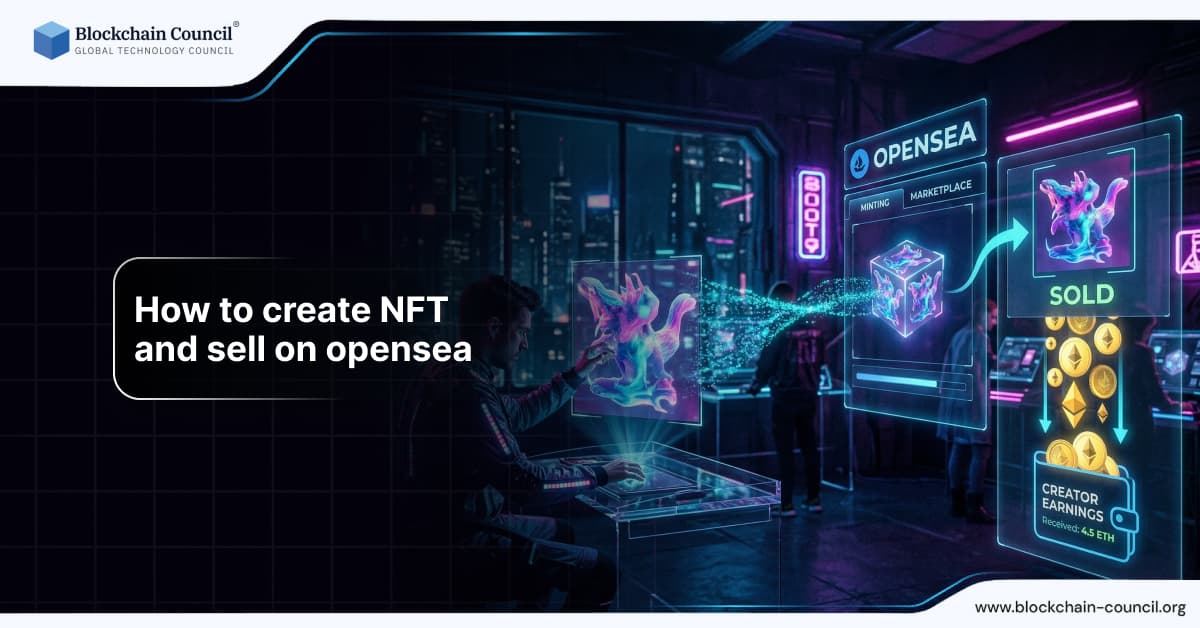
How to create an NFT and sell on OpenSea is one of the most practical entry points into Web3 for artists, developers, brands, and collectors. OpenSea supports multi-chain NFTs, common sale formats including fixed price and auctions, and creator royalties. Outcomes depend heavily on your blockchain choice, fee expectations, and security habits.
This step-by-step guide covers creating an NFT on OpenSea, listing it for sale, understanding fees and royalties, and applying security best practices to avoid costly mistakes.

What You Need Before Creating an NFT on OpenSea
Before you start minting, prepare these essentials:
A self-custodial wallet: MetaMask and Coinbase Wallet are the most common options for OpenSea.
Funds for network fees: Depending on the chain, you may need ETH or other compatible tokens to pay gas. Lazy minting can defer some costs to the buyer on supported networks.
A digital asset file: Image, video, GIF, audio, or 3D model. OpenSea supports files up to 100 MB.
Metadata: Title, description, properties (traits), supply, and optional external links.
Create and sell NFTs on OpenSea by mastering minting, metadata, and marketplace strategies as an NFT Expert, building workflows using a Python Course, and promoting collections via a Digital marketing course.Step-by-Step: How to Create an NFT on OpenSea
Step 1: Set Up and Secure Your Wallet
Install a compatible wallet extension or app such as MetaMask. Then:
Create a new wallet and store your seed phrase offline using paper or a hardware backup. Never share it with anyone.
Enable available security protections including a device lock, a strong password, and wallet-level safeguards.
Fund the wallet with a small amount of crypto if you plan to mint on a chain that requires gas upfront.
Security note: Most NFT losses stem from phishing attacks and malicious signature requests rather than platform breaches. Use only official URLs such as opensea.io and metamask.io, and avoid clicking wallet prompts from unknown sources.
Step 2: Connect Your Wallet to OpenSea
Go to OpenSea, select Connect wallet, choose your wallet provider, and approve the connection by signing the prompt. A signature confirms wallet ownership and does not automatically grant access to your funds, but certain signatures can authorize specific actions depending on what you are approving.
Step 3: Choose the Blockchain for Your NFT
OpenSea supports multiple networks including Ethereum, Polygon, and several Layer 2 networks such as Arbitrum and Optimism. Your choice affects three key factors:
Gas fees: Ethereum mainnet typically carries the highest cost, while Polygon and L2 networks generally reduce fees significantly.
Buyer experience: Lower gas reduces purchase friction and can improve conversion rates.
Lazy minting availability: On supported networks like Ethereum and Polygon, lazy minting defers the on-chain minting cost to the buyer at the time of purchase.
Many creators start on Polygon or Arbitrum for lower fees while retaining Ethereum ecosystem compatibility.
Step 4: Create a Collection
On OpenSea, you create a collection even if you plan to mint only a single NFT. From your profile menu:
Click Create collection or use OpenSea Studio if available in your interface.
Add a collection name, description, category (art, music, PFP, and others), and links to your website, X profile, or Discord.
Select the blockchain for the collection.
Collections establish provenance, support consistent branding, and are particularly important for multi-item series and scheduled drops.
Step 5: Mint the NFT
To create the NFT item:
Click Create inside your collection.
Upload your asset file (up to 100 MB).
Add metadata including the name, description, properties (traits), and optional levels or stats.
Set the supply if the standard supports it, choosing between a single edition or multiple editions.
Set creator earnings (royalties), typically between 5% and 10% depending on your strategy.
Confirm and complete the minting flow. With lazy minting on supported networks, no gas is paid upfront; the buyer covers the on-chain cost at the time of purchase.
Step-by-Step: How to Sell an NFT on OpenSea
Once your NFT appears in your OpenSea profile, you can list it for sale using the steps below.
Step 1: Open the NFT and Select Sell
Go to your profile, open the NFT item page, and click Sell.
Step 2: Choose a Sale Type
Fixed price: You set one price and the buyer purchases immediately. Best for straightforward sales with a defined value.
English auction: Bidders compete until the end time and the highest bid wins. Useful for high-demand pieces where price discovery matters.
Dutch auction: Price starts high and decreases over time until someone buys. Effective when you want to test demand or prioritize speed of sale.
Step 3: Set Pricing, Duration, and Currency
Configure:
Price or minimum bid for auctions
Duration for timed listings
Currency, commonly ETH on Ethereum-compatible networks
Approve any required listing permissions in your wallet and confirm the listing. In most cases, listing is free, and fees are applied only when a sale completes.
OpenSea Fees, Gas Fees, and Total Cost Expectations
OpenSea Marketplace Fee
OpenSea charges a 2.5% seller fee on each completed sale. There is typically no fee to list. Fee policies can change, so verify the current rates in your OpenSea account documentation before listing.
Network Gas Fees
Gas fees are paid to the blockchain network, not to OpenSea. They vary based on network load and are often quoted in gwei on Ethereum. Creators commonly monitor conditions using tools such as the Etherscan gas tracker.
Ethereum: Higher gas costs paired with strong liquidity and a broad collector base.
Polygon: Low fees, near-zero minting costs in many flows, and popular for high-volume mints.
L2 networks (Arbitrum, Optimism): Reduced fees with Ethereum compatibility, increasingly adopted by cost-sensitive creators.
Estimating Net Proceeds
If an NFT sells for 1 ETH, a 2.5% OpenSea fee amounts to 0.025 ETH deducted from sale proceeds. The buyer may also pay gas depending on the network and minting method used. With lazy minting on a supported network, the buyer generally covers the on-chain minting cost at the time of purchase.
Royalties on OpenSea: How Creator Earnings Work
Royalties, referred to as creator earnings on OpenSea, are a percentage set by the creator (commonly 5% to 10%) designed to generate ongoing income when an NFT trades on the secondary market. When enforced through the relevant on-chain or marketplace mechanisms, royalties can provide revenue well beyond the primary sale.
Practical guidance on setting royalty rates:
5% to 7.5%: Generally considered a balanced range that supports long-term trading activity without deterring buyers.
10%: Common for 1-of-1 art and creator-led brands where the community expects stronger ongoing creator participation.
Royalty enforcement varies across marketplaces and evolves with changing standards. Creators should review current OpenSea policies and consider contract-level enforcement approaches when building custom drops. Blockchain Council's Certified NFT Expert and Certified Smart Contract Developer programs cover royalty design tradeoffs and implementation options in depth.
Security Best Practices: Protect Your NFTs, Wallet, and Listings
NFT security is fundamentally wallet security. Most incidents involve phishing sites, fake marketplace clones, and malicious approval requests rather than breaches of OpenSea itself.
Checklist for Safer NFT Creation and Selling
Verify URLs: Only use official domains such as opensea.io. Bookmark them directly and avoid clicking search ad results.
Never share your seed phrase or private keys: No legitimate marketplace or support agent will ever request them.
Review every wallet signature prompt: Signatures can authorize sensitive actions. Reject any prompt you do not fully understand.
Use a hardware wallet for valuable holdings: Keeping keys off your computer significantly reduces malware risk.
Separate your wallets: Use one wallet for minting and interacting with dApps, and a separate vault wallet for storage.
Audit token approvals: Revoke unnecessary contract permissions regularly using a reputable approval management tool.
Phishing campaigns targeting NFT users have resulted in millions of dollars in losses across multiple years. Treat every unexpected direct message, email, or unfamiliar link as suspicious until verified.
Common Mistakes to Avoid
Minting on the wrong chain: Moving NFTs between chains is not straightforward. Choose based on your target buyers, fee tolerance, and ecosystem fit.
Underestimating total costs: Account for marketplace fees, gas, and potential approval transactions in your planning.
Overpricing without a distribution plan: Use auctions for price discovery when demand is uncertain rather than committing to a fixed price.
Weak metadata: Clear descriptions, consistent trait structures, and professional collection branding build buyer trust and improve discoverability.
Signing unknown requests: Many wallet drains originate from a single malicious signature approval.
Conclusion
Creating and selling an NFT on OpenSea follows a repeatable workflow: secure your wallet, choose the right blockchain, create a collection, mint your NFT with well-structured metadata, and list it using the sale format that matches your goals. Plan for the 2.5% marketplace fee, account for network gas dynamics based on your chosen chain, and set royalties deliberately to support long-term creator earnings.
Launch successful NFT projects with strong branding and community engagement by mastering blockchain through a Blockchain Course, analyzing trends via a machine learning course, and scaling visibility using an AI powered marketing course.
FAQs
1. What is an NFT and how does it work?
An NFT (Non-Fungible Token) is a unique digital asset stored on a blockchain that represents ownership. It can include art, music, videos, or other digital content. Each NFT has a distinct value and cannot be replaced.
2. What is OpenSea and why is it popular for NFTs?
OpenSea is one of the largest NFT marketplaces where users can buy and sell digital assets. It offers a user-friendly interface for beginners. It supports multiple blockchains and a wide range of NFTs.
3. How can beginners create an NFT?
Beginners can create an NFT by selecting digital content such as artwork or music. They need to upload it on a blockchain-based platform. The process of converting it into an NFT is called minting.
4. Do I need cryptocurrency to create an NFT?
Yes, most NFT platforms require cryptocurrency for transactions. You also need a crypto wallet to connect with the marketplace. Some blockchains offer low or no gas fee options.
5. What is minting an NFT?
Minting is the process of converting digital content into a blockchain-based token. It records ownership and authenticity on the blockchain. This allows the NFT to be traded.
6. How do I create an NFT on OpenSea?
You need to create an account, connect your crypto wallet, and upload your digital file. Then you add details like title and description. After that, you mint the NFT and list it for sale.
7. What types of files can be turned into NFTs?
You can create NFTs from images, videos, music, and digital documents. The content should be unique and original. Popular categories include art and collectibles.
8. What is a crypto wallet and why is it needed?
A crypto wallet stores your digital assets and connects you to NFT platforms. It allows you to manage transactions securely. Wallets are essential for buying and selling NFTs.
9. What are gas fees in NFT transactions?
Gas fees are charges required to process transactions on the blockchain. They vary depending on network demand. Some platforms offer gas-free minting options.
10. How do I price my NFT?
Pricing depends on demand, uniqueness, and market trends. Beginners often start with lower prices. Researching similar NFTs can help determine pricing.
11. How can I sell my NFT on OpenSea?
After minting, you can list your NFT for sale at a fixed price or auction. Buyers can purchase directly or bid. Once sold, the NFT is transferred to the buyer.
12. What are NFT royalties?
Royalties allow creators to earn a percentage from every resale of their NFT. This creates passive income opportunities. It is set during the minting process.
13. How can I promote my NFT?
Promotion can be done through social media, online communities, and collaborations. Building a personal brand helps increase visibility. Marketing plays a key role in sales.
14. Are NFTs safe to create and sell?
NFT platforms are generally secure, but risks like scams exist. Using trusted platforms and wallets is important. Always verify transactions.
15. Can I sell NFTs without being an artist?
Yes, you can create other types of digital assets or collaborate with artists. NFTs are not limited to art alone. Creativity and marketing are key factors.
16. What are the risks of selling NFTs?
Risks include market volatility and low demand. Not all NFTs sell successfully. Proper research and strategy are important.
17. Do I need technical knowledge to create NFTs?
No, most platforms are beginner-friendly and require minimal technical skills. The process is simple and guided. Learning basics helps improve success.
18. Are NFT earnings taxable?
Yes, earnings from NFT sales are subject to taxation based on local laws. It is important to track transactions. Compliance is necessary.
19. How long does it take to sell an NFT?
It depends on demand and promotion efforts. Some NFTs sell quickly, while others take time. Visibility and marketing influence sales.
20. What is the future of NFTs and marketplaces like OpenSea?
NFT adoption is growing across industries like gaming and art. Platforms like OpenSea continue to evolve. The future includes more utility-based NFTs.
Related Articles
View All
NFT
How to Buy, Sell, and Create NFTs: A Complete Guide
A Non-Fungible Token (NFT) is a blockchain cryptographic asset that represents an intangible and one-of-a-kind digital item such as a piece of artwork, an image, an in-game reward, or a tweet that other assets cannot substitute due to its unique properties. Each NFT is one-of-a-kind,…
NFT
Nft marketplace UAE how to start
Learn how to start an NFT marketplace in the UAE, including platform setup, legal considerations, and business strategies.
NFT
How to earn money from nft in India
Learn how to earn money from NFTs in India through digital art, trading, and Web3 opportunities.
Trending Articles
How Blockchain Secures AI Data
Understand how blockchain technology is being applied to protect the integrity and security of AI training data.
Claude AI Tools for Productivity
Discover Claude AI tools for productivity to streamline tasks, manage workflows, and improve efficiency.
How to Install Claude Code
Learn how to install Claude Code on macOS, Linux, and Windows using the native installer, plus verification, authentication, and troubleshooting tips.