

Key Features of Blockchain Product Passports
 Suyash Raizada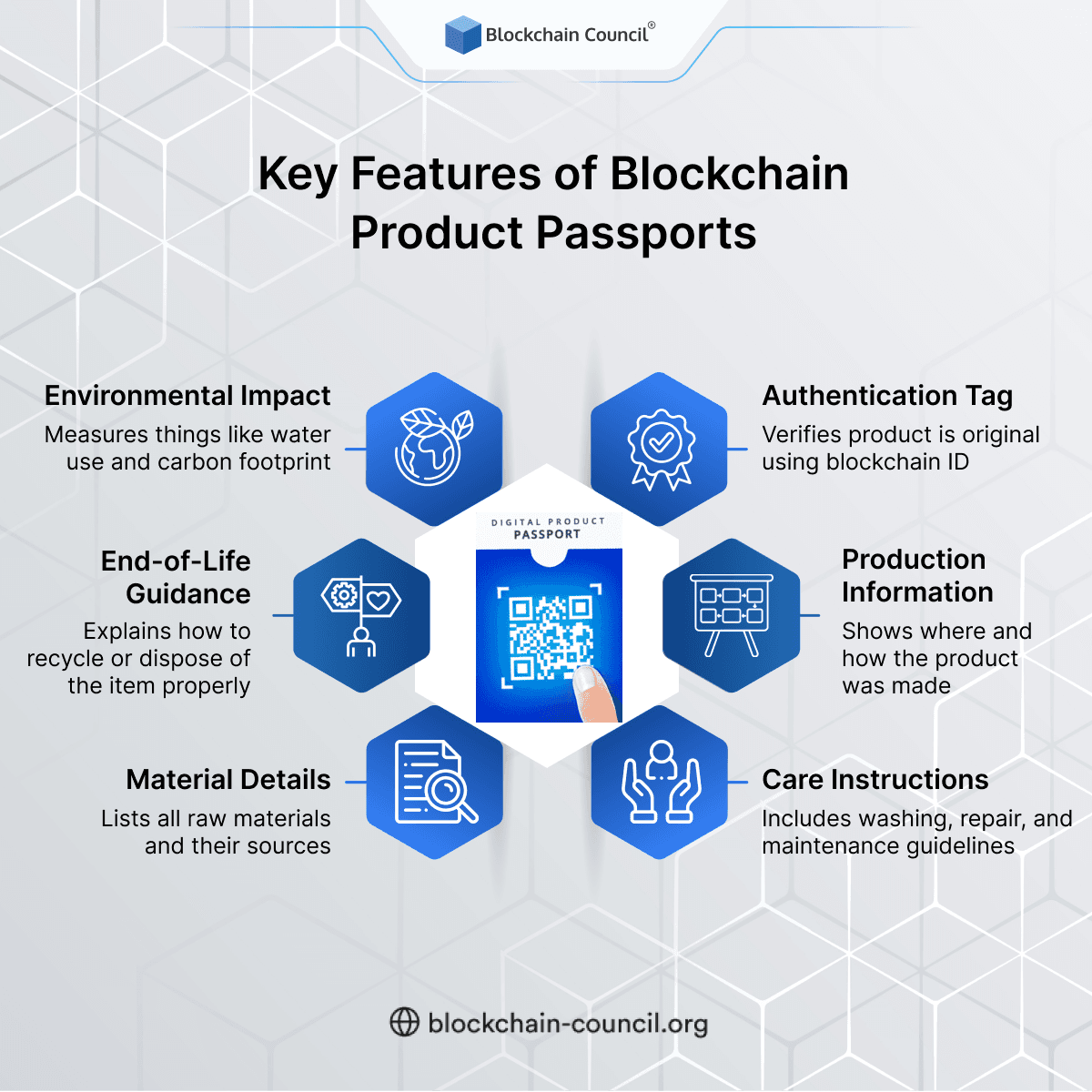
Blockchain product passports, often discussed as digital product passports (DPPs), are digital records linked to physical goods that capture lifecycle data such as materials, environmental impact, repair guidance, and compliance information. Under the EU's circular economy direction and the Ecodesign for Sustainable Products Regulation (ESPR), DPPs are becoming a practical mechanism to make product data trustworthy, portable, and auditable across supply chains.
Explore how blockchain product passports enable traceability, transparency, and lifecycle tracking by mastering decentralized systems as a Certified Blockchain Expert, strengthening data integration with a Python certification, and scaling enterprise adoption using a Digital marketing course.

What Are Blockchain Product Passports (DPPs)
A blockchain-based DPP is a digital identity and data trail for a product, anchored to a blockchain ledger to strengthen integrity, traceability, and verification. Most implementations use a hybrid approach: blockchain stores cryptographic proofs (hashes) and key events, while detailed documents such as test reports, certificates, and bills of materials remain off-chain for scalability and confidentiality.
This architecture aligns with EU expectations for authenticity, reliability, and long-term accessibility, while accommodating real-world supply chain constraints like sensitive supplier pricing, proprietary formulas, and regulated data handling.
Core Features of Blockchain Product Passports
1. Immutability and Tamper-Proofing
Immutability is central to blockchain product passports. Once lifecycle claims or certification proofs are recorded on-chain, they cannot be silently edited or deleted. This is particularly valuable for:
Compliance evidence: audit trails for regulators
Certifications and test results: preserving document integrity over time
Recalls and incident handling: time-stamped, durable records
2. Traceability and Transparency Across Lifecycle Stages
DPPs connect events from upstream sourcing through manufacturing, distribution, retail, use, repair, and end-of-life. Because entries form an auditable chain, multiple stakeholders can validate what happened and when, without relying on a single centralized database owner. This supports circular economy goals by making it easier to confirm origin, repair history, and recycling instructions.
3. Decentralization and Resilience
Decentralized ledgers reduce single points of failure and improve resilience for multi-party ecosystems. In permissionless networks, onboarding new participants can be simpler because verification is driven by network consensus rather than bilateral trust agreements. Many enterprise deployments still use permissioned components, but anchoring proofs to a public chain can strengthen independent verifiability even in those setups.
4. Security and Privacy Through Hybrid Storage
A standard DPP design stores only hashes and minimal metadata on-chain, while underlying files are stored off-chain in enterprise databases or decentralized storage systems. This pattern provides two clear benefits:
Privacy: restricted data remains accessible only to authorized parties.
Integrity: hashes allow anyone with file access to verify it has not been altered.
Smart contracts can automate checks such as validating that required fields exist or enforcing role-based write permissions.
5. Access via Unique Identifiers
DPPs are typically accessed through a unique identifier attached to the physical item, commonly a QR code or RFID tag. This identifier resolves to machine-readable data and supports tiered permissions, for example:
Write access: producers and authorized supply chain partners
Public read access: consumers and recyclers for non-sensitive fields
Restricted read access: regulators or auditors for controlled documents
Data Standards for DPPs: What Must Be Included?
EU-aligned DPP models emphasize interoperability, machine readability, and minimum required content. While sector-specific delegated acts define the exact fields, commonly expected mandatory elements include:
Product identification: product ID and unique identifier mapping
Manufacturer details: accountable entity, production information, and relevant contacts
Materials and sourcing: composition, critical materials, and upstream provenance where applicable
Environmental data: carbon footprint and other impact indicators, depending on the sector
Durability and circularity: durability attributes, repairability guidance, spare parts information, and recyclability
Compliance evidence: certifications, declarations, and test results
End-of-life instructions: disposal, take-back, and recycling guidance
Beyond content requirements, DPPs must be machine-readable and accessible via unique IDs that can be registered in EU-facing portals or registries. For long-lived products, continuity mechanisms such as backups via third-party providers are also necessary to keep the passport available for the product's full lifetime.
Some implementations use token standards like ERC-721 to represent product identities in a wallet-compatible way, improving compatibility with existing Web3 tooling. Public chains frequently cited for these deployments include Ethereum and networks such as Polygon, Avalanche, and Fantom.
Understand the core architecture behind digital product passports including smart contracts and immutable records by gaining expertise through a Blockchain Course, enhancing analytics via a machine learning course, and promoting sustainable tech solutions with an AI powered marketing course.
Interoperability Requirements: What Makes DPPs Work at EU Scale?
Cross-System Integration and Shared Identifiers
Interoperability is a core requirement because DPPs must function across industries, Member States, and technology stacks. At minimum, systems need common approaches for:
Unique identifiers that resolve consistently across platforms
Data models that map required fields in a consistent structure
APIs and protocols that allow lifecycle events to be appended and verified
Stakeholder Cooperation and Governance
Standardization depends on coordination between industry groups, policymakers, and technical experts. While permissionless blockchains can reduce friction for verification and third-party application development, governance is still required for schema definitions, role assignments, and conformance testing.
Hybrid Storage Patterns for Scalability
Storing all product data directly on-chain is rarely practical. Hybrid designs are preferred because they:
Support high document volumes without blockchain storage bottlenecks
Preserve privacy for sensitive supplier and compliance data
Maintain auditability by anchoring hashes and key events on-chain
Real-World Implementations and Sector Momentum
As of 2025, DPP initiatives are advancing across fashion, electronics, automotive, pharmaceuticals, luxury goods, and furniture. Platforms including TRUE, Arianee, and the Aura Blockchain Consortium illustrate multi-chain and hybrid approaches for authenticity, traceability, and compliance workflows. Industry analyses also identify adoption barriers such as integration costs and legacy system constraints, which remain active considerations in sectors like furniture supply chains.
Conclusion
Blockchain product passports provide tamper-resistant lifecycle records, verifiable compliance evidence, and scalable traceability for the EU's developing DPP ecosystem. The most practical designs combine on-chain integrity proofs with off-chain data storage, controlled permissions, and machine-readable standards anchored to unique identifiers. As EU rules mature through sector-specific delegated acts, interoperability and governance will determine which implementations move beyond isolated pilots to become genuinely cross-border, cross-industry DPP networks.
FAQs
1. What is a blockchain product passport?
A blockchain product passport is a digital record that stores detailed information about a product on a blockchain. It includes data such as origin, materials, and lifecycle history. This ensures transparency and traceability across the supply chain.
2. How does blockchain ensure product transparency?
Blockchain records are immutable and cannot be altered once stored. Every transaction or update is visible to authorized participants. This creates a transparent and trustworthy system.
3. What information is stored in a product passport?
A product passport typically includes manufacturing details, raw materials, certifications, and ownership history. It may also track sustainability and compliance data. This provides a complete lifecycle view of the product.
4. Why are blockchain product passports important?
They improve trust between consumers, manufacturers, and regulators. They help verify authenticity and reduce fraud. This is especially important in industries like fashion and electronics.
5. How do product passports improve supply chain traceability?
Blockchain allows every step of the supply chain to be recorded and tracked. Each participant updates the data in real time. This enables full visibility from production to delivery.
6. Can blockchain product passports prevent counterfeiting?
Yes, they help verify product authenticity through unique digital identities. Consumers can check product history before purchase. This reduces the risk of counterfeit goods.
7. What is the role of smart contracts in product passports?
Smart contracts automate processes like verification and compliance checks. They execute predefined rules without manual intervention. This improves efficiency and accuracy.
8. How do product passports support sustainability?
They track environmental data such as carbon footprint and material sourcing. This helps companies meet sustainability goals. Consumers can make informed, eco-friendly choices.
9. Are blockchain product passports secure?
Yes, blockchain uses encryption and decentralized storage to secure data. Unauthorized changes are nearly impossible. This ensures data integrity and reliability.
10. How do consumers benefit from product passports?
Consumers gain access to verified product information. This helps them make informed purchasing decisions. It also increases trust in brands.
11. What industries use blockchain product passports?
Industries like fashion, electronics, automotive, and pharmaceuticals use them. These sectors require transparency and traceability. Adoption is growing across multiple industries.
12. How do product passports improve regulatory compliance?
They store compliance data and certifications in one place. Regulators can easily verify information. This simplifies audits and reporting.
13. What is digital identity in product passports?
Each product is assigned a unique digital identity on the blockchain. This identity tracks its lifecycle and ownership. It ensures authenticity and traceability.
14. Can small businesses use blockchain product passports?
Yes, solutions are becoming more accessible and scalable. Small businesses can benefit from transparency and trust. It helps them compete with larger brands.
15. How do product passports enable circular economy practices?
They track product lifecycle and materials, enabling reuse and recycling. This supports sustainable production models. It reduces waste and improves resource efficiency.
16. What are the challenges of implementing product passports?
Challenges include integration with existing systems and initial costs. Technical expertise is also required. However, long-term benefits outweigh these challenges.
17. How is data updated in a blockchain product passport?
Authorized participants update data at each stage of the product lifecycle. Each update is recorded securely on the blockchain. This ensures accurate and real-time information.
18. What role does IoT play in product passports?
IoT devices collect real-time data such as location and condition. This data is recorded on the blockchain. It enhances accuracy and automation.
19. Are blockchain product passports the future of supply chains?
Yes, they are expected to become a standard for transparency and traceability. Many industries are adopting them rapidly. They align with digital transformation goals.
20. How can businesses adopt blockchain product passports?
Businesses can start by integrating blockchain solutions into their supply chain systems. Partnering with technology providers helps simplify implementation. Gradual adoption ensures smoother transition.
Related Articles
View All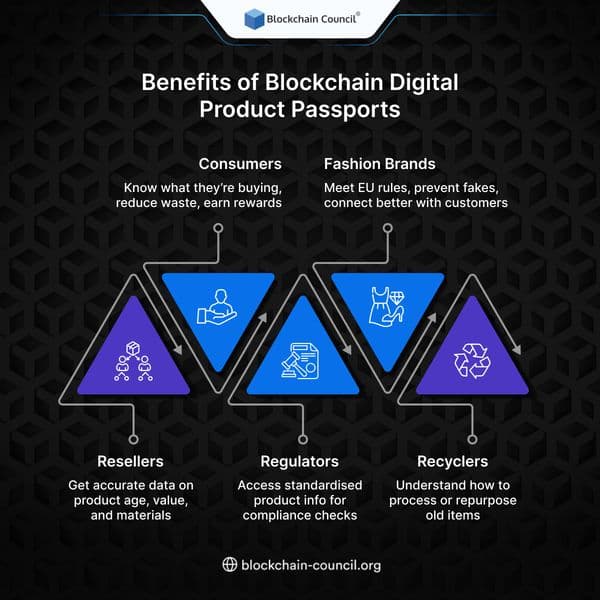
Infographics
Benefits of Blockchain Digital Product Passports
Blockchain digital product passports improve compliance, supply chain traceability, and consumer trust with tamper-proof records, smart contracts, and privacy-preserving proofs.
Infographics
Key Features of Agentic AI Systems
Infographics
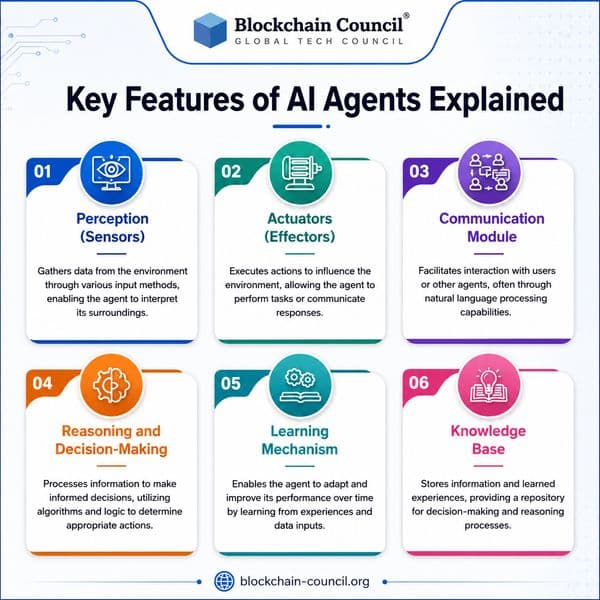
Key Features of AI Agents Explained
AI agents use autonomy, reasoning, memory, and task execution capabilities to automate workflows and perform intelligent actions independently.
Trending Articles
The Role of Blockchain in Ethical AI Development
How blockchain technology is being used to promote transparency and accountability in artificial intelligence systems.
AWS Career Roadmap
A step-by-step guide to building a successful career in Amazon Web Services cloud computing.
Claude AI Tools for Productivity
Discover Claude AI tools for productivity to streamline tasks, manage workflows, and improve efficiency.