

Agent AI System Features Explained
 Suyash Raizada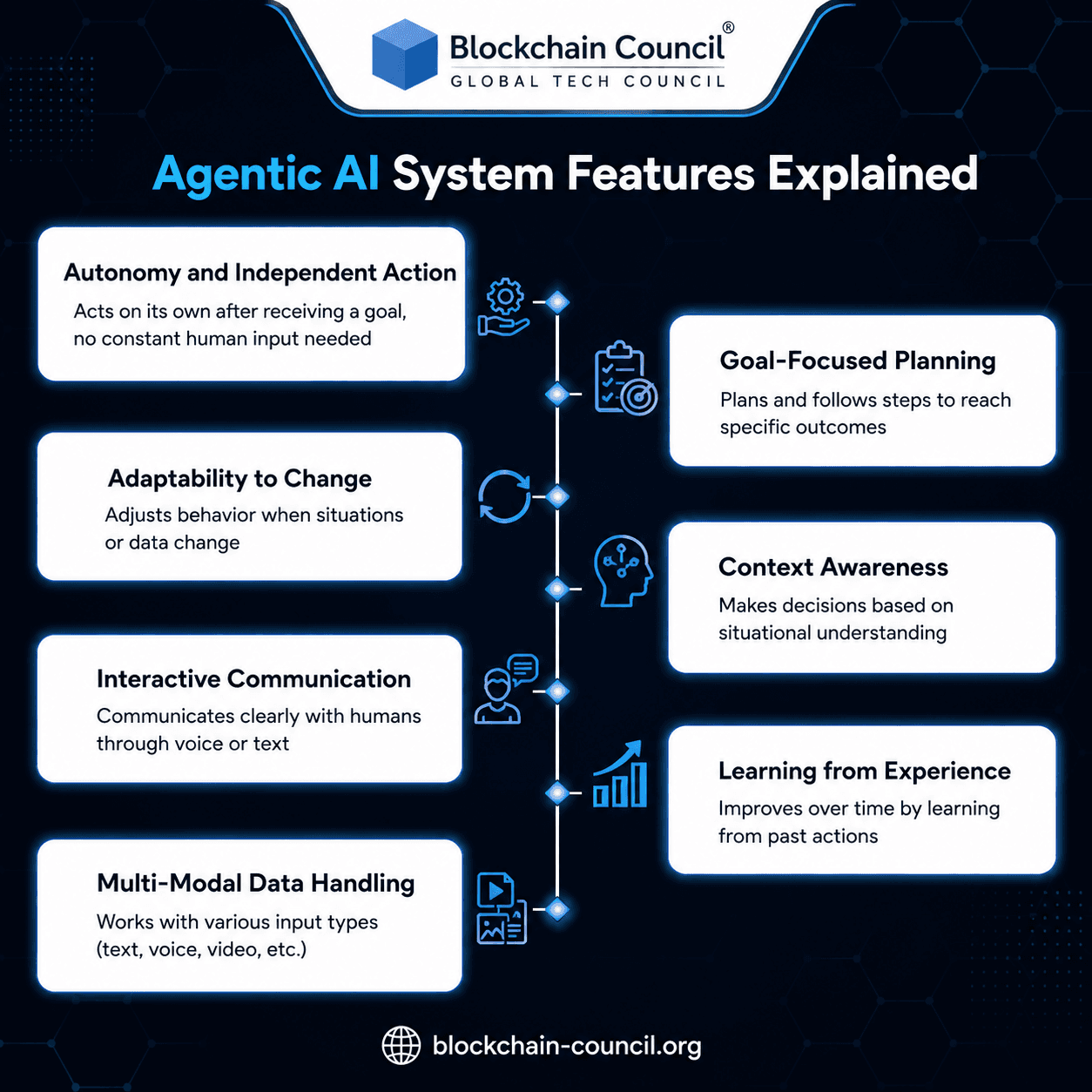
Artificial intelligence has evolved far beyond simple automation tools. In 2026, one of the most transformative developments is the rise of agent-based AI systems, often referred to as Agentic AI. These systems are designed to operate autonomously, make decisions, collaborate with other systems, and execute complex tasks with minimal human intervention.
Unlike traditional AI models that respond to inputs in isolation, agent AI systems act with purpose. They can plan, adapt, and interact dynamically with their environment. This shift is redefining how businesses operate, how software is built, and how digital ecosystems function.

This article explores the key features of agent AI systems, explains how they work, and highlights their real-world applications.
What Is an Agent AI System?
An agent AI system is a type of artificial intelligence designed to perform tasks independently by perceiving its environment, making decisions, and taking actions to achieve specific goals. These systems are often composed of multiple components, including perception modules, decision-making engines, and execution mechanisms.
Professionals looking to understand the foundations of such systems can explore the Agentic AI expert certification and the AI Expert certification, which provide structured knowledge of how intelligent systems are built and deployed.
Agent AI systems differ from traditional AI in one critical way. They are not passive. They actively pursue objectives, adapt to changing conditions, and often collaborate with other agents.
Core Features of Agent AI Systems
1. Autonomy
Autonomy is the defining feature of agent AI systems. These systems can operate without constant human input. Once given a goal, they can determine the steps required to achieve it.
For example, an AI agent managing an e-commerce platform can monitor inventory, adjust pricing, and optimize product listings without manual intervention. This level of independence reduces workload and improves efficiency.
2. Goal-Oriented Behavior
Agent AI systems are designed to achieve specific objectives. They break down complex goals into smaller tasks and execute them systematically.
In a business setting, an AI agent might be tasked with increasing sales. It can analyze customer data, optimize marketing strategies, and adjust pricing to achieve this goal.
This feature makes agent AI systems highly effective in dynamic environments where priorities can change rapidly.
3. Perception and Context Awareness
Agent AI systems rely on perception to understand their environment. This involves collecting data from various sources, such as sensors, databases, or user interactions.
Context awareness allows these systems to interpret data accurately and make informed decisions. For example, a customer service AI agent can understand user intent and respond appropriately based on context.
Advanced conversational systems, supported by programs like the Claude AI expert certification, demonstrate how AI can interpret nuanced human communication.
4. Decision-Making Capabilities
Decision-making is at the core of agent AI systems. These systems use algorithms, machine learning models, and rules to evaluate options and choose the best course of action.
For instance, a financial AI agent can analyze market trends and decide when to buy or sell assets. This ability to make decisions in real time is crucial for industries such as finance and logistics.
5. Learning and Adaptability
Agent AI systems are designed to learn from experience. They use feedback to improve performance over time.
This adaptability allows them to handle new situations and optimize their behavior. For example, a recommendation system can refine its suggestions based on user interactions.
Learning capabilities ensure that agent AI systems remain relevant in changing environments.
6. Multi-Agent Collaboration
One of the most advanced features of agent AI systems is their ability to collaborate with other agents. This creates a network of intelligent systems working together.
For example, in a supply chain, one agent may manage inventory, another handles logistics, and a third oversees customer orders. These agents communicate and coordinate to ensure smooth operations.
This collaborative approach enhances efficiency and scalability.
7. Task Automation and Execution
Agent AI systems excel at automating repetitive and complex tasks. They can execute actions based on predefined rules or learned behaviors.
In software development, AI agents can write code, test applications, and deploy updates. Professionals interested in this area can benefit from the AI Powered coding expert certification, which focuses on integrating AI into development workflows.
Automation reduces human effort and increases productivity.
8. Scalability
Agent AI systems can scale efficiently to handle large workloads. They can operate continuously and manage multiple tasks simultaneously.
This scalability is particularly valuable for businesses experiencing rapid growth. It allows them to expand operations without significantly increasing resources.
9. Real-Time Processing
Agent AI systems can process data in real time, enabling quick decision-making. This is essential in industries such as finance, healthcare, and transportation.
For example, an AI agent in a logistics company can adjust delivery routes based on real-time traffic conditions.
10. Integration with Other Systems
Agent AI systems are designed to integrate with existing technologies. They can connect with databases, APIs, and other software systems to access information and execute tasks.
This integration ensures that agent AI systems can operate within complex digital ecosystems.
Applications of Agent AI Systems
Business Operations
Companies use agent AI systems to automate workflows, manage resources, and improve efficiency. For example, AI agents can handle customer support, inventory management, and data analysis.
Digital Marketing
In marketing, agent AI systems analyze consumer behavior, create campaigns, and optimize performance. The AI Powered digital marketing certification helps professionals understand how to leverage these systems effectively.
Healthcare
In healthcare, AI agents assist in diagnosis, patient monitoring, and treatment planning. They help improve accuracy and reduce workload for medical professionals.
Finance
Financial institutions use agent AI systems for fraud detection, risk assessment, and automated trading. These systems can analyze large volumes of data quickly and accurately.
Software Development
AI agents are transforming software development by automating coding, testing, and deployment processes. This accelerates development cycles and improves software quality.
Benefits of Agent AI Systems
Agent AI systems offer numerous benefits. They improve efficiency by automating tasks, reduce operational costs, and enhance decision-making. They also enable businesses to scale operations and respond quickly to changes.
These systems allow organizations to focus on strategic activities while AI handles routine tasks.
Challenges and Limitations
Despite their advantages, agent AI systems face challenges. These include data privacy concerns, system complexity, and the need for continuous updates.
Ensuring security and ethical use is critical. Poorly designed systems can lead to unintended consequences.
Additionally, integrating agent AI systems with existing infrastructure can be complex and resource-intensive.
Future of Agent AI Systems
The future of agent AI systems lies in increased autonomy and collaboration. These systems will become more intelligent, adaptive, and capable of handling complex tasks.
Advancements in machine learning, natural language processing, and real-time data processing will drive this evolution.
In the long term, agent AI systems could manage entire business processes with minimal human intervention.
Conclusion
Agent AI systems represent a significant advancement in artificial intelligence. Their ability to operate autonomously, collaborate with other systems, and adapt to changing environments makes them highly valuable.
By understanding their features and applications, businesses and professionals can leverage these systems to improve efficiency and innovation.
As technology continues to evolve, agent AI systems will play a central role in shaping the future of industries and digital ecosystems.
FAQs
1. What is an agent AI system?
An agent AI system is a type of artificial intelligence that can operate independently to achieve specific goals. It perceives its environment, makes decisions, and takes actions accordingly. These systems are designed to handle tasks without constant human intervention. They are widely used in automation and intelligent applications. Their ability to adapt makes them highly effective.
2. How is agent AI different from traditional AI?
Traditional AI responds to specific inputs, while agent AI operates autonomously. Agent AI can make decisions and take actions independently. It is goal-oriented and adaptive. This makes it more dynamic and flexible. It is suitable for complex tasks.
3. What are the key features of agent AI systems?
Key features include autonomy, decision-making, learning, and collaboration. These systems can process data in real time. They adapt to changing environments. They also automate tasks efficiently. These features make them powerful tools.
4. Where are agent AI systems used?
They are used in industries such as healthcare, finance, and marketing. Businesses use them for automation and data analysis. They improve efficiency and accuracy. Their applications are expanding rapidly. They are becoming essential in modern industries.
5. Are agent AI systems expensive to implement?
The cost depends on the complexity of the system. Initial implementation can be expensive. However, they reduce long-term operational costs. Businesses benefit from increased efficiency. This makes them a valuable investment.
6. Can agent AI systems learn on their own?
Yes, they are designed to learn from data and experiences. They use machine learning techniques. This allows them to improve over time. Learning enhances their performance. It helps them adapt to new situations.
7. What is multi-agent collaboration?
It involves multiple AI agents working together. Each agent handles specific tasks. They communicate and coordinate actions. This improves efficiency. It is useful for complex systems.
8. Are agent AI systems secure?
Security depends on system design. Proper measures must be implemented. Data protection is essential. Regular updates improve security. Organizations must follow best practices.
9. How do agent AI systems make decisions?
They use algorithms and data analysis. They evaluate multiple options. The best action is selected based on goals. Decision-making is continuous. It improves with learning.
10. What skills are needed to work with agent AI?
Skills include programming, data analysis, and AI knowledge. Understanding algorithms is important. Practical experience is valuable. Certifications can help. Continuous learning is essential.
11. Can small businesses use agent AI systems?
Yes, they can benefit from automation. Agent AI improves efficiency. It reduces manual work. Costs can be managed with scalable solutions. It supports business growth.
12. What are the limitations of agent AI?
Limitations include complexity and cost. They require continuous updates. Data privacy is a concern. Errors can occur if not managed properly. Human oversight is necessary.
13. How does agent AI improve productivity?
It automates repetitive tasks. This saves time and effort. Employees can focus on important work. Efficiency increases significantly. Productivity improves overall.
14. What is real-time processing in AI?
It refers to analyzing data instantly. Decisions are made quickly. This is important in dynamic environments. It improves responsiveness. It enhances system performance.
15. Can agent AI replace human jobs?
It can automate certain tasks. However, it also creates new opportunities. Human skills remain important. Collaboration between humans and AI is key. It changes job roles.
16. What industries benefit most from agent AI?
Industries like healthcare, finance, and technology benefit greatly. These sectors require advanced solutions. Agent AI improves efficiency. It enhances decision-making. It drives innovation.
17. How does agent AI handle large data?
It processes data efficiently using algorithms. It can handle large volumes. Real-time analysis is possible. This improves accuracy. It supports decision-making.
18. Is coding necessary for agent AI?
Basic coding knowledge is helpful. It helps in understanding systems. Advanced roles require programming skills. Learning coding improves opportunities. It is an important skill.
19. What is the future of agent AI?
The future includes more advanced systems. They will be more autonomous. Collaboration will improve. New applications will emerge. It will shape industries.
20. How can I start learning agent AI?
Start with basic AI concepts. Take relevant courses. Practice with real projects. Gain hands-on experience. Continuous learning is important.
Related Articles
View All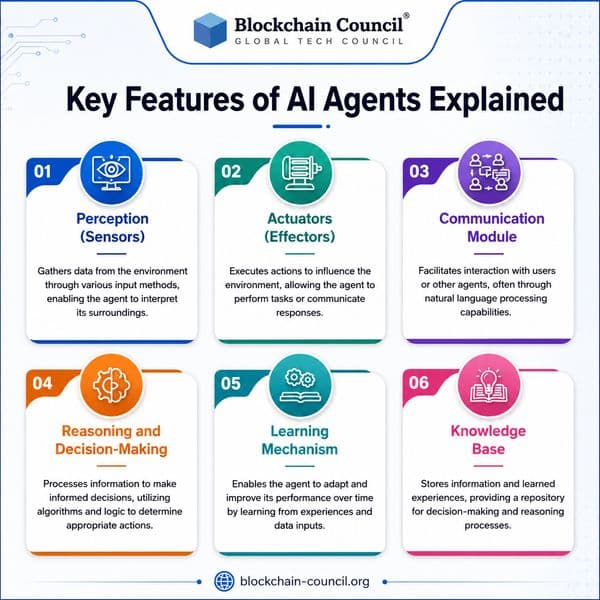
Infographics
Key Features of AI Agents Explained
AI agents use autonomy, reasoning, memory, and task execution capabilities to automate workflows and perform intelligent actions independently.
Infographics
Key Features of Agentic AI Systems
Infographics
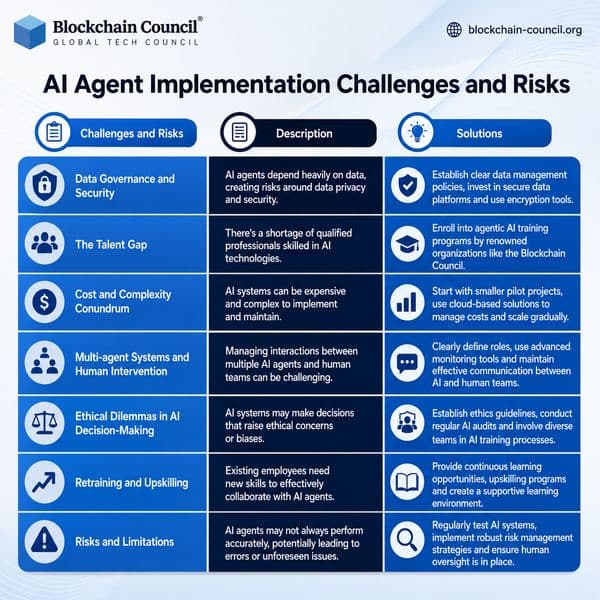
AI Agent Implementation Challenges and Risks
AI agent implementation challenges include security risks, governance issues, reliability concerns, and workflow orchestration complexities.
Trending Articles
The Role of Blockchain in Ethical AI Development
How blockchain technology is being used to promote transparency and accountability in artificial intelligence systems.
AWS Career Roadmap
A step-by-step guide to building a successful career in Amazon Web Services cloud computing.

Top 5 DeFi Platforms
Explore the leading decentralized finance platforms and what makes each one unique in the evolving DeFi landscape.