

Cryptocurrency Regulations Comparison: A Global Overview
 Suyash Raizada
The global cryptocurrency landscape is rapidly evolving, with governments introducing regulations to balance innovation with security. From the United States to Singapore, regulatory frameworks are shaping how crypto businesses operate and how users interact with digital assets.
Understanding these regulations is essential for investors, developers, and businesses navigating the crypto ecosystem.

Understanding global crypto regulations is essential for navigating markets safely-build your expertise with a Cryptocurrency Expert, analyze regulatory trends using a Python Course, and explore market adaptation strategies through an AI powered marketing course.
Why Crypto Regulation Matters
Cryptocurrency operates in a decentralized environment, but regulation is necessary to:
Prevent financial crimes
Protect investors
Ensure market stability
Enable institutional adoption
Key Global Regulations
United States: GENIUS Act
Focus: Stablecoin reserves, audits, AML
Status: Proposed in Senate
The U.S. is focusing heavily on stablecoin transparency and compliance, aiming to integrate crypto into traditional financial systems.
European Union: MiCA
Focus: Broad crypto asset regulation
Status: Enacted
MiCA is one of the most comprehensive frameworks, covering issuance, trading, and service providers across the EU.
United Kingdom: FSMA Amendment
Focus: Stablecoins under payments law
Status: Passed
The UK is positioning itself as a regulated crypto hub, integrating stablecoins into financial infrastructure.
Singapore: PSA & MAS Licensing
Focus: Crypto firms and stablecoins
Status: Active
Singapore emphasizes strict licensing and compliance, making it a trusted environment for crypto businesses.
Key Insight
Global regulation is shifting from uncertainty to structured frameworks supporting growth and compliance.
Impact on the Crypto Industry
For Businesses
Clear compliance requirements
Increased operational transparency
Easier access to global markets
For Investors
Better protection
Reduced fraud risks
Increased confidence
To stay compliant across evolving crypto frameworks, combine technical and analytical skills with a Cryptocurrency Expert, deepen insights via a machine learning course, and understand user and market behavior through a Digital marketing course.
Final Thoughts
Crypto regulation is no longer optional-it is becoming the foundation of mainstream adoption.
To stay ahead:
Explore regulatory frameworks through a Cryptocurrency Expert Course
Strengthen technical knowledge with a Python Course
Understand market dynamics via an AI-powered marketing course
FAQs
1. What are cryptocurrency regulations?
Cryptocurrency regulations are laws and guidelines governing the use, trading, and taxation of digital assets. They aim to protect investors and prevent illegal activities. Regulations vary widely across countries.
2. Why do countries regulate cryptocurrencies differently?
Each country has different economic priorities, legal systems, and risk tolerance. Some focus on innovation, while others prioritize control and security. This leads to varied regulatory approaches.
3. Which countries have strict cryptocurrency regulations?
Countries like China and Algeria have strict bans or heavy restrictions on crypto activities. They limit trading and mining operations. These policies aim to control financial risks.
4. Which countries are crypto-friendly?
Countries such as Switzerland, Singapore, and the UAE are considered crypto-friendly. They provide clear regulations and support innovation. This attracts blockchain businesses and investors.
5. How is cryptocurrency regulated in the United States?
The US regulates crypto through multiple agencies like the SEC and CFTC. Rules focus on securities laws, taxation, and anti-money laundering. The regulatory framework is complex and evolving.
6. What is the European Union’s approach to crypto regulation?
The EU has introduced the Markets in Crypto-Assets (MiCA) regulation. It aims to standardize rules across member states. This improves transparency and investor protection.
7. How does the UK regulate cryptocurrencies?
The UK regulates crypto through the Financial Conduct Authority (FCA). It focuses on anti-money laundering and consumer protection. Crypto assets are not considered legal tender.
8. Are cryptocurrencies legal worldwide?
Cryptocurrencies are legal in many countries but restricted or banned in others. Legal status depends on national regulations. Users should always check local laws.
9. How are crypto exchanges regulated globally?
Crypto exchanges must comply with licensing, KYC, and AML requirements in many jurisdictions. Regulations vary by country. Compliance is essential for legal operation.
10. What is KYC in cryptocurrency regulation?
Know Your Customer (KYC) requires platforms to verify user identities. It helps prevent fraud and money laundering. Most regulated exchanges enforce KYC policies.
11. What is AML in crypto regulations?
Anti-Money Laundering (AML) rules aim to detect and prevent illegal financial activities. Crypto platforms must monitor transactions and report suspicious activity. This improves financial security.
12. How are cryptocurrencies taxed globally?
Tax treatment varies by country but often includes capital gains tax. Some countries treat crypto as property or income. Users must report transactions according to local laws.
13. What are stablecoin regulations?
Stablecoins are often subject to stricter rules due to their link to fiat currencies. Regulations may require reserves and transparency. Authorities aim to reduce financial risks.
14. How do regulations impact crypto adoption?
Clear regulations encourage adoption by reducing uncertainty. Strict or unclear rules can slow innovation. Balanced policies support growth and stability.
15. What challenges exist in global crypto regulation?
Challenges include lack of standardization and cross-border enforcement. Rapid technological changes make regulation difficult. Coordination between countries is limited.
16. How do developing countries approach crypto regulation?
Some developing countries embrace crypto for financial inclusion. Others impose restrictions due to risk concerns. Approaches depend on economic and regulatory capacity.
17. What is the role of central banks in crypto regulation?
Central banks monitor financial stability and may issue digital currencies. They also influence regulatory policies. Their role is critical in shaping crypto frameworks.
18. How do regulations affect crypto investors?
Regulations impact trading access, taxation, and legal protection. Investors must comply with local laws. Clear rules can increase confidence and reduce risk.
19. Are global crypto regulations becoming more unified?
There is a growing effort to align regulations through international cooperation. However, full standardization is still limited. Differences between countries remain significant.
20. What is the future of cryptocurrency regulations globally?
Regulations are expected to become clearer and more structured over time. Governments will focus on balancing innovation and risk. Global coordination may improve gradually.
Related Articles
View All
Infographics
Digital Asset Infrastructure: The Foundation of the Next Era of Global Finance
Digital asset infrastructure is the technology backbone that enables the creation, storage, transfer, trading, and management of cryptocurrencies, tokenized assets, and other blockchain-based digital assets. It includes blockchain networks, digital wallets, custody solutions, exchanges, smart contracts, and security protocols. This guide explores the key components of digital asset infrastructure and their role in supporting the rapidly evolving Web3 and digital finance ecosystem.
Infographics
GPT-4o vs GPT-4.5 Comparison
Infographics
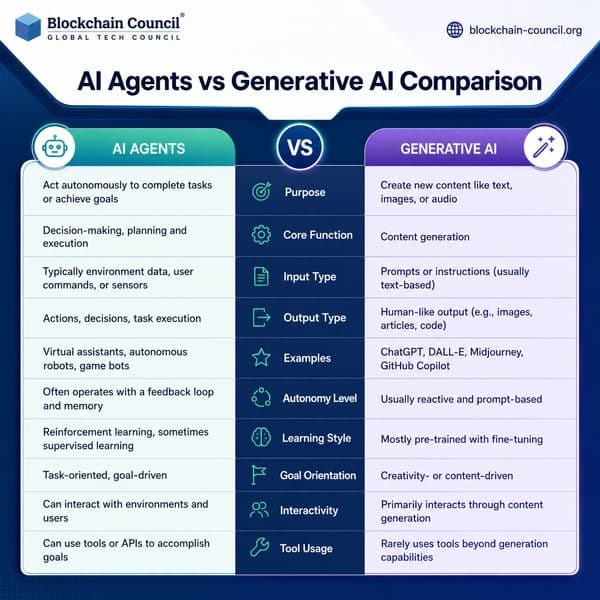
AI Agents vs Generative AI Comparison
AI agents focus on autonomous decision-making and task execution, while generative AI specializes in creating content and responses.
Trending Articles
The Role of Blockchain in Ethical AI Development
How blockchain technology is being used to promote transparency and accountability in artificial intelligence systems.
How Blockchain Secures AI Data
Understand how blockchain technology is being applied to protect the integrity and security of AI training data.
Claude AI Tools for Productivity
Discover Claude AI tools for productivity to streamline tasks, manage workflows, and improve efficiency.